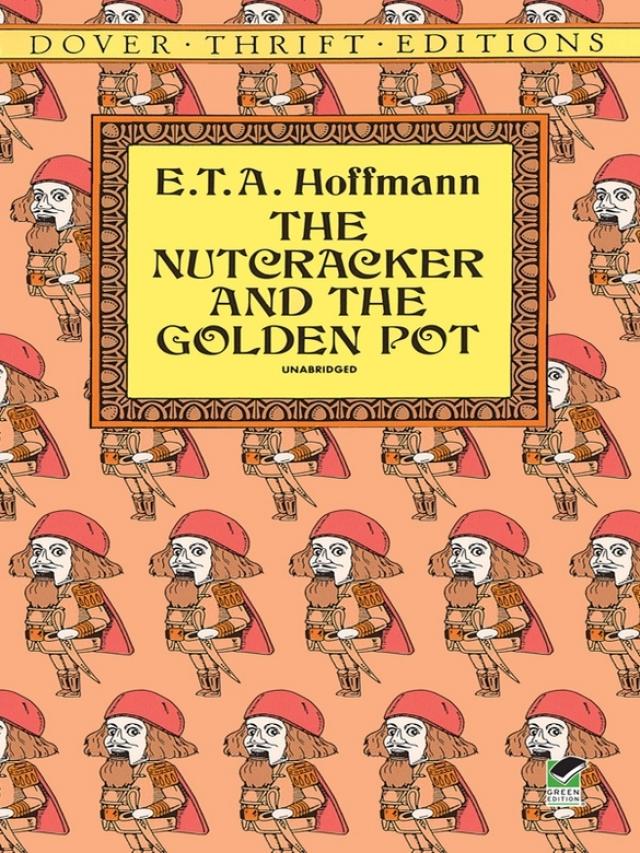
The nutcracker and the g.., p.16
The Nutcracker and the Golden Pot,
p.16


“This is Bonbonville,” Nutcracker said. “An embassy has just arrived from Paperland and the King of Chocolate. These poor Bonbonville people have been vexatiously threatened lately by the Fly-Admiral’s forces, so they are covering their houses over with their presents from Paperland, and constructing fortifications with the fine pieces of workmanship which the Chocolate-King has sent them. But oh! dearest Miss Stahlbaum, we are not going to restrict ourselves to seeing the small towns and villages of this country. Let us be off to the metropolis.”
He stepped quickly onwards, and Marie followed him, all expectation. Soon a beautiful rosy vapour began to rise, suffusing everything with a soft splendour. She saw that this was reflected from rose-red, shining water, which went plashing and rushing away in front of them in wavelets of roseate silver. And on this delightful water, which kept broadening and broadening out wider and wider, like a great lake, the loveliest swans were floating, white as silver, with collars of gold. And, as if vying with each other, they were singing the most beautiful songs, at which little fish, glittering like diamonds, danced up and down in the rosy ripples.
“Oh!” cried Marie, in the greatest delight, “this must be the lake which Godpapa Drosselmeier was once going to make for me, and I am the girl who is to play with the swans.”
Nutcracker gave a sneering sort of laugh, such as she had never seen in him before, and said:
“My uncle could never make a thing of this kind. You would be much more likely to do it yourself. But don’t let us bother about that. Rather let us go sailing over the water, Lake Rosa here, to the metropolis.”
THE METROPOLIS
Nutcracker clapped his little hands again, and the waves of Lake Rosa began to sound louder and to splash higher, and Marie became aware of a sort of car approaching from the distance, made wholly of glittering precious stones of every colour, and drawn by two dolphins with scales of gold. Twelve of the dearest little Negro boys, with headdresses and doublets made of hummingbirds’ feathers woven together, jumped to land, and carried first Marie and then Nutcracker, gently gliding above the water, into the car, which immediately began to move along over the lake of its own accord. Ah! how beautiful it was when Marie went over the waters in the shell-shaped car, with the rose-perfume breathing around her, and the rosy waves splashing. The two golden-scaled dolphins lifted their nostrils, and sent streams of crystal high in the air; and as these fell down in glittering, sparkling rainbows, there was a sound as of two delicate, silvery voices, singing, “Who comes over the rosy sea?—Fairy is she. Bim-bim—fishes; sim-sim—swans; sfa-sfa—golden birds; tratrah, rosy waves, wake you, and sing, sparkle and ring, sprinkle and kling—this is the fairy we languish to see—coming at last to us over the sea. Rosy waves dash—bright dolphins play—merrily, merrily on!”
But the twelve little boys at the back of the car seemed to take some umbrage at this song of the water jets; for they shook the sun shades they were holding so that the palm leaves they were made of clattered and rattled together; and as they shook them they stamped an odd sort of rhythm with their feet, and sang:
“Klapp and klipp, and klipp and klapp, and up and down.”
“These are merry, amusing fellows,” said Nutcracker, a little put out, “but they’ll set the whole lake into a state of regular mutiny on my hands! ” And in fact there did begin a confused and confusing noise of strange voices which seemed to be floating both in the water and in the air. However, Marie paid no attention to it, but went on looking into the perfumed rosy waves, from each of which a pretty girl’s face smiled back to her.
“Oh! look at Princess Pirlipat,” she cried, clapping her hands with gladness, “smiling at me so charmingly down there! Do look at her, Mr. Drosselmeier.”
But Nutcracker sighed, almost sorrowfully, and said:
“That is not Princess Pirlipat, dearest Miss Stahlbaum, it is only yourself; always your own lovely face smiling up from the rosy waves.” At this Marie drew her head quickly back, closed her eyes as tightly as she could, and was terribly ashamed. But just then the twelve Negroes lifted her out of the car and set her on shore. She found herself in a small thicket or grove, almost more beautiful even than Christmas Wood, everything glittered and sparkled so in it. And the fruit on the trees was extraordinarily wonderful and beautiful, and not only of very curious colours, but with the most delicious perfume.
“Ah!” said Nutcracker, “here we are in Comfit Grove, and yonder lies the metropolis.”
How shall I set about describing all the wonderful and beautiful sights which Marie now saw, or give any idea of the splendour and magnificence of the city which lay stretched out before her on a flowery plain? Not only did the walls and towers of it shine in the brightest and most gorgeous colours, but the shapes and appearance of the buildings were like nothing to be seen on earth. Instead of roofs the houses had on beautiful twining crowns, and the towers were garlanded with beautiful leaf-work, sculptured and carved into exquisite, intricate designs. As they passed in at the gateway, which looked as if it was made entirely of macaroons and sugared fruits, silver soldiers presented arms, and a little man in a brocade dressing gown threw himself upon Nutcracker’s neck, crying:
“Welcome, dearest prince! welcome to Sweetmeatburgh!”
Marie wondered not a little to see such a very grand personage recognize young Mr. Drosselmeier as a prince. But she heard such a number of small delicate voices making such a loud clamouring and talking, and such a laughing and chattering going on, and such a singing and playing, that she couldn’t give her attention to anything else, but asked Drosselmeier what was the meaning of it all.
“Oh, it is nothing out of the common, dearest Miss Stahlbaum,” he answered. “Sweetmeatburgh is a large, populous city, full of mirth and entertainment. This is only the usual thing that is always going on here every day. Please come on a little farther.”
After a few paces more they were in the great market place, which presented the most magnificent appearance. All the houses which were round it were of filagreed sugarwork, with galleries towering above galleries; and in the centre stood a lofty cake covered with sugar, by way of obelisk, with fountains round it spouting orgeat, lemonade, and other delicious beverages into the air. The runnels at the sides of the footways were full of creams, which you might have ladled up with a spoon if you had chosen. But prettier than all this were the delightful little people who were crowding about everywhere by the thousand, shouting, laughing, playing, and singing, in short, producing all that jubilant uproar which Marie had heard from the distance. There were beautifully dressed ladies and gentlemen, Greeks and Armenians, Tyrolese and Jews, officers and soldiers, clergymen, shepherds, jack-puddings, in short, people of every conceivable kind to be found in the world.
The tumult grew greater towards one of the corners; the people streamed asunder. For the Great Mogul happened to be passing along there in his palanquin, attended by three-and-ninety grandees of the realm, and seven hundred slaves. But it chanced that the Fishermen’s Guild, about five hundred strong, were keeping a festival at the opposite corner of the place; and it was rather an unfortunate coincidence that the Grand Turk took it in his head just at this particular moment to go out for a ride, and crossed the square with three thousand Janissaries. And, as if this were not enough, the grand procession of the Interrupted Sacrifice came along at the same time, marching up towards the obelisk with a full orchestra playing, and the chorus singing: “Hail! all hail to the glorious sun!”
So there was a thronging and a shoving, a driving and a squeaking; and soon lamentations arose, and cries of pain, for one of the fishermen had knocked a Brahmin’s head off in the throng, and the Great Mogul had been very nearly run down by a jack-pudding. The din grew wilder and wilder. People were beginning to shove one another, and even to come to fisticuffs; when the man in the brocade dressing gown who had welcomed Nutcracker as prince at the gate, clambered up to the top of the obelisk, and, after a very clear-tinkling bell had rung thrice, shouted very loudly three times: “Pastrycook! pastrycook! pastrycook!”
Instantly the tumult subsided. Everybody tried to save himself as quickly as he could; and after the entangled processions had been disentangled, the dirt properly brushed off the Great Mogul, and the Brahmin’s head stuck on again all right, the merry noise went on just the same as before.
“Tell me why that gentleman called out ‘Pastrycook,’ Mr. Drosselmeier, please,” said Marie.
“Ah! dearest Miss Stahlbaum,” said Nutcracker, “in this place ‘Pastrycook’ means a certain unknown and very terrible Power, which it is believed can do with people just what it chooses. It represents the Fate or Destiny which rules these happy little people, and they stand in such awe and terror of it that the mere mention of its name quells the wildest tumult in a moment, as the burgomaster has just shown. Nobody thinks further of earthly matters, cuffs in the ribs, broken heads, or the like. Every one retires within himself, and says: ‘What is man? and what his ultimate destiny?’”
Marie could not forbear a cry of admiration and utmost astonishment as she now found herself suddenly before a castle shining in roseate radiance, with a hundred beautiful towers. Here and there at intervals upon its walls were rich bouquets of violets, narcissuses, tulips, carnations, whose dark, glowing colours heightened the dazzling whiteness, inclining to rose-colour, of the walls. The great dome of the central building, as well as the pyramidal roofs of the towers, were set all over with thousands of sparkling gold and silver stars.
“Aha!” said Nutcracker, “here we are at Marzipan Castle at last!”
Marie was sunk and absorbed in contemplation of this magic palace. But the fact did not escape her that the roof was wanting to one of the principal towers, and that little men up upon a scaffold made of sticks of cinnamon were busy putting it on again. But before she had had time to ask Nutcracker about this, he said:
“This beautiful castle a short time ago was threatened with tremendous havoc, if not with total destruction. Sweet-tooth the giant happened to be passing by, and he bit off the top of that tower there, and was beginning to gnaw at the great dome. But the Sweetmeatburgh people brought him a whole quarter of the town by way of tribute, and a considerable slice of Comfit Grove into the bargain. This stopped his mouth, and he went on his way.”
At this moment, soft, beautiful music was heard, and out came twelve little pages with lighted clove-sticks, which they held in their little hands by way of torches. Each of their heads was a pearl, their bodies were emeralds and rubies, and their feet were beautifully worked pure gold. After them came four ladies about the size of Marie’s Miss Clara, but so gloriously and brilliantly attired that Marie saw in a moment that they could be nothing but princesses of the blood royal. They embraced Nutcracker most tenderly, and shed tears of gladness, saying, “Oh, dearest prince! beloved brother!”
Nutcracker seemed deeply affected. He wiped away his tears, which flowed thick and fast, and then he took Marie by the hand and said with much pathos and solemnity:
“This is Miss Marie Stahlbaum, the daughter of a most worthy medical man and the preserver of my life. Had she not thrown her slipper just in the nick of time—had she not procured me the pensioned Colonel’s sword—I should have been lying in my cold grave at this moment, bitten to death by the accursed king of the mice. I ask you to tell me candidly, can Princess Pirlipat, princess though she is, compare for a moment with Miss Stahlbaum here in beauty, in goodness, in virtues of every kind? My answer is, emphatically ‘No.”’
All the ladies cried “No;” and they fell upon Marie’s neck with sobs and tears, and cried: “Ah! noble preserver of our beloved royal brother! Excellent Miss Stahlbaum!”
They now conducted Marie and Nutcracker into the castle, to a hall whose walls were composed of sparkling crystal. But what delighted Marie most of all was the furniture. There were the most darling little chairs, bureaus, writing-tables, and so forth, standing about everywhere, all made of cedar or Brazil-wood, covered with golden flowers. The princesses made Marie and Nutcracker sit down, and said that they would themselves prepare a banquet. So they went and brought quantities of little cups and dishes of the finest Japanese porcelain, and spoons, knives and forks, graters and stew pans, and other kitchen utensils of gold and silver. Then they fetched the most delightful fruits and sugar things—such as Marie had never seen the like of—and began to squeeze the fruit in the daintiest way with their little hands, and to grate the spices and rub down the sugar-almonds; in short, they set to work so skillfully that Marie could see very well how accomplished they were in kitchen matters, and what a magnificent banquet there was going to be. Knowing her own skill in this line, she wished in her secret heart, that she might be allowed to go and help the princesses and have a finger in all these pies herself. And the prettiest of Nutcracker’s sisters, just as if she had read the wishes of Marie’s heart, handed her a little gold mortar, saying:
“Sweet friend, dear preserver of my brother, would you mind pounding a little of this sugar-candy?”
Now as Marie went on pounding in the mortar with good will and the utmost enjoyment—and the sound of it was like a lovely song—Nutcracker began to relate with much minuteness all that had happened on the occasion of the terrible engagement between his forces and the army of the king of the mice; how he had had the worst of it on account of the bad behaviour of his troops; how the horrible mouse king had all but bitten him to death, so that Marie had had to sacrifice a number of his subjects who were in her service, etc., etc.
During all this it seemed to Marie as if what Nutcracker was saying—and even the sound of her own mortar—kept growing more and more indistinct, and going farther and farther away. Presently she saw a silver mistiness rising up all about, like clouds, in which the princesses, the pages, Nutcracker, and she herself were floating. And a curious singing and a buzzing and humming began, which seemed to die away in the distance; and then she seemed to be going up—up—up, as if on waves constantly rising and swelling higher and higher, higher and higher, higher and higher.
CONCLUSION
And then came a “prr-poof,” and Marie fell down from some inconceivable height.
That was a crash and a tumble!
However, she opened her eyes, and, lo and behold, there she was in her own bed! It was broad daylight, and her mother was standing at her bedside, saying:
“Well, what a sleep you have had! Breakfast has been ready for ever so long.”
Of course, dear audience, you see how it was. Marie, confounded and amazed by all the wonderful things she had seen, had at last fallen asleep in Marzipan Castle, and the Negroes or the pages, or perhaps the princesses themselves, had carried her home and put her to bed.
“Oh, mother darling,” said Marie, “what a number of places young Mr. Drosselmeier has taken me to in the night, and what beautiful things I have seen!” And she gave very much the same faithful account of it all as I have given to you.
Her mother listened, looking at her with astonishment, and when she had finished, said:
“You have had a long, beautiful dream, Marie; but now you must put it all out of your head.”
Marie firmly maintained that she had not been dreaming at all; so her mother took her to the glass cupboard, lifted out Nutcracker from his usual position on the third shelf, and said:
“You silly girl, how can you believe that this wooden figure can have life and motion?”
“Ah, mother,” answered Marie, “I know perfectly well that Nutcracker is young Mr. Drosselmeier from Nuremberg, Godpapa Drosselmeier’s nephew.”
Her father and mother both burst out into laughter.
“It’s all very well your laughing at poor Nutcracker, father,” cried Marie, almost weeping, “but he spoke very highly of you; for when we arrived at Marzipan Castle, and he was introducing me to his sisters, the princesses, he said you were a most worthy medical man.”
The laughter grew louder, and Louise and even Fritz joined in it. Marie ran into the next room, took the Mouse-King’s seven crowns from her little box, and handed them to her mother, saying, “Look there, then, dear mother; those are the Mouse-King’s seven crowns which young Mr. Drosselmeier gave me last night as a proof that he had got the victory.”
Her mother gazed in amazement at the little crowns, which were made of some very brilliant, wholly unknown metal, and worked more beautifully than any human hands could have worked them. Dr. Stahlbaum could not cease looking at them with admiration and astonishment either, and both the father and the mother enjoined Marie most earnestly to tell them where she really had got them from. But she could only repeat what she had said before; and when her father scolded her and accused her of untruthfulness, she began to cry bitterly, and said, “Oh, dear me; what can I tell you except the truth!”
At this moment the door opened, and Godpapa Drosselmeier came in, crying, “Hullo! hullo! what’s all this? My little Marie crying? What’s all this? what’s all this?”
Dr. Stahlbaum told him all about it, and showed him the crowns. As soon as he had looked at them, however, he cried out:
“Stuff and nonsense! stuff and nonsense! These are the crowns I used to wear on my watch-chain. I gave them as a present to Marie on her second birthday. Do you mean to tell me you don’t remember?”
None of them did remember anything of the kind. But Marie, seeing that her father and mother’s faces were clear of clouds again, ran up to her godpapa, crying:
“You know all about the affair, Godpapa Drosselmeier; tell it to them. Let them know from your own lips that my Nutcracker is your nephew, young Mr. Drosselmeier from Nuremberg, and that it was he who gave me the crowns.” But Drosselmeier made a very angry face, and muttered, “Stupid stuff and nonsense!” upon which Marie’s father took her in front of him, and said with much earnestness:


_preview.jpg)
_preview.jpg)