The golden pot, p.14
The Golden Pot,
p.14



“Sleep must finally have overtaken me, since when I shot up out of bed, awakened by the shrill blast of the postal horn, the bright sunlight of morning flooded my room, and I realized that it was only in my dream that I had been privy to the greatest happiness, the most profound bliss to be found in this life on earth. A lovely, budding young girl entered my room
— it was the singer – and she spoke to me in a sweet voice: ‘You must have recognized me again, my dear, dear Ferdinand! I know that all I had to do was sing to completely come alive in you again; for every note I sang was already present in you and only had to resound in the echo chamber of my heart.’ What unnamable rapture swept through me as I saw that it was the beloved of my soul whom I bore in my heart since early childhood, from whom a cruel turn of fate had made me part, but whom I was ecstatic to have found again. But my fervent love resounded again in that melody so full of ardent yearning and, in our words, our looks were transmuted into musical notes that coalesced like a burst of fire.
“But now that I was fully awakened, I had to admit to myself that no recollection from early in life accorded with that most radiant dream vision – it was the first time that I ever set eyes on that lovely girl. I overheard loud and hefty chatter emanating from the street in front of the inn – mechanically I picked myself up and hurried to the window; an older, well-dressed gentleman quarreled with the porters who had broken something on the postal carriage. Finally all was resolved, and the man called up to my room: ‘Everything is now in order, we’re ready to depart.’ I became aware of a woman peering out the window of the room directly next to mine, but she promptly pulled her head back so quickly, that since she had on a rather wide-brimmed travel hat, I caught no sight of her face. When she strode out the door, she turned and looked back up at me and— Ludwig! It was the singer, my dream vision— the glance of those heavenly eyes fell upon me, as if the pitch of a ringing crystal pierced my breast like the thrust of a dagger, and I felt a physical shot of pain, so that every nerve and fiber in my body set to tingling, and I froze in a fit of nameless rapture. One, two, three, she had climbed into the carriage— the postilion blasted a lively ditty as if to taunt me. A moment later, the carriage had turned a corner and disappeared.
“Like a man lost in dreams, I remained stationed at the window. The Courlanders burst into my room to fetch me for a previously arranged expedition— I didn’t utter a word— they took me for ill— how in heaven’s name could I have expressed in words the slightest inkling of what I’d experienced! I refrained from asking after the stranger who’d occupied the room next to mine, for it seemed to me as if any word regarding the identity of that lovely vision spilled from profane lips would defile the precious secret of my heart. I vowed then to carry my secret faithfully and be forever true to her who had now become the eternally beloved of my heart and soul, even if I never set eyes on her again. You, my dearest friend, must surely recognize the state of mind in which I felt I’d put myself; you will, therefore, not think badly of me for forsaking all my other responsibilities in an effort to track down the slightest clue as to the identity and whereabouts of my unknown beloved. Given my disposition, the company of the boisterous Courlanders became repulsive to me; heading off an inevitable confrontation, one night I up and left, and hurried off to B—— to pursue my pressing concern of the moment.
“As you know, from an early age I had a knack for drawing; in B—— I came under the influence of skilled masters in the art of the miniature, and within a short amount of time I managed to fulfill my sole object, namely to paint a faithful likeness of the unknown beauty. Secretly, behind closed doors, I painted her portrait. No other human eye has ever seen it, for I painted another picture of the same dimensions, had it measured for a medallion, and took great pains to replace it with the picture of my beloved. I have worn it ever since then dangling against my breast.
“This is the first time I have ever spoken of the most important moment in my life, and you, Ludwig, are the only living soul to whom I revealed my secret. But today a strange, inimical force broke into the sanctuary of my innermost self! Upon approaching the Turk, thinking of my heart’s beloved, I asked: ‘Will I ever again experience a moment like the one during which I was completely happy?’ As you no doubt noticed, the Turk did not want to reply; but finally, when I would not let up, he said, ‘My eyes peer into your breast, but the mirrorlike polish of the golden medallion you wear blocks my view – turn the picture toward me!’ I am at a loss for words to describe the feeling that made me tremble all over. You will surely not have failed to notice the stir that swept through me. The picture really did lie against my breast, as the Turk declared; I turned it around without attracting notice and repeated my question, whereupon the automaton said, in a solemn tone, ‘Oh, you poor unfortunate soul. At the precise moment you see her again you will have lost her forever!’“
Ludwig was about to attempt to cheer up Ferdinand, who had fallen into a dark brooding state, with a few consoling words, when they were interrupted by the approach of several acquaintances.
Rumors of the wise Turk’s latest mysterious response spread through the city, and people tore their hair out trying to guess what infelicitous prophecy could have so upset an open-minded fellow like Ferdinand. The friends were bombarded with questions – so much so that, to help Ferdinand out of a tight fix, Ludwig felt obliged to dish up a doozy of a yarn that gained more credence the further it wandered from the truth. The same group of friends that had egged on Ferdinand to visit the wondrous Turk gathered once a week, and at their very next get-together the Turk was once again on everybody’s tongue, since, much as Ferdinand tried to hide his sorry state, the whole gang kept peppering him with questions about what the automaton could possibly have said to make him so downhearted. Ludwig felt all too poignantly how deeply his friend must have been shaken up upon having the buried secret of his fantastical love uncovered by a strange, horrid force. Like Ferdinand, he too was firmly convinced that the piercing look of that mysterious entity able to uncover deepest secrets might well also have the ability to forge a link between the future and the present. Ludwig felt compelled to believe the oracle’s pronouncement, but the hostile, shameless revelation of the cruel fate foretold to his friend set him against the being hidden behind the Turk. Consequently, he took a steadfast stand in opposition to the artwork’s countless admirers. While they pronounced that there was something altogether remarkable in the natural movements of the automaton that enhanced the effect of the oracular pronouncements, he maintained that it was precisely those eye and head movements that lent an indescribably absurd element to the honorable Turk, and it was due to this that he had let slip a bon mot, vexing the unseen creator behind the device, which ill humor the latter had exhibited with a slew of insipid and meaningless replies.
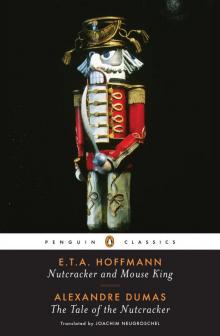
“I must admit,” Ludwig continued, “that at first sight the figure immediately reminded me of an altogether delicate and finely crafted nutcracker that a cousin of mine once gave me for Christmas when I was a little boy. The device in the shape of a little man had a deadpan comic expression, and by means of an ingenious hidden mechanism, his big eyes would come twisting and popping out of his head whenever he cracked a nut, which gave the entire figure such an absurdly animated manner that I played with it for hours on end, and transformed the wooden dwarf in my hands into a mystical mandragora root. All of the perfectly fashioned marionettes I later encountered seemed stiff and lifeless compared with my splendid nutcracker. So much had been said of the wondrous automata at the Danzig Arsenal that I could not possibly resist paying it a visit when I finally found myself in Danzig some years ago.
“Soon after I entered the hall, an old German soldier came striding toward me and fired his rifle, the reverberation of which rang out with an ear-splitting intensity against the vaulted ceiling. More shenanigans of that sort, which I have since forgotten, from time to time took me by surprise, until finally I was led into the hall occupied by the God of War, terrible Mars himself, and his entire court entourage. He sat decked out in rather grotesque attire on a throne adorned with weapons of all sorts, ringed by tribunes and warriors. As soon as we set foot in front of the throne, a few tympanists started beating their drums, and pipers sounded out something awful, so that the spectator felt inclined to hold his hands over his ears to block out the cacophonous clang. I remarked that the God of War had a wretched military band, altogether unworthy of his majesty, and everyone agreed.
“Finally, the banging and the piping stopped; the tribunes started turning their heads and stamping with their halberds, until the God of War himself rolled his eyes a couple of times, leapt up out of his seat, and appeared to want to stride toward us. But soon after that, he plunked himself back down on his throne, and there was more drumming and piping, until all returned to its former wooden silence.
“After having surveyed all these automata, I said to myself in parting: ‘I prefer my nutcracker!’ And now, my good Sirs, after having witnessed the wise Turk, I say it again: ‘I prefer my nutcracker!’“
Everyone had themselves a good laugh, but agreed that Ludwig’s take on the matter was more amusing than earnest, since aside from the extraordinary mindfulness evidenced time and again by the automaton’s answers, the undetectable link between the hidden being and the Turk, that not only spoke through the device but also produced the figure’s movements in response to the questions, proved altogether remarkable, and was, in any case, a testament to mechanical and acoustical wizardry.
Even Ludwig himself had to admit that this was true, and everyone was full of praise for the automaton’s unknown creator. Whereupon, an elderly gentleman who generally said little, and this time, too, had not taken part in the conversation, rose from his chair, as was his wont when he wished to add a few words (which were always absolutely pertinent to the subject at hand), and in his polite manner began, “If you will be so good as to permit me a word— I bid you most respectfully, kind Sirs! You rightfully extoll this most unusual work of art, that has for such a long time now riveted our attention; you are, however, ill-advised to refer to the ordinary man standing by it as an artist, since he has played no part whatsoever in those aspects of the work that we justifiably find to be so sublime; said credit belongs, rather, to a man well versed in all the related arts, who has for many years resided within the walls of our city, and whom we all know and hold in high regard.”
Stunned by his pronouncement, everyone peppered the old man with questions, and he continued, “I mean no one other than Professor X——. The Turk had already been here for two days without anyone taking any particular notice of it; Professor X——, on the other hand, made haste to go see it, since everything related to automata intrigues him. No sooner had he heard of a few of the Turk’s answers than he pulled aside the artist standing by and whispered some words in his ear. The latter turned white in the face, and after the departure of the few curiosity-seekers who had found their way there, he promptly locked the door. The posters advertising the Turk disappeared from the street corners where they had been plastered on walls, and nothing more was heard of the wise Turk until two weeks later a new announcement appeared, and the Turk was now found to be adorned by his splendid headgear and enveloped by the inscrutable riddle, as we see him today. Ever since that time, his answers have also become so quick-witted and profound. But there can be no doubt that all this is the doing of Professor X——, since all the while the artist withheld his automaton from public view he paid the professor daily visits, and also, as we well know, the professor spent many consecutive days in the hotel room in which the figure stood and in which he still stands today. You all surely know, my good Sirs, that the professor has a collection of the most splendid, exquisite automata, albeit all outfitted with a musical element. He has long been in correspondence and competition with Court Counselor B—— concerning his collection as well as the magical arts, and you will, I’m quite sure, concur that it can only be him and him alone likely to arouse general amazement. Yet even though he is glad to show off his rare artworks to anyone who so wishes and who takes real pleasure in seeing them, he continues to work and create in complete secret.”
Although it was common knowledge that the professor, whose principle scientific research interests were in physics and chemistry, also liked to dabble on the side with mechanical artworks, no one among the group of friends suspected he had a hand in the savvy Talking Turk, and it was only from hearsay that anyone knew of the cabinet of wonders of which the old gentleman spoke. Ferdinand and Ludwig felt a strange excitement at the old man’s account of the professor and his influence on the curious automaton.
“I cannot deny,” said Ferdinand, “that the prospect of approaching Professor X—— for an explanation now gives me a flicker of hope at unraveling the secret that weighs so awfully on my heart. It is indeed possible that I might find some solace in pursuing my suspicion of a mysterious connection between the Turk – or rather the hidden person utilizing him as a vehicle for oracular pronouncements – and myself, and that in so doing I may perhaps diffuse the effect of those terrible words. I have consequently decided to make the mysterious man’s acquaintance, under the pretext of wanting to see his collection of automata, and since, as we’ve heard, his devices have a musical element, you might find it of interest to accompany me.”
“As if it were not enough,” replied Ludwig, “for me to stand by you in word and deed in this unsettling matter! I cannot deny that when the old man spoke of Professor X——’s influence on the talking machine, all sorts of strange thoughts ran through my mind, although it may well be that I am seeking far-fetched explanations for something lying right under our nose. Is it not conceivable, to posit an explanation close at hand, that the unseen person was cognizant of the fact that you wore a picture in a pendant hanging against your breast, and could not an informed guess have led to the seemingly portentous pronouncement? Perhaps with his grim augur the unseen person simply sought to get back at us for our mockery of the wisdom of the Turk.”
“As I already told you before,” Ferdinand replied, “no one ever saw the picture, and I never told another living soul of the effect of that incident on my life. The Turk could not possibly by any ordinary means have been apprised of it all! Perhaps the far-fetched explanation you seek comes closer to the truth!”
“What I mean to say,” Ludwig remarked, “even though I seemed just now to suggest the contrary, is that our automaton really is one of the most remarkable devices I’ve ever seen, and everything appears to suggest that whoever may be directing its functioning is privy to a more profound understanding than ever suspected by those who flippantly gawk and puzzle over the puzzling. The figure is nothing more than the form of a communication, but there can be no doubt that this form is skillfully fashioned, since its overall appearance as well as the automaton’s movements are geared to deflecting the spectator’s attention, so as to guard the secret, and in a sense to optimally prime the questioner in anticipation of the responding entity. No human being could possibly be hidden inside this figure, of this there can be no doubt; the fact that we believe the answers emanate from the Turk’s mouth is surely based on some acoustical illusion; just how this is accomplished, how the person answering is set in such a position to observe those asking the questions, to examine them and respond in an intelligible manner, is and remains a riddle to me. It presupposes a keen acoustical and mechanical know-how, an exceptional perspicacity, or perhaps rather a consequent slyness on the part of the creator, who employed every means to pull the wool over our eyes.
“I must admit to being less interested in the disclosure of this secret, overshadowed as it is by the most extraordinary fact that the Turk can often peer deep into the innermost recesses of the heart and soul of the questioner, as you yourself observed even before it was proven to you. It is as if the responsive being were somehow, by a means unknown to us, able to exert a psychic influence, indeed to establish such a spiritual rapport with us that it appears to grasp our state of mind, to fathom our entire internal makeup. Even if it does not clearly reveal the secret we harbor, it calls forth, in an ecstatic state fostered by the strange spiritual principle’s rapport with us, intimations of all things buried in our breast, which are illuminated by our mind’s eye. It is the psychic force that plucks at our heartstrings, ordinarily just rustling against each other like reeds, so that they now vibrate and ring out together, producing a pure and clearly audible chord; so in a sense it is we ourselves who answer our own questions. Awakened by a strange spiritual principle, we more clearly hear our inner voice, and our muddled musings become mesmerized in form and concept, congealing into clear pronouncements. This is just like in dreams, in which a strange voice edifies us concerning things outside of her ken, or about which we were at the very least in doubt; the fact notwithstanding that this voice that appears to introduce unknown truths, it does, after all, emanate from inside ourselves and express itself in intelligible words. It goes without saying that the Turk, by whom I naturally mean the hidden entity moving his lips, seldom needs to establish a psychological rapport with the questioner. A hundred questioners are superficially dispatched, one after another, as much as their individuality demands, and often enough, all that’s called for is a keen insight spawned by the natural erudition or the quick-wittedness of the answering being, with no need to sound the depths of the question. But an exalted state of mind on the part of the questioner will presently affect the Turk in an altogether different way, and then he deploys the capacity that creates the psychic rapport, granting him the ability to respond from the questioner’s innermost self. The Turk’s hesitation to immediately answer such deeply probing questions is perhaps just the pause he permits himself to give him the time he needs to apply his enigmatic power. This is my heartfelt opinion, and as you can tell, the fabulous figure is not as contemptible to me as I gave you to believe before – perhaps I am taking this entire matter too seriously! But I do not wish to hide the fact that, if you go along with my take, I realize that I am not offering you any reassurance in your troubled state of mind!”


_preview.jpg)
_preview.jpg)