The golden pot, p.17
The Golden Pot,
p.17
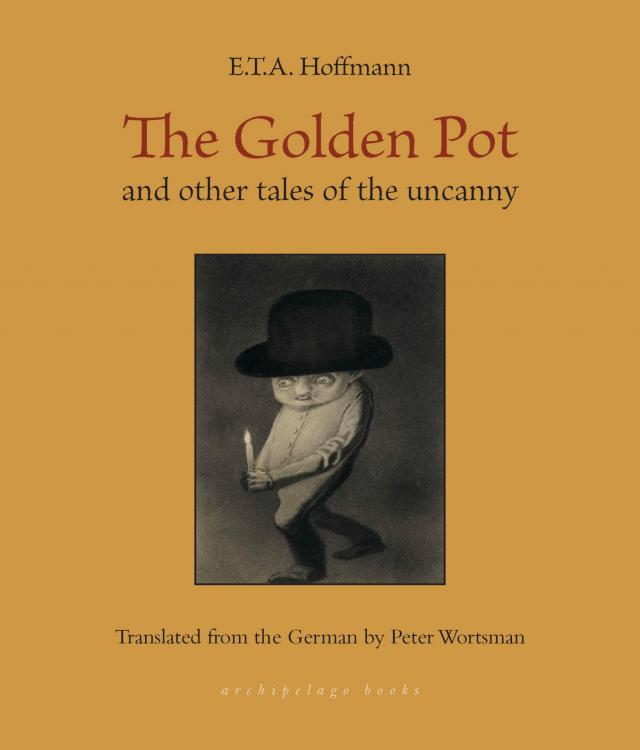


“Eyes out, eyes out!” Coppelius cried with a muffled roaring voice. Gripped by wild terror, I let out a scream and burst out of my hiding place onto the floor. Coppelius grabbed hold of me and, baring his teeth, grumbled, “Little beast! Little beast!” Picking me up, he hurled me at the hearth so that the flames singed my hair. “Now we’ve got eyes— eyes— a lovely pair of children’s eyes,” Coppelius whispered. With his fists he grabbed glowing cinders from the flames which he was about to sprinkle in my eyes, when my father raised his hands, folded as in prayer.
“Master! Master! Let my Nathaniel keep his eyes! Let him keep them, I beg you!”
Coppelius let out a burst of shrill laughter. “Let the boy keep his eyes and whimper his lesson through life; but let us take a close look at the mechanism of the hands and feet.” Whereupon he grasped me so hard that my joints snapped, twisted off my hands and feet, and reattached them here and there. He sputtered and lisped, “It’s not right this way! ‘Twas good the way it was!— The old man got it right!” Everything around me went dark, a sharp cramp flashed through my nerves and limbs— and then I felt nothing.
A warm and gentle breath wafted over my face, and I awakened as if from the sleep of death with my mother bent over me.
“Is the Sandman still here?” I stammered.
“No, my dear child, he’s been gone a long long time, he won’t hurt you!” my mother said, kissing and cuddling her recuperated little darling.
Why should I try your patience, my dearest Lothar! Why should I keep babbling in minute detail when there’s still so much to be told? Suffice to say that I was caught eavesdropping and was mishandled by Coppelius. Fear and trembling had fetched me a high fever, with which I lay sick for several weeks. “Is the Sandman still here?” – That was the first clear word to issue from my lips and the sign of my recovery, my salvation. Let me just tell you the most terrible moment of my youth, then you’ll be convinced that it’s not the failing of my eyes that makes everything appear colorless, but rather that a dark destiny has really draped a veil of clouds over my life, which perhaps I may only rip through in death.
Coppelius stopped coming by; we were told that he’d left town.
It was about a year later, as we sat one evening at the round table, true to our old family custom. Father was very chipper and entertained us with delightful stories from the travels of his youth. Then, at the strike of nine, we heard the front door hinges creak and slow, leaden steps thumped through the hallways and up the stairs.
“It’s Coppelius,” said Mother, going pale in the face.
“Yes, it is Coppelius,” Father confirmed with a weak and broken voice.
Tears streamed from Mother’s eyes. “But Father, Father!” she cried, “must it be so?”
“This one last time,” he replied, “it’s the last time he comes here, I promise you. Just go, go with the children!— Go!— Go to bed! Good night!”
I felt like I’d been pressed into cold, heavy stone— my breath stood still! Mother grabbed hold of my arm when I remained standing there, motionless. “Come, Nathaniel, come along, please!” I let her lead me into my room. “Be quiet, be quiet, just go to bed!— sleep— sleep,” Mother cried after me, but torn as I was by my inner fear and turmoil, I could not close an eye. The image of that hated, repulsive Coppelius stood there snickering at me with his sparkling eyes. In vain, I tried to erase the image from my mind. It must have been midnight already when a terrible boom went off, as if a cannon had been fired. The whole house rumbled, something rattled and roared past my door, and the front door slammed shut with a mighty clatter.
“That’s Coppelius!” I cried out in terror, and leapt from my bed. Then came a piercing shriek and a wretched wail, and I rushed to my father’s room. The door stood open, and a suffocating steam hit me in the face. The chambermaid cried out: “Oh, the master! The master!” In front of the steaming hearth, my father lay dead on the floor, his contorted face burnt black. My sisters howled and moaned around him, my mother lay unconscious at his side. “Coppelius, you cursed Satan, you killed my father!” I cried out, and immeditely lost consciousness.
Two days later, when they laid my father in his coffin, his expression was once again mild and gentle as it had been in life. It was at least comforting to think that his pact with that devilish Coppelius could not have condemned him to eternal damnation.
The explosion had awakened the neighbors; the incident seemed suspicious to them, and they informed the authorities, who issued a warrant for Coppelius’s arrest. But he had disappeared without a trace.
If I tell you now, my dearest friend, that the barometer salesman was none other than the accursed Coppelius, you will not, I trust, think ill of me for taking his inimical reappearance as a sign of bad things to come. He was dressed differently, but Coppelius’s physique and facial features are too deeply engraved in my memory for me to mistake him for another. Moreover, Coppelius did not even change his name. He now pretends to be a Piedmontese mechanic and calls himself Giuseppe Coppola.
I have resolved to confront him and to avenge my father’s death, come what will.
Don’t tell your mother a thing about that terrible creature. Give a hug to my dear sweet Clara, I’ll write her when I’ve calmed down a bit. Be well, etc. etc.
Clara to Nathaniel
It is true that you haven’t written to me in quite a while, but I still believe that you think of me and hold me dear. I was surely very much on your mind, for though you intended to send your last letter to my brother Lothar, you unwittingly addressed it to me, not him. I tore open the envelope with joy and only realized the error upon reading the words: “Oh, my dearest Lothar.” I know I ought not to have gone on reading after that, but rather to have handed the letter to my brother. But seeing as you sometimes reproached me in a childish teasing way that I had such a calm, ladylike, sensible disposition that, before fleeing a house about to collapse I would be inclined to quickly smooth out a wrinkle in the curtain, I dare hardly admit that the first lines of your letter upset me profoundly. I could hardly breathe— my eyes went blank. Oh, my dearest Nathaniel! What terrible thing could have burst into your life! Being separated from you, the possibility of never seeing you again, that thought pierced my breast like the sharp blade of a dagger. I read and read! Your description of that disgusting Coppelius is really horrible. Only now do I fathom that your dear old father died such a terrible and violent death. My brother Lothar, to whom I passed the letter, tried in vain to calm me down. The image of that despicable barometer peddler Giuseppe Coppola pursued me wherever I went, and I am almost ashamed to admit that he even managed to trouble my ordinarily unruffled and restful sleep with all sorts of nightmarish phantasms. But soon thereafter, in fact by the very next day, my mood calmed down. Don’t be mad at me, my dearest one, if Lothar tells you that despite your strange premonition that Coppelius would harm you, I am once again my old cheerful, carefree self.
Let me confess here and now my firm conviction that all the awful and frightening things you speak of only happened in your imagination, and that the real outside world played little part in it. That old Coppelius may well have been repulsive enough, but the fact that he hated children made you and your siblings develop a real aversion to him.
Your childish imagination naturally associated your nanny’s nursery account of the terrible Sandman with old Coppelius who remained a fantastic monster of the kind children fear so intensely, even though you didn’t believe in the Sandman. The weird goings-on with your father at night were surely nothing other than alchemical experiments the two conducted together in secret, which would have vexed your mother since not only was a lot of money no doubt squandered in the process but, as is always the case with such laboratory assistants, your father became so consumed by the elusive craving for higher wisdom that he forgot about the family. Your father probably brought about his own death by a careless mistake, and Coppelius is not to blame. Can you believe that yesterday I asked the pharmacist next door if such a sudden deadly explosion ever occurred during chemical experiments? He said: “Yes, indeed,” and described for me in his typical long-winded and minute manner how such a thing could happen, and in the process cited all kinds of curious-sounding substances I cannot now recall. Now you’ll get angry with your Clara. You’ll say: “Not a ray of the mysterious that embraces us with its invisible arms could break into that cold nature of yours. You only focus on the colorful surface of things and take a childish delight in the glittering golden fruit whose flesh contains a deadly poison hidden within.”
Oh, my dearly beloved Nathaniel! Don’t you think that even a cheerful, unaffected, carefree nature like mine could harbor an inkling of a dark force that insidiously strives to corrupt the sanctum of our inner self? But forgive me if, innocent girl that I am, I dare imply what I really think of that inner battle. I can’t find the right words to say it and you’re probably laughing at me, not because I mean to say something foolish, but because I am having such a hard time saying it.
If there is a dark force that can insidiously slip a perfidious filament into our innermost self to grab hold of us and drag us along on a dangerously destructive path that we would not otherwise have taken – if there is such a force, then it must reconfigure itself in our image, indeed it must become us; only in this way will we be inclined to believe in it and give it the space it needs to realize its shadowy end. If we have enough good sense, fortified by healthy living, to recognize strange and hostile influences as such, and to steadfastly hold to the path our nature and calling prescribe, then that sinister force will fail in the futile attempt to fashion itself in our image. It is also certain, Lothar adds, that we surrender ourselves to that dark physical force, it often makes us internalize strange figures that life flings into our path, so that we merely rouse the spirit which our vivid delusion makes us believe emanates from that figure. It is the phantom of our own self whose deep affinity and profound influence on our state of mind either damns us to hell or uplifts us into heaven.
You see, my beloved Nathaniel, that we, my brother Lothar and I, discussed at length the subject of dark forces and compulsions, a subject on which I have taken great pains to formulate an outline, and which now seems to me to be very profound indeed. I don’t quite grasp Lothar’s last point, though I have a sense of what he means and firmly believe it to be true. I beg you, erase the image of that ugly barrister Coppelius and the barometer peddler Giuseppe Coppola from your mind. Be assured that these strange figures have no power over you; only your belief in their malevolent power can, in fact, make them malevolent to you. If the deep upset of your soul did not cry out in every line of your letter, if your state of mind did not shake me up as profoundly as it does, in truth I could make light of your Mr. Sandman, Esq. and that barometer peddler Coppelius. Be cheerful— cheerful! I have decided to come to you and act as your guardian angel, and should that repulsive Coppelius dare reappear and trouble you again in your dreams, I will exorcize him with loud laughter. I am not in the least bit afraid of him and his loathsome fists, he will not spoil a tender tidbit with his barrister’s touch or steal my eyes as the Sandman.
Forever, my dearly beloved Nathaniel, etc. etc. etc.
Nathaniel to Lothar
I am very sorry that – granted, on account of my own absentminded mistake – Clara recently tore open and read the letter I wrote to you. She wrote me a very profound philosophical response in which she took great pains to prove that Coppelius and Coppola only existed in my imagination and were phantoms of my own troubled self, phantoms that would be instantaneously reduced to dust if only I recognized them as such. It is indeed hard to believe that the spirit that emanates from such brightly smiling, sweet, innocent eyes could display such brilliant insight. She cites you. So you talked about me. You instruct her in logic so that she may learn to sort and filter out the wheat from the chaff. Better leave it alone! By the way, it’s certain that the barometer peddler Giuseppe Coppola is not the old lawyer Coppelius. I’ve just begun attending the lectures of the recently arrived professor of physics, who, like the illustrious naturalist, is also named Spallanzani, and is of Italian descent. He has known Coppola for a good many years and, moreover, you can tell from the peddler’s accent that he really is Piedmontese. Coppelius was a German, but no true-blue one, I think. I’m still not completely calmed down. Even if you and Clara take me for a dark dreamer, I cannot erase the terrible impression of Coppelius’s accursed face. I’m glad, as Spallanzani claims, that Coppelius has flown the coop. This professor is a wondrous sort – a round little man with high cheekbones, a finely chiseled nose, pouting lips and small, piercing eyes. But you can get a clearer picture of him if you look at Chodowiecki’s portrait of Cagliostro in any Berlin pocket calendar – that’s just what Spallanzani looks like.
Recently, while climbing the steps to the lecture hall, I discovered that the glass door that is ordinarily covered with a curtain left a visible crack open at the side. A tall, very slender, well-proportioned, and splendidly dressed lady sat in the room at a little table on which she rested both her arms, her hands folded before her. She was seated just opposite the door, so that I got a good look at her angelically lovely face. She did not seem to notice me, and in fact her eyes were somewhat glassy— I’d almost be inclined to say they could not see. It seemed to me as if she were sleeping with open eyes. I felt the strangest rush of feeling, and therefore slipped quietly off to the auditorium next door. Later, I learned that the lovely figure I spotted was Spallanzani’s daughter Olympia, whom for some strange reason he keeps locked up so that no one can come near her. I’ve begun to think there is something peculiar about her, that perhaps she’s simple-minded. But why do I write you about all this? I could have told it to you more clearly and in greater detail in person. I might as well admit that I’ll be visiting you in two weeks’ time. I simply had to see my sweet angel-faced Clara again. By then the ill humor brought on (I must admit) by that annoyingly understanding letter of hers that sought to sound my depths will have blown over. Which is why I’m not writing to her today.
A thousand greetings, etc. etc. etc.
* * *
It would be impossible to imagine anything more incredible or more strange than what happened to my poor friend, the young student Nathaniel, which, dear reader, I have undertaken to tell you. Have you, gentle reader, ever experienced anything that so completely permeated your heart, your mind, and your thoughts that it supplanted all other notions? Something that simmered and seethed in you, that made your blood boil and flow like lava through your veins, and made your cheeks turn a fiery red. A thing that turned your gaze so eerie, as if it sought to grasp the presence of figures imperceptible to all other eyes in an empty room, as your words melted into dark sighs. Your nearest and dearest asked you, “What is it, friend? What on earth is the matter with you?” And you wanted to describe your state of mind in all the glowing colors and shadows and lights, and strained to find the words, and didn’t know where to begin. But it seemed to you as if with your very first word you felt compelled to evoke all the wondrous, beautiful, horrible, laughable, frightening things that happened, so that your account would strike your listeners like an electric shock. But every word that came to mind, anything that language could conjure up, seemed colorless, frigid, and dead. You searched and searched, and stuttered and stammered, and the sensible questions of friends struck like icy gusts of wind that soon dissipated in the emotional cauldron within. But had you, like a bold painter, begun with a few audacious brushstrokes to set down the rough outline of your state, you would have easily been able to apply with great ease ever brighter dabs of color, so as to dazzle your friends with the living swirl of multifarious figures, and that they would see themselves, as you see yourself, in the middle of the picture that issued from your imagination.
No one, I must admit, gentle reader, ever actually asked after the story of young Nathaniel; but as you well know, I am one of those rum writers who, if burdened with impressions of the kind I’ve just described, feels as if anyone who happens to cross their path, indeed the whole world, is dying to know, “What’s bothering you? Pray tell us if you please!”
So, I felt a pressing need to speak to you of Nathaniel’s fateful path. The very wondrousness and strangeness of it consumed my consciousness, but for that very reason, and because I needed to make you, dear reader, likewise inclined and therefore able to bear the things I am about to tell, which is no small feat, I tormented myself as to how to begin my account in a significant, original, gripping fashion. “Once upon a time” – the nicest start to any tale – seemed too vapid! “In the small provincial town of S—— there Lived…” – sounded a bit better, at least informative enough to pave the way for the climax. Or to begin right off in media res: “ ‘The devil take you!’ the young student Nathaniel cried out with a wild-eyed look of anger and dread at the sight of the barometer peddler Giuseppe Coppola”— this I had, in fact, already written down when I was suddenly struck by something droll in the wild-eyed look of the young student Nathaniel— but the story is not in the least bit comical. I could find no words to reflect even the faintest glimmer of the burning heart of the matter. So I decided to dispense with the beginning. Just take the three letters, gentle reader, that my friend Lothar was kind enough to pass on to me, as the outline of the picture, to which I will take pains to add more and more color in the telling. Maybe I will manage, like a good portrait painter, to conjure up a character such that you will find a convincing resemblance without knowing the original – indeed, that it will seem to you as if you had seen that person many times with your own two eyes. Maybe then, dear reader, you will believe that there is nothing more wondrous or more strange than life itself, and that all that the poet can do is convey a dark reflection of it in a lightly buffed mirror.


_preview.jpg)
_preview.jpg)