He who hesitates 87th pr.., p.7
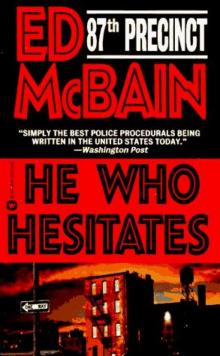
He Who Hesitates (87th Precinct),
p.7



“No, we didn’t know until we got over there. When we was climbing to the roof, we saw the sign for the dress loft.”
“And decided to jimmy open the door while you were at it.”
“What jimmy? We were going up the roof for our pigeons.”
“Where are they?”
“Where’s what?”
“The birds.”
“They flew away when we got up there.”
“I thought they didn’t know how to fly?”
“Who said that? You said that, not us.”
A man came down the iron-runged steps leading into the muster room, and the men at the desk turned momentarily to look at him. He was well-dressed, clean-shaven, with eyes that slanted to give his face an almost Oriental look. He wore no hat, and his hair was a sandy brown, cut close to his head, but not in a crew cut. He was reading something, some form or other, as he crossed the room, and then he folded the form and put it in his inside jacket pocket and stopped at the desk. The sergeant looked up.
“Dave, I’m going out to lunch,” the man said. “Anybody calls for me, I’ll be back around one-thirty, two o’clock.”
“Right, Steve,” the sergeant said. “You recognize these two?” he asked.
The man called Steve looked at Mancuso and Di Paolo and then shook his head. “No,” he said. “Who are they?”
“A couple of pigeon fanciers.” The sergeant looked at the patrolman, and the patrolman laughed. “You don’t make them, huh?”
“No.”
The sergeant looked at Di Paolo and said, “You see this fellow here? He’s one of the meanest cops in this precinct. Am I right, Steve?”
The man, who was obviously a plainclothes detective, smiled and said, “Sure, sure.”
“I’m only telling you this because if you’re smart you’ll give your story to me, and not wait until he gets you upstairs. He’s got a rubber hose up there, right, Steve?”
“Two rubber hoses,” the detective answered. “And a lead pipe.”
“There ain’t no story to give,” Mancuso said.
“We was going up after the pigeons, and—”
“See you, Dave,” the detective said.
“—that’s the truth. We spotted them on the roof from where we was flying the pigeons—”
“So long, Steve. In February?”
“What do you mean?”
“Flying your pigeons on a day you could freeze your ass off?”
“What’s that got to do with…”
Roger stood up suddenly. The detective had gone through the door, and was heading down the front steps of the building. The desk sergeant looked up as Roger reached the door, and then—as though noticing him for the first time—asked, “Did you want something, mister?”
“No, that’s all right,” Roger said. He opened the door quickly. Behind him, he could hear Di Paolo patiently explaining about the pigeons again. He closed the door. He came down the front steps and looked first to his left and then to his right, and then saw the detective walking down Grover Avenue, his hands in the pockets of his gray tweed overcoat, his head ducked against the wind. Swiftly, he began following.
He could not have said what it was that had forced him to rise suddenly from that bench. Perhaps it was the way they had those two fellows trapped, the way they were trying to make out those fellows had tried to rob the dress loft when it was plain to see that all they’d really been after was their pigeons up on the roof. Perhaps it was that, or perhaps it was the way the detective had smiled when the sergeant said he was one of the meanest cops in the precinct. He had smiled and said, “Sure, sure,” as if he wasn’t really a mean cop at all, but simply a guy who had a job to do and the job only accidentally happened to deal with men who maybe were or maybe weren’t trying to break into dress lofts.
There was something good about that detective’s face, Roger couldn’t say what. He only knew that there were bums in this world and there were nice guys, and this detective struck him as being a nice guy, the same way Parker in the luncheonette had struck him immediately as being a bum.
He sure walks fast, though, Roger thought.
He quickened his pace, keeping sight of the gray overcoat. The detective was tall, not as tall as Roger himself, but at least six-one or six-two, and he had very broad shoulders and a narrow waist, and he walked with the quick surefootedness of a natural athlete, even on pavements that were getting very sloppy with fallen snow. The snow was still wet and heavy, large flakes filling the air like a Christmas card, everything gray and white and sharp, with the buildings standing out in rust-red warmth. Everyone always thought of the city as being black and white, but during a snowstorm you suddenly saw the colors of the buildings, the red bricks and the green window frames and the yellows and the blues of rooms only glimpsed behind partially drawn shades. There was color in the city.
Following the detective, he began to feel pretty good again. He had always liked snow, and it was beginning to snow pretty heavy now, with the streets and sidewalks turning white, and with the snow making a funny squeaking sound under his shoes as he walked into the large swirling flakes. In Dick Tracy, whenever it snowed, the guy who drew the cartoon always made these big round white circles, they filled the whole page almost, he sure knew how to make it snow. It snowed in Dick Tracy sometimes three, four times every winter.
The detective had turned the corner into a side street, and Roger quickened his step, slipping on the sidewalk, regaining his balance, and then turning the corner and seeing the detective stop in front of a restaurant just short of the middle of the block. The detective stood with his hands in his pockets, his head bent, hatless, his brown hair covered with snowflakes and looking white from a distance. He was probably waiting for someone, Roger thought, and then looked around for a place where he could stop without attracting attention. That man up there is a detective, he reminded himself. He knows all about following people and about being followed, so make up your mind quick, do something. Either walk past him, or turn back, or find a place where you can hide, or pretend to be waiting, no, I’ll go right up to him, Roger thought. I’ll just go right up to him and tell him what I have to tell him, what’s the sense of kidding around?
He was walking toward the detective when the taxicab pulled up, and the woman got out.
The woman was beautiful.
Roger was perhaps eight or ten feet away from her when she got out of the cab, her skirt pulling back over her knees momentarily as she slid over on the seat, her hand moving swiftly to lower the skirt as she paid the driver. The detective extended his hand to her and she took it and raised her face and her eyes to his, a rare and lovely smile coming onto her face, God she was beautiful. Her hair was black, and her eyes were a very deep brown, and she smiled up at the detective with her eyes and her mouth and her entire face, and then stood beside him on the sidewalk and kissed him briefly on the mouth, not on the cheek or the jaw, but a swift sudden kiss on the mouth. She moved away from him and took his hand, her fingers lacing into his, and they began walking toward the door of the restaurant. The snow caught in her hair at once, and she shook her head and tilted her face, grinning, and he thought at first she was one of those girls who get the cutes whenever they’re around a man. But no, it was something else, he couldn’t quite place what it was at first. And then, as they opened the door and walked into the restaurant, he realized that the woman was simply very very happy to be with this man.
Roger had never been loved that way.
He opened the restaurant door, and followed them inside.
Abruptly, he thought of the girl Molly.
He had walked over to her table across the bar, and she had looked up at him briefly and then gone back to her drink. She was drinking something in a small stemmed glass, a whiskey sour or something, he figured. She looked up at him with disinterest, and then turned back to her drink with disinterest, as if she were equally bored with everything and everyone in the world.
“I’m sorry I stole your table,” Roger said, and smiled.
“Forget it,” she told him.
He stood by the table, waiting for her to ask him to have a seat, but the girl just kept looking at the open top of her glass, where some white foam was clinging to the inside, a kind of empty despair on her face, a sadness that made her look even more plain than she actually was.
“Well,” he said, “I just wanted to apologize,” and he started to move away from the table, thinking she wasn’t interested after all, didn’t want him to sit with her. And then, all at once he realized that the girl probably wasn’t used to approaches from men, didn’t know how to handle a man coming to her table and flirting with her. He stopped dead in his tracks and turned to the table again, and said, “Mind if I sit down?”
“Suit yourself,” the girl said.
“Thanks.”
He sat.
The table was silent again.
“I don’t know why you bothered asking,” the girl said, looking up briefly from her drink. “I thought you just sat wherever you pleased.” She lowered her eyes. Her hand came out, her fingers began toying with the stem of the cherry in her glass.
“That was really a mistake,” he said. “I really didn’t know anyone was sitting there.”
“Mmm, yeah, well,” the girl said.
“Would you like another drink?” he asked.
“Are you having one?”
“Just a beer. I don’t care much for hard liquor.”
“I don’t, either,” the girl said. “Unless it’s something sweet. Like this.”
“What is it anyway?” Roger asked.
“A whiskey sour.”
“That’s what I thought it was.” He paused. “How come a whiskey sour is sweet?”
“I ask them to go easy on the lemon.”
“Oh.”
“Yeah,” the girl said.
“Well, would you like another one?”
The girl shrugged. “Sure. Why not?”
Roger signaled the waiter. When he came to the table, Roger said, “I’ll have a glass of beer, and the lady would like another whiskey sour.”
“Easy on the lemon,” the girl said to Roger, not the waiter.
“Easy on the lemon,” Roger said to the waiter.
“Right,” the waiter said, and walked away.
“My name’s Roger Broome,” Roger said to her. “What’s yours?”
“Molly Nolan.”
“Irish,” he said, almost to himself.
“Yes. What’s Broome?”
“English, I think. Or Scotch. Or maybe both mixed,” Roger said.
“B-R-O-O-M?”
“No, with an E.”
“Oh,” she said, as though the E made a difference. The table was still again.
“You come here often?” Roger asked.
“First time,” Molly said.
“Me, too.”
“You live in the neighborhood?”
“No,” Roger said. “I’m from upstate.”
“I’m from Sacramento,” Molly said. “California.”
“No kidding?”
“That’s right,” she said, and smiled. She isn’t even pretty when she smiles, Roger thought. Her teeth are too long for her mouth and her lower lip has marks on it from her bite.
“You’re a long way from home,” he said.
“Don’t I know it,” she answered.
The waiter came to the table with their drinks. They were silent while he put them down. When he walked away, Roger lifted his glass and extended it toward her.
“Well,” he said, “here’s to strangers in the city.”
“Well, I’m not really a stranger,” she said. “I’ve been here a week already.” But she drank to his toast anyway.
“What brought you here?” he asked.
“I don’t know.” She shrugged. “Opportunity.”
“Is there?”
“Not so far. I haven’t been able to get a job yet.”
“What kind of work are you looking for?”
“Secretarial. I went to a business school on the Coast. I take very good shorthand, and I type sixty words a minute.”
“You ought to be able to get a job easy,” Roger said.
“You think so?” she asked.
“Sure.”
“I’m not very pretty,” she said flatly.
“What?”
“I’m not very pretty,” she said again. She was staring at the fresh whiskey sour, her fingers toying again with the cherry. “Men want their secretaries to be pretty.” She shrugged. “That’s what I’ve found anyway.”
“I don’t see what difference it makes,” Roger said.
“It makes a lot of difference.”
“Well, I guess it depends on how you look at it. I don’t have a secretary, but I certainly wouldn’t mind hiring someone who looked like you. There’s nothing wrong with your looks, Molly.”
“Well, thanks,” she said, and laughed in embarrassment, without really believing him.
“How’d your folks feel about you coming all the way east?” he asked.
“I don’t have any folks.”
“Oh, I’m sorry to hear that,” he said.
“They both died when I was nineteen. My father died of cancer, and then my mother died six months afterwards. Everybody says it was of a broken heart. Do you think people can die of a broken heart?”
“I don’t know,” Roger said. “I suppose it’s possible.”
“Maybe,” Molly said, and shrugged. “Anyway, I’m all alone in the world.”
“You must have relatives,” Roger said.
“I think my mother had a brother in Arizona, but he doesn’t even know I exist.”
“How come?”
“Oh, my father had an argument with him long before I was born, about a deed or something he said belonged to my mother, I don’t know, something to do with land in Arizona. Anyway, my uncle hauled my father into court, and it was a big mess, and my father lost, and everybody stopped speaking to each other right then and there. I don’t even know his name. My uncle’s, I mean. He doesn’t know mine, either.”
“That’s a shame,” Roger said.
“Who cares? I mean, who needs relatives?”
“Well, it’s nice to have family.”
“Mmm, yeah, well,” Molly said.
They were silent. Roger sipped at his beer.
“Yep, I’ve been all alone since I was nineteen,” Molly said.
“How old are you now?” he asked.
“Thirty-three,” she answered unflinchingly. “Decided it was time for a change, figured I’d come east and look around for a better job. So far, I haven’t found a goddamn thing.”
“You’ll find something,” Roger assured her.
“I hope so. I’m running out of money. I was staying down-town when I got here last week, but it was costing me twenty dollars a day, so I moved a little further uptown last Friday, and even that was costing me twelve dollars a day. So yesterday I moved to a real dive, but at least I’ll be able to hold out a little longer, you know? This city can kill you if you don’t watch out. I mean, I left California with two hundred fifty dollars and a suitcase full of clothes, and that was it. I figured I’d be able to land something pretty quick, but so far…” She shrugged. “Well, maybe tomorrow.”
“Where’d you say you were staying?” Roger asked.
“The Orquidea, that’s a hotel on Ainsley. There’s a lot of Spanish people there, but who the hell cares, it’s very inexpensive.”
“How much are you paying?” Roger asked.
“Seven dollars a night. That’s very inexpensive.”
“It certainly is.”
“It’s a nice room too. I always judge a hotel by how fast they are on room service, and whether or not they get your phone messages right. Not that I’ve gotten any phone messages since I checked in—after all, it was only yesterday—but I did order a sandwich and a glass of milk from room service last night, and they brought it right up. The service was really very good.”
“That’s important,” Roger said. “Good service.”
“Oh, sure it is,” Molly said. She paused and then asked, “Where are you staying?”
“Oh, in a furnished room on…uh…South Twelfth, I guess it is.”
“Is it nice?”
“No, no, it’s pretty crumby. But it’s only for a few nights. And I didn’t want to spend too much money.”
“When are you leaving?” she asked.
“Tomorrow, I guess. Tomorrow morning.”
“Mmm,” she said, and smiled weakly.
“Yep, tomorrow morning,” he repeated.
“Mmm.”
“How’s your drink?” he asked.
“Fine, thank you.”
“Not too sour, is it?”
“No, it’s just right.” She smiled again, lifted her glass, and sipped at it. A little foam clung to her lip, and she licked it away. “Do you like this city?” she asked.
“I don’t know it too good,” he said.
“Neither do I.” She paused. “I don’t know a soul here.”
“Neither do I,” he said.
“Neither do I,” she said, and then realized she was repeating herself, and laughed. “I must sound like a poor little orphan child, huh? No parents, no relatives, no friends. Wow.”
“Well, I’m sure you have friends back in…what was it… Sacramento?”
“Yeah, Sacramento. I had a very good friend there, Doris Pizer is her name, she’s Jewish. A very nice girl, though. In fact, one of the reasons I came here was because of Doris. She went to Hawaii.”
“Oh, yeah? Is that right?”
“Mmm,” Molly said, nodding. She lifted her drink again, took a quick sip at it, put it down, and then said, “She left last month. She wanted me to go with her, but I’ll tell you the truth, heat has never really appealed to me. I went down to Palm Springs once for a weekend, and I swear to God I almost dropped dead from the heat.”
“Is it very hot in Hawaii?”
“Oh, sure it is.” Molly nodded. “She got a job with one of the big pineapple companies. Dole, I think, who knows?” She shrugged. “I could have got a job there, too, but the heat, no thanks.” She shook her head. “I figured I’d be better off here. It gets cold as hell here in the winter, I know, but anything’s better than the heat. Besides, this is a pretty exciting city. Don’t you think so?”