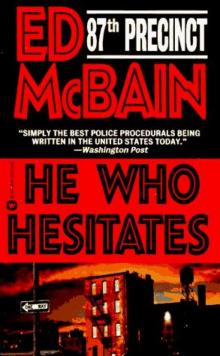
He who hesitates 87th pr.., p.9
He Who Hesitates (87th Precinct),
p.9



Roger, who was listening intently, almost turned to the detective and nodded in anticipation.
“We have got her on something, haven’t we? Or maybe, anyway.”
The woman raised her eyebrows inquisitively.
“The gun,” the detective said. “If she hasn’t got a permit for it, we can charge her with that. Or at least we can scare her with threatening to charge her. We’ll see how it goes. Boy.” He shook his head. “The thing about it, though, is I’m still not sure whether the priest copped out or not. Did she confess, or didn’t she? It bothers me, hon. What do you think?”
The woman’s hands began to speak again. Roger did not know what she was saying. Occasionally, he glanced at her as the wonderfully fluid fingers moved in front of her face. He had never been loved by a beautiful woman in his life—except, of course, his mother.
The waiter brought his omelette.
Silently, he ate.
Beside him, the detective and his wife finished their drinks, and then ordered lunch.
He followed the detective and his wife to a subway kiosk, where they embraced and kissed briefly, and then the woman went down the steps and the detective stood on the sidewalk for a moment or two, watching her as she descended. The detective smiled then, secretly and privately, and began walking back toward the station house. The snow was very thick now, thick in the air, falling in great loose silent flakes, and thick underfoot where it clung to the pavement and made walking difficult.
Several times on the way back to the station house, he almost approached the detective and told him the whole story. He had overheard enough during lunch to know that this was the kind of man he could trust, and yet something still held him back. As he thought about it, as he walked behind the detective and wondered for perhaps the fifth time whether he should approach him now or wait until they were back at the station house, it seemed to him the reason he felt he could trust this man was simply because of the way he’d treated his wife. There had been something very good and gentle about the way those two looked at each other and talked to each other, something that led Roger to believe this man would understand what had happened. But at the same time—and curiously, considering it was the man’s wife who had caused Roger to trust him—the wife was also responsible for his reluctance to approach the man. Sitting alongside them, Roger had shared their conversation, become almost a part of it. He had watched the woman’s face and had seen the way she looked at her husband, had watched her hands covering his, had watched the score of gentle tender things she did, the secret winks, the glances of assurance, and had been suddenly and completely lonely.
Walking behind the detective now in a silent white world, he thought of Amelia and wanted to call her.
But wait, he thought, you have to tell the detective.
They were approaching the station house now. The detective stopped at a patrol car parked outside the building, and the patrolman sitting closest to the curb rolled down the window on his side. The detective bent down and looked into the car and exchanged a few words with the cops inside, and then he laughed, and the patrolman rolled up the window again, and the detective started walking up the seven flat steps to the front doors of the precinct.
Wait, Roger thought, I have to…
He hesitated on the sidewalk.
The detective had opened the door and gone inside. The door eased shut behind him. Roger stood on the pavement with the snowflakes falling fat and wet and floppy all around him, and then he nodded once, sharply, and turned and began looking for a telephone booth. The first one he found was in a combination pool room and bowling alley on the Stem. He changed a dollar bill at the desk—the proprietor made it clear he didn’t like making change for the telephone—and then went to the booth and closed the door and carefully took from his wallet the folded slip of paper with Amelia’s number on it.
He dialed the number and waited.
A woman answered on the fourth ring. It was not Amelia.
“Hello?” the woman said.
“Hello, could I talk to Amelia, please?” Roger said.
“Who’s this?” the woman asked.
“Roger.”
“Roger who?”
“Roger Broome.”
“I don’t know any Roger Broome,” the woman said.
“Amelia knows me.”
“Amelia isn’t here. What do you want?”
“Where is she?”
“She went downstairs to the store. What do you want?”
“She asked me to call. When will she be back?”
“Five, ten minutes,” the woman said.
“Will you tell her I called?”
“I’ll tell her you called,” the woman said, and hung up.
Roger stood with the silent receiver to his ear for a moment, and then replaced it on the hook and went out of the booth. The man behind the desk gave him a sour look. A clock on the wall told him it was almost 2:00. He wondered if Amelia would really be back in five or ten minutes. The woman who’d answered the phone had sounded very colored, with the kind of speech that could sometimes be mistaken for white Southerner, but more often was identified immediately as coming from a Negro. It was just his luck, he thought. The first pretty girl he’d ever met who seemed to take a real liking to him, and she had to be colored. He wondered why he was bothering to call her at all, and then decided the hell with her, and headed back for the police station.
I mean, what’s the sense of this, he thought. What am I putting this off for? It’s got to be done, I’ve got to go in there sooner or later and tell them about it, so it might as well be now. What do I get by calling Amelia, she’s probably up on the roof with one of those Persian Lords she was telling me about, getting her ass screwed off, the hell with her.
The thought of Amelia in embrace with one of the Persian Lords was infuriating to him, he didn’t know why. He barely knew the girl, and yet the idea of her being laid by one of those gang members, no less all the members of the gang, filled him with a dark rage that twitched into his huge hands hanging at his sides. He had half a mind to tell the police about that, too, about young punks jumping on a nice girl like Amelia, she was probably a slut anyway, letting them do that to her.
He heard voices in the park.
Through the snow, he heard the voices of children, loud and strident, cutting through the falling snow, a sound of glee, a halfremembered sound, he and his father on the small hill behind the clapboard house they’d lived in near the tracks when Buddy was still a baby, “Off you go, Roger!” and a push down the hill, the rush of wind against his face, his lips pulled back over a wide joyous grin, “That’s the boy!” his father shouted behind him and above him.
There were three boys with sleds.
He walked into the park and sat on a bench some fifteen feet from where they were sliding down a wide snow-covered slope, the snow packed hard by the runners of their sleds. The boys couldn’t have been older than six or seven, probably kindergarten kids who’d been let out of school early, or maybe firstgraders, no older than that. Two of them were wearing old ski parkas, and the third had on a green mackinaw. The one with the mackinaw had a woolen hat pulled down over his forehead and his ears and damn near over his eyes as well. Roger wondered how he could see where he was going. The other two were hatless, their hair covered with snow. They yelled and screamed and shouted, “Watch me! Hey, watch me!” and took running starts and then threw the sleds down and leaped onto them in bellywhops and went down the hill screaming happily all the way, one of them imitating a police siren with his mouth. Roger got up off the bench and walked to the crest of the hill and waited for them to climb up again. The boys ignored him. They were talking among themselves, reliving the excitement of the ride down the hill—”Did you see the way I almost hit that tree?”—pulling the sleds behind them on their ropes, glancing back over their shoulders down the hill every now and then, anticipating the next ride down. The one with the mackinaw walked past Roger, took a deep breath and then turned to face the downhill slope again, ready for another run.
“Hi,” Roger said.
The kid looked up from under the woolen hat pulled almost clear down over his eyes. He wiped a gloved hand across his running nose, mumbled, “Hi,” and turned away.
“The hill looks good,” Roger said.
“Mmm,” the kid mumbled.
“Can I take a ride?”
“What?”
“Can I take a ride?”
“No,” the kid said. He looked up at Roger in brief contempt, took his running start, threw himself onto the sled, and went down the hill again. Roger watched the sled go. He was still angry at the thought of those Persian Lords jumping Amelia, and he was also beginning to get a little apprehensive about what might await him in the police station across the way, nice detective or not. Besides, this snot-nosed little kid had no right to talk to him that way. His hands began to twitch again. He waited for the boy to climb back to the top of the hill.
“Didn’t your mother teach you any manners?” he asked.
The boy looked up at him from under the hat. The other two boys had stopped some three feet away, and they were staring at Roger curiously, with that odd, belligerent, somewhat frightened look all kids wear when they’re expecting crap from a grown-up.
“Why don’t you get lost, mister?” the kid said from under his hat.
“What’s the matter, Tommy?” one of the other boys called.
“This guy’s some kind of nut,” Tommy said, and he turned away and looked down the hill again.
“All I did was ask you if I could have a ride,” Roger said.
“And I told you no.”
“What’s that sled made of, gold or something?” Roger asked.
“Come on, mister, don’t bug me,” Tommy said.
“I want a ride!” Roger said suddenly and harshly, and he reached out for the sled, grasping it near the steering mechanism at the top, and pulling it away from Tommy, who clung to it for just a moment before releasing his grip. Tommy was the first to begin yelling, and the two other kids began yelling with him, but Roger was already running, propelled at first by anger and then by a rising exhilaration as he moved toward the brow of the hill and threw the sled down and then hurled 210 pounds of muscle and bone onto it. The sled made a sound beneath his weight as though it would splinter, but it began sliding immediately and the forward motion eased the strain of the load, gravity pulling the sled down the slope, gaining momentum, 210 pounds hurtling down the hill, faster, faster, he opened his mouth and yelled like a kid, “Wheeeeeeeeeeeeeee!” as the sled raced through the falling snow. Behind him, Tommy and the other kids were shouting and ranting and running down the hill after him, he didn’t give a damn about them. His eyes were tearing from the wind roaring over the front end of the sled, the big falling flakes made visibility almost impossible, the sled suddenly turned over and he rolled into the snow, the sled flying up into the air, he landing on his side and continuing to roll down the hill, laughing as his coat and his trousers and his face and his hair got covered with snow, and then finally sitting up at the base of the hill, still laughing, and looking up to where Tommy and the others were yelling as they retrieved the sled from a snowbank.
“Call a cop, Tommy,” one of the boys said.
“Go on, do it,” the other boy said.
Roger got to his feet. Laughing, he glanced over his shoulder once, quickly, and began running.
He wondered how much time had passed. Was it five or ten minutes already, would Amelia be back?
He laughed again. That ride had really been something, he’d left those little yelling bastards clear up at the top of the hill, boy that had really been something. He shook his head in bemused wonder and then suddenly stopped and threw back his head and shouted “Yahoooo!” to the falling snowflakes, and then began running again, out of the park. He stopped running when he reached the sidewalk. He put his hands into his coat pockets and began walking at a very gentlemanly dignified pace. He could remember him and his father and the fun they used to have together before Buddy was born, and even when Buddy was just a little baby. And then of course when Buddy was two, his father had got killed, and it was Roger who’d had to take care of the family, that was what his mother had told him at the time, even though he was only seven years old, It’s you who’s the man in the family now, Roger. Riding down the hill on that kid’s sled had been just like it was before his father died, just a lot of fun, that was all. And now, walking like a gentleman on the sidewalk, this was the way it got after his father was killed in the train wreck, you couldn’t kid around too much anymore, you had to be a man. It’s you who’s the man in the family now, Roger.
Seven years old, he thought.
How the hell can you be a man at seven?
Well, I was always big for my age.
Still.
He shrugged.
He was beginning to feel depressed, he didn’t know why. His face was wet with snow, and he wiped one hand over it, and then reached into his pocket for a handkerchief, and wiped his face again. He guessed he should try Amelia. He guessed he should go talk to that detective.
He began making bargains with himself. If the next car that comes down the street is a black Chevrolet, then I’ll go to the police station and talk to the detective. But if the next car that comes down is a taxicab, I’ll call Amelia. If it’s a truck, though, I’ll go back to my room and pack my bag and just go home, probably be best anyway, people worrying about me back home. No cars were coming down the street for a while because the snow was so thick, and when one finally did pass, it was a blue Ford convertible, for which he had made no provisions. He said the hell with it and found a phone booth and dialed Amelia’s number.
The same woman answered the phone.
“What do you want?” she said.
“This is Roger Broome again,” he said. “I want to talk to Amelia.”
“Just a minute,” the woman said, and then she partially covered the mouthpiece and Roger heard her shout, “‘Melia! It’s your Mr. Charlie!”
Roger waited.
When Amelia came to the phone, he said immediately, “Who’s Mr. Charlie?”
“I’ll tell you later. Where are you?”
“I don’t know, somewhere near the park.”
“Did you want to see me?” Amelia asked.
“Yes.”
“I can’t come down for a while. I’m helping my mother with the curtains.”
“Was that your mother who answered the phone?”
“Yes.”
“She sounds very sweet.”
“Yes, she’s a charmer,” Amelia said.
“What did you say you were helping her with?”
“The curtains. She made some new curtains, and we were putting them up.”
“Can’t she do that alone?”
“No.” Amelia paused. “I’ll meet you later, if you like.”
“All right. When later?”
“An hour?”
“All right. Where?”
“Oh, gee, I don’t know. How about the drugstore?”
“Okay, the drugstore,” Roger said. “What time is it now?”
“It’s about two-twenty, I guess. Let’s say three-thirty, to be sure.”
“Okay, the drugstore at three-thirty,” Roger said.
“Yes. You know where it is, don’t you?”
“Sure I do. Where is it?”
Amelia laughed. “On the corner of Ainsley and North Eleventh.”
“Ainsley and North Eleventh, right,” Roger said.
“Three-thirty.”
“Three-thirty, right.” Roger paused. “Who’s Mr. Charlie?”
“You’re Mr. Charlie.”
“I am?”
Amelia laughed again. “I’ll tell you all about it when I see you. I’ll give you a course in black-white relations.”
“Oh, boy,” Roger said.
“And other things,” Amelia whispered.
“Okay,” Roger said. His heart was pounding. “Three-thirty at the drugstore. I’ll go home and put on a clean shirt.”
“Okay.”
“So long,” he said.
“So long,” she said.
A squad car was parked at the curb when he got back to the rooming house.
The car was empty. The window near the curb was lowered, and he could hear the police radio going inside. He looked up the steps leading to the front door. Through the glass panels on the door he could see Mrs. Dougherty in conversation with two uniformed policemen.
He was about to turn and walk off in the opposite direction when one of the cops looked through the glass-paneled door directly at him. He couldn’t turn and walk away now that he’d been seen, so he walked casually up the steps and kicked snow from his feet on the top step and then opened the door and walked into the vestibule. A radiator was hissing behind the fat cop, who stood with his hands behind his back, the fingers spread toward the heat. Mrs. Dougherty was explaining something to the cops as Roger stepped into the vestibule. “…only discovered it half an hour ago when I went down to the basement to put in some laundry, so that was when I called you, hello, Mr. Broome.”
“Hello, Mrs. Dougherty,” he said. “Is something wrong?”
“Oh, nothing important,” she said, and turned back to the policemen as he went past. “It’s not that it was new or anything,” she said to the fat cop. Roger opened the inner vestibule door. “But I suppose it was worth maybe fifty or sixty dollars, I don’t know. What annoys me is that somebody could get into the basement and…”
Roger closed the door and went up the steps to his room.
He had just taken off his coat when the knock sounded on his door.
“Who is it?” he said.
“Me. Fook.”
“Who?”
“Fook. Fook Shanahan. Open up.”
Roger went to the door and unlocked it. Fook was a small, bald, bright-eyed man of about forty-five, wearing a white shirt over which was an open brown cardigan sweater. He was grinning as Roger opened the door, and he stepped into the room with an air of conspiracy, and immediately closed and locked the door behind him.