

Fearless, p.13
Fearless,
p.13
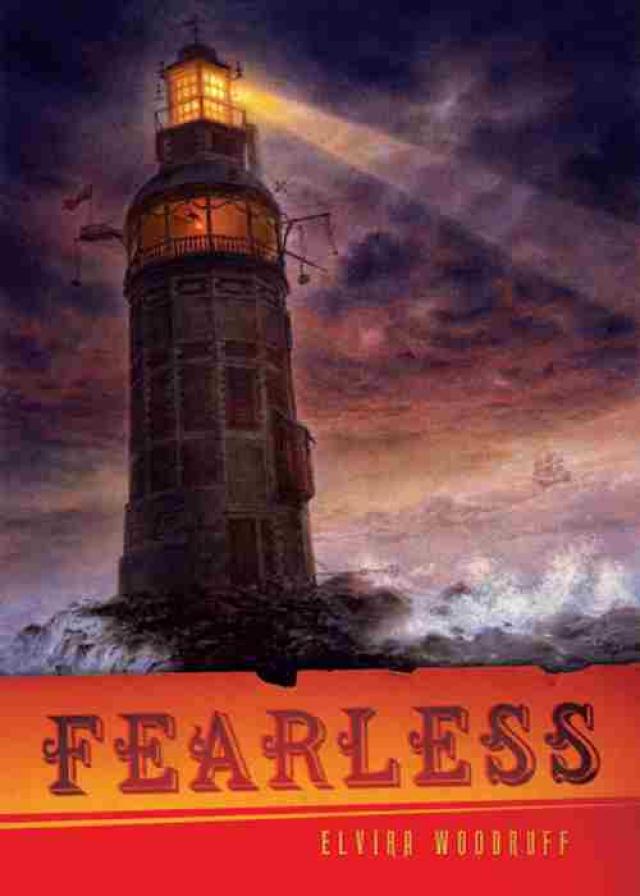


“But … but what of the boatman and the others?” Digory asked, his voice groggy and his head reeling.
The old fish seller shrugged. “Can’t say. Them that brought ye up onto the beach left ye there for us to find.”
“And Master Henry?” Digory cried weakly. “What of Master Henry?”
“Let the boy rest now,” the old woman said, shooing her husband away. She turned back to Digory. “Close yer eyes and rest now, lamb. Ye need to sleep.”
Digory did as he was told, for he was still so very tired. He fell back into a sound and dreamless sleep. When he awoke, hours later, or perhaps it was days, he found the old woman snoring beside the fire with her knitting in her lap. The old man was nowhere to be seen. As Digory sat up in the bed, he tried to remember what had happened.
Where was Cubby? Where was Master Henry? And what happened to the boatman and the keepers?
I must get back to the inn and find Cubby, he thought. He glanced down and saw that he was wearing a large muslin shirt that was not his own. He looked around the room that was a clutter of mismatched teacups, chipped china plates, baskets of seashells, and buckets filled with fish bones.
When Digory spotted his clothes draped over a large spinning wheel before the fire, he slipped out from under the quilt and crept out of the bed. The floorboards creaked loudly as he limped across the room. Looking down, he noticed that his legs and arms were badly bruised and there was a deep gash above his left knee.
The old woman stirred and mumbled in her sleep. Digory silently reached for his clothes. He struggled into his breeches and headed out the door.
Once outside, Digory stopped short and stared at the destruction all around him. Could this really be the same Plymouth? The sun was shining under a blue, cloudless sky, but the street had disappeared and was replaced by piles of rubble and wreckage: lumber, bricks, and broken furniture, as far as the eye could see. Rooftops had been torn off completely. Windows were smashed and shutters ripped off their hinges. There was not one chimney left on a house. Those who had survived were silently sifting through the rubble that had once been their lives.
As Digory slowly found his way down the street, a sickening feeling took hold of him. Never before had he seen such devastation. He had to find Cubby right away.
“Can you tell me the way to the White Owl Inn?” Digory asked a man who was pushing a cart full of bricks. But the man shook his head and kept on walking.
“Please, miss,” Digory begged of a young woman who was picking through a pile of rubble. “Have you heard any news of the White Owl Inn?”
“I’ve heard nothing but my mother’s wails,” answered the woman. “For this place where you stand was my father’s tavern.” She pulled a chipped mug from the heap and started to cry.
Digory fought back his own tears. How was he to find the inn? He began wandering from one pile of rubble to the next, when his eyes fixed on a familiar scene in the distance. It was the bluff, Plymouth Hoe, where he and Cubby and Master Henry had first seen the lighthouse on their return to Plymouth.
His heart raced as a man looked out over the water through a spyglass, and Digory scrambled over a pile of timber and bricks to join him.
“Please, sir,” Digory pleaded. “Might I borrow your glass to look at the Light?”
“You can look all you like, lad,” the man said, handing him the glass. “But you’ll not see the Eddystone Light, not ever again.”
“What do you mean, sir?” Digory cried as he brought the glass to his eye.
“She’s not there,” the man said, shaken. “She’s just not there!”
“That’s impossible!” Digory gasped. “She must be there! She must!” But the more he searched through the glass, the more he understood that the man spoke the truth. For all he could see was the smooth span of the ocean spreading out across the horizon, save for the reddish reef that jutted up from the waves. It was as if the little lighthouse had never been there! As if it had all been a dream.
“They say that the Jester himself was out there last night,” Digory heard the man say. “Imagine being in that tower when it came down.”
Digory could listen no more. He returned the glass to the man and ran away. He ran past broken crockery, fallen timbers, and shards of glass. He kept on running. When he finally got to the Barbican steps, he sank down and buried his face in his hands. Then he sobbed as if his heart would break. Master Henry was gone! How could that be?
“All or nothing, that’s what you said!” Digory cried as he lifted his face up to the blue sky above. “But where did it get you? You gave your all and now there is nothing!”
Digory looked out over the beach at the many splintered ships that were piled high upon it. Each one was smashed and broken beyond repair, as if a giant had walked across the water, crushing everything in his path and tossing it up onto the sand.
A gull lay dead at the bottom of the steps, a gaping wound in its neck. Digory sucked in another sob. He felt as broken as the smashed ships, as wounded as the gull that would never fly again. Master Henry, whom he had come to love and admire, was gone. How could someone so full of life be dead?
With another pang of sadness he thought of his father. He remembered how strong and full of vigor he had always been. But the sea had taken him as well, just as it had taken his mother, his uncle, and his grandfather, too.
“The sea has taken everyone I love,” he said aloud. And suddenly he thought of Cubby. He had to find Cubby right away! He got to his feet and ran toward the street. He darted around the wreckage looking for the White Owl Inn, but when he reached the street, there was nothing he could recognize.
“Please, mistress, can you point out the White Owl Inn?” he asked a woman who was carrying a large bundle of rags on her back.
“The White Owl?” she whispered, laying a shaky hand on Digory’s arm. “Why, ’tis over there. They’ve been pulling bodies from it all day.” She pointed across the street to a building that had collapsed upon itself and was now just another mountain of rubble.
On top of the broken heap was a sign with a large white owl painted on it. The owl’s eyes were open, as if it were staring up at the sky.
“It can’t be!” Digory cried, breaking away from the woman and running across the street. “Cubby! Cubby!” he shouted. He dug into the rubble with his bare hands. “Where are you, Cubby?” he pleaded.
“Come away with you now, lad,” a man covered in dust called as he pulled Digory back. “Can you not see how dangerous it is to be poking around here?”
“But my brother,” Digory tried to explain. “He was staying at the inn. I thought he’d be safe here. I have to find him! I have to help him!”
“There’s nothing you can do now, lad,” the man said gently. “No one’s coming out of there alive today. We pulled out twenty dead from here already.”
“Did you pull out my brother?” Digory asked, taking all his strength to find the words. “He’s a small boy with red hair and freckles. And he has a dog with a blue parrot riding on its back.”
The man shook his head no and pointed down the street to the one stone building that was still standing. “They are bringing all the bodies to the blacksmith’s shop. If he was one of them pulled out today, he’d be there.”
Digory stumbled toward the stone building, heart heavy with dread.
He recalled the old fish seller saying how lucky they’d all been to survive the storm. But what was lucky about it if everyone Digory ever loved was gone? Unlucky to be alive — that was more like it, Digory thought as he smelled the fresh horse manure beside the blacksmith’s shop. From inside came the harrowing sound of a woman’s wails. Digory shuddered and shrank back away from the building.
How was he to go in there? How was he to face seeing what the storm had done to his little brother? He crouched beside a wall, unable to move. An hour went by and then another. The sky was still a brilliant blue with not a cloud on the horizon. Digory bowed his head, unable to look at such a bright, beautiful day, when he heard a voice that made his heart leap.
“Yo, ho, ho! Nincompoop off the mizzen!”
CHAPTER XXXIII: The Shanty
Digory rose with a start. “Mizzen!” he called out. Then he noticed a sailor with a black eye and a bloodstained bandage wrapped around his head. A bright blue parrot was perched on his shoulder squawking, “Yo, ho, ho!”
“What are you doing with Mizzen?” Digory cried. “And what have you done with my brother, Cubby? He was staying at the White Owl.”
The sailor’s face fell. “Lost half our crew there last night,” he said hoarsely. “Every sailor expects to be taken in a storm, but not on land. My God, not on land …” His voice trailed off.
“And my brother?” Digory pleaded. “Where is my brother?”
“The little carrottop in a big blue coat?”
Digory nodded as he wiped at his eyes.
“He’s got me minding his parrot while his arm is being tended to,” the sailor said. “There’s a doctor set up shop, setting bones and such, in a coffeehouse around the corner.”
“Then he’s alive?” Digory cried, clutching the man’s sleeve.
“Oh, he’s alive, all right. Said he’d run out into the street to look for his dog, just before the building come down,” the sailor explained. “He got banged up good from the timbers falling around him, but he made it out all right. That dog of his saved his life. When we found him and his dog, he was holding on to his birdcage and a leather case for dear life.”
Digory followed the sailor around the corner to one of the few buildings left on the street. Once inside, he found it crowded with bloodied and bruised people. It seemed as if all of Plymouth was crammed inside its walls. Many were moaning and crying out in pain or for lost loved ones. Others stood shaken and silent. And still others lay unconscious on makeshift cots. But Digory’s heart leaped when he heard a familiar voice calling him from across the room.
“Digory! Digory!” Cubby cried.
Though his freckled face was covered in cuts and bruises and his arm was in a sling, Cubby’s grin was as wide as ever on seeing his brother alive.
“Are you all right?” Digory cried, reaching out for him and petting Fishbone, who wildly licked Digory’s face. The dog’s tail wagged so hard, he knocked a cup off a table.
The sailor returned Mizzen to his cage on the floor beside Cubby and then disappeared into the crowd. Meanwhile, the two brothers lost no time in telling each other their stories of all that had happened during their time apart.
A sudden commotion arose at the door as two sailors burst into the room. “We’ve just heard the news,” one of them cried. “They say the Eddystone Light is no more!”
Digory shuddered at the sound of the collective gasp that followed.
“How shall we manage that monster reef now?” someone cried.
“Without the Light we’ve no chance of staying clear of those rocks!”
“The Widow Maker is back!”
“They say that the Jester himself was swept out to sea with his tower!” the sailor continued.
Digory swallowed back a sob as he looked at Cubby’s stricken face.
“God save his soul!” a sailor shouted. “His beacon guided our ship in last night!”
“His beacon guided us all,” another added.
“Three cheers for Henry Winstanley!”
“Hear! Hear!” The room erupted. “Three cheers for the Jester and his Eddystone Light!”
Digory put his arm around his little brother.
“You’ll have to move on now, lads,” a man carrying a bundle of rags told them. “There are many more injured who need to come in.”
Digory stared back numbly. Just where were they to “move on” to? No one in Plymouth would hire them now, not with such devastation everywhere. And without Master Henry they had nothing and no one to return to.
Digory picked up Mizzen’s cage, and he and Cubby began to inch their way through the crowded room. A baby shrieked in its mother’s arms. “Hush, now, hush,” the woman said, trying to quiet her child.
Digory had almost reached the door when he heard someone say, “I’ve just the shanty to calm the babe.”
The voice sounded so familiar, Digory froze in place. His heart pounded wildly as the man began to sing the old shanty:
“Dance to your daddy,
My little laddie.
Dance to your daddy,
My little man.”
CHAPTER XXXIV: A Radiant Future
The baby quieted as the man continued to sing:
“Thou shall have a fish,
Thou shall have a fin,
Thou shall have a haddock,
When the boat comes in.”
“Do you hear that?” gasped Cubby.
Digory searched the room full of faces until he spotted the man who was singing. He was lying on a cot with his leg wrapped in bloody rags. His hair was matted and dirty, and his face unshaven. But his smile was unmistakable. It was the same sad smile that Digory had always loved. And his eyes were as green as Digory’s own.
“Father!” Digory shouted as he and Cubby pushed through the crowd to reach him. “Father! Oh, Father!” he and Cubby cried together.
Nicholas Beale’s handsome, weathered face broke into a radiant smile at the sight of his sons before him. His big, strong arms wrapped around them. He couldn’t hold them tight enough. And he couldn’t stop looking at them.
“Am I dreaming?” he said. “Whatever are you two doing here?”
“We had news of the Flying Cloud wrecking in Yarmouth,” Digory began. “Aunt Alice could no longer keep us, so she sent us to look for you.”
“There was no way to get word home. I departed on the Flying Cloud, but I never boarded her for the return voyage,” their father explained. “I fell sick with fever in Genoa and had to stay behind. I only got to Plymouth yesterday in the midst of that horrific storm. How long have you been here?”
It was then that Digory told his father how Aunt Alice sent him to Plymouth, and about their harrowing journey there, and Master Death and the press-gang, and how Master Henry saved them from prison and took them to the Magic House to live and work. He told him how Master Henry had discovered Digory’s talent for drawing and had taken him on as his apprentice. Digory told his father about the lighthouse and the dangerous trip out to Eddystone.
“Master Henry wouldn’t leave the reef,” Digory said, fighting back his tears. “The keeper tried to warn him, but he wouldn’t listen. We lit the candles together. But when he saw a boat in the distance, he decided to stay to keep the tower lit. But the storm was too strong. Now he and his lighthouse are gone!”
Color rushed to his father’s face, for suddenly he understood. “You were out on the Eddystone in that storm? Then it was you and your Master Henry who saved my life and the lives of our crew,” his father told him. “For that was our ship that came around the Stone late yesterday. It was only because of the light from the tower that we were able to steer clear of the Eddystone Reef and make it back into the harbor. There were over one hundred of us on that ship. Many of them are in here now.” He gazed at the sailors who stood close by.
“So what was he like, son, this Jester of Littlebury?” Digory heard his father ask.
The tears came to Digory’s eyes as he struggled to answer. He pictured Master Henry back in his workshop, creating his amazing gadgets and rides for the Magic House, his voice crackling with excitement as he talked of his many projects and plans.
He thought of the love and caring the master had shown when he and Cubby had no one to turn to. And he thought of the hope Master Henry’s words had given him, words he would never forget. “Your future is as radiant as you see it….”
But most vivid to Digory was his memory of the master standing so bold and brave in his lantern room, in all that glorious light. Again Digory glanced around at the many sailors who owed their lives to the Jester of Littlebury. But when he looked at his father, he realized the most important thing of all. Thanks to Master Henry, his father was alive! Digory finally understood. It was not all for nothing. It had never been that.
“He was unlike anyone I’ve ever met,” Digory finally answered.
His father nodded. “And to light that rock and stay out there in that storm. Why, he must have been …”
“Fearless,” Digory finished the sentence for him. “He was fearless.”
Everyone was quiet for a moment.
“And what’s this you’re carrying?” Their father broke through the silence, tapping on the leather tube across Cubby’s chest.
In all of the commotion Digory had forgotten about the case! He quickly slid it off Cubby’s shoulder and opened the lid. He took out two rolled papers. With a pang of sadness he recognized the master’s stylish script.
“These must be the documents Master Henry spoke of,” Digory murmured. “They are signed by him,” he said, reading the signature.
“How could you know that?” his father asked. “Because I can read,” Digory said proudly. “Mistress Elizabeth taught Cubby and me our letters.”
Nicholas Beale smiled in awe at his eldest son. “I never thought I’d see the day a child of mine could read! Go on, Digory, read the words aloud.”
Digory looked back down at the paper and cleared his throat.
“‘To Mistress Henry Winstanley of Littlebury,’” he began.
People around them grew quiet at the mention of the master’s name. Digory continued to read.
My dearest Elizabeth,
If you receive news that I am gone, please know that it was never my intention to leave you. Someone must stay in the tower to keep the light, and I pray to God it will hold. But should it not, I want you to remember what I’ve always told you — that you have been my light, my beacon through so many storms. If I am to perish tonight it is with a full heart, full of love, my dear, for you.
Your most grateful and adoring husband,
Henry


