

Fearless, p.14
Fearless,
p.14


A sad silence hung over the room. No one spoke. No one moved. Then Digory lowered the first paper and picked up the second. He swallowed hard and began to read:
To Digory Beale,
Though I have been your master and you my apprentice, it is you who have taught me so very much. You’ve opened my eyes and my heart to what it’s like to be a father to a brave boy with a keen mind and a noble heart.
I am leaving you some coin and my compass to give you some direction, even though I trust you are a clever lad and will find your way in the world on your own. Whatever happens, wherever I may be when you read this, do not be sad, for I have lived the life I chose. I had the chance to light the reef and I took it.
Farewell, my young friend, and remember: c’est tout ou rien.
Henry Winstanley
Digory turned the case over and gave it a shake. A shower of silver coins poured out along with the small brass compass.
“I never saw so much silver in all me life!” Cubby cried, picking up the coins that had fallen to the floor.
“The master told me to keep the coins,” Digory said quietly. “But I thought there’d be just enough to buy us two seats on a coach back to Littlebury.”
“Why, there’s enough silver here to buy an entire coach and four!” his father exclaimed.
Tears filled Digory’s eyes as he read the letters on the face of the compass, and he remembered back to the day Master Henry had taught to him how to read it.
“If we follow the W it will direct us west,” Digory said, swallowing hard. “Back to Mousehole.”
“Can we go home now, Father?” Cubby pleaded.
“Aye, as soon as I am well,” their father said. “And after we deliver Master Henry’s letter back to his wife in Littlebury,” he added.
“When we get back to Mousehole, will we have to live with Aunt Alice in her smoky cottage again?” asked Cubby.
“Nay.” His father smiled. “We’ve enough silver here to rent us a fine cottage down by the harbor.”
“With a chimney that don’t smoke?” Cubby asked hopefully.
“Aye.” His father laughed. “With a chimney that don’t smoke.”
“And a window,” Digory said, smiling through his tears. “It must have a window to let in the light.”
“Yes,” said his father. “With a window to let in the light.”
Six weeks later, five weary travelers disembarked from a boat in Mounts Bay. They made an unusual sight as they walked up the cobbled streets of the sleepy little village of Mousehole. There was a handsome man with a slight limp, a tall, thin boy with black hair and ocean-green eyes, and a smaller boy in a big wool coat with a carrot-colored ponytail. Following close behind them was a shaggy dog with a crooked smile and a bright blue parrot perched on his head.
As they rounded a familiar street, the taller boy looked up at the smoke that curled from a chimney top. He stared hard with all of his attention. Where the others saw only smoke, he saw a picture take shape. It was a tower, wide at the bottom, thinning at the top. A lighthouse. The smoky tower wiggled and waved in the air. Then the boy blinked, and the vision disappeared on the breeze before him.
Later that day in the sand on the beach overlooking the bay, he would draw it back to life for his many cousins to see. And every day after that, for the rest of his life, he would carry a small brass compass in his pocket along with a picture of the light in his heart, a light as bright as the sixty candles that once burned atop a brave little lighthouse on the Eddystone Reef.
AUTHOR’S NOTE
THE MAGIC HOUSE IN LITTLEBURY
This story was inspired by the life and times of a very real person — Henry Winstanley, artist, architect, gadgeteer, and showman. Henry was born in 1644 in Saffron Walden, England. In 1683, he married Elizabeth Taylor, and they built a house in the village of Littlebury. It was in this house that Henry created many of his one-of-a-kind gadgets and amusements, including a self-opening door, a clockwork ghost, trick mirrors, musical fountains, the world’s first robotic butler, and the forerunner to the roller coaster.
The Winstanley house was topped with a magnificent lantern and further decorated with whirligigs and weather vanes. A musical windmill turned in the garden. The effect was so whimsical that people passing by on the Coach Road stopped to stare. A turnstile was soon added and admission of one shilling per person was charged to walk through Winstanley’s House of Wonders, or the Magic House or Smiling House, as it was sometimes called. Thus was born one of the first fun houses in England and the forerunner of our amusement parks of today.
Henry Winstanley’s House of Wonders in Littlebury, Essex, in England.
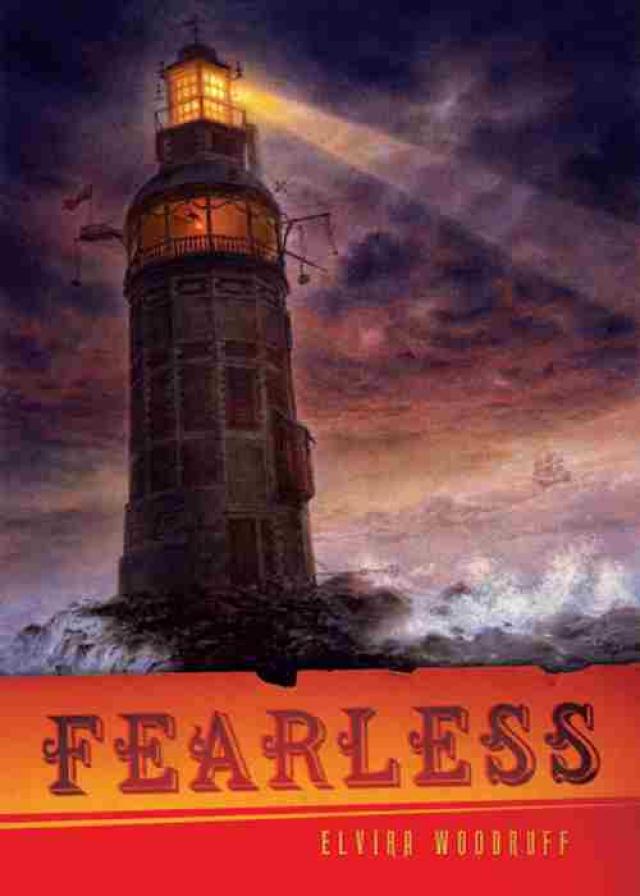
The Eddystone Light, as it stood on the Eddystone Reef in 1699.
Winstanley’s House of Wonders was a huge success, and even King Charles took notice. He commissioned Henry to build a fun fair entertainment for him in Piccadilly. It was known as Winstanley’s Waterworks and consisted of trick fountains and firework displays that dazzled all of London. As people flocked to see it, Henry became one of England’s most famous showmen. He was nicknamed the Jester of Littlebury.
A LIGHT ON “THE WIDOW MAKER”
Besides his gadgeteering, Henry Winstanley’s passion for art and architecture led him to his most challenging project yet — to put a lighthouse on the Eddystone Reef. It was a project that many called madness, for the Eddystone was fourteen miles from Plymouth’s shores and one of the deadliest reefs on the English coast. They called it “The Widow Maker.”
It was the age of sail. In 1695, with no modern navigational instruments, as many as fifty ships a year were wrecked on the Eddystone Reef. Hundreds of sailors lost their lives, and legends of the deadly reef spread all along the coast. Henry Winstanley, never one to be put off by a challenge, decided that he was the man to tame the killer reef.
In the early summer of 1696, the Jester headed to Plymouth armed with his designs. The lighthouse he envisioned was no ordinary, practical-looking structure but a graceful, whimsical tower, looking more like something out of a fairy tale. It was a lighthouse that only Henry Winstanley could have dreamed up.
The project was to consume him for the next three years. The boat ride out to the reef was a grueling six to seven hours, with the men often having to resort to oars in the strong currents. Once they did reach the reef, there was no guarantee they could land, and often they had to seek shelter along the coast.
The work itself seemed all but impossible. How were they to pierce the ironlike rock when the only available tools were picks and axes? It took the strongest, heartiest men of Cornwall and Devon to accomplish such a punishing task. Through all the difficulties, Winstanley’s determination never flagged. With his stories, conjuring tricks, and high spirits, he cheered his men on through the entire project.
Finally, on November 14, 1698, Henry Winstanley was able to do what no person had ever done before him. He climbed up to his lantern room and lit the first candle that was to shine on the Eddystone Reef. The world’s first rock (or caisson) lighthouse was lit.
As fishermen spread the word, people rushed to the beaches. Crowds swarmed Plymouth Hoe to catch a glimpse of the brightness through their telescopes. Henry Winstanley was toasted as a hero and given a silver replica of the lighthouse in miniature, made as a standing salt (meant to hold salt and sugar).
THE STORM OF THE CENTURY
Over the next five years, not one ship was lost on the Eddystone Reef, due to the light from Henry Winstanley’s beacon. Winstanley himself often traveled back and forth from Littlebury to Plymouth to make repairs on his lighthouse. When word reached him that the keepers he had hired were worried about the tower’s ability to withstand another storm, Henry once again traveled out to Plymouth for what was to be his final journey.
Little could he have known when he bragged about the strength of his lighthouse and uttered the words “I should only wish to be there in the greatest storm that ever blew under the face of the heavens” that his wish was about to be granted. He had no way of knowing that the worst storm ever to ravage England’s coast, the “Storm of the Century” as the writer Daniel Defoe would later describe it, was barreling straight for the Eddystone Reef.
On November 26, 1703, the night the storm hit, the wind tore all across England with a violence that seemed supernatural. The fury coming off the Atlantic was a combination of hurricane, tornado, and cyclone. Eight hundred houses were destroyed and thousands more damaged. Hundreds of thousands of trees were uprooted. Fifteen thousand sheep were killed as miles of countryside were flooded.
In the West Country alone, over one hundred and fifty ships were lost that night and eight thousand sailors were said to have drowned.
Back in Littlebury, when a strong gust came through a window at the Magic House, it knocked the silver replica of the lighthouse onto the floor. Elizabeth Winstanley said that when she saw the little lighthouse in pieces she knew it was a sign that her Henry was dead.
Indeed, the Eddystone lighthouse, along with all those within her, was swept out to sea sometime between midnight and seven in the morning on November 27, 1703. Henry Winstanley; James Bound, the boatman; the workmen; and the keepers were never seen again.
Two nights later, the Winchelsea, bound from Virginia with a cargo of tobacco, wrecked on the Eddystone Reef. Only two of the crew survived. It was the first ship in five years’ time to wreck on the Eddystone’s deadly rocks. “The Widow Maker” was back.
HENRY’S GIFT TO THE WORLD
Henry Winstanley believed that his lighthouse could withstand any storm. He paid the ultimate price for his miscalculations. But it was his creativity, energy, and determination that inspired others to go on to rebuild the Eddystone Light as well as other rock lighthouses all over the world.
Henry Winstanley saved hundreds of lives in his lifetime and thousands more since. The Eddystone Light recently celebrated its three-hundredth birthday. The Jester of Littlebury is all but forgotten, though the light from his magical mind and unique spirit still shines on our world today.
Henry Winstanley, a self-portrait.
This map of England in 1700 highlights places where the story is set. It also shows England in relation to the world (bottom right).
GLOSSARY
BARNACLE: any of various crustaceans that permanently affix themselves to boat hulls and rocks.
BILGEWATER: water that collects in the bilge of a ship; thus, putrid water.
BLUFF: a high, steep bank.
BOATSWAIN: a petty officer on a merchant ship who controls the work of the other seamen.
BREECHES: trousers that end at or just below the knee.
CHAMBER POT: a small bowl or pot kept under the bed and used as a toilet at night.
CHANDLER: one who makes or sells candles and soap.
CHANNEL: a narrow part of the sea running between two close masses of land.
CONSTABLE: a policeman.
COPPERS: slang for copper coins, particularly the large cents and half cents.
CORNISHMAN: a native of Cornwall.
CORPSE: a dead body.
COXSWAIN: the sailor who steers and takes charge of both crew and boat.
FAIR MAIDENS: Cornish expression for dried, salted pilchard fish.
GADGETEER: a person who designs and builds gadgets.
GALE: a strong wind from 32 to 63 miles per hour.
GIBBET: an upright post with an extending arm used for hanging criminals; a gallows.
GNEISS (pronounced like nice): a reddish-colored rock; the rock on which Henry Winstanley built his lighthouse.
HIGHWAYMAN: a highjacker or thief who robs travelers on a road.
HOGSHEAD: a large barrel holding up to 63 gallons.
INFRACTION: a violation of a law; a minor offense.
JESTER: a servant dressed as a clown employed to entertain a king or nobleman in the Middle Ages.
MICHAELMAS: a Christian feast observed on September 29 in honor of the archangel Michael.
MILLER: one who owns, operates, or works in a mill that grinds grain into flour.
PINCH: slang for steal.
PENCE: a penny.
PILCHARD: an oily sea fish.
PRESS-GANG: a group of sailors who recruited for their ship using violence and intimidation. This was a particular threat for civilian men in port towns in times of war.
REEF: an underwater chain of rocks or coral that juts out slightly from the surface of the water and creates a hazardous obstruction.
RICKETY: broken down, weak, and shaky.
SCULLERY MAID: the lowest ranking of female servants. The scullery maid assists the kitchen maid and performs the most physical and disagreeable tasks — such as cleaning the floors, stoves, and sinks, and scrubbing pots and dishes.
SHILLING: a former unit of money in the United Kingdom.
SNAIL TEA: Chinese tea made from a bud that is shapped like a snail.
SQUIRE: an English country gentleman; often the chief landowner in the district.
TALLOWS: candles made of tallow, a waxy fat.
TANKARD: a large drinking mug.
TINCTURE: a medicinal substance in an alcohol base.
TOPIARY: plants or bushes trained, cut, or trimmed into ornamental shapes.
TWILL: a type of weave.
WAGE: a salary; payment in exchange for labor.
WAISTCOAT: A VEST.
WHIST: a card game.
WINDOW TAX: a tax levied on windows in England in 1696 by William III to raise money. Many houses bricked their windows to avoid the tax.
SHIP’S GLOSSARY
BOW: the forward part of a boat.
CROW’S NEST: a platform for a lookout at or near the top of the mast.
FIGUREHEAD: an ornamental figure on the bow of the boat.
KETCH: a sailboat with two masts.
HULL: the body of a ship that provides the buoyancy to keep it afloat.
JIB: a triangular headsail mounted to the head stay.
JOLLY BOAT: a medium-size boat onboard a ship used for general work.
MAST: a vertical pole holding up the sails.
MIZZENMAST: third mast from the bow in a vessel having three or more masts.
PORT: the left side of a ship looking forward.
RATLINES: any of the small ropes fastened horizontally to the shrouds of a ship and forming a ladder for going aloft.
SHROUD: one of the ropes leading from a ship’s mastheads to give lateral support to the masts. Shrounds are usually found in pairs.
STARBOARD: the right side of a ship looking forward.
STERN: the rear or aft part of the ship.
BIBLIOGRAPHY
BARNES, ALISON. Henry Winstanley: Artist, Inventor and Lighthouse-builder. Plymouth: Tourist Information Service and Saffron Walden Museum, Uttlesford District Council and Plymouth City Museum, 2003.
BEER, TREVOR AND ENDYMION. Birds of Cornwall. Cornwall: Tor Mark Press, 1999.
BEER, TREVOR AND ENDYMION. Wild Flowers of the Cornish Coast. Cornwall: Tor Mark Press, 1999.
BLAKE, GEORGE. British Ships and Shipbuilders. London: Collins, 1946.
HOGG, GARRY. Facets of the English Scene. Devon: David & Charles, 1973.
HUNT, ROBERT. Cornish Folklore. Cornwall: Tor Mark Press, 2000.
MAJDALANY, FRED. The Eddystone Light. Boston: Houghton Mifflin, 1960.
MUIR, RICHARD. The English Village. New York: Thames and Hudson, 1980.
PALMER, MIKE. Eddystone 300: The Finger of Light. Cornwall: Palmridge Publishing, 1998.
PORTERPUB, ROY. English Society in the Eighteenth Century. London: Penguin Books, 1982.
SEMMENS, JASSON. Eddystone: 300 Years. Cornwall: Fowey Rare Books/Alexander and Associates, 1998.
TRURAN, CHRISTINE. A Short Cornish Dictionary. Cornwall: Truran, 1986.
ART CREDITS
Winstanley’s House of Wonder © The Trustees of The British Museum
The Edystone Lighthouse Engraving by Henry Roberts 1760 © Private Collection, The Stapleton Collection/ The Br an Art Library
Self-portrait of Henry Winstanley © Saffron Walden Museum
Map by Jim McMahon, © 2008 by Scholastic, Inc.
This tale owes its telling to:
Alison Barnes, for so generously sharing her expertise on Henry Winstanley’s life and times. Her many handwritten letters from across the ocean were invaluable in helping to bring Henry to life. Her encouragement from afar was a gift I will always remember.
Nigel Overton, Maritime Heritage Officer at the Plymouth Museum, Plymouth, England, for patiently answering all of the nautical questions and for his rousing and enlightening lecture about the Eddystone Light on a dark November day in Plymouth.
The helpful and enthusiastic staff at the Saffron Walden Museum for giving me a glimpse of Henry’s original drawings and self-portrait.
My fearless and tireless editor, Dianne Hess, who never gives less than her all.
And last but not least, thanks to my research partner, my husband, Joe Pilyar, who boldly took the wheel as we crisscrossed the English countryside in search of a wily ghost.
The very best part of writing this book was the journey we made together to uncover the man behind the light.
With special thanks to Jackie Worthington from Saffron Waldon Museum for meticulously fact-checking the manuscript, and to Els Rijper from the Scholastic Photo Research Department for her tenacious search for maps and prints.
OTHER BOOKS BY
ELVIRA WOODRUFF
The Ravenmaster’s Secret
The Orphan of Ellis Island
The Christmas Doll
The Memory Coat
The Magnificent Mummy Maker
George Washington’s Socks
George Washington’s Spy
About the Author
Elvira Woodruff first discovered Henry Winstanley in a dusty little blue book called The Eddystone Light. Famous throughout England in the 17th century, “The Jester of Littlebury” was the Ben Franklin, Walt Disney, and P. T. Barnum of his day. Not only was he an accomplished artist, architect, and inventor who lived in a fun house full of gadgets, but he also saved the lives of thousands by building a wooden lighthouse on a killer reef. “I had never met anyone so ingenious, so fun-loving, or so fearless,” says Woodruff. “I knew in my heart that I had to tell his story.” So she and her husband, Joe, packed their suitcases and made their way across the ocean to England to track down this remarkable man.


