Missing in action part 2, p.19
Missing in Action Part 2,
p.19
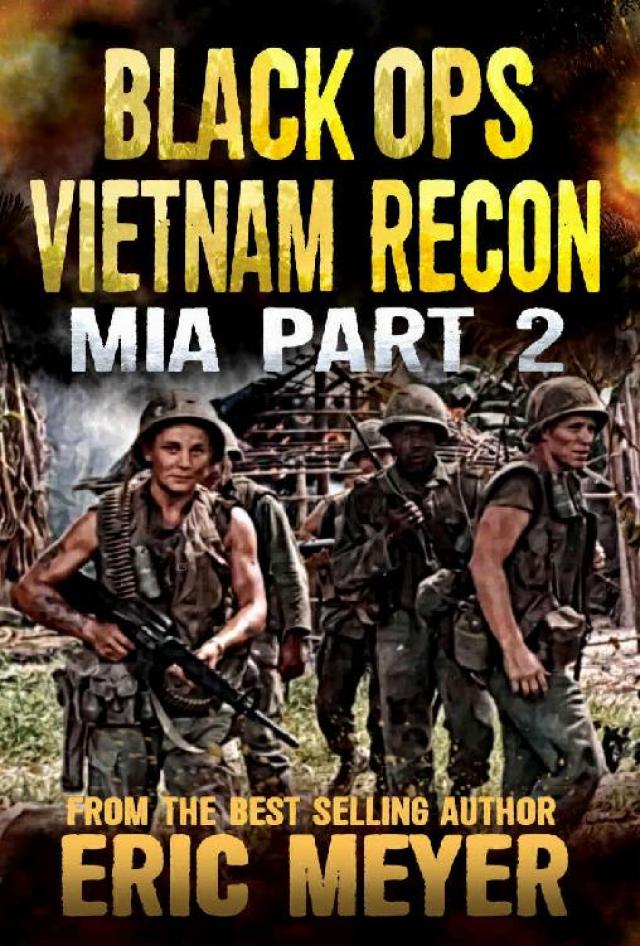


He tried to pull himself away, but Heller’s hand had reached around his mouth, holding him close. He struggled to move the hand away so he could breathe and shout a warning to his fellow soldiers. Thrashed like a wounded lion, and he went with him, tumbling to the ground, rolling over and over until they collided with Ripley, who had his own problems. Somehow, he’d dropped his knife and failed to disable the sentry. Yet he held on grimly, battering his clenched fist into his mouth, again and again.
His teeth broke and scattered on the ground, blood poured from his mouth, and his eyes were coated in sweat, so he was almost blind. Yet he fought on, knowing the fate that awaited him if he lost the battle. The four struggling men became entangled. One moment Heller was trying to get in a mortal blow, and the next the writhing bodies shoved his target away. Suddenly, Ripley’s man lay beneath him, and he seized the moment. Stabbed down, pushing the point of his bayonet into the guy’s throat, and he held him, twisted the blade, and withdrew it.
The guy was finished, no question, but his first target was anything but finished. Incredibly, he managed to free himself and leap to his feet. At any moment, he could’ve shouted a warning and they’d have been surrounded by a shitload of enemy soldiers. He didn’t shout a warning. Heller recalled that leather collar around his neck, and maybe he was recovering from a wound in the neck that’d damaged his vocal cords. It could also have been because at the moment of extreme peril, he never thought of it.
He stood with his back to a tree, and although he dropped his rifle, he’d somehow managed to find the combat knife Ripley had dropped and had it pointed toward them. Daring them to come closer. He had to finish it fast, didn’t have time to screw around, so he didn’t screw around. Picked up the rifle dropped by Ripley’s victim, with the long bayonet fixed to the barrel, and ran at him. In the semi-darkness, in the heat of the moment, his eyes half blinded by sweat and blood, he didn’t see it coming.
He ran at him, flat-out, and his momentum forced the tip of the bayonet into his belly. All the way through, just like they showed them in basic training when the target was a sandbag. This was no sandbag. The target was living flesh, but the blade went through, out the other side, and impaled him on the tree. The Viet squirmed for several seconds, his mouth opening and closing, yet mercifully, no sound came out. He dropped the knife. Ripley picked it up and sliced it across the neck. A final gasp of escaping breath, and he was still.
The remaining two sentries were candy. Both men were unsuspecting, so Heller and Ripley crashed out of sight in the dark shadows at the point where their patrol routes met in the middle, lunged, and this time there was no mistake. Two hands clamped over two mouths, and two blades sliced across two throats. After a quick look around to make sure no more Viets were wandering around, Ripley returned to give Anderson’s men the nod.
They came forward and although they weren’t infantry trained, they were men who’d survived the worst the Communist prison camp system could throw at them, and they set about their grisly work with a vengeance. Two or three men came awake, sensing something was wrong, but their cries of alarm were brief, and within minutes they were all dead. The missile was a Soviet-supplied S-75 Dvina high altitude area defense system, and several muttered ominously they’d been brought down by Dvinas. They rendered it useless, ripping out the electronic guidance system, and smashed the radar control station. Making sure by hammering at the metal fuselage and fins so it would never fly again. If it did, there was no way it was going to fly straight.
Heller and Ripley snuck forward to scout out the next battery. This time, they found a quad barrel ZSU 23mm mounted on a truck. Two of the crew were awake, one seated in the gun layer’s position, the other adjusting the sighting mechanism. Not so easy, yet they were so absorbed and engrossed in their task, they were able to creep closer and hide in nearby shadows. Heller groaned to get their attention. At first, they ignored it. Until he groaned louder. He wasn’t sure how a Vietnamese would groan but reasoned that groans were groans in any language. A sign that a man needed immediate assistance, and after several minutes they glanced at each other, jumped off the truck, and walked toward him.
They weren’t looking for trouble. Smiling at each other, probably assuming this was a soldier who’d eaten or drunk too much the night before, and it served him right. They didn’t find a sick man in the shadows. Ripley found them, pounced, and wrapped his muscular forearms around their throats, strangling their cries of alarm. They struggled, but Heller sprung out and gave each man a swift blow on the head with the butt of his rifle. They pushed them to the ground, and yet again wielded their blades to put an end to their struggles.
The other soldiers hadn’t woken up, and there was no need to get an assist from Anderson. Four Viets sleeping on the ground on a polythene sheet, each sheltering beneath a thin blanket covered with another polythene sheet to keep off the rain. They took them one by one and called Anderson’s men forward.
They were grinning, but Heller cautioned them it was too early to celebrate. As they got closer to Haiphong, it would get tougher, and so it proved. He and Ripley moved on to the next battery, another S-75 Dvina, and this time the crew was wide awake. They must’ve experienced a malfunction, because they were using flashlights to swarm around it. The inspection hatch was unscrewed and open, and a panel from the radar removed.
Whoever was in charge had his men keeping a close watch for the enemy. He knew the prisoners had escaped and would’ve suspected they had to be headed this way. Eight men with rifles were patrolling the area, their routes organized so that each man was always in sight of the others. They crept back to Anderson, and he described what he’d seen.
“It won’t be so easy. A sensible man would circle around them. There’s no way we can hit them without it turning into a firefight, and this close to the city there’ll be plenty of soldiers and more batteries, so they’re bound to hear it.”
“How long would it take to circle?”
“Several hours, and we have to hide out during daylight, so we’d lose a day.”
He grimaced. “If that’s what it takes, I guess we’ll have to do it, but I don’t like leaving those men in our rear.”
“Nor me, but I’m not sure we have an alternative. Like I said, if we try to take them, we’ll get into a firefight. That means more men are gonna show up.”
“There’s no other way?”
“No.”
They turned inland to detour around the missile battery, but they hadn’t got more than fifty meters when all hell broke loose. Haiphong was a strategic target for Operation Linebacker. Most nights American aircraft gave the city their attention, and this night was no exception. The dark sky was suddenly lit up by flames, the peace of the night split asunder by massive explosions. Yet more flames soared into the sky, anti-aircraft batteries opened fire, missiles trailing smoke as they streaked toward the attacking aircraft. Heavy machine guns clattered, firing huge quantities of 23mm rounds into the sky aimed at enemy aircraft. They watched a high-flying bomber take a missile hit. It had been invisible until the explosion lit up the huge B-52, one wing drooped, and it began to descend.
“Bail out, bail out!” aircrews shouted as if they could hear them. They didn’t bail out. A second missile hit the stricken aircraft, and the airframe exploded in a ball of fire. They watched it descend until it hit the ground several klicks away, and nobody suggested looking for survivors. No man could survive two missile hits and a crash of that magnitude. The bombing continued, and the noise increased. It seemed like every anti-aircraft gun and missile battery within a ten-kilometer radius was attempting to pluck the bombers from the sky.
They even heard automatic rifle fire, North Vietnamese soldiers attempting to score hits on aircraft a long way outside of effective range. The Dvina launcher the Viets had been working on hadn’t yet fired, but they’d be working hard to fix the fault, whatever it was, and join in the fun. The likelihood was they’d get it fixed, and he’d dearly like to have ruined their party, but the danger of fighting a pitched battle where the inexperienced aircrews would take casualties worried him, even if the noise would go unheard.
He decided there wasn’t a damn thing they could do. Thought again, maybe there was. A surprise assault on the enemy would work, but it was likely men would die. Unless they had an edge, something they could use to give them an even bigger surprise. Something like a ZSU Shilka quad barrel.
He told Anderson to head toward the Dvina, but stay out of sight, at least fifty meters east. He told him what he had in mind, and the Colonel smiled.
“I like it. Tell me what we can do.”
“Nothing. Just keep well away until we’re done.”
He and Ripley returned to the truck-mounted ZSU Shilka. Formidable, powerful, yet unmoving and silent without a crew to put it into action, and the corpses that lay around weren’t likely to make a move any time soon. Ripley climbed into the cab and the engine started on the button. He positioned himself in the gunner’s seat and did his best to familiarize himself with how it worked. It wasn’t too hard. Simple, crude controls, a firing lever linked to all four heavy machine guns, so they’d work together. A simple safety mechanism, and he moved the barrels in every direction, up and down, side to side, to make sure when the time came, he’d be shooting at targets and not shredding a distant patch of jungle.
A final check to make sure each of the four, five-hundred-round box magazines was fully loaded, and he shouted to Ripley he was ready to get the show on the road. He had to shout. The noise from the distant air bombardment combined with the intense anti-aircraft fire was loud, even at such a distance away. They drove onto the road and headed north for a few hundred meters until they came to the S-75 Dvina. Just in time, the panels had been replaced, and he could see the officer shouting urgently to his men. He’d be telling them to get that missile into the air while there was still time to bring down an aircraft.
As they got close, he saw the missile starting to move. The radar dish was beginning to revolve, searching for lock. The missile was ready to go. Ripley glanced behind, and he waited for him to go ahead. He drove straight at the missile, and a second before they reached it, Heller pulled the firing lever. The powerful quad-barrel machine gun was designed to take out low-flying aircraft, as well as lightly armored assault vehicles and infantry carriers.
His targets weren’t lightly armored. They were men, human flesh. He blasted them where they stood, and as survivors ran, he mowed them down. Aimed at the radar station and ripped it into shreds. Rotated the gun to search for further targets, and he got them all, with one exception. The officer. He suddenly stood upright in the front seat of the GAZ jeep clutching something familiar to many soldiers in Vietnam. An RPG-7, a short-range shoulder-launched missile system. He pointed the warhead at the Shilka, and Heller worked rapidly to switch aim and bring the barrels toward him.
The guy hesitated. He looked closely at the RPG as if trying to work something out. Whatever it was, he swung it back up, and Heller even saw his finger tighten on the trigger. Saw the mouth open, teeth bared in a rictus of hatred, and a second later the missile launched. It almost killed him, but it soared overhead. A lucky escape, but he doubted he’d get another. The Viet stooped to pick up another rocket to load into the launcher, but when he straightened it was already too late. He’d managed to align the barrels so they pointed at his body, and he pulled the firing lever.
He felt a chill of fear sweep over him when that missile launched, seeing his impending death come toward him trailing smoke and fire. His reaction made him feel angry, and it was probably the anger that dictated he kept shooting when it was impossible for anything to survive, man or vehicle. Man or vehicle didn’t survive. He must’ve fired off almost a thousand rounds until he came to his senses and ceased. His target had gone, disappeared. Where they’d been man, RPG launcher, and jeep, all that remained was scrap metal and small pieces of flesh.
Ripley stopped the truck close to the target, what was left of it, and climbed out. Looked up at Heller. “I guess you like to make sure.”
He didn’t reply at first, still staring at the incredible scale of the destruction. “He was about to launch another rocket, so I took care of him.”
“Yeah, I noticed. Wherever he is now, he’ll be regretting it.”
There was no need to destroy the Dvina. The collision with the truck and devastating fire from the Shilka had done enough. Anderson arrived at the head of his men, nodded, and looked admiringly at what they’d done.
“Nice job, Sergeant. What do we do now?”
The bombing was still intense, and it gave them an opportunity. “Get the men onto the truck. We’re heading into town while the going’s good.”
“You’re serious?”
“There’ll never be a better time. We’ll be driving a North Vietnamese vehicle, and if we put two of your ARVN in the cab, we stand a good chance of getting through. Right now, most will be too busy just trying to stay alive and shoot down those bombers to worry about us. When we’re inside the city, there will be plenty of bombed-out buildings we can find to hide in until we work out how to get a boat. Get them onto the truck, Colonel, and make sure they stay out of sight.”
They swarmed onto the MAZ-200 truck. They found a mass of camouflage netting, commonly used for such vehicles, stashed behind the cab, and strung it over everything to cover them all, including the gun. The two ARVNs climbed into the cab, and Heller made a final inspection to ensure everything was hidden. Close up, and in daylight, it would be possible to see it through the gaps in the camouflage netting. They didn’t plan to drive around in daylight, and if anyone got close enough to identify them, they’d have no choice but to risk the shots and kill them.
Heller had never been more uncomfortable in his life, squeezed between several men, trying to keep his assault rifle free enough to use it if it became necessary. The ARVN driver drove onto the road and pointed the hood north. Where bombs were still falling, where the night sky was lit up with flames and tracer rounds. Reminding them they were going into an area of chaos, high-explosive, and death.
They drove down streets wreathed in flames. Men and women ran everywhere, most of them soldiers and firefighters. Some civilians were fleeing the cataclysmic destruction, some searching for shelter, some for missing loved ones. Nobody gave the truck a second glance, no surprise there. Anti-aircraft guns would be a familiar sight in downtown Haiphong, many shrouded in camouflage to hide them from enemy aircraft searching for targets during the hours of daylight.
The ARVNs in the cab were looking for a way through to the docks, but it wasn’t to be. Several tons of bombs had struck a line of buildings, bringing them down into the street, and soldiers had erected a barrier to prevent people and traffic from moving closer. They turned around and headed back into the city. Heller slid open the rear cab window and spoke to the driver.
“If you can’t find a way through, we’ll have to find a place we can hide during the day and try again tonight. When you see anything that looks likely, get off the road and turn in. We need to be out of sight before dawn.”
They found what they wanted a half-kilometer from the docks. What’d once been a ship’s chandlery, supplying ropes, marine spares, and fishing nets for many of the smaller vessels that docked in the harbor. The place had taken several direct hits, and the spacious front yard with storehouses behind had become mere piles of rubble. But not all. One storehouse had remained mostly intact, and they threaded their way past the debris. The truck almost overturned as the wheels on one side climbed a pile of rubble but dropped down after they drove past.
They entered the building, which was empty, apart from broken timbers and tar paper where the roof had collapsed. The truck halted out of sight of the street, and they climbed out to examine their new surroundings. There was no sign the building was still in use, other than by a pack of a half-dozen mangy dogs that snarled and ran off when they appeared. Before he dismounted, Heller rotated the barrels of the Shilka, so they pointed outward. Just in case.
The men were walking around, limbering up after the cramped ride into the city. He looked for and found Anderson, who didn’t look so happy.
“What now, Sergeant? If they find us here, they’ll murder us. Even with that popgun mounted on the truck, they’ll bring in mortars and field artillery to finish us off.”
“If they don’t know we’re here, we’ll be fine. As long as we stay out of sight.”
“And tonight?”
“We make a run for the docks. Try to locate a boat we can steal, like a fishing trawler. Start the engine and sail away.”
He nodded gloomily like he wasn’t looking forward to a voyage on the ocean waves. Heller didn’t tell him he felt the same way. Why make things worse?
It would still be dark for a couple more hours, and the Viets were likely to be busy for even longer. He decided to scout around, work his way through the rubble piles and check out their surroundings. Make sure the place wasn’t next door to something best avoided, like a Ministry of State Security post. He made the first three hundred meters without encountering any problems. As he got closer to the docks, the scale of the bomb damage increased. The area was more middle-class and looked like it had once been prosperous, probably during the French occupation. Colonial-style architecture, houses, and bungalows, most showing signs they were still occupied, although many hadn’t survived the constant bombing.
They needed local knowledge to find the best way to get through to the docks without being spotted. The place was a maze of streets, and the chances of them all getting through without being spotted were next to zero. He didn’t like the idea of grabbing a civilian but felt he had no choice. He hung back behind a wall adjacent to the street that’d previously been the front of the building. Behind him, it’d disappeared, but the wall still stood to hide him, and he waited. People were screaming past, but he needed to choose a moment when it wasn’t so busy. Ideally, when the street was empty, just one man walking alone. It was almost dawn when the moment came.