Missing in action part 2, p.2
Missing in Action Part 2,
p.2
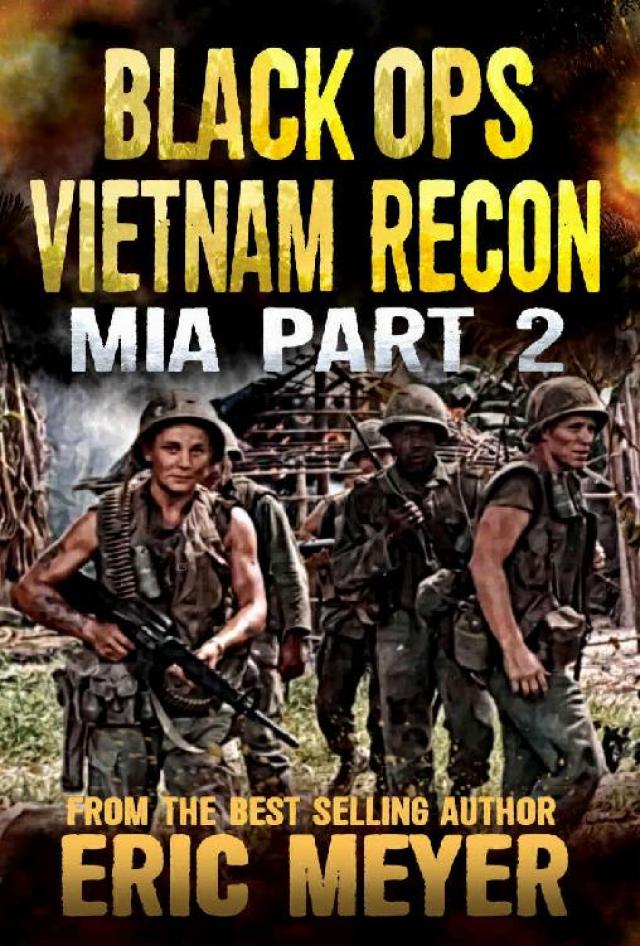


They hovered overhead while the guns went into action. .50 caliber Brownings and 7.62mm M-60s, pouring out a storm of lead chewing into everything that got in its way. They cut the enemy down like wheat before a combine harvester. The Viets pulled back, leaving the bodies of thirty men on the ground. Almost like turning a switch, the enemy fire stopped.
Witherspoon let out his breath and gave Cruz a satisfied grin. “I reckon they got them all.”
He nodded. “I reckon you’re right, Captain. We’ll check it out first, then call in the Hueys to pick us up.”
He took one step and stopped. “I wouldn’t.”
He looked at Heller. “Excuse me?”
“I don’t believe they’ve gone.”
“They haven’t gone because they’re all dead! Follow me and remember we must search the bodies of officers for documents. Captain, this won’t take long, you can call in our ride.”
He strode away, brushing aside the thick vines, and after a brief hesitation, Heller nodded for them to follow. Maybe he was right, but he doubted it. If he was wrong, he’d need somebody to keep him alive. He was wrong. They got halfway when a shitstorm erupted around them. The survivors hadn’t gone. They’d gone to ground. Well used to getting into cover when the dreaded gunships attacked. This time, they didn’t sniper at them from the tops of trees or holes in the ground. They came at them in a rush, a frontal attack. They saw the Americans heading toward them, just seven men, and assumed they’d be a pushover.
When the bullets began to fly, Heller shouted at them to get into cover and wait. “There’s a lot of them, so use grenades when they’re close enough!”
They snatched grenades from their webbing and pulled the pins. In dense jungle, firing at a target through trees and thick foliage from even a short distance was more often than not useless. They waited. When they were close, they lobbed the grenades and ducked as shards of hot metal lacerated everything in its path. Trees, bushes, vines, and flesh. Men screamed when they ran into the lethal hail of hot metal. They stopped. It was time to throw some lead, and they opened fire, but the concentrated automatic fire from McGuigan’s M-60 did most of the damage.
McGuigan was propped behind a tree trunk, holding the machine gun at the hip while he squeezed the trigger. Lynch, who carried spare belts of ammunition over his shoulders, stood at his side, holding the next belt ready to load. Cruz, Collins, and Akulov kept up a steady rate of fire from their XM-177s. Collins flinched when a bullet tore through his uniform and his flesh, carving out a deep gouge in his leg, but it wasn’t enough to stop him from shooting. They were dropping like ninepins, and it looked like they could make a clean sweep until the bullets zinged in from behind. Without warning, enemy soldiers appeared from nowhere and got close enough to engage. Witherspoon’s company had its own problems, and that meant they’d have to deal with it, and they turned to meet the new threat.
The enemy charged in with yet another frontal attack. Screaming in Vietnamese what was probably ‘Death to the Americans.’ It wasn’t a dinner invitation. They were directly in front of Heller and Weiss, and they stood to meet them, firing from the hip. They got close, too close, and when his magazine emptied, Heller snatched out his Colt and emptied seven rounds into the mass of charging enemy.
Weiss kept up a steady rate of fire, short, disciplined bursts that gave him breathing space while he reloaded, but it almost wasn’t enough. The enemy sensed their fire had slackened and increased the pace, rushing closer until they were almost on top of them. Heller snatched out a grenade and lobbed it in front of the charging men, now less than eight meters away. He shouted at Herman to take cover, and they flung themselves down a split second before the grenade exploded. The enemy was hurt, but not hurt enough, and three men kept coming.
They were too close for a second grenade and hastily finished reloading. They were so close he could see their maddened expressions, their determination to kill. He stood his ground and blazed away with the rifle. Firing like there was no tomorrow, spent cartridges spewing from the ejector port in a continuous hail. Until once again the firing pin clicked on empty, no time to switch magazines, so he dragged out his Colt. One man had survived, and he kept coming at them. Not shooting, so his AK-47 was probably empty, but he had a bayonet fixed to the muzzle. He rushed forward, the steel blade pointed at his belly, his plan to impale the round-eye standing directly in front of him. Three meters away, and he emptied the Colt once more. Seven .45 ACP rounds and every one missed.
In the heat of combat, he’d snapped off the shots without taking proper aim. None had been enough to stop him, and the guy was still coming. The tip of the bayonet was one meter away. He noticed the spreading bloodstain around the belly of his uniform tunic, so he’d scored at least one hit, but it wasn’t enough. He swung his XM-177 like a club to deflect the bayonet and closed with the gook. Bunched a fist and smashed it into his nose, felt bone and cartilage break, but the Viet retaliated with a roundhouse kick that took his legs from under him and threw him flat on the ground.
For a split second, he was defenseless, watching the bayonet about to plunge into his belly. Until Weiss intervened. He squeezed off a single shot that took the Viet in the leg and ran forward to drag him off. The soldier wasn’t finished and spun his rifle around until it was pointed at Weiss. Heller watched it happen in slow motion, and he couldn’t believe it when Herman’s momentum carried him onto the sharpened steel blade. He stopped, mouth open in shock and agony, and the Viet shouted a shrill, guttural cry of triumph. Twisted the blade, watching Herman’s guts spill out on the ground.
Heller catapulted up and took him with a football tackle. He dragged him to the ground and smashed another fist into his bleeding and ruined face. The Viet shouted, but this time it was a scream of agony, and he kept screaming as Heller kept punching at him. He slammed his knee into the guy’s belly, and the cries of agony became a shrill shriek as his blow collided with his wound. He hit him again, and again. Both men breathed heavily with the exertion, and Heller managed to get on top and snatch up the AK. With the bayonet mounted at the end of the muzzle, he rammed the sharpened tip into the soldier's belly, alongside the wound. In his fury he pushed it harder and harder, twisting it around, left to right, right to left, like stirring a stew pot. Except this stew was blood and guts. Commie blood and guts.
It wasn’t over. Out of the corner of his eye a movement got his attention, another soldier running toward him. His vision was blurred with sweat and blood, but not so he couldn’t identify an enemy. He ripped out the bayonet from his victim and ran at the new threat. Blade outstretched, and the momentum of his run carried the bayonet into the guy’s guts. He stabbed down again and again, twisting the blade in a macabre parody of the way he’d killed the other Viet. He kept stabbing, seeing his opponent squirming and shrieking in his death throes. Until too late he realized the guy hadn’t been holding a gun. His hands had been in the air. Trying to surrender.
He felt hands pulling him off. McGuigan and Lynch. “You’re done,” the Irishman growled, “The bastard’s in hell.”
“Yeah.” He suddenly felt weak and tired, “What about Herman?”
“He’s gone. Never stood a chance,” Lynch replied. Uncharacteristically, he sounded almost sorry, like he’d lost a friend. Not a man he’d professed to despise, the way he despised all men.
Heller glanced at the body of the man he’d killed. His uniform was saturated with blood, and his eyes were open, staring up at the sky, sightless. “Where is he?”
His body lay several paces away, and he walked over to the bloody corpse of his friend. He took a few seconds to get his emotions under control. He’d known Herman Weiss for a long time. They’d fought together, shed blood together, and partied together. Every soldier in Vietnam knew this could happen, but every soldier assumed it would happen to the next man, not him.
“Pick him up, we’ll take him back. What’s happening back there?”
PFC Collins answered. “It’s over, Sarge. Cruz is talking to Witherspoon. They’re working out the kill ratio.” He meant they were making it up, cooking the books, “They’ll have to make it good. We lost a lot of men.”
Kill ratio. More bullshit.
They linked up with Witherspoon’s unit and it wasn’t pleasant. More like a time for men to wonder what it was all about. He’d lost twenty-eight killed, and another ten badly wounded.
Cruz glanced up as he arrived and noticed the bloodstained clothing. “Sergeant, are you hurt?”
He looked down. His clothes were soaked in the Viet’s blood. “Nope.”
He nodded. “Good to know. Say, you men did well, better than Witherspoon’s company.”
“Weiss is dead.”
“Hermann dead? Shit, that’s too bad. I thought we’d gotten away with it. I’ll request a replacement when we get back.”
“He was a good soldier. One of the best.”
“Uh-huh, sure.”
He could’ve reminded him their orders were to locate the enemy and leave it to the gunships to deal with them, but he didn’t. Both officers, Cruz and Witherspoon, had made stupid decisions, and like all bad decisions made in battle, men died. Usually not them. Pity.
Why do these bastards seem to live a charmed life? Officers sometimes get killed, sure, but they’re the guys who make the bad calls. The enlisted men bear the brunt and suffer the most. Those bodies will be returned in aluminum caskets. While their officers work with pencil and paper to calculate lies about kill counts so they can justify the slaughter. Fucking war. Fucking Vietnam.
They helped carry the dead and wounded to a nearby clearing for the helicopters to land and take them off. While they were boarding the Hueys, they had a bad moment when a crazed North Vietnamese soldier rushed out from cover, blazing away with an AK-47. They’d put down their rifles while they were helping the wounded, and the range was too far for a handgun. The nearest weapon was McGuigan’s M-60 with a half-empty belt still loaded. Heller didn’t hesitate. Grabbed it, took quick aim, and fired. And kept firing until the belt had snaked through the breech and bullets stopped pouring from the business end.
He must’ve loosed off around thirty or forty rounds. Many had hit the target and tossed the soldier to the ground where he lay. A bloody corpse, unrecognizable even by his wife or mother. A mass of blood, tissue, and torn fragments of uniform, flesh and pith helmet. He realized he was shaking. Not in fear, but in the fury of battle. When he looked around, they were lifting another body into the Huey. The Viet had killed another man, so now Witherspoon had to explain how come he’d suffered twenty-nine fatalities and numerous wounded. Unnecessary dead and wounded, and no explanation for how come he’d failed to achieve the mission objective. Failed to punish the North Vietnamese and failed to take revenge for the brutal torture and annihilation of the crew of the supply convoy. He didn’t doubt he’d manage it somehow. This was Vietnam, where lies were the truth, and the truth was lies.
They lifted off and flew the short distance back to Tan Son Nhut. During the journey, men were silent. There was nothing to talk about, nothing to boast about, nothing to feel good about. Men dying for no good reason was no conversation piece. He felt bitter and couldn’t calm the fury eating up his body. Weiss shouldn’t have died, yet his body lay four feet away, shrouded in a shelter half. He wanted to lash out, but at what, at who? He wanted to go back into the jungle and find more gooks to kill. As if it would make a difference. It wouldn’t. Every time a man turned his back, they came crawling out of the woodwork. He doubted there were enough bullets in the U.S. inventory to get them all.
They flew back with their grisly cargo of bullet-riddled, blood-spattered bodies. Men who’d been compelled by politicians they distrusted to join a war they didn’t believe in. Yet they’d come to Vietnam to do their duty. To defend democracy, to kill the enemy, but the enemy had killed them first. Senior officers whose vanity was offended sent soldiers back out to avenge the dead. To balance the butcher’s bill. So it went on.
Men soon lost the last vestiges of their humanity. They became beasts, committed to the slaughter, no matter what the cost. Those men whose bodies were wrapped in shelter halves, men like Hermann Weiss, had paid the price and lost their lives. For the survivors, men like him, they’d lost their souls.
* * *
Twelve hundred klicks north, flying low over Hanoi, the pilot of the F-4 Phantom, Major Mo Taylor, jinked to avoid a line of anti-aircraft fire that reached up to blow them out of the sky.
“Probably a ZSU-23 Shilka,” he grunted. Forcing his voice to remain calm. He didn’t feel calm. The last burst had rocked the fuselage, “That one was a bit too close for comfort.”
His weapons system officer, Captain Luke Campbell, riding in the rear seat, grunted, “We’re flying pretty low, Major. Those guns are damn accurate, radar-guided. At this height, we must be a sitting duck.”
“We’re nearly there, Luke. Focus on the mission. Time to target?”
“Twenty-three seconds,” the answer came immediately. As if he couldn’t wait to unload the ordnance and get out fast. Taylor knew just how he felt. His finger flicked the switches, “Weapons armed. Target identified.”
“Confirmed. Fire when ready.”
The aircraft lurched as the 6× AGM-65 Maverick missiles left the wing pylons. They closed the short distance to the target, a cluster of anti-aircraft missile batteries on the outer ring of the Hanoi air defenses. They’d done what they came here to do. Mo Taylor jammed the throttles forward to engage the afterburners, and the Phantom clawed for height as the inevitable cloud of surface-to-air missiles hurtled toward them. Black smoke poured from the two General Electric J79-GE-17A turbojet engines, a perennial problem of the Phantom. They didn’t have to rely on radar. The smoke made the aircraft easily identifiable to enemy anti-aircraft batteries. The only remedy was speed. Get in and get out fast. Pilots in Vietnam claimed ‘speed was life.’
“We have incoming missile lock,” Luke Campbell announced, his voice cool and laconic. Taylor knew it was an act. He wouldn’t be feeling laconic. When an enemy missile acquired lock, there was a narrow margin between life and death. All too frequently, death was the likely outcome.
He put the aircraft into a soaring climb, watched the missile track them, and waited until the last moment. Shoved the stick over, kicked the rudder pedals and hurtled into a dizzying, downward spiral. Zooming all over the sky, yet still the missile kept coming.
“Has to be a fucking Guideline,” he grumbled, “Hard to shake those bastards.”
“He’s getting closer,” Campbell said, struggling to keep his voice under control. He didn’t sound quite so laconic, “Still has lock.”
“I’m on it.”
The heavy aircraft darted all over the sky, hitting speeds of Mach 2, the equivalent of around fourteen hundred mph. He corkscrewed, climbed, barrel-rolled, and at last the missile failed and flew past, its guidance system unable to keep up.
“Lost lock,” Campbell announced, “Shit, that was close.”
“They’re always close. It’s time to go home.”
Home was the giant aircraft carrier ‘Forrestal,’ cruising the South China Sea about fifty klicks offshore. He flew low, straight and level. On a course he’d deliberately set over a relatively uninhabited area. No towns or cities, no large population centers, and no military installations meant zero chance of another encounter with a missile battery. They flew steadily on, still keeping a watchful eye out for missiles, but not expecting them to come. Why would the North defend several thousand trees and hundreds of square kilometers of deserted jungle?
No reason, yet suddenly alarms sounded in the cockpit. A cloud of missiles heading toward them.
Jesus Christ, there’s a lot of them!
Once again, he tried every maneuver he’d learned during more missile attacks than he could count. He also tried a few maneuvers he hadn’t learned but were worth trying. He pointed the nose up, hit the afterburners, and the aircraft reached sixty thousand feet. It wasn’t enough. The Guideline was good for eighty thousand.
He spent the next few minutes engaged in a dizzying series of turns and dives, and both men almost blacked out from the massive G forces as the Phantom performed tight turns, climbs, and abrupt changes of direction the designers had never considered in their wildest dreams. Eight missiles had launched toward them, and three got lock. He avoided one, and as it flew past, he fired the M61A1 Vulcan Rotary cannon in the nose, destroying it with a burst of 20mm shells.
One down, two to go.
The next veered away with some malfunction, or maybe it’d just run out of propellant. The third and last missile was a bastard, and he’d burned up so much fuel avoiding it that by the time Campbell announced, “Lost lock,” he was doubtful they’d have enough to reach the carrier. He climbed slowly and throttled back to conserve fuel. They made it back, just. The engines were almost running on fumes when the arrester wire snagged the hook and dragged them to a standstill. They climbed out, dazed and sweaty after the near miss, and went to write their after-action reports.
When they informed the intelligence officer about the last missile battery, he was puzzled about why they were there. Why would they protect what appeared to be an uninhabited patch of jungle? Taylor couldn’t make it out.
“There’s no reason for them to be in that location. Unless the Commies have something to hide, something they don’t want us to find.”
The intel officer looked doubtful and pursed his lips. “In my opinion, it was just a training area to shake down recruits and get them up to scratch where there’s not much action. Forget it, I don’t think there’s anything in it.”
Taylor looked at his Weapons System Officer. “I don’t agree. What do you think, Luke?”
“Skipper, it didn’t look like a training exercise, not to me. Those guys were the varsity, deadly serious, and they were loaded for bear. We nearly bought the farm.”