

Hot cash cold clews, p.1
Hot Cash, Cold Clews,
p.1
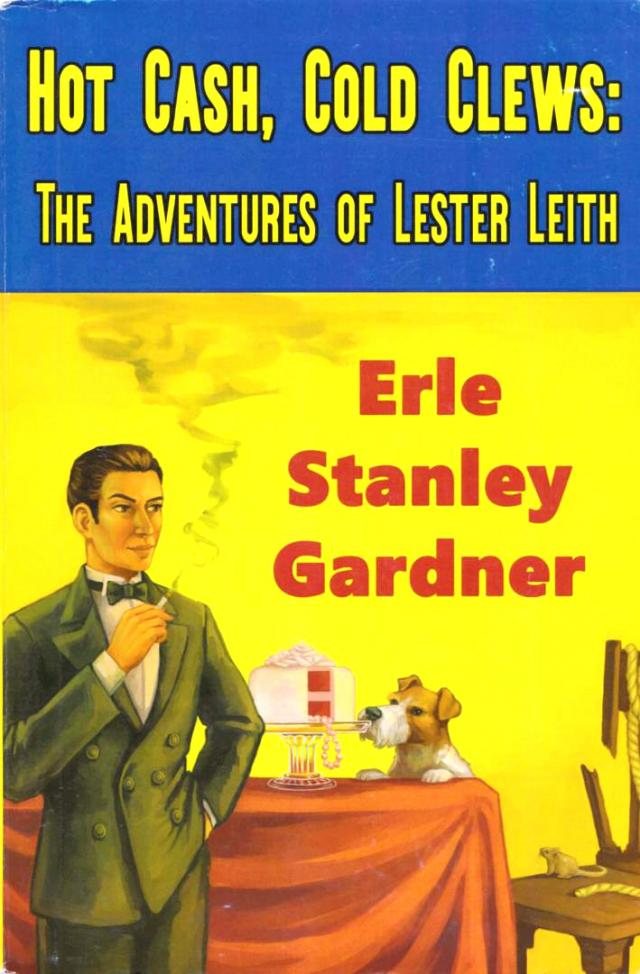


HOT CA$H,
COLD CLEWS
HOT CA$H,
COLD CLEWS
BY ERLE STANLEY GARDNER
Crippen & Landru Publishers
Cincinnati, Ohio
Copyright © 1929, 1930, 1931,
1932 by Erle Stanley Gardner
This edition copyright © 2020 by the estate of Erle Stanley Gardner.
All characters in this publication are fictitious and any resemblance to real persons, living or dead, is purely coincidental.
All rights reserved.
No part of this publication may be reproduced, stored in a retrieval system, or transmitted, in any form or by any means, without the prior permission in writing of the publisher, nor be otherwise circulated in any form of binding or cover other than that in which it is published and without a similar condition including this condition being imposed on the subsequent purchaser.
For information contact:
Crippen & Landru, Publishers P. O. Box 532057 Cincinnati, OH 45253 USA
Web: www.crippenlandru.com
E-mail: info@crippenlandru.com
ISBN (softcover): 978-1-936363-46-9
ISBN (clothbound): 978-1-936363-45-2
First Edition: July 2020
10 9 8 7 6 5 4 3 2 1
Contents
Introduction
Hot Cash
A Tip from Scuttle
The Girl With The Diamond Legs
Lester Takes the Cake
Thieves’ Kitchen
Put It in Writing!
Cold Clews
Introduction
Erle Stanley Gardner was one of the most prolific American authors of the twentieth-century. Best known as the creator of Perry Mason in the eighty works about the feisty lawyer, Gardner was also dubbed the King of the Pulps long before Perry and Della appeared. Loyal Crippen & Landru customers will know about Gardner’s pulp career from the three previous volumes of Gardner’s works edited by Bill Pronzini.
Born in 1889, Gardner came from a Boston family who moved to California when Erle was still young. The wilderness appealed to him. Gardner’s father was an engineer who took his son to the rough country in Alaska and California. Gardner became fascinated by the deserts and barren, uncharted land in these areas, and many of his works featured them. Gardner wanted to live free enough to enjoy the land.
A human dynamo, Gardner struggled to stay focused long enough to complete a formal education. He opted to study the law in an office rather than sit in a law school classroom. His boundless energy served him well in the courtroom, but he soon chafed at life at a desk. He longed to be free of the confines of society and to that end, he chose to be a writer.
In the 1920s, Gardner began to write a novelette (defined as a story of 7,500 to 17,500 words) every three days. He came home from the law office and wrote until the wee hours of the morning. Using this regimen, he produced more than 600 short works of fiction before he finalized the switch to novel writing.
While many stories were hard-boiled, Gardner wrote about a variety of characters from lawyers to con-men. In the days of the Depression, even Gardner’s con-men worked for the greater good. Lester Leith, the anti-hero of this volume, was a modern-day Robin Hood with panache. He gave his ill-gotten gains to the poor after taking a well-earned commission.
Leith lived alone in a luxurious apartment served by his butler Scuttle, who was, in fact, a police officer by the name of Edward Beaver. The faux butler had been placed in Leith’s home to catch him in the act of robbing the rich. Leith was open about his ways, even sending Scuttle out for the odd assortment of gear that he needed to complete each robbery. The fun of the stories, which matched Gardner’s own sly humor, was missing in so many of his other works. Leith accumulated the oddest variety of items for each theft and prided himself on the slippery ways in which he continued to avoid capture. Sixty-five stories from February 1929 to July 1943 appeared in all, making Leith one of Gardner’s most enduring pulp characters along with Ed Jenkins. [Note: A complete bibliography is included at the end of this volume.]
Most of the stories appeared before the advent of Perry Mason in novel form and ran almost monthly in Flynn’s Detective Fiction Weekly from 1929-1931. The pulp magazine asked for a new Leith story ever three weeks, and three of the stories appeared in the first month of the character’s appearance.
By the early 1940s, Gardner had all but abandoned pulp writing for his more lucrative novels. By the time of his death Gardner had written more than 125 books, 80 of which belonged to the Perry Mason series, the character for whom Gardner is most remembered.
The Leith stories have languished, gathering dusts in a few anthologies and the collections of pulp magazine aficionados. The major difficulty in getting copies of the stories is price and availability. Single issues run between $40 to $100 apiece. If a collector could find all those issues, the cost would run into the high four-figures. The stories in this collection came from Gardner’s own records at the Harry Ransom Center at the University of Texas in Austin. The collection there includes almost all of the 650 short works that Gardner wrote for the pulps.
In the early 1950s, Fred Dannay ran a series of Leith stories in Ellery Queen’s Mystery Magazine. Dannay published five novelettes from Detective Fiction Weekly for the magazine, most likely from Dannay’s own collection. The stories were met with such applause that the stories were later collected into The Amazing Adventures of Lester Leith, published in 1980. Gardner’s estate made a few collections of Gardner’s short works in the months after his death in 1970, which provided a few more stories. Since the anthologized stories could be collected with ease, readers have only been able to see the character from the vantage point of this handful of stories. Any appearance of the dapper detective since then has come from a previously anthologized story. This new collection nearly doubles the readily available stories regarding the charming Mr. Leith. We hope to produce more Gardner collections in the near future.
Jeffrey Marks
Cincinnati, OH
May 2020
Hot Cash
CHAPTER I
Harry Burr had a platform presence, a booming voice, and glassy eyes. He became a “reformer.” His activities netted him fifty thousand dollars a month. The newspapers referred to him as “the great crusader. “
Sticky Hume was a gangster.
Sam Milne was a watery-eyed lawyer who knew which side of the bread held the butter. He handled the payoff which passed between Sticky Hume and the great crusader. No one else knew Burr could be reached. Sam Milne alone contacted the gangs.
Harry Burr was a crusader and a doer. Sam Milne was a crook and a thinker. Sticky Hume furnished the funds. Hume got them from various underworld activities. They called him “Sticky” because things had a habit of sticking to his fingers.
Sticky’s tailor was the best in the city. The nails which had once been broken from manual labor, were now manicured, polished, carefully shaped.
Every month Sticky Hume levied rich tribute on those under him. The money dribbled in from various and sundry sources. Speakeasies dipped into cash registers. Mysterious trucking concerns wrote checks to “cash.” These various sums trickled through numerous hands, the flood of cash growing in volume as the stream concentrated higher up.
How much money Sticky made in return for protection, no one actually knew. Harry Burr got fifty grand a month. Sam Milne paid it to him, taking the money from Sticky, seeing that it was delivered to Burr.
Milne was crooked and because he was crooked, he had sold himself too early in the game and too cheaply. Sticky Hume owned him body and soul. Sam Milne was avaricious, but he made piking money compared with Harry Burr.
“Blinky” Bings wanted to be a gangster. He had done an occasional stick-up job, playing a lone hand. A blonde spotted him for easy sugar and told him she loved him. Blinky took her into his confidence. The blonde fell for another sugar, and Blinky, feeling tough, made threats. The threats frightened the new sugar, who was a salesman. He blabbed his fears to the blonde. The blonde stepped into a pay station, called police headquarters, and talked.
An hour and fifteen minutes later, Blinky regarded the handcuffs on his wrists with a dazed expression, and asked the officers what they had against him.
The officers told him.
The charges covered every job Blinky had confided to the blonde.
Blinky went to jail. A runner steered him to Sam Milne, the lawyer who had a pull. Blinky had some two thousand dollars the blonde hadn’t taken. Sam Milne took that Blinky got off on a technicality and a split with an assistant district attorney. He owned the clothes he stood in and had a horror of blondes. He thought Sam Milne was the smartest man in the world.
Sam Milne cultivated him, watched him through narrowed lids, studied him over glass rims, stared speculatively at him over cigarette smoke. After three months of this grooming, Sam Milne was ready.
Blinky was a new gangster. He wanted to be tough. He was credulous. His expressionless eyes blinked at the world in perpetual wonderment. He could be hard with a gun or quick with a sling shot, but his mental processes were always groping in a fog.
Sam Milne kicked the black bag.
“If you had what’s in there, Blinky, you could be a big shot.”
Blinky blinked at the lawyer. “How?” he asked.
“Fifty grand,” explained Sam. “It’s a pay-off.”
“Who?” said Blinky.
Sam Milne got up and walked to the sca
rred door of his office. He tried the lock. Then he went to the window and lowered the shade. The precautions were utterly senseless, but they convinced Blinky.
Sam returned, lowered his voice.
“Harry Burr,” he whispered. “And if anybody knew I’d spilled it to you we’d both be put on the spot.”
Blinky’s eyes blinked.
“I thought he was the big reformer!” he said. “Everybody does,” replied Sam.
“But,” protested Blinky, “he was elected to office on the solemn promise he’d clean up the underworld.”
“Yeah,” said Sam. “He’s cleanin’ it all right.”
He lit a cigarette and studied Blinky’s face. He had taken a big chance with the giving of that information. Blinky couldn’t be trusted with it. No one could be trusted with it. Sam Milne would have to keep tabs on Blinky now, from the time he left the office until he hit a marble slab at the morgue. Sam didn’t intend the interval should be great.
“Huh!” said Blinky.
Sam waited until Blinky’s eyes were on his face. Then he suddenly let a smile twist his countenance, the smile of one who has thought a great thought.
“Blinky,” he said, slowly, impressively, “there’s no reason why we should sit back and let that stuffed shirt take all the gravy. You and me could be splitting fifty grand by midnight if you wanted to show some nerve.”
Blinky let his mouth sag half open.
“I got the nerve,” he said. “I ain’t much good on thinkin’ things out.”
Sam Milne smacked his palm against the thigh of his right leg.
“It’s simple, too!”
Blinky blinked attentively.
“Sure,” said Sam, and lowered his voice to a hissing whisper. “The money comes from Sticky Hume. He pays it to me. I contact Burr. I’m the only contact he has. No one’s in the know except us.
“Now I’m taking that bag out there to-night. Suppose you should follow and use a gun? See?”
Blinky looked at his friend with puzzled eyes.
“Stick him up?” he asked.
“Hell, no. There’s a car follows me until I turn in to Burr’s driveway,” lied Sam Milne. “They’d smear you. No. What you do is stick up Burr after he gets the bag.”
Blinky let his forehead look like a washboard.
“Huh?” he asked.
“Cinch,” said Sam, and chuckled. “Burr can’t make a squawk. How in hell could he explain having fifty grand in a black bag in his house? He couldn’t. He was elected on a reform ticket. He tells every time he gets in public about having sacrificed his private business interests in order to execute a public trust. Burr couldn’t even make a squawk, I tell you! You’d only have to walk in, lift the bag and walk out. You might have to croak one of the servants, but what’s a croaking compared with twenty-five grand? And I could get you off.”
“You could get me off?”
“Sure. I could guarantee it. The witnesses wouldn’t dare to testify. I could get you off if you got caught, but you wouldn’t get caught.”
Blinky heaved a sigh and relaxed.
“How do I work it?” he asked.
“Simple. I’m leaving for Burr’s house in ten minutes. You drive out there and park your car on the slope, so it’s downhill. Keep the motor running. When you see me go in the driveway, you go to the front door carrying a black bag. You ring the bell. A butler will answer. You say that you have a bag to deliver to Mr. Burr from Mr. Sam Milne. The butler will let you in. About that time I’ll be coming in the side door with the real bag that’s got the money. You drop your bag. Start for the big room that’s to the right and pretty far back. That’s where Burr always receives the take.
“It’s a study. There’ll be a man with Burr that’s tough. His name is Dumoe. He’s supposed to be a secretary. He’s really a gunman, and acts as a bodyguard. Don’t take any chances with Dumoe. Sock him on the bean or plug him. Make a good job of it. Take the bag and go to 6478 Milpas Street. There’s a furnished house there, and a garage. Here’s a key to the house. I keep it for parties now and then. Hole up there until I come for you. Put the car in the garage.”
Blinky let his jaw sag.
“It’s sure complicated,” he said. “Where do I get the car?”
“It’s down here, parked in front of the office—a car I use once in a while for an undercover job.”
Blinky started checking things off on his fingers. “Listen,” said Sam, “you’ve only got to do three things, and then you’ll get—“ He crossed to the black bag, flung back the straps, slipped the catch, opened it up. “Half of this.”
He looked back and up over his shoulder.
Blinky’s eyes were staring.
“A cinch,” said Sam Milne, the crooked lawyer.
Ten minutes later he escorted Blinky to the door of his office building, pointed across the street.
“There’s the car. The keys are in it. Go to it.” Blinky crossed the street.
The car was a new one, yellow, of distinctive lines. It had been in a smash recently and the left headlight was dented. The right rear fender was crumpled flat. The body had a long scrape of paint removed from it. A red tag dangled from the steering wheel. The car had been parked in front of a fire plug.
Blinky crossed to it.
Sam Milne stood watching him.
Blinky crawled in back of the wheel, regarded the red tag on the steering wheel, looked at Sam. Sam made a motion with his hands, as though to tear up the red tag.
Blinky tore up the tag.
Sam Milne went back to his office and picked up the black bag. He was smiling.
CHAPTER II
A Man With Brains
The residence of Harry Burr sat well up on a hill. The lights of the city showed as a twinkling sea of brilliance. The residence itself was like its owner, pretentious, blatant in its loud respectability.
Sam Milne swung his car into the private driveway.
He noticed that the car with the crumpled fender, the dented headlight and the scratched finish on the body was parked just where he had told Blinky to park it, under the street light, against the curb, headed downhill.
Sam Milne took his time about crawling from his own sedan, picking up the black bag and climbing the three steps to the side door.
Charles Dumoe, the big bodyguard, swung open the door. ‘“Lo, Sammy.”
‘“Lo, Gnick.”
“Got the stuff?”
“Sure.”
A huge form stepped forward, making something portentously impressive of the mere advance. A voice boomed forth a greeting. “Ah, Samuel Milne! Counsellor, good evening.”
Harry Burr was a tall man who bulged importantly. He wore spectacles on a black ribbon and had a habit of thrusting his right hand into his waistcoat. When he spoke, even upon the most trivial subjects, he used a platform manner that made his presence dominate the surroundings. Loud voiced piety exuded from every pore.
“Good even’n’,” said Sam Milne. He was jealous of Harry Burr’s greater success in crookedness. Milne had sold out cheaply. He felt that he had brains. Harry Burr had nothing but a front.
“Ah,” said the personage, glancing at the bag through his glasses, the black ribbon cutting against the impressive jowls of the man as a dignified color contrast, “you have brought something?”
It was always his manner. Always he acted upon the assumption that both of his hearers would believe the synthetic surprise with which he received the “small campaign contribution “which Sam Milne delivered.
The man had avoided sincerity for so long that he refused to be sincere, even with himself. He always went through the same deep-toned formula, as though his hypocrisy would convince his own credulity.
“Yeah,” said Sam Milne. “I got a little campaign contribution, an’—”
He broke off, staring at the curtains which led into the alcove behind which was a door. An arm and a gun protruded through those curtains. Just above the gun was the glitter of an eye showing through a mask which had been carefully adjusted.
“Stick’m up,” said the voice of the newcomer.















