

The case of the sunbathe.., p.1
The Case of the Sunbather's Diary,
p.1
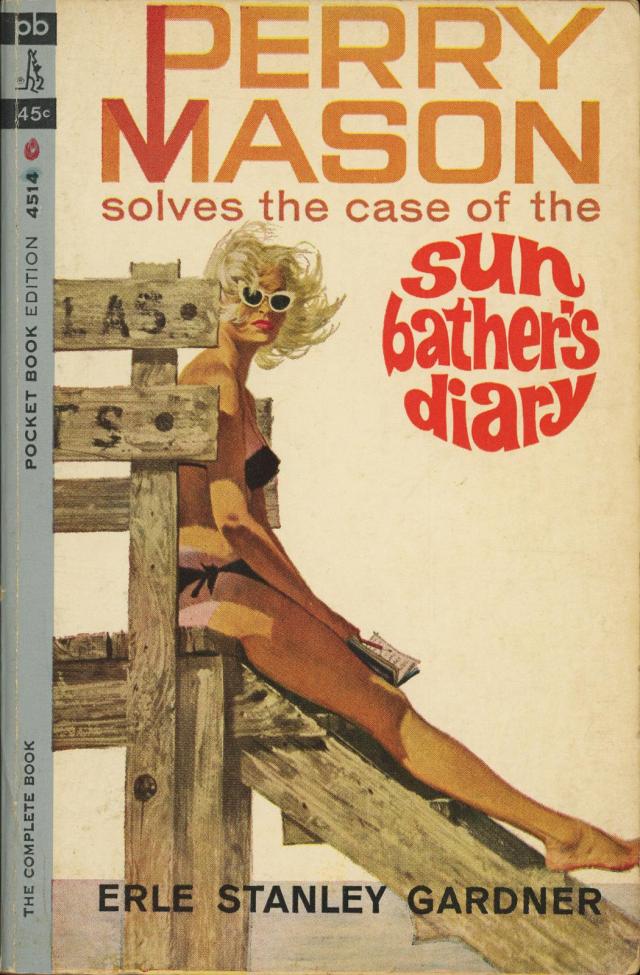


The Case of the
Sun Bather’s Diary
Erle Stanley Gardner
FOREWORD
Quite frequently I am asked whether there is any such thing as “the perfect crime.”
The answer, of course, is that there have been literally hundreds of so-called “perfect crimes.” Every veteran medical examiner can tell about cases in which only the painstaking competence of a skilled autopsy surgeon disclosed the fact that a seemingly natural death was actually a murder.
And there are cases which baffle even the most competent medical examiners. In such cases no one can determine with certainty whether the man died a “natural” death or whether he was murdered by means which left no trace.
Is there such a thing as a murder by witchcraft?
I have talked with voodoo priests in Haiti and with kahunas in Hawaii. I have investigated some cases of “black magic” and I have been told many strange stories of people who have been “kahunaed” to death in the South Sea Islands. I have seen some things I can’t explain; and from people in whose integrity I have absolute confidence, I have learned of many other things. I have spent many hours with Dr. Alvin V. Majoska in Honolulu, discussing the strange “Nightmare Deaths” of Honolulu.
I first heard of these deaths when I was attending one of Captain Frances G. Lee’s seminars on homicide investigation at the Harvard Medical School in Boston. Dr. Milton Helpern, the famous forensic pathologist of New York, was lecturing there and remarked that it was not always possible to determine the cause of death. He cited as an example that he had recently been called upon to examine vital organs from bodies sent him from the Hawaiian Islands, and that in each case it had been impossible to discover a cause of death. There was no sign of poison; the heart, lungs, brain, kidneys, and all of the vital organs were in perfect working order.
These men simply had ceased to live, and medical science was powerless to find out why they had ceased to live.
After the seminar, Dr. Alan R. Moritz, then the head of the Department of Legal Medicine at Harvard and now at Western Reserve in Cleveland, a brilliant investigator and pathologist, said to Dr. Helpern, “I didn’t know you were getting those bodies. They’ve been sending them to us, and we can’t find any cause of death.”
Driven by intense interest, I finally went to Honolulu and tried to find out about these strange deaths. What I found amazed me. The deaths occurred only in young Filipino men who were in the prime of life and the best of health. These men invariably died at night, under circumstances indicating a nightmare. They would go to bed apparently in the best of spirits. During the night they might be heard to moan. Before help could reach them, they would be dead.
Dr. Alvin V. Majoska is a remarkably competent man. He is on the young side of middle age, an alert, intelligent, observing, highly trained physician and pathologist. He lives in Honolulu because he loves the tropical sea, the warm surf swimming. He loves sailing his boat over the sparkling waters. He is a skin-diving enthusiast. Physically, he is an athlete. Mentally, he has all of the shrewdness and caution of a well-trained medical man.
He devoted months of his time to studying these “Nightmare Deaths,” and he has written an article which was published in the Hawaii Medical Journal, reprints of which are available. That article was entitled, “Sudden Death in Filipino Men: An Unexplained Syndrome.”
Stripped of its technical nomenclature, this article admits, in effect, that medical science is completely baffled, or, as Dr. Majoska expresses it, we are dealing with a “brand new mechanics of death.”
It is interesting to note that Dr. Majoska’s extensive investigation disclosed that this form of death also occurs in the Philippines, where it is known as Bangugut and comes from the two Tagalog words, “Bangun,” meaning a person trying to arise, and “Ugul,” meaning to groan.
The fact that prior to 1945 no less than fifty-one of these “Nightmare Death” cases had occurred in the Hawaiian Islands (and heaven knows how many more there were that had not been correctly diagnosed) shows the seriousness of the situation.
There is a feeling among some of the Filipinos that these deaths occur in connection with a reflex sex mechanism, and I have in my possession a photograph, which unfortunately cannot be published, showing the elaborate mechanical precautions taken by one of these victims to safeguard himself against this form of death.
In addition to the weird mechanical contrivance which he invented, he arranged to have someone sleeping beside his bed who could arouse him the instant he started to moan.
These elaborate precautions did no good. The photographs of the device which I have were taken when the man’s body was in the morgue. The most thorough postmortem investigation, the most complete autopsy that could be performed failed to disclose the cause of death.
At about the time I went to Honolulu to study these cases, they came to an abrupt end. Now, I understand, they have again started, a peculiar sequence of stark terror which strikes in the tropical night.
I was able to find only one instance of a man who had made a recovery, and it is, of course, impossible to determine whether his experience was the same as that of the men who had died.
This man was sleeping in a room that he shared with a young, alert and very muscular Japanese. In the middle of the night the Japanese heard this Filipino emitting the peculiar moans associated with this dreaded type of death.
Acting with rare presence of mind, the Japanese hurled himself physically upon the Filipino, as though coming to grips with an unknown force, and he succeeded either in awakening the Filipino from a nightmare while he was still alive or in fighting off the invisible forces of witchcraft, whichever you wish to believe.
I managed to locate this Japanese. I interviewed him, photographed him, and secured not only his story but the story that had been given him by the Filipino after he had awakened from his all-but-fatal “nightmare.”
These nightmare deaths are tremendously interesting, and the fact that they exist at all is a challenge. It shows the need of giving more and more attention to legal medicine and of educating a greater number of forensic pathologists.
I love the Hawaiian Islands. I was, and am, fascinated by the “Nightmare Deaths” of Honolulu. Through the investigation of these deaths I formed a valued friendship with a man whom I consider exceptionally competent, an outstanding example of the highest type of medical examiner; and so, I dedicate this book to my friend:
ALVIN V. MAJOSKA, M.D.
—Erle Stanley Gardner
CAST OF CHARACTERS
Perry Mason—When the famous criminal lawyer played the fall guy in a hot “numbers” game, he almost became a defendant himself
Della Street—She was the perfect jewel of a secretary to Mason—and lots more besides
Arlene Duvall—A blond nature girl, with a mysterious source of support, who adored sun-bathing in the altogether but would rather die than reveal her secret diary
Colton P. Duvall—Arlene’s father, he was the convicted “It” in a hide-and-seek game involving $396,751.36
Paul Drake—A tall, thin, deceptively slow-moving private detective with a knack for getting the facts fast
Dr. Holman B. Candler—A physician, one-time boxer and a trusted friend of Arlene. To him a murder was good news
Jordan L. Ballard—An ex-bank employee, he was rooting home a hot tip on a horse while the bank was being robbed
Bill Emory—He’d been the driver of the Mercantile Security Bank’s armored Car 45 the day of the robbery
Horace Mundy—A sleuth who lost one trail, then picked up another he didn’t want
Rose Travis—Dr. Candler’s head nurse. Attractive, magnetic, she knew how to make waiting for the doctor a pleasure
Hamilton Burger—The D.A., a man grimly determined to see justice done—to Perry Mason
Helen Rucker—Sackett’s curvaceous, redheaded girl friend, whose bathing suit revealed more than it was supposed to
Thomas Sackett—A muscle man with a jeep, a shady past and a document that became too hot to handle
Chapter 1
Della Street, Perry Mason’s confidential secretary, placed her palm over the mouthpiece of the telephone and said to the lawyer, “Do you want to talk with a girl who has been robbed?”
“Of what?” Mason asked.
“She says of everything.”
“Why is she calling me instead of the police?”
“She says that’s something she’ll have to explain.”
“So it would seem,” Mason observed.
“She sounds like a nice girl, Chief. She’s in quite a predicament.”
“All right. Tell her to come in and I’ll see her, Della.”
“I asked her about coming in. She says she can’t. She has nothing to wear.”
Mason threw back his head and laughed. “Now,” he said, “I’ve heard everything. I’ll talk with her, Della. What’s her name?”
“Arlene Duvall.”
Mason said, “Throw the communicating switch so we can both listen, Della. This I have to hear.”
Mason picked up his phone and, when Della Street had thrown the switch, said, “Yes. Hello… . Perry Mason speaking.”
“Mr. Mason, this is Miss Arlene Duvall.”
“Yes.”
“I want to see you on a matter of the greatest importance. I… I have money to pay for your services.”
“Yes.”
“I’ve been
robbed.”
“Well,” Mason said, winking at Della Street, “come in and see me, Miss Duvall.”
“I can’t.”
“Why?”
“I’ve nothing to wear.”
Mason said, “We’re not particularly formal here. I would suggest you come just as you are.”
“If you could see me you’d cancel that suggestion.”
“Why?” Mason asked.
“What I have on wouldn’t hide a postage stamp.”
“Well,” Mason said impatiently, “put something on. Put on anything. You—”
“I can’t.”
“Why?”
“I tell you I’ve been robbed.”
“Wait a minute,” Mason said, “what is this?”
“I’m trying to tell you, Mr. Mason, that I’ve been robbed. Everything I have in the world has been taken—my clothes, my personal effects, my car, my home.”
“Where are you now?”
“At the fourteenth hole at the Remuda Golf Club. The members have installed a telephone out here. The golf club seems to be deserted just now. I lied to the operator at the clubhouse by telling her I was a member, so she put the call through. I need clothes. I need help.”
Mason, suddenly interested and curious, said, “Why not call the police, Miss Duvall?”
“I can’t call the police. They mustn’t know anything about this. I’ll explain when I see you. If you can arrange to get some clothes to me I’ll pay—”
“Just a minute,” Mason said. “I’ll put my secretary on the lime.”
He nodded to Della Street.
Della Street said, “Yes. Miss Duvall, this is Miss Street, Mr. Mason’s secretary, again.”
“Miss Street, if you could get some clothes to me, just anything I could wear. I’m five feet two. I weigh a hundred and twelve and I take size ten or twelve.”
“Just how am I supposed to get the clothes to you?” Della Street asked.
“If you could… if you could bring them, Miss Street, I would be glad to pay whatever it’s worth. Oh, I know you don’t do this sort of thing. This is all out of the ordinary and everything, but I simply can’t explain over the telephone, and… well, you’re the only hope I have in the world. I can’t appeal to the police and I most certainly can’t go around like this.”
Della Street glanced across at Mason and raised her eyebrows. Mason nodded.
“Where will you be?” she asked.
“I don’t suppose you’re a member of the Remuda Golf Club.”
“Mr. Mason is,” Della Street said.
There was relief in the voice. “Well, if he could give you a guest card and you could put some clothes down in the bottom of a golf bag and start out… you could come directly to the fourteenth hole. Back about fifty yards beyond that hole there’s a patch of rather thick brush that runs down to a service road, and if you’ll just yoo-hoo—heavens, here come some golfers! Good-by!”
The phone was slammed up.
Della Street waited a moment then gently hung up the telephone and looked across at Mason.
Mason dropped his own telephone into the cradle and said, “Now we’ve heard everything.”
“The poor kid,” Della Street said. “Imagine being out there at eleven-thirty in the morning in broad daylight without… Chief, how in the world could she have been robbed? How could she have lost everything and—?”
“There,” Mason said, “is the part that intrigues me. Do you want to go out, Della?”
“Try holding me back.”
“I think I’ll go with you,” Mason announced.
“You would,” Della Street said, smiling.
“No, no,” Mason went on, “I won’t go out on the course. I’ll just drive you out to the golf club, give you a guest card and be waiting there when you come back. You can get her some clothes?”
“She can wear my size,” Della Street said. “I have an old dress I was going to give away. It’s nothing particularly fancy—a sport outfit with shorts and a skirt. It will at least enable her to get across the golf course without having a wolf pack howling in hot pursuit.”
Mason glanced at his watch. “My next appointment is at two o’clock. We can just about make it, Della. This thing has really aroused my curiosity. Let’s go.”
Chapter 2
From the veranda of the clubhouse Mason saw the two girls appear against the skyline as they came over a hill on the fairway.
They were almost of a size. Arlene Duvall was perhaps half an inch shorter than Della. She walked with a springy, athletic gait. Mason could see their heads turn from time to time as they exchanged comments on their way to the clubhouse.
The lawyer walked down to the foot of the terrace to meet them.
Della Street presented Arlene Duvall as though she had been an old friend.
Mason’s hand was gripped with firm, strong fingers. Slate-colored eyes looked steadily into his.
“Thank you, Mr. Mason,” she said, “for everything.”
She was, Mason noted, a creamy-skinned blonde, with hair that had the color of honey and a sheen which made it seem smooth and silky.
“Miss Street is the one to thank,” he said.
“I’ve already thanked her.”
“You two could swap clothes very nicely,” Mason said, making conversation.
“Except that I’ve nothing to swap,” Arlene Duvall said.
“Your clothes were stolen?”
“Everything was stolen.”
Mason said, “Your phone call certainly furnished a welcome change in the humdrum of a routine day.”
“Are your days ever routine?”
“Too many of them.”
She laughed. “I’m pretty well satisfied Miss Street thought I had worked out a novel method of arousing your interest, that—”
“Was it?” Mason asked.
She shook her head.
“If it had been,” Mason told her, “it would still have worked. Anyone who had ingenuity and daring enough to plan a scheme of that sort would have aroused both interest and curiosity.”
“Unfortunately I can’t claim any credit for what was probably an original approach.”
“What happened?” Mason asked.
“It’s a long story.”
Mason led the way up to the veranda, ordered drinks, then settled back in the chair. “Let’s hear the story.”
“I was living in a trailer.”
“All by yourself?”
She nodded.
“In a trailer camp?”
“Only part of the time. There’s a service road that runs to the back of the golf course. Very few people know of it. I think perhaps I was the only one who traveled that road regularly. When they bought the course it was part of a large tract of land. There’s a long wooded stretch down below the fourteenth hole, and a stretch of sloping, grassy meadow. Then there are more woods and then the highway.
“I found that I could drive in on this service road, park my trailer and have complete privacy. No one seemed to object. In fact I don’t think anyone ever went down to that part of the club. It must be two hundred yards in an air line from the meadow to the nearest fairway, and it’s probably another two hundred yards in an air line to the road. It is, of course, longer the way the service road winds in through the woods.”
“Go on,” Mason said.
She met his eyes. “I’m a nature girl. I like to get out and prowl around through the woods. I like to go barefooted. I like to take all my clothes off and brown in the sun.”
“What,” Mason asked, “do you do for a living?”
“At the moment, nothing.”
“All right, what about losing your things?”
“This morning I followed my usual routine. I had stayed down in the meadow all night—in fact, I’d been down there about three nights, parked with my house trailer.”
“Weren’t you afraid?”
“No. After all, a house trailer is about the safest place one can be. When you lock the door from the inside there’s no way anyone can get in. Even if they smash the windows it wouldn’t help. The windows are too small for a person to climb in from the outside.”
“So this morning you went sun-bathing?”
“I followed my usual custom. I slipped out of my clothes, took a robe, crossed the open meadow into the woods, then took the light robe off and just walked around in the sunlight for a while, feeling the air on my skin, the grass on my bare feet. You’ll probably think I’m crazy. If you haven’t been a sun bather you’ll never understand the freedom, the caress of the air, the warmth of the sunlight, the touch of a passing breeze. Oh, what’s the use?”















