

The case of the fabulous.., p.1
The Case of the Fabulous Fake,
p.1
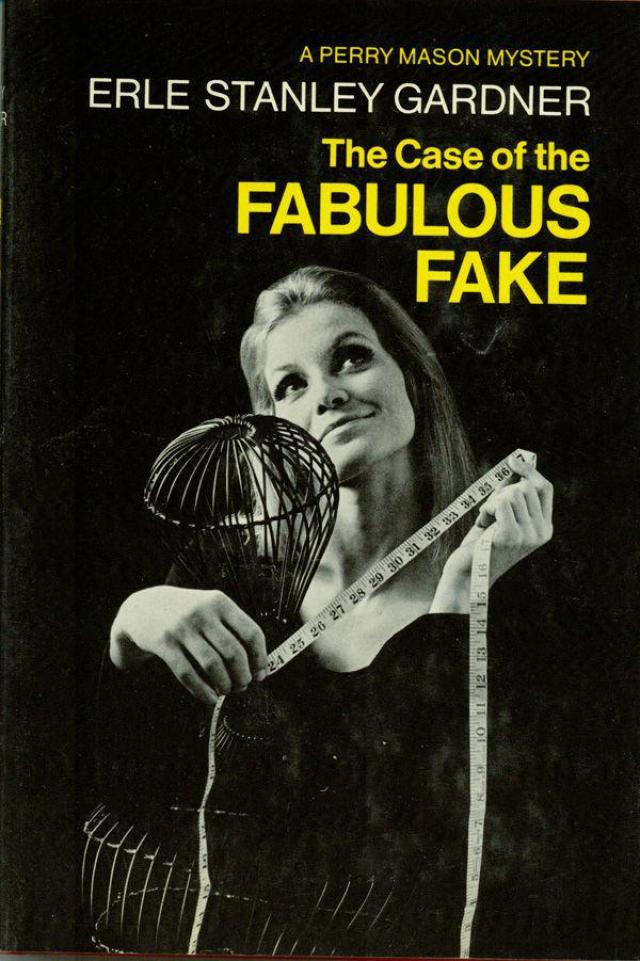


The Case of the Fabulous Fake
Erle Stanley Gardner
© 1969, 2011 Erle Stanley Gardner. All rights reserved.
Contents
FOREWORD
CAST OF CHARACTERS
Chapter 1
Chapter 2
Chapter 3
Chapter 4
Chapter 5
Chapter 6
Chapter 7
Chapter 8
Chapter 9
Chapter 10
Chapter 11
Chapter 12
Chapter 13
Chapter 14
Chapter 15
Chapter 16
Chapter 17
Chapter 18
About the Author
FOREWORD
FOR many years, my Perry Mason books have been dedicated to leaders in the field of courtroom medicine. For the most part, these people have been forensic (courtroom) pathologists (experts in disease and injury), whose skill in determining the cause of death helps convict the guilty and protect the innocent.
Cause of death is always a medical question.
Manner of death, on the other hand, is never a medical question. If, for example, the cause of death is a bullet through the head, the manner of death is whether it was self-inflicted, accidental or fired by another person in the commission of a crime.
Jack Cadman, Director of the Orange County Sheriff’s Criminalistics Laboratory in Santa Ana, California, is an expert investigator in determining the manner of death.
One of his early cases dealt with a young woman who had been fatally shot in the back with a shotgun. There were two prime suspects, the husband and one of his friends. Cadman asked for the clothing that each was wearing the night of the shooting. He found microscopic droplets of flesh and blood embedded in the sweater of the boy friend, the man entered a plea of guilty, and the case was solved without even the necessity of a trial.
A short time later, a proverbial “hired” man was found dead in a barn. His crushed head looked much as if he had been kicked by a horse. Jack Cadman examined the man’s hair and scalp, and discovered tiny fragments of dust and a few wood splinters. This initiated a search through a huge wood pile for a two-by-four which, Jack suggested, “… may be three feet long.” It was found, and examination under the microscope disclosed fresh depressions caused by the head hairs being pressed into the compressed wood. Hairs and micro droplets of blood from the victim’s head confirmed that this was the weapon that had caused the death.
A suspect was found; robbery was the motive; and another guilty plea to murder resulted.
Jack Cadman is internationally known for developing the Cadman-Johns method for detecting alcohol in the blood stream through the use of the gas chromatograph. This method is perhaps the most accurate one developed to date. A test can be completed in fifteen minutes, whereas other methods require from one to four hours.
Cadman is in great demand as a lecturer at scientific meetings and at universities throughout the West.
He has just moved into a modern and well-equipped crime laboratory which is a real show place, illustrating what science can do in evidence that will tie a criminal to the scene of his crime.
“The solution of the crime problem has to be the field of science,” Cadman said, as he surveyed his stereoscopic and ultropak microscopes, his refractometer, search and sweep tables with their vacuum attachments, and a dozen other new crime-fighting tools. “This is the space age, but crime-fighting has not kept pace with other scientific developments since World War II. Any time the American people are ready to give the problem sufficient attention and priority, we can raise the present ‘solved’ and ‘conviction’ rates from maybe 10 percent to 90 percent. When it becomes unprofitable for a criminal to commit a crime, he’s going to think twice or three times about doing it. When he knows that the odds are nine to one that he’s going to get caught and going to jail, crime will lose a lot of its appeal. But until that happens, why shouldn’t people continue to commit crimes? It’s quite a profitable trade!”
Therefore, I dedicate this book to an outstanding leader in the field of forensic science:
JACK CADMAN
Director, Orange County Sheriff’s Criminalistics Laboratory
Santa Ana, California
ERLE STANLEY GARDNER
CAST OF CHARACTERS
PERRY MASON—Usually tough with his clients in their own best interests, he lets a pretty girl talk him into acting more like a man than a crack lawyer
DELLA STREET—A confidential secretary with a sharp eye, she makes a very feminine observation about the new client
GERTIE—Mason’s incurably romantic switchboard operator, she manages some fast observations of her own
PAUL DRAKE—Mason’s favorite private detective, he agrees to track down the elusive client
DIANA DOUGLAS—Pretty, evasive, and in deep trouble, she swears that she’s neither embezzler nor murderer
STELLA GRIMES—One of Paul Drake’s operatives, she follows Mason’s lead brilliantly, backed up by some very defensive underwear
MORAY CASSEL—A blackmailer and a liver-off-women, he went one step too far and wound up dead
HOMER GAGE—Junior partner in a somewhat shady import business, he is a blusterer with something to hide
FRANKLIN GAGE—Homer’s uncle and senior officer of the import company, he wants his company protected and his employees left alone
BILL ARDLEY—A homicide detective, he meets his match in Stella Grimes and Perry Mason
JUDGE CHARLES JEROME ELLIOTT—He does his best to hold Mason to strict courtroom procedure
RALPH GURLOCK FLOYD—The trial deputy thinks he has a perfect case—Mason’s client had motive, opportunity—and the gun
JOYCE BAFFIN—A friend of Diana’s, she seems to be the only one who believes she’s not a fake
1
PERRY MASON looked up from his desk as Della Street, his confidential secretary, stood in the door of the office which communicated with the reception room.
“Yes, Della?”
“We have a young woman in the outer office who won’t give her name.”
“Then I won’t see her,” Mason declared.
“I understand how you feel about these things,” Della replied, “but I think there’s some interesting reason why this young woman won’t give us the information.”
“What sort of reason?” Mason asked.
Della Street smiled. “I think it might be interesting to find out.”
“Blonde or brunette?”
“Blonde. She’s holding on to a flat black bag in addition to a purse.”
“How old?” Mason asked.
“Not over twenty-two or twenty-three.”
Mason frowned. “Are you sure she’s over twenty-one?”
Della shook her head. “You can’t tell by looking at her teeth,” she said, smiling.
“How about her hands?” Mason asked.
“And you can’t tell too much by a woman’s hands until after she passes thirty,” Della explained.
“All right,” Mason said, “bring her in, we’ll take a look.”
Della Street turned, went into the outer office and shortly returned with a young woman who was trembling with excitement as she approached the desk and said, “Mr. Mason?”
Mason smiled. “There is no need to be nervous,” he said. “After all, I’m an attorney and if you are in trouble perhaps I can help you.”
She seated herself across the desk from the lawyer and said, “Mr. Mason … I … I … I’m going to have to disappear and I don’t want my parents ever to be able to find me.”
Mason regarded her thoughtfully. “Why are you going to have to disappear?” he asked. “The usual reason?”
“What’s the usual reason?” she asked.
Mason smiled and shook his head. “Don’t cross-examine me,” he said. “Let me do the questioning. Why do you want to disappear?”
“I have my reasons,” she said. “I don’t think I need to go into all the details at the present time, but I do want to disappear.”
“And you want me to help you?”
“I want you to be in such a position that you can, if necessary, furnish the missing link which will connect me with my past life. But I don’t want you to do it unless I give you permission and tell you to, or unless certain circumstances develop which will make it imperative that you do communicate with my parents.”
The telephone on Della Street’s secretarial desk rang and she said, “Hello … yes, Gertie. … Right away? … Is it that important? … Very well, I’ll be right out.”
She glanced meaningly at Perry Mason, said, “If you’ll excuse me a moment,” and hurried through the door to the outer office.
Mason regarded his visitor quizzically. “You’re asking me to take you on trust.”
“Don’t you have to take all your clients on trust?”
“Not entirely. I usually know with whom I am dealing and what the score is.”
“And you are usually retained to defend some person who is accused of crime?”
“Quite frequently.”
“And how do you verify the fact that your client is telling you the truth?”
Mason smiled. “You have a point there,” he admitted.
“You take them on trust,” she said.
“Not entirely,” Mason replied. “Any person accused of crime, whether guilty or innocent, is entitled to a defense
. He’s entitled to his day in court. I try to give him legal representation.”
“But you try to make that representation effective so that you prove his innocence.”
Mason thought for a moment, then, choosing his words carefully, said, “I try to make my representation effective. I’ll go that far.”
Della Street appeared from the outer office, motioned to Perry Mason, and walked through the door into the law library.
Mason said, “You’ll have to excuse me just a moment. We seem to have some rather important matter demanding immediate consideration.”
“Certainly,” she said.
Mason swung around in his swivel chair, got up, walked around the desk, gave his visitor a reassuring smile, said, “I’m satisfied it will only be a moment,” then opened the door to the law library.
“What’s the excitement?” he asked Della Street when he had closed the door.
“Gertie, at the switchboard,” Della said.
“What about her?”
“I hardly know,” she said. “You know Gertie, she’s an incurable romantic. Give her a button and she’ll sew a vest on it every time, and sometimes I think she even uses an imaginary button.”
Mason nodded.
“She observed something about our visitor in there, or thinks she did, and perhaps you’d better talk with her.”
“Can’t you tell me what it is?”
“Of course I can,” Della said, “but I can’t evaluate what Gertie’s saying the way you can—it makes quite a story.”
“All right,” Mason said, “let’s go see what it is.”
He took Della’s arm, escorted her through the door which opened from the law library into the entrance room.
Gertie, at the switchboard, was sitting on the edge of her chair, her eyes wide with excitement, her jaws chewing gum in a frantic tempo, indicative of her inner nervousness.
Gertie had an insatiable curiosity. She always wanted to know the background of Mason’s clients and, quite frequently, vested them with an imaginary environment which, at times, was surprisingly accurate.
Considerably overweight, Gertie was always going on a diet “next week” or “after the holidays” or “as soon as I return from my vacation.”
Despite the fact there was no one in the office, Gertie beckoned Mr. Mason over to her desk and lowered her voice so that it was barely audible.
“That young woman who went in your office,” she said.
“Yes, yes,” Mason said, “what about it, Gertie? Did you notice something about her?”
“Did I notice something about her!” Gertie said, quite obviously savoring the fact that she had for the moment become the center of attention. “I’ll say I did!”
“Well,” Della said impatiently, “tell it to Mr. Mason, Gertie. After all, she’s waiting in there.”
Gertie said, “you noticed that black bag she’s carrying with her, that she hangs on to so tightly?”
“I didn’t notice her hanging on to it so tightly,” Mason said, “but she has both a black bag and a hand purse with her.”
“It’s a kind of cosmetics and overnight bag,” Della said. “In a bag of that type there’s a mirror on the inside of the lid when you open it.”
“And cosmetics, creams, and hairbrushes on the inside?” Mason asked.
“Not in this bag,” Gertie asserted vehemently. “It’s packed, jammed solid with hundred-dollar bills, all neatly packaged.”
“What!” Mason exclaimed.
Gertie nodded solemnly, obviously enjoying Mason’s surprise.
“How do you know, Gertie?” Della Street asked. “Tell him that.”
“Well,” Gertie said, “she wanted to get something out of the bag or put something in it. Anyway, she opened it, but it was the way she opened it that attracted my attention.”
“In what way?” Mason asked.
“She turned around in her chair, her back toward me, so that I couldn’t see what she was doing.”
Mason smiled and said, “And the minute she did that you craned your neck, trying to see what it was she was concealing.”
“Well,” Gertie said, “I guess everyone has a natural curiosity, and after all, Mr. Mason, you want me to find out about the clients that come to see you.”
“I was just making a comment,” Mason said. “Don’t let it worry you, Gertie. What did you see?”
“Well, what she didn’t realize,” Gertie said, “was that just as soon as she turned her back and opened the lid of the bag, the mirror at a certain angle reflected the contents of that bag so that I could look right into the mirror and see what was inside.”
Mason said, “Tell me exactly what you saw.”
“The whole inside of that black bag,” Gertie said impressively, “was just one mass of hundred-dollar bills, all neatly stacked in piles just as they came from the bank.”
“And you saw that in the mirror?”
“Yes.”
“Where were you?”
“I was here at my desk by the telephone switchboard.”
“And where was the young woman?”
“Sitting over there.”
“All the way across the office,” Mason commented.
“That’s right. But I saw what I saw.”
“You say she turned her back to you?”
“Yes, very ostentatiously.”
“And then opened the bag?”
“Yes.”
“And when the lid reached an angle of approximately forty-five degrees you could see the contents of the bag?”
“That’s right.”
“Now, did she very carefully hold the lid in that position so you could continue to look at the contents, or did she open it the rest of the way so the lid was straight up?”
Gertie thought for a moment and said, “When I stop to think of it, I guess she opened it the rest of the way, but I was so startled at what I saw that I didn’t realize she had opened it the rest of the way until you asked me just now.”
“Then she held the lid which contained the mirror for some appreciable interval at the angle of forty-five degrees so you were able to see the contents?”
“I guess she must have, Mr. Mason,” Gertie conceded. “I didn’t think this all out until—My heavens, you cross-examine a person so!”
“I don’t want to cross-examine you,” Mason said, “but I do want to find out what happened. You must admit that if she opened the lid of that bag and then held the mirror at an angle so that you could see the contents, she must have been rather anxious for you to see what was in the bag rather than trying to conceal it from you.”
“I never thought of that,” Gertie admitted.
“I’m thinking of it,” Mason said thoughtfully.
After a second or two, he went on. “How did you know they were hundred-dollar bills, Gertie? You couldn’t see the denomination at that distance.”
“Well, they … they looked like hundred-dollar bills, all flat and—”
“But they could have been fifty-dollar bills?” Mason asked as Gertie hesitated. “Or perhaps twenty-dollar bills?”
“Well, I distinctly had the impression they were hundred-dollar bills, Mr. Mason.”
“And, by the same sign,” Mason said, “looking at those bills in the mirror across the length of the office, they could have been one-dollar bills?”
“Oh, I’m certain they weren’t one-dollar bills.”
“What makes you so certain?”
“Just the way they looked.”
“Thanks a lot, Gertie,” Mason said. “I’m glad you tipped us off on this. You did quite right.”
Gertie’s face lit up. “Oh, I thought I had botched it up, the way you were asking those questions.”
“I’m just trying to get it straight,” Mason said. “Forget all about it, Gertie.”
“Forget about something like that!” Gertie exclaimed. “Mr. Mason, that woman is … well, she’s going to lead you into something. She just isn’t any ordinary client.”
“That’s quite right,” Mason said. “She isn’t an ordinary client, which is perhaps why the case intrigues me.”
The lawyer patted Gertie on the shoulder. “You’re a good girl, Gertie,” he said. “You just keep an eye on these clients that come in, and if you see anything unusual always let me know.”
Mason nodded to Della Street and they went through the door into the library.















