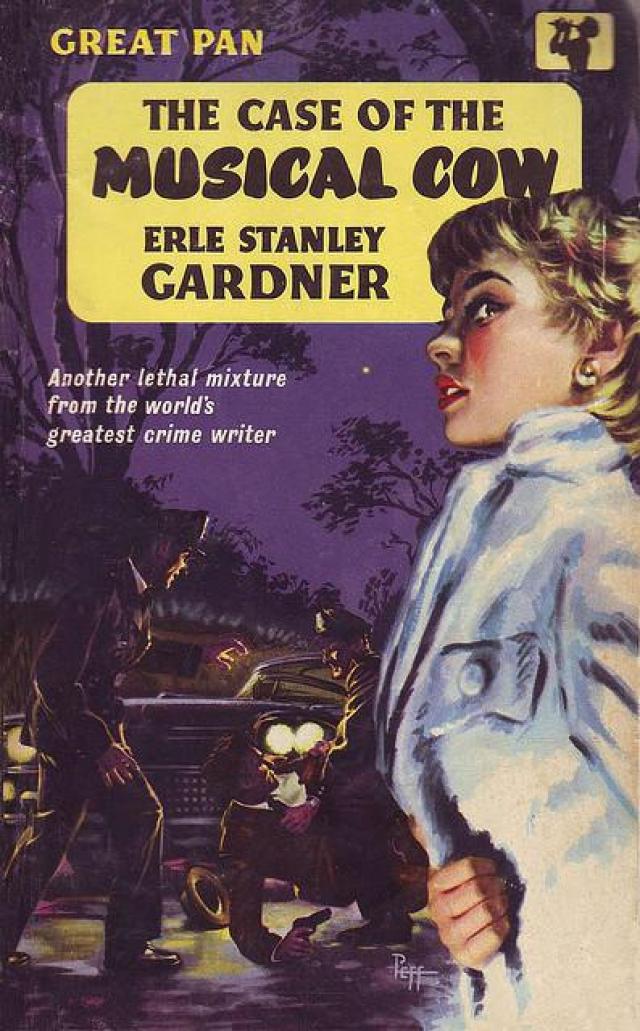
The case of the musical.., p.13
The Case of the Musical Cow,
p.13


Linda Mae's lips clamped in a thin, straight line of firm determination. "You're right. We'll keep out of it."
The rowboat landed at the pier. The coroner jumped ashore with a rope and made the boat fast. The sheriff and deputy assisted the solemn, handcuffed man to the little pier and started towards the official car with its red spotlight.
Rob started to turn away so that his eyes could not meet those of the prisoner.
Suddenly he heard a voice saying, "There he is now. That's the man. The one with the dog."
Rob turned and saw a young woman pointing directly at him, saw people staring with curious, gaping interest.
For a moment there was no motion. It was as though some strip of moving film, running smoothly through the machine, had suddenly run off the track and stopped, and the action had suddenly frozen into immobility.
The young woman said, excitedly, "I'd know him anywhere. I saw him with that other man at the bus depot in Falthaven yesterday. They drove off together."
Then the big sheriff was coming towards Rob. His right hand dropped ominously to his holster.
"All right, young fellow," he said. "We want to ask you some questions. Now you can either fix it so that dog doesn't make any trouble, or else he's going to get hurt. Just take your choice."
Rob felt Linda's hand reaching for the leash. "I'll take him, Rob," she said, a catch in her voice.
"Not a word," Rob heard Ostrander caution him in a low voice. "Clam up. Don't talk. I'll get you a lawyer. One of my fraternity brothers is practising near here. You can trust him."
"Down, Lobo," Rob said, and stepped forward to meet the sheriff.
CHAPTER NINETEEN
Sun came pouring in through the west windows of the sheriff's office. A fly droned in lazy circles over the desk.
Rob Trenton sat motionless. The lawyer whom Merton Ostrander had secured to represent him was seated on Rob's right. He was a thin-faced, quick-eyed, fast-talking individual who interjected comments from time to time, always winding up his remarks with the same formula, "Of course, gentlemen, I'm merely pointing out a discrepancy. Anything 1 say is not binding on my client, and my client refuses to make any statement at this time."
The smuggler whom the sheriff held under arrest, the same one who had decoyed Rob into the car, who had helped overpower him and hold him prisoner, sat at the sheriff's right. There was an air of smug cunning about him. So far he had failed to make any statement within Rob's hearing, but from references made by the sheriff, the man had evidently told a detailed story of what had happened.
Rob wondered what that story was.
A stenographer entered the office, carrying a typewritten statement, which she handed to the sheriff The sheriff took it, cleared his throat and said to the smuggler, "I will now read your statement to you This isn't in your exact words. It's boiled down, but it's taken from what you said. If there's anything you want to change about it, you speak up right now and change it.
If it's wrong we want to fix it so it's right. Do you understand that?"
The smuggler nodded.
The sheriff read slowly so that there would be ample opportunity to make corrections:
My name is Sam Joyner. I am fifty-two years of age. I am the registered owner of a houseboat, the Lady-Lou.
About two months ago I was approached by a man whom I only know as Big Jim. He wanted to rent my houseboat. He said he wanted to do some entertaining. At the time, I thought it was just a question of a few wild parties, but after a while I began to believe it was something more sinister. I should have gone to the police right then, but I didn't. I rode along because the rent was good and because it was only my word against theirs. I didn't participate in any of the profits from smuggling. They paid me a flat rent for the boat, and permitted me to keep one cabin for my own use. However, I lived aboard and, by keeping my ears open, got to know what was going on.
Last night things came to a showdown. Harvey Richmond, who I now understand is connected with the State Narcotics Division, forced his way aboard and tried to make an arrest.
A man, whom I only met yesterday, who gave the name of Rob Trenton, had smuggled in a shipment of heroin that had been concealed by him in an automobile which he had arranged to drive for a young woman who was on the ship with him. After he had smuggled this dope shipment ashore he buried it. He told the smugglers where he had buried it and they went to get it. I understand one of the gang was arrested when he went to dig it up.
M. ( „H - M
This man Trenton was aboard my houseboat last night. Harvey Richmond evidently had been keeping the boat under observation. I didn't know this. I had decided to terminate the lease on the boat and notify the police. I went ashore but left my car parked clown under a little wooden shed on an adjoining farm which I rent as a garage. I had gone to it and then recalled some personal belongings I wanted on the boat.
It was as I was returning to the boat that 1 heard a car drive up at high speed. Then, when I was almost to the boat, 1 saw this man, Rob Trenton, run off the houseboat and to the pier. 1 saw him cast loose the lines that held the houseboat, then someone tried to stop him. I think it was Harvey Richmond, but 1 can't be sure. He called to Trenton to stop and surrender. Robert Trenton raised a gun and fired twice. Richmond, or whoever it was, fell back to the deck. 1 turned and started to run through the darkness to my car. I had gone about twenty yards when I looked back over my shoulder and saw the first flames coming up from my boat. I debated whether to notify the police and finally decided against it because 1 thought no one knew I had been aboard the boat, so I got in my car and went to my home.
That is all 1 know.
"Now that's true?" the sheriff asked.
"So help me, that's true," Sam Joyner said. The sheriff handed him a pen. Sam Joyner signed the statement.
"Now," the sheriff said, "write underneath that: 'I, Sam Joyner, have made the above statement as my free and voluntary act and without any coercion of any sort.' If that is the case, sign that declaration. If it isn't, just tear the thing up."
Hi
"That's the case," Sam Joyner said.
"All right. Write it."
Joyner wrote and signed the statement as requested.
Rob Trenton, who had been listening incredulously, said, "That's a lie! That whole statement is false. This man was one of the..."
"Hold it!" Rob's lawyer interrupted. "Don't say a word, Mr Trenton, not a word. If you do, you'll have to explain, have to answer questions. We'll make a complete statement later. Right now all I want you to say is that you deny this accusation and that it's false."
"Of course it's false! This man kidnapped ..
"That's all," the lawyer interposed. "You've denied the charge. That's enough."
"Every word of that is the truth," Joyner said doggedly.
"My client says it's false," Staunton Irvine, Rob's lawyer, said promptly.
"Your client's trying to lie out of a murder rap," Joyner said.
"How do you know?" Irvine shot the question at him.
"Because I saw him shoot this man. I think the man was Richmond. 1 don't know, but I'm pretty certain that's who it was. Trenton shot twice and hit him both times. Then the boat caught fire."
"Now then," Rob's attorney said, "you don't know it was Robert Trenton who fired those shots. You can't swear to it, can you?"
"I can swear to it," Joyner said.
"And," the attorney went on, "you don't know that any of the shots hit Harvey Richmond. You were on the shore, and ..."
"That'll do," the sheriff said. "Mr Joyner is not going to be cross-examined at this time. Now then, Mr Trenton, you've heard Mr Joyner's statement. Do you care to make any statement?"
Irvine said quickly, "My client denies shooting Harvey Richmond. The claim that he did is absurd. Joyneris statement is a lie. However, we are not prepared to make any statement of our own at this time."
"When will you make one?"
"Well, now," the attorney said, "that depends very much upon the circumstances. Has it ever occurred to you, Sheriff, that this is the wrong jurisdiction in which to try this case? The river is a state boundary. That boat burned and drifted aground ..."
"That doesn't make any difference," the sheriff said. "According to the testimony of Mr Joyner, the murder was committed right here in this state and in this county. We're taking charge. Now then, I'm going to tell you some more things. The charred body of Harvey Richmond was identified by a badge that he carried in his pocket, by a tattoo mark which was still visible, and by his dentist."
"No comment," the attorney said.
"Two bullets were found in his body. Either one of those bullets would have been instantly fatal."
"No comment."
"Two empty cartridges which had been ejected from an automatic were found on the ground by the pier this morning."
"No comment."
"And," the sheriff went on triumphantly, "the State Police from across the river have co-operated to the extent of making a search of the house of Linda Mae Carroll at 205 East Robinson Street, where your client apparently spent the night, and in the drawer of a locked desk there they found a .32 calibre automatic which had been recently fired, with two shells missing from the cartridge clip. 1 think you'll find that ballistics experts will identify the fatal bullets as having come from that gun."
"1 tell you we have no comment," the attorney said. "Not at this time."
"When will you have a statement?"
"1 can't tell you. That will depend on developments. I am protecting the interests of my client. He is the victim of a frame—
up,"
"Yeah. That's what they all say. You got any more comments?"
"We are making no statement at this time. 1 would like to point out to you, however, the utter absurdity of the claim that Harvey Richmond could or would have been aboard that houseboat freely and voluntarily and in a position to have tried to apprehend my client."
"Why not?" the sheriff asked.
"Because that houseboat had been rented by a gang of smugglers. If Harvey Richmond had been aboard that boat he would have been a prisoner."
"They weren't aboard the boat when the shooting took place," Sam Joyner said hurriedly. "The only two persons 1 saw were this man Trenton and the man who was killed."
"You don't know the others weren't aboard."
"Well ... no, of course, I didn't search the boat."
"And something happened which caused you to get out of there and decide you'd go to the police? Why didn't you?"
"That's all," the sheriff interposed. "Don't answer that question, Joyner. Dont answer any more questions. If Trenton isn't going to make a statement, we're not going to make any more statements. We've accused Rob Trenton of the murder of Harvey Richmond."
"And that accusation has been denied," the attorney said.
"Not specifically and categorically."
"Deny it," the lawyer said to Rob Trenton. "Deny it specifically and categorically."
"I deny it," Trenton said, "specifically and categorically."
The sheriff jerked a thumb. "Okay," he said to one of the deputies. "Lock him up. We'll file murder charges."
CHAPTER TWENTY
Colonel Miller C Stepney of the State Police surveyed the charred wreckage of the fire-swept houseboat.
"I don't give a hang where the murder was committed," he said. "The boat is within our jurisdiction. The body was within our jurisdiction. We're going to see that the evidence is preserved. Then at least we'll know what we've found and what we didn't find."
Captain Stanway Harmon said, "We're going to have some trouble with the folks on the other side. The coroner wants to get the body put in a coffin and sent to the relations. He says there's no use performing an autopsy because the X-ray showed the presence of two bullets in the body. Their doctor dug the bullets out and is prepared to state that either one of the bullets would have been instantaneously fatal. One of them went through the heart and the other was just above the heart."
"Neither bullet went all the way through the body?" Colonel Stepney asked.
"No, they were ,32-calibre and they were lodged inside the body."
"How did they happen to do such quick work with the X-ray? Itls a wonder they didn't claim the death was due to burning simply because they found a charred body."
"They found the two ejected cartridge cases and the owner of the houseboat told this story of the gun fight. So they X-rayed the charred body, found the bullets, and the doctor is willing to testify death was instantaneous and that's that."
Colonel Stepney stroked his jaw thoughtfully. "Makes it look pretty bad for that Trenton chap."
"I'll say it does."
"Well, Dr Dixon wants to check up on the cause of death. Harvey Richmond was not only a friend of his, but it seems that Narcotics had a tip-off a load of dope was to come over on that ship, and Richmond went along in an undercover capacity. He became acquainted with Trenton on the ship. Richmond seemed to think Trenton was just a fall guy who was apt to be on the receiving end. He felt he was being used as a cat's-paw.
"Well, Richmond!; dead now," Colonel Stepney went on, "and Dr Dixon wants to perform an autopsy. I've told the sheriff they'll either have to hold the body until Dixon gets here or that we'll demand its return. After all, it was removed from our jurisdiction."
"They're touchy about that," Captain Harmon said.
"I'm touchy about it myself," Colonel Stepney snapped. "It's surprising that a chap like Trenton could have fooled a veteran investigator such as Harvey Richmond."
"You think he did?"
"Sure he did. Remember we have the goods on Rob Trenton because of the work that Trooper Wallington did in checking on the location where Trenton had a blowout.
"Rob Trenton pulled off to the side of the road and buried the shipment of heroin. He intended to dig it up later. Trooper Wallington was on patrol duty, stopped him and checked his licence. Trenton told him he'd stopped to change a tyre. He showed a blown-out tyre on the rear of the car. It just happened, however, that Wallington in handling the tyre remembered later that it wasn't warm. The cold tyre showed Trenton had given a false story. Later on Wallington checked up on it and found where something had been buried and found a cache of heroin."
Captain Harmon nodded thoughtfully
"All that ties Trenton right into the dope smuggling," Colonel Stepney went on, "and if Ballistics ties those two bullets up with the gun we recovered in the desk at Linda Mae Carroll's place, it!s the electric chair for Trenton. A perfect case."
Til say it's a perfect case," Captain Harmon agreed fervently.
"But," Colonel Stepney went on, "1 don't like the way they're jumping at conclusions over there and getting the cart all in front of the horse. I want to go about the thing methodically and I want to have this evidence preserved so that we'll know just what we have and what we don't have."
Captain Harmon pointed up the river to where a speed launch was clipping through the water at a fast rate, spreading a bow wave on each side of the prow in a huge, curling V of sheeted water. "This looks like Dr Dixon now," he said.
The two officers stood waiting until the launch veered and slowed down, then crept alongside and Dr Herbert Dixon climbed aboard.
One look at the doctor's face and Captain Harmon said, "He's mad."
Dr Dixon nodded a curt greeting, said, "We seem to be up against a question of jurisdiction here. What's the answer?"
"We dont want to make any trouble," Colonel Stepney said. "The thing isn't worth it. We need the co-operation of those folks across the river from time to time, just as they need ours. We can get all worked up over this thing and there'll be repercussions that will impair our joint efficiency for the next ten years. Let's keep our heads."
"Well," Dr Dixon said, "it looks like an open-and-shut case. This man Trenton certainly fooled me, but they're acting on the assumption that they know everything that is to be known. The coroner is satisfied he knows the cause of death, and he probably does. But I want a complete necropsy performed and 1 either want to do it or I want to be there when it's done."
"You do it," Colonel Stepney said. "Thai much we're entitled to."
"The coroner's been in touch with the relatives. He's a mortician, you know, and he's more concerned right now with the type of casket he's going to sell and the type of funeral service, than he is with anything else."
Colonel Stepney said, "You go and make a post-mortem on that body. If you want to make an issue of it, go make an issue of it."
"I want to make an issue of it."
"All right, go ahead."
"I can tell you one thing," Captain Harmon said. "It won't make a darned bit of difference what you find out. They're going ahead with a murder prosecution against Robert Trenton. The prosecutor wants to be a judge and this looks like a good stepping stone."
"Well, it probably is," Dr Dixon said. "It bothers me that Trenton was able to pull the wool over my eyes the way he did. It's too bad the fire consumed so much of the evidence. What do you make of it, Colonel?"
Colonel Stepney said, "Captain Harmon has made a rather complete examination. Suppose you tell him, Captain."
Harmon said, "Well, the situation is a little peculiar. We aren't dealing with anything stationary like a house. We have to take into consideration the fact that a drifting boat will swing around in the river and the wind might blow the flames from several different directions, but the fact remains that from my examination of the boat my conclusion is this fire started up in the bow in what evidently was a locker room."
"In the bow?" Dr Dixon said. "But the engine is in the stern and the gasoline tanks are in the stem."
Captain Harmon nodded.
"Yet the fire started in the bow?" "That's my best belief."
"What caused it?"
"The theory of the sheriff it that is was a short circuit between two wires. 1 asked him what caused the short circuit and he just looked at me. My own theory is that it was a fire of incendiary origin that started near the bow and I'm going to take photographs that'll prove my point. There's an unequal area of charring, and quite evidently parts of the structure there in the bow were subjected to greatly varying degrees of heat. It's as though there had been some inflammable liquid used in starting the fire. Then the flames swept back towards the stern."