

The case of the musical.., p.15
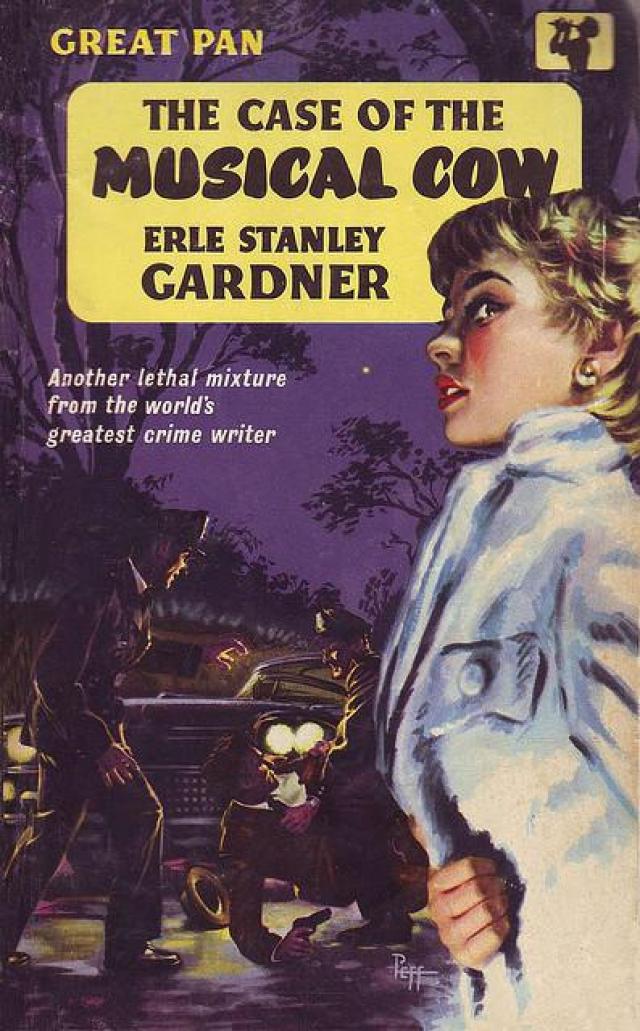
The Case of the Musical Cow,
p.15


Dr Dixon said, "I'd like to know the exact sequence of events. However, those shots were fired from close range."
"Powder stains on the garments?"
"No. Not anything quite so tangible. However, I've been able to salvage some of the charred cloth and I find in it distinct evidence of lead particles. Nothing you can get with the naked eye, but stuff that the X-ray picks up."
"How close was the killer when the shots were fired, Doctor?"
"I'd say under eight feet and more than two feet."
"What's that?" Stepney exclaimed. "That hardly ties in with the story anyone tells."
"That's why I want to do some more checking of facts. Suppose I should come up with something that would prove Trenton didn't do it?"
"You couldn't. He may not have done it when they claim he did it, or how they claim he did it, but he's the murderer. He has to be."
"Suppose he isn't?"
"Gosh, Herb, they've picked him over there as a natural. Look at the evidence against him!"
"That's just what I'm doing."
"Their political careers may depend on a speedy conviction on open-and-shut evidence."
"Suppose they're wrong?"
"Well, we'd have to be mighty certain of our facts. The way things are now ... I'm satisfied it'!! all tie in when you get the evidence lined up, Herb."
"Suppose it doesn't?"
"We'll cross that bridge when we come to it. There's a lot at stake - co-operation between the police of two states for one thing."
"And a human life for another," Dr Dixon said.
"Sheriff Landes tells me they have one of Robert Tremens fingerprints on the cartridge clip. It's his thumbprint beyond any question."
Dr Dixon said, "I'm having photographs made of the ejected cartridge cases. Apparently there's no question but what ncy were fired in and ejected by that .32 automatic."
Colonel Stepney shook his head. "We've go to be careful and objective, Herb. You knew this chap on the ship and he made you like him. You're going to have to put all that to one side."
"Of course. But I'm not going to put my conscience to one side."
"No one's asking you to ... but if it should go the other way, Herb, we'd have to be so sure of our facts that we could go all the way. We'd have to demonstrate Trenton's innocence. To do what would be virtually impossible. He had the gun. It had two shots fired. He admits he fired them."
"I know," Dr Dixon said. "1 can t tell what I'm going to find - probably nothing."
"If you find anything, find a lot."
"I'll try to find everything that remains, Colonel."
Colonel Stepney paced the floor for a few minutes. "All right," he said at length. "We'll hew to the line, Doctor. To hell with the chips."
CHAPTER TWENTY-FOUR
Sheriff Landes and Norton Berkeley, the prosecuting attorney, sat in conference.
There was a gleam of triumph in the eyes of Sheriff Landes, and the district attorney, making notes, would from time to time nod his head approvingly.
Landes said, "We have it all sewed up and wrapped in cellophane. We've made a deal with the State Police. They're going to release Marvus Gentry and he's going to give us everything we need to tie Robert Trenton right up with the dope shipments."
Berkeley nodded.
"And," the sheriff went on, "that's just peanuts. We now have a bombshell you can spring in court, a perfect motive for the murder."
"What is it?" Berkeley asked.
"When we searched the room of Harvey Richmond, we found he'd been cabling the authorities in Switzerland. There's a little inn run by a man named Ren£ Charteux. Madame Charteux died very suddenly, apparently of poisoning from eating a toadstool which had been included in mushrooms she'd used as a sauce for meat.
"Apparently Richmond was suspicious, for some reason or other. He first sent a ship's wireless to the Swiss authorities. The Swiss authorities started work. What do you think they found?"
"What did they find?"
"Madame Charteux died because she ate enough arsenic to kill a horse."
"Can we check that up with Robert Trenton?"
"Robert Trenton stayed at the inn."
"What dates?"
"Well," Sheriff Landes admitted, "there's a little discrepancy there. He apparently was at the inn a couple of days or so after the funeral. But he was pretty thick with the husband. And Harvey Richmond got the tip to work on the murder angle because of stuff he learned on the ship when he was investigating Trenton. The copies of the wireless messages show all that.
"Now what I figure is that you can throw all this into your opening statement, or you may want to hold it in reserve."
The prosecutor said, "It's hard to get the evidence from Switzerland in a form we can use."
"Does that mean our hands are tied?"
"Not at all. There are lots of ways of skinning a cat. 1 might wait until Trenton gets on the stand and then start throwing questions at him on cross-examination, asking if it isn't a fact that he stayed at this inn, and if it isn't a fact that this Madame Charteux died very suddenly, and if he didn't know that Harvey Richmond was investigating the facts concerning her death at the time Richmond met his death."
The sheriff nodded. "That should do it."
Berkeley said, "Incidentally, there's no reason why you have to keep quiet about this, you know."
"You mean the newspapers?"
"I don't mean anything," Norton Berkeley said sharply, "but I see nothing about it that's confidential. You say you found the evidence there in Harvey Richmond's things?"
"That's right. There were copies of the wireless messages he sent, and there was a cable that was received from. the authorities in Switzerland the day he died. The Swiss authorities are launching an investigation."
"Well," Berkeley said, fixing his eyes significantly on the sheriff, "1 don't see anything about it that necessarily needs to remain confidential so far as we are concerned."
"Well, that's fine," the sheriff said, "The metropolitan papers have asked me for a statement, and ..."
"Better let me handle that end," Berkeley interposed quickly. "There are some fine legal points to be considered."
"Okay. Just as you say. Now here's something else that ties right in on that poisoning plot. When the Customs men searched Trenton they found two capsules filled with white powder in his bathrobe pocket."
"The deuce they did! Where are they?"
"Harvey Richmond asked for them. The Customs men gave them to him and they've disappeared. We can't find 'em."
Berkeley's manner showed excitement. "That's why Trenton killed him. He had this evidence that would tie Trenton in on this Swiss killing, so Trenton killed him and got the capsules. Get one of the Customs men to say he's seen powdered arsenic and these capsules contained a powder that was the colour of arsenic."
"The colour of arsenic?" the sheriff asked. "Those Customs men never even opened the capsules. They didn't taste, smell, or..."
"The colour of arsenic," Berkeley repeated.
"There are too many things that colour. Flour, soda, baking powder ..."
"Never you mind that," Berkeley said. "You get those Customs men on the line. Get 'em to say the capsules contained a powder that was just like arsenic in appearance."
"Okay," Sheriff Landes said. "Now I've made arrangements to get Gentry all cleaned up on that dope possession charge. He's going to co-operate with us."
"Does he understand that?"
"Sure he does. I thought it might be a good idea for us to talk with him together."
Berkeley toyed with his pencil. "It's better to have all the preliminary matters cleared up before such a witness actually talks with the district attorney."
"I know, I know," Landes said. "I know how you feel about that, but this is one time where we just can't afford to have any misunderstanding. I thought it would be a good idea if they checked with me on this thing. In that way we could both ... well, we'd sort of be together on it."
"Where is he now?"
"Waiting outside in the other room, in the custody of one of the deputies."
"All right," Berkeley said. "Let's get him in."
Jk
CHAPTER TWENTY-FIVE
Dr Herbert Dixon, closeted with Rob Trenton in the visitors' room of the little country jail, said, "Trenton, I'd like you to have confidence in me."
Trenton nodded.
"1 want you to tell me what happened. I want you to begin at the beginning and tell me your whole story, from the time you first met Linda Carroll on the ship until you found yourself under arrest."
Rob Trenton thought things over for a moment, then said, "I'm sorry. Doctor, but my attorney tells me I shouldn't talk to anyone."
"And who's your attorney, Trenton?"
"Staunton B Irvine."
"Do you have confidence in him?"
"Naturally."
"You've known him for a long time?"
"No."
"How did you get him?"
"A friend got him for me. That is, he put Irvine in touch with me."
"Who's this friend?"
"Merton Ostrander."
"You have confidence in Ostrander?"
"Not too much."
"Then why do you have confidence in the attorney Ostrander selected for you?"
"Because when you're in a mess of this sort you have to hire a lawyer. Just the same as when you're sick and need an operation, you have to consult a doctor."
"And why doesn't your attorney want you to say anything?"
"Well, I suppose ..."
"Are you afraid that you might get tripped up, might get caught in some lie?"
"Of course not."
"Then why shouldn't you tell your story?"
"I think he wants it to come as a surprise when 1 tell it in court."
"It may be a surprise all right, and you may be the one who gets the surprise."
Rob said nothing.
"I'm going to tell you this," Dr Dixon went on. "There's something strange about the facts in this case. They don't tie in the way they should. 1 want you to tell me your story. 1 want you to recite every single fact, even the facts which seem to you to be utterly insignificant."
"Why?"
"Because 1 think in some insignificant fact, some little thing which doesn't seem to you to have any particular bearing or importance on the case, the key to the whole situation may be concealed."
"When you have a lawyer you must do what he tells you."
"Not always. Are you afraid to talk to me - afraid you'll betray yourself?"
"Of course not."
"Then why not talk?"
"I've told you that."
"I'll promise to keep the information as confidential as possible. I'm actually a physician, you know."
"And you're tied up with the State Police."
"What does that mean?"
"It means that police always hang together and in the long run you'll try to stick me."
"I'll try to find the real criminal. If you're the murderer, don't talk with me."
"Just what do you want to know?"
"You took that .32 automatic to the home of Linda Mae Carroll in Falthaven, didn't you?"
"Yes. I'll admit that. I'll have to. They all saw the gun."
"Where did you get that gun?"
Rob said, "I took that gun from the man I overpowered there on the houseboat. If the gun had been used to kill somebody, it had been used before I got it. And if that's the case, the person was already dead."
"You fired that gun?"
Rob hesitated a moment, debating whether to answer.
"Please," Dr Dixon said. "This may mean a lot to you."
"Yes, 1 fired it," Rob Trenton said, "but 1 didn't hit anything, and I didn't kill anyone."
"Will you tell me the circumstances under which you fired it, Trenton?"
"Well, I got off the houseboat and got to the wharf, and then I was afraid that the others might pursue me and catch me, so 1 cut the lines loose that held the boat to the wharf. There was a current running past there, and the boat very gently, very slowly started out into the current."
"It didn't scrape against the dock?"
"No."
"There was no bump? Nothing to warn the people aboard that they were drifting?" "Well," Rob said thoughtfully, "there must have been something, because someone came up on the deck and looked around. By that time the bow of the boat had drifted out and started to swing. The stem of the boat was coming in so that it would almost touch the little landing dock. The figure started to run towards the stem of the boat - I shouldn't be telling you this."
"I think you should, Rob. I think you're coming to the part 1 want right now."
Rob Trenton shifted his position uneasily in the stiff-backed prison chair, then said, "Well, t fired the gun."
"How many times?"
"Twice."
"Why?"
"To keep the man from running to the stem of the boat."
"Did you hit him?"
"1 know 1 didn't hit him."
"How do you know?"
"Because he didn't act as though he was hit. He flung himself down."
"He didn't fall down?"
"It wasn't a fall. Anyhow, I don't think it was. I think he just flung himself flat on the deck."
"Did you sight the gun?"
"No, I just pointed it."
"And fired twice?"
"Yes."
"Are you sure that you didn't hit him?"
"1... I don't know for sure," Rob blurted. "I wish I did. 1 keep kidding myself by saying that I'm sure he flung himself down. But how do 1 know how a man acts when he's received a fatal bullet in the heart? I've seen men shot in war, but those circumstances were different. Anyhow, this man seemed to fling himself down on the deck."
"Did he move after that?"
"1 didn't see him move. We may as well face it, Doctor, 1 can't tell for sure whether 1 hit him. I don't think I did, but 1 can't tell."
"Now let's think carefully," Dr Dixon went on. "When you shoot a gun there's a split second between the sound of the explosion and the sound of the hitting of the bullet, particularly with a relatively low velocity hand gun, and if the distance is great enough to allow such an appreciable interval. There were three things you might have struck with those bullets. One was the figure of the man, the other one was wood, such as the hull of the boat or the pier, and the other one was water. Now did you hear any thud that would indicate the bullet had struck wood - either of the bullets?"
"I ... I can't remember. I didn't notice if 1 did."
"Did you hear any smacking sound that would indicate the bullet had struck water?"
"The same answer. I can't remember whether 1 did. If I did, I didn't notice it at the time, and therefore don't remember it now."
"All right, you shot twice. Then what happened?"
"Well, the boat swung around and after the bow had swung into the current the stern came out, the current hit the boat broadside on, and it started drifting downstream."
"So what did you do?"
"Put the safety on the gun and ran towards the shelter of some trees - because I'd heard a car coming."
"And then what?"
"Well, when I'd gone a short distance 1 heard steps. 1 listened and then I could hear very distinctly the sound of steps. A woman's steps."
1/. <»K / >
"So what did you do?"
"1 crouched down, turned around and waited."
"And what happened?"
"Then all at once there was a flare of light which shot up from the houseboat. The boat started to burn. A big pillar of flame shot up as though gasoline or something had been ignited. I crouched there watching, and 1 saw this woman standing out at the edge of the pier, her figure silhouetted by the burning boat. There was a ruddy reflection on the water, and after a moment, the sky, which was overcast, began to reflect back the flames."
"How far was the boat from the dock at that time?"
"A little way. 1 can't tell how far."
"A hundred feet?"
"Wei! ... it's hard to estimate distance at night, and with a burning object. It could have been a little over a hundred feet."
"The last you saw of this man you shot at, he was lying prone on the side of the boat that was drifting towards the current?"
"Yes."
"Which side?"
"7"hat would be the left side. The port side."
"All right. And you fired while the figure was on the port
side?"
"Yes."
"Fired twice?"
"Yes."
"Fired to frighten him?"
"Yes, sir. That's right. So he wouldn't run towards the rear of the boat and be able to jump ashore. I fired those two shots as a warning."
"And the figure stopped moving?"
"That's right, flung himself down."
"And was then on the port side of the boat?"
"Yes, sir." "Lying still, the last you saw of him?"
"Yes, sir."
"And how long was it after that when you saw the boat burst into flames?"
"Oh, I'd say it was ... well, I don't know. You lose track of time on an occasion of that sort. 1 think perhaps it could have been as much as two minutes. I don't know."
"Where were you standing when you lired the shots, Rob?"
"1 guess that part of it is all right. They found the ejected shell cases where the automatic had thrown them out. 1 was standing about ten or fifteen feet from the shore line, from the end of the pier where it touches the land."
"You were standing on land?"
"Yes."
"Some ten or fifteen feet from the end of the pier?"
"Yes."
"And how long is that pier?"
"Oh, it must be thirty or thirty-five feet."
"And the boat was out away from the dock?"
"Yes."
"So the distance from where you were standing, to the figure on the boat, must have been at least sixty or seventy ieet?"















