The case of the borrowed.., p.14
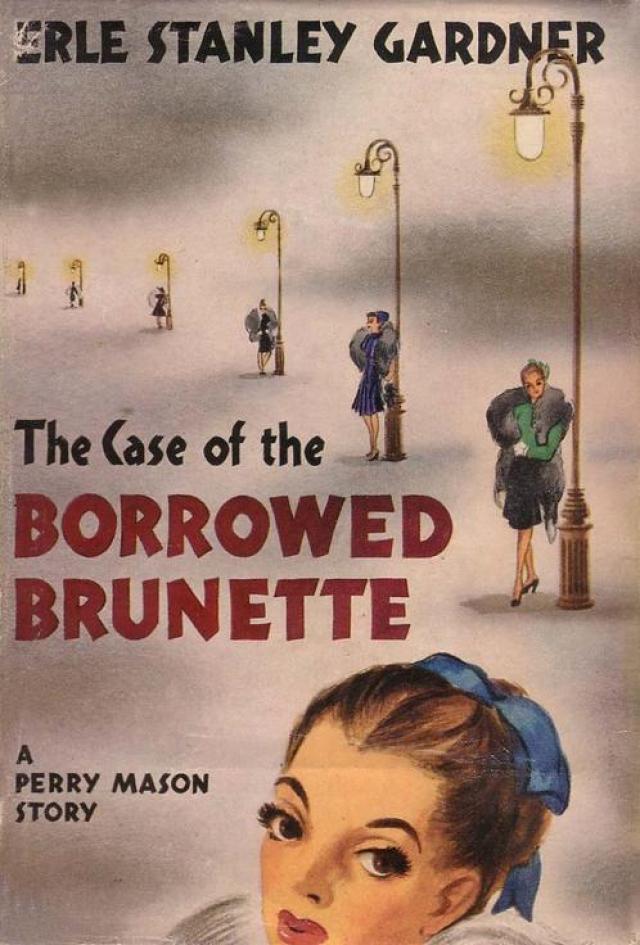
The Case of the Borrowed Brunette,
p.14


(Continued on Page 11)
Mason didn’t bother to turn to the inside page. He folded the paper, tossed it to one side, and said to Della Street, “Della, I have a letter I want you to write.”
She whipped open her notebook and held her pencil ready.
“This letter,” Mason instructed her, “is not to be typed. It must be written in longhand on a delicately perfumed sheet of stationery. It will read: ‘Dear Mr. Mason. I hope you won’t think I did wrong in telling the Grand Jury I had never seen Eva Martell in my life. Things happened so fast I didn’t have any time to get in touch with you and wasn’t sure just what I should do under the circumstances. However, I remembered that when I last heard from you, you told me that you wanted me to put her in a room where——But I guess I’d better say this in our code.’”
Della Street looked up with surprise, her eyebrows raised interrogatively.
“Now,” Mason said, “let’s devise a code that no one can decipher!”
“I thought experts could decipher any code.”
“They can,” Mason answered with a grin, “provided the code means anything! You, Della, will fill the rest of that sheet of social stationery with letters and numbers, all mixed together and broken up into words containing five characters each. See that there are both numbers and letters in each word. And when you finish it, sign the letter ‘Mae’ and bring it in to me.”
“No last name?”
“No last name—just ‘Mae.’”
“Chief, what in the world are you doing? It’s manufacturing evidence that will put your neck in a noose!”
“Exactly,” Mason said. “When you have written the letter, go to the bank and get me seven hundred and fifty dollars in cash. And,” he warned as Della started for the door, “be sure to see that the handwriting in the letter is unmistakably feminine.”
“Any particular type of stationery?” Della asked.
“I think Mae would buy a box of pale-rose or something of that sort; and don’t forget the perfume!”
“I won’t,” she promised. “I’ll get started right now.” And she left the office.
A few minutes later Paul Drake’s code knock sounded on the door of Mason’s private office. The lawyer crossed over to open it.
“Hello, Paul, what’s new?”
“Lots of things,” Drake said. “When I got to my office I found a collection of stuff.”
“Important?”
“I think it’s damned important, Perry.”
Drake crossed over to the big overstuffed chair, slid into his favorite position, his legs dangling over one of the arms, his back propped against the other.
“Now here’s a funny one,” Drake said. “I got this right from headquarters and I’m darned if I know what it means.”
“Shoot.”
“You know that the banks these days are-quietly keeping a record of all large bills passed out. They don’t say much about it, but when a man asks for big bills the bank keeps a record. Not ostentatiously, of course. For instance, the hundred-dollar bills in a drawer are listed by their serial numbers. A man who wants ten hundred-dollar bills gets the top ten—and after he’s left the bank the cashier makes a note of the top ten numbers on the list, and that’s that. They’ve got a record of who has those particular bills.”
Mason nodded.
“Now in that wallet of Hines’s,” Drake went on, “there were twenty-one hundred-dollar bills. I don’t think the police have yet traced the history of all of those bills, and probably they never will, because the bills came from various sources. But the point is that five of them, Perry, came from Orville L. Reedley.”
“The devil they did!”
“Uh-huh.”
“Well,” Mason commented, “when you stop to figure that angle of it, I guess . . . Say, Paul, let’s check up on this Reedley boy. Let’s find out where he was at the time the murder was committed. After all, you know, he’s supposed to be insanely jealous and—”
“He’s absolutely in the clear. Police have already checked on him up one side and down the other. He had lunch that day with the local manager at the Interstate outfit. He went back to the office with this manager and was there until around two-thirty, blocking out a strategy by which he hoped to trap his wife. Incidentally, Perry, I think the guy had begun to smell a rat. I think Helen Reedley was having her double put on too good an act. That chaperone business was too good to be true.”
Mason said, “Well, there must have been some connection between Hines and Reedley.”
“That’s what the police figure. They’re giving Reedley a shakedown. As soon as they get done, I’ll find out just what they’ve discovered.”
“But why should Orville Reedley pay money to Hines? There’s only one answer to that, Paul: it must have been because Hines was giving Helen Reedley a double-cross. But there’s no evidence of that. There’s—Wait a minute, Paul, I’ve got it!”
“What?”
“Don’t you remember? Reedley’s a gambler. He’s been doing a little gambling, and it was at a poker game that he broached the subject of the detective agency. Well, Hines also is a gambler. Hang it, Paul, Hines must have been sitting in on that poker game when Reedley asked that question. And yet Reedley isn’t supposed to know Hines . . . That money must have changed hands in a poker game and found its way into Hines’s pocket.”
“How?” Drake asked.
“Wait a minute,” Mason said. “I’m beginning to get the picture now. That gambler friend of Helen Reedley’s . . . ”
“What about him?”
“Probably in love with her. Remember that Helen got Hines to rig up the double for her, but she didn’t tell him why. The gambler tipped Helen off to the probability that her husband’s detectives were going to be on the job, but he also wanted to know why. So he probably hired Hines to do a little snooping for him, and the money with which he paid Hines was, ironically enough, money that had been lost to him in a poker game—lost by Orville Reedley!”
Drake nodded. “That does it, all right, Perry. When you stop to think, it’s logical enough.”
“That’s probably the way it was. When did Reedley get those bills at his bank?”
“About a week ago. Went in and cashed a check for five thousand dollars-—wanted it all in hundreds. The bank has a pretty good idea what he does with it. Of course, the explanation of the listing of the numbers is that the Government is trying to get information about the black market, and about the boys who are evading the income tax. Reedley has a clear record. But the bank took the numbers of those bills simply because the drawer with the hundred-dollar bills in it had already been arranged and the list was right there. So that’s it, Perry.”
Mason nodded in assent, but Drake had not quite finished.
“Now,” Paul went on, “let’s give the police a run-around on this. Orville Reedley can’t tell them how Hines got those bills, because in the first place he doesn’t know, and in the second he’d be afraid to even if he did know.”
“Why afraid?”
“He lost them gambling,” Paul explained. “Suppose he tells the officers that. Then the officers say, ‘O.K., who were you gambling with? Give us the names.’”
“Boys who start tattling on these big gamblers,” Mason said, “aren’t very good life-insurance risks.”
Drake nodded.
“So,” Mason went on, “you’re quite right. We’ll give Orville L. Reedley to the police as a nice red herring. You say his present flame is Daphne Gridley?”
“As nearly as we can tell.”
“See that the cops get a tip on that, too.”
“You’ve already sent his wife off on a hot scent.”
Mason grinned. “Start the cops on it as well. The success of a red herring, Paul, depends on choosing one who just might be suspect—”
“Okay, Perry, we’ll toss Reedley to the wolves.”
“What else have you got?”
“I don’t suppose it makes any difference, but I’ve identified that boy friend of Helen Reedley’s that she was so touchy about.”
“Who is he?”
“Chap by the name of Arthur Clovis.”
“How in the world did you get a line on him, Paul?”
“Through those telephone numbers on the pad that Frank Holt picked up.”
“Say, wait a minute, Paul. You say the number was on that pad?”
“That’s right.”
“And that pad was in Carlotta Tipton’s apartment?”
“Uh-huh.”
“By the telephone that Hines used?”
“Yes.”
“But Hines wasn’t supposed to know anything about the boy friend. That was supposed to be a secret from him!”
“That’s the way I understood it, too—but the number was there.”
“How did you know it was Helen’s friend’s number?”
“We had a lucky break there. I had my men checking up on all the telephone numbers on that pad. One of them happened to be working today on this Arthur Clovis—at Clovis’s apartment—when suddenly Helen Reedley came to call on Clovis. The operative who was there had no idea who she was, naturally, but he gave me a description of her a little while ago that checked all right.”
“Better watch those descriptions, Paul,” Mason said. “Don’t forget how easy it was to find brunettes of that same physical description.”
“I know, but the Reedley girl has something else that sticks out like a sore thumb. The operative made a note in parentheses after the description—he called her ‘high-voltage.’ That’s certainly Helen Reedley.”
Mason nodded. “Sounds that way. Now how about Arthur Clovis? What does he do?”
Drake grinned as he fished a cigarette case out of his pocket. “You’ll get a real kick out of this, Perry.”
“Okay, let me have it. What does he do?”
“He works in a bank.”
“What bank?”
Drake lit the cigarette and blew out the match deliberately. “The bank where Orville L. Reedley keeps his account.”
“Well, I’ll be damned! What job?”
“Assistant cashier. Evidently a nice chap—dreamy-eyed and idealistic. From all we can find out, he’s been saving some money and planning to go into business for himself.”
“Then he’s quite well acquainted with Orville Reedley?”
“I should suppose so.”
“Probably handles his deposits, cashes his checks, and all that?”
“Uh-huh.”
“Say, wait a minute, Paul. Do you suppose he’s the one that cashed Reedley’s check and recorded the numbers on those hundred-dollar bills?”
“Gosh, Perry, he may have been.”
Mason frowned. “Let’s give this some thought, Paul. If Hines had Arthur Clovis’s phone number, it must mean he’s been doing some gumshoeing of his own. Ostensibly, he was just a nice, cooperative little tool for Helen Reedley. Really, he was laying the foundation for a sell-out. He must have got that telephone number by snooping around Helen Reedley’s apartment. And that gives us a picture. Helen Reedley gave him her keys and the run of the apartment, so that he could fix up this substitute brunette convincingly. He used the keys to prowl around whenever the apartment was unoccupied.
“That means only one thing, Paul—blackmail. Or a sell-out, if you look at it from the other angle. Now that gambler, let’s suppose he’s in love with Helen Reedley. Any idea who he might be?”
“Hines went around some with Carl Orcutt,” Drake replied. “Orcutt used him for little things.”
“Check on Orcutt, Paul.”
“That’ll be tough. My operatives won’t want to work on him. The guy’s pretty hard, Perry. Anybody that gets in his way is likely to become a casualty.”
“Well, see what you can do. And how about Helen Reedley’s calling on Clovis today? Why wasn’t he on his job at the bank?”
“Oh, he isn’t working today—he’s at home, sick. Probably all broken up over the way things are going for Mrs. Reedley.”
Mason got up and started to pace the floor. “Hang it, Paul, this begins to have ramifications. Why should Arthur Clovis be broken up?”
“Well, we’ve heard how sensitive he is, you know. And-—after all—the bird was killed in Helen Reedley’s apartment.”
“Sensitive or not, Clovis must be a pretty good egg, or Helen wouldn’t have fallen for him. I’d guess that he would be willing to take the gaff if he had to.”
“Yes,” Drake said. “You may be right, at that.”
“Your man didn’t have much of a talk with him?” asked Mason.
“No talk at all—didn’t even see him. Didn’t have to, as it turned out. He was going to represent himself as coming from an insurance company to check on a policy application Clovis had made. But when he got to the house—But first let me tell you about the house. It’s one of those with no attendant in the lobby—-just a whole string of bells in the vestibule. You ring the apartment you want, and a buzz signal opens the door and tells you to come up. And there’s a speaking tube in case the person upstairs wants to find out who it is, before buzzing the door open.
“Well, my man had planned to snoop around the apartment house for a while, get a line perhaps on how long Clovis had been there, and even see him if he could get in. But as he was standing there in the vestibule, checking up on the address and making sure that Clovis did live there, this woman came hurrying in from the street and jabbed her linger on Clovis’s bell. She gave it a short push, a long one, and then two more short ones. The buzzer sounded right away and she went on in. He got a pretty good description of her, and gave it to me.”
“How long ago did this happen?”
“Apparently some time within the last hour or so. He reported just before I came up here.”
Mason was silent for a few moments as he paced the floor, deep in thought. Then he said, “The thing just doesn’t click, Paul. There’s something wrong somewhere, some discrepancy in character . . . . Of course, no one checks the accuracy of the lists turned in by the bank employees.”
“You mean the lists of serial numbers?”
“That’s right. A cashier’s cash has to balance at the end of the day; but he can take out all the hundred-dollar bills he wants, make up the amount with twenties, and report giving hundred-dollar bills to anyone.”
“You mean that those hundred-dollar bills that Hines had didn’t come to him through the husband?”
“I don’t know,” Mason said. “But when the assistant bank cashier who has reported giving hundred-dollar bills to a husband turns out to be the boy friend of the husband’s estranged wife, and those bills show up in the wallet of a man who was murdered in the wife’s apartment—well, after all, Paul . . . it does make me skeptical.”
“Hell,” Drake said, “when you put it that way, it makes me skeptical, too! Let’s go see the guy.”
Mason nodded. “I want to wait for Della. She’s gone down to pick up some cash.”
“Not in hundred-dollar bills, I hope?”
Mason grinned. “In hundred-dollar bills, Paul. And I only hope the bank keeps a record of them. Here she is now.”
Della Street breezed into the office. “Hi, Paul! Here’s the money, Chief.”
“Okay, get that letter written. I’m going out with Paul. Probably back in three-quarters of an hour.”
“Rumor around the courthouse is that Harry Gulling is laying for you, Perry.”
“Let him lay,” Mason said. “He may lay an egg.”
Chapter 16
MASON pushed the button opposite the name Arthur Clovis, giving a short ring, then a long, and then two shorts. Almost instantly the buzzing of the door signified that the electrically controlled catch had been released and Drake, who was waiting, pushed the door open.
“What’s the number?” Mason asked.
“Two-eleven.”
“An elevator?”
“I don’t know. But here are the stairs, anyhow.”
“Okay, we’ll walk up,” Mason said.
They climbed to the second floor, found the apartment they wanted, and Mason tapped gently.
The door was flung open. A man’s voice said, “Why, Helen, what brings you back—” He stopped in open-mouthed astonishment.
Mason thrust out his hand, his smile was affable. “Mr. Clovis, I believe?”
“That’s right.”
“My name’s Mason, and this is Mr. Drake. May we come in?” And Mason pushed on past the startled young man, seated himself, smiled, and said, “I was talking with Helen Reedley. I believe she told you about it.”
“She . . . Did she send you here?”
Mason’s face showed surprise. “You mean you didn’t know I was coming?”
“No.”
“Well, close the door and sit down; we may as well talk things over without taking the whole apartment house into our confidence. I want to find out what you can tell me about what happened when Orville Reedley cashed that five-thousand-dollar check. I believe you were the one who took the record of the numbers . . . .”
Arthur Clovis’s face showed relief. “Oh, that. That’s all been taken care of. A Lieutenant Tragg from the Homicide Division of the Metropolitan Police Force questioned me and drew up a written statement for me to sign.”
“You cashed the check for Reedley?”
“Yes, I did.”
“Worked in the bank for some time, have you?”
“Three or four years.”
“Know Orville Reedley quite well?”
“Only as a depositor.”
“Wait on him frequently?”
“Yes. As it happens, I’m in charge of the window R-to-Z and I often have dealings with Mr. Reedley.”
“Large cash withdrawals?”
“I’m afraid I’m not allowed to discuss the affairs of a client at the bank. But if you’ll get in touch with the account manager, he’ll doubtless—”
“I’ll do that later,” Mason interrupted. “I’m interested now in finding out something of the personal relationship.”