

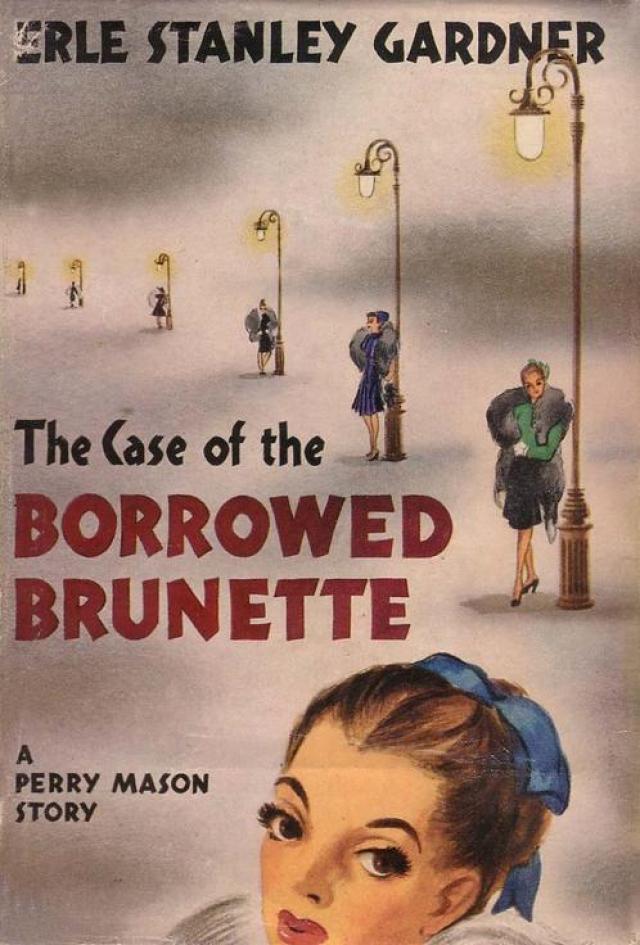
The case of the borrowed.., p.15
The Case of the Borrowed Brunette,
p.15


“What do you mean?”
“You’re in love with Reedley’s wife.”
“Mr. Mason!”
“Come, come,” Mason said, “save the dramatics. Let’s just get down to brass tacks.”
“That remark is . . . ”
“The truth,” Mason finished, as Clovis hesitated.
“You are asking about something that is none of your business. Damn your impertinence anyway!”
“Let’s skip all this, Clovis, and find out what the score is. The last thing you want is to have this given any publicity. And, what’s more to the point, you know very well that it’s the last thing Helen wants. I have all the facts, so let’s not do any bluffing. We can save time being frank.”
“I understand you are an attorney,” Clovis said sullenly.
“That’s right.”
“Well, what business is this of yours?”
“I’m making an investigation on behalf of my clients.”
“Who are your clients?”
“Two women, Adelle Winters and Eva Martell. Do you know them?”
“No.”
“Then you shouldn’t have any hesitancy about answering questions.”
“It’s a matter I don’t care to discuss.”
“If necessary, I can subpoena you as a witness at the preliminary examination, put you on the stand, and get the information I want in front of a courtroom full of people.”
“I don’t think the law would let you do that.”
Mason lit a cigarette and said nonchalantly, “Lots of people disagree with me about points of law. Some of them are lawyers, too.”
“Just what do you want to know?”
“I want to know what the set-up is. I want to know why Helen Reedley arranged for a stand-in. I want to know why you’re so surreptitious about your affair with Helen.”
“Helen is a married woman, and there is no ‘affair.’”
“She’s left her husband.”
“Who is a particularly ruthless, determined man, unusually possessive and jealous.”
“And so you’re afraid of him?”
“Afraid of him?” Clovis exclaimed indignantly. “Hell, I’ve been wanting to go have it out with him for two months, but I refrained on account of Helen. She’s frightened to death of him. He has all but ruined her life. She’s becoming a nervous wreck.”
“Did you know about the woman who was impersonating Helen Reedley?”
“No.”
“You knew Helen wasn’t at her apartment.”
“She told me she’d let a friend have the apartment.”
“And gave you her new address at the hotel?”
“Yes.”
“You saw her there?”
“Yes.”
“Went out with her?”
“Yes.”
“Same old restaurants as usual?”
Clovis started to say “Yes,” then gave the question puzzled consideration, changed his mind, and said, “Well no, as a matter of fact, we were going to new restaurants.”
“I know,” Mason said, “but you didn’t have any idea of the purpose back of all this?”
“None whatever.”
“Until Hines came to see you,” Mason said.
Clovis jerked as though Mason had pushed a pin into him. “Hines,” he said, as though the repetition of the name would give him time to think.
“He came to see you?” Mason asked.
“What makes you think he did?”
“Did he?”
“Well, yes.”
“When?”
“The morning of the third.”
“What did he want?”
“I . . . Mr. Mason, you won’t think this is the truth, but it is. I simply don’t know what the man wanted.”
“Didn’t he say?”
“No.”
“Lay any foundation for meeting you at a later time under different circumstances?”
“No.”
“Any attempt at blackmail?”
“I don’t think there was.”
“Why don’t you know?”
“Because I wasn’t at the time aware of all the circumstances. And in such a situation, naturally, one is likely to overlook significant passages in the conversation, little hidden meanings that tie in with . . . ”
“Suppose you tell me exactly what happened.”
“I was on duty at the bank. Hines came to my window. It was during a slack period and there was no queue. When he gave me his name I told him he was at the wrong window, that I only handled only the R-to-Z deposits. He smiled and said, no, he thought he was at the right window.”
“Then what?”
“Then he started making enigmatic remarks. I couldn’t get what he was driving at.”
“Can you remember what he said?”
“Well, it was all rather mysterious. He said he might want to borrow some money, and that the person who would endorse his note would be a depositor whose name would be in the accounts that were handled at my window.”
“And what did you tell him?”
“I told him that notes were handled in an entirely different department in the bank. And then he asked, ‘I suppose you know Orville L. Reedley and Helen Reedley, his wife?’ I didn’t answer the question directly, though I was perfectly polite—I just told him that he would have to inquire at the Loan Department.”
“Then what happened?”
“He started to turn away from the window, then stopped and smiled pleasantly and said, ‘I’ve seen your face before,’ or something of that sort. I told him I didn’t remember him and he said that he had a girl friend who lived in the Siglet Manor Apartments and asked me if I knew the place.”
“What did you do?” Mason asked.
“I simply turned away. He smiled and walked out.”
“Do you know whether he went to the Loan Department?”
“No, he didn’t—he just walked out. I watched him.”
“He intimated to you that he would be asking to borrow money on a note signed by Helen Reedley?”
“Or Orville Reedley. That, of course, was just my guess. I don’t really know.”
“I understand.”
“There was no suggestion of blackmail?”
“Blackmail? Well—no. Only the smirking, insinuating way he approached me.”
“Was it threatening?”
“Not threat so much as unctuous assurance.”
“And what are you going to do, now that the cat’s out of the bag?”
“Going to do?” Clovis exclaimed. “I’m going to see Orville Reedley and tell him that he can’t ruin Helen’s life by arbitrarily refusing her a divorce. She doesn’t need his consent, really. It might not be pleasant-—it might be . . . To hell with it! I’ll fight. I’m not going to be pushed around.”
“Are you absolutely certain that Hines didn’t cash a check?”
“When?”
“When he called at the bank.”
“Hines cash a check? Absolutely not! Not at my window. He couldn’t have cashed it there anyhow, because I don’t have any H clients. But from the way he talked I don’t think he had any money in the bank. I didn’t check to find out, but I don’t think he has a dime with us.”
“You’re sure you didn’t give him five hundred dollars, and then tell the police that the five hundred had been delivered to Orville Reedley on a check he had cashed?”
“Mr. Mason—please! What on earth gave you any such idea as that?”
“I don’t know,” Mason said, and added somewhat wryly, “And I wish I did. Does Mrs. Reedley know you plan to talk with her husband?”
“I told her I was going to.”
“What did she say?”
“She pleaded with me not to. She said that would spill the beans; that her husband would never consent to a divorce and that we would have played right into his hand.”
“Look here,” Mason said. “Did you ever, under any circumstances or for any length of time, have a key to Helen Reedley’s apartment?”
“Hang it, Mason, that’s a slanderous insinuation! You can’t—”
“Keep your shirt on. Answer my question. Did you at any time have a key to Helen Reedley’s apartment?”
“No.”
“Not for any period of time, no matter how brief? Not just to go and get something for her?”
“No!”
Mason said, “Hines had a key.”
“He was working for her. He had to go in and out.”
“And you never had a key, not even for a brief period? She never sent you up there to get something for her?”
“Absolutely not! If Helen had wanted anything in her apartment, she’d have got it herself. She would never have thought of sending me up there with a key.”
“I’m trying to get certain points cleared up. There doesn’t seem to be any pattern yet, and I’m trying to get the real facts. I was hoping you could help me.”
“I can tell you this much: Orville Reedley is intensely jealous and possessive—absolutely impossible! He refused to give his wife a divorce and swore that he’d contest any divorce she’d apply for. She had placed herself in his power by telling him that she cared for someone else.”
“Any witnesses to that conversation?”
“No—there were just the two of them. But that’s one thing about Helen Reedley, she wouldn’t lie for anybody; she wouldn’t even shade the truth. If her husband ever got on the witness stand and repeated that conversation, Helen wouldn’t deny it—she isn’t built that way. You can bank on that: Helen won’t lie!”
Mason was silent for a moment. Then he said, “You were on duty at the bank when Hines showed up and talked with you?”
Clovis nodded.
“That was the day of the murder?”
“That’s right.”
“You saw Helen Reedley that same day?”
“Yes, she was in the cafeteria where I usually eat lunch.”
“What time?”
“Twelve-thirty.”
“You knew she’d be there?”
“Well, I . . . ”
“You’ve seen her there before?”
“Yes.”
“Sat at the same table with her?”
“Well, naturally.”
“You told her about Hines?”
“Yes.”
“And then what happened?”
“Why, we ate lunch-—that’s all.”
“Did she say anything to lead you to believe she was at all concerned over the conversation you’d had with Hines?”
“Not exactly. She said she knew him slightly.”
“And what time did you leave her?”
“Well, it was about—oh, I’d say a little after one-thirty.”
“A little after one-thirty?”
“Yes.”
“I thought you said you had lunch at twelve-thirty?”
“I did.”
“Do you have more than an hour for lunch?”
“Well, I . . . I wasn’t feeling well that afternoon and took the rest of the day off. I had one of my headaches—eyestrain.”
“Now then,” Mason said, “tell me the truth, because I can verify it by checking up on your record at the bank. How many days have you missed work in the last six months because of those headaches?”
Clovis hesitated.
“Come on,” Mason said, “let’s be frank. How many days?”
“The afternoon of the third—and today.”
“You’ve had a hundred-percent record at the bank up until the day Hines was murdered?”
“Why keep referring to it as the day the man was murdered? It was the third of this month!”
“All right, we’ll call it the third. Where did Helen Reedley go when she left the cafeteria on the third?”
“I don’t know.”
“Did you try to follow her?”
“Mr. Mason, I’ve been patient with you and answered a lot of questions about matters that are really none of your business, if I may say so. Now I am going to ask you and your companion to leave. Really—I’m too nervous to answer any further questions.”
“Then I am to assume that you did try to follow her?”
“Mr. Mason, will you please leave this apartment?”
Mason nodded to Paul Drake. “I guess that’s as good as we want,” he said. The two men walked across to the door. Just before Mason stepped out into the corridor, he turned and shot a rapid-fire question at Arthur Clovis. “Did you follow her all the way to the Siglet Manor Apartments?”
In dignified silence, Clovis walked over and closed the door behind them.
“Well,” Mason said out in the corridor, “that’s that!”
“What do you make of it, Perry?”
“Darned if I know,” Mason said. “He’s trying to cover for her, for something. He knows something that has him worried sick—Lord knows what it is. He’s no weak sister, but he’s certainly a nonbelligerent! A high-voltage girl like Helen Reedley would fall for the big, dynamic type, and then on the rebound—as her mother instinct came to the fore—she’d fall for some clean-cut young chap who is sensitive, shy, and retiring, but has a nice clean mind and a healthy imagination.”
“Meaning Arthur Clovis?”
“Arthur Clovis comes pretty close to answering that description.”
“So what do we do?” Drake asked.
“We go back and wait for something to break. We’ve stretched several wires almost to the breaking point. What I want right now is to have something crack that will give Gulling a jolt. He’s going to get me before the Grand Jury. I want to have this preliminary hearing slap him in the face with a surprise before he gets me there.”
Chapter 17
IN THOSE tense few moments before the arrival of the judge on the bench, the whispered comments of the spectators sounded like a continual hissing. What came as considerable surprise to the initiate was the fact that Harry Gulling was present personally at this preliminary hearing, representing the district attorney’s office and thus advertising to those who knew their way around the courthouse that this was indeed the “grudge fight” it had been called in the papers.
Perry Mason looked up as a deputy sheriff brought in Adelle Winters and Eva Martell. The lawyer rose, shook hands with the two defendants, and saw that they were seated beside him.
“I’m so sorry about that taxicab,” Eva Martell whispered. “I thought I would drive by the apartment that Cora and I shared, and if the police weren’t watching it . . . It was foolish—I don’t know why I did it.”
“That’s all right,” Mason said. “That’s all water under the bridge now.”
“They’ve been trying to get a statement out of me. Not so much about the crime itself as about where I stayed that night. Whether you had anything to do with getting me . . . ”
“I know,” Mason whispered. “Let’s not bother about it. Excuse me for a moment—there’s Paul Drake. I have to see him.” He got up and beckoned to Drake, who had just entered the courtroom.
As the detective joined him, Mason said, “Paul, stand close to me. I’m going to slip you something. I don’t want anyone to see it.”
“What?”
Mason didn’t answer him directly, but said, “This is something I’ve been hoping for but hardly dared believe might happen: Harry Gulling is going to handle the case for the prosecution himself!”
“Isn’t that rather unusual?”
“Damn near unique!” Mason replied. “As you know, he’s the shrewd legal mind that guides the policy of the district attorney’s office, but I never thought he’d be much good before a jury—his mind is too mathematical and detached, and he hasn’t enough understanding of human nature. Now, listen, Paul: I want to have witnesses to the contents of this wallet. It’s my own, and I want an inventory of it made. In it are some money, some letters, my driving license, and a few other papers. I want Gulling to find it in the men’s room.”
“Going to be rather difficult,” Drake said.
“No, it isn’t. You can have a man in there ready to plant it. Then have another man out in the corridor who can give a signal when Gulling heads that way. I want it left where it will be readily seen, but where it isn’t too conspicuous.”
“Okay,” Drake said. “I’ll give it a whirl.”
Mason moved closer and slipped the wallet into Drake’s hand. “Make sure Gulling gets it, and—”
They were interrupted by the banging of a gavel and a clerk ordering everyone to stand.
Judge Homer C. Lindale entered the courtroom, took his place at the bench, and nodded the spectators to their chairs. A moment later he called the case of The People vs Adelle Winters and Eva Martell.
“Ready for the prosecution,” Gulling said.
“Ready for the defense,” Mason announced.
“Proceed,” Judge Lindale said to Gulling.
“Your Honor is familiar with the crime charged?”
“I have read the complaint. It is a case of first-degree murder, I believe.”
“Yes, Your Honor. The defendants are charged jointly and are both represented by Mr. Mason.”
“I so understand. Proceed.”
“Your Honor, my first witness will be Samuel Dixon.”
Dixon, duly sworn, took the witness stand, stated that he was a radio-car officer and had been such on the third of the month when he received a call to go to Siglet Manor Apartments and investigate at Apartment 326. On arriving there he had found both defendants in the apartment. The younger, Eva Martell, was excited and somewhat hysterical, but the older one, Adelle Winters, was quite calm and collected. They had shown him a body which they said was that of a man named Robert Hines.
“Where was this body?”
“Seated in a chair in the bedroom, rather slumped forward, the head inclined over toward the right shoulder. There was a hole almost in the center of the forehead. There were powder marks visible around the hole, indicating that it was a bullet hole. There had been some hemorrhage. The man was in his shirt sleeves. His coat had been removed and hung over the back of the chair in which the body was slumped.”
“Did the defendants make any statements to you in regard to the identity of the dead man or how they happened to discover him?”
“Yes, sir.”
“What were those statements?”















