

The case of the deadly t.., p.14
The Case of the Deadly Toy,
p.14


“Mrs. Jennings took the empty gun and started to take it back upstairs to put it where it belonged, then remembered a guest, Norda Allison, was in the room. So she left the gun on the stand in the front hall at the foot of the stairs and went back to bed.”
“Where was her husband?” Mason asked.
“Asleep in another downstairs bedroom. When he has his attacks of arthritis, he takes codeine and sleeps in a separate room.”
“How did he find out about it?” the lawyer asked.
“Mrs. Jennings was worried. She slept for an hour or two and then wakened and couldn’t go back to sleep. She heard her husband moving around in his room. That was about daylight. She went to him and told him what had happened. He became very much alarmed. He went out to look around and evidently found something which caused him great concern. He told Mrs. Jennings to take the gun from the place where she had left it on the hall stand and as soon as Norda Allison got up to return it to the drawer where they kept it. Then Mr. Jennings took Robert and brought him to me. I kept Robert all day yesterday and reassured him as best I could. Mr. Jennings said I should do a job of brain washing.
“Then this morning Mr. Jennings brought some of Robert’s clothes to me and said I was to leave at once and take Robert to Mexico City. He said we had reservations at the Hotel Reforma. He gave me money for the fare, told me that we had reservations on a plane and everything was all cared for. We were to leave this morning.
“So we went down to the airport and Mr. Horace Selkirk, the boy’s grandfather, showed up. I had never met him, but he identified himself to me and told me that under no circumstances was Robert to leave the jurisdiction of the court. He said we were to come with him and that he would take the responsibility. He said he would send for Barton Jennings and get the thing straightened out.
“He had a man with him and they put us in an automobile and took us up to Horace Selkirk’s big house. Robert was happy there but I was worried because Mr. Jennings didn’t show up to tell me that I had done the right thing.
“I took Robert in swimming and he had a wonderful time in the pool. He’s visited there several times and always has the time of his life. His grandfather keeps toys and things for him and Robert loves it.
“Well, almost as soon as we had finished dressing after our swim Mr. Selkirk came rushing in to the rooms he had assigned us in the west wing of the house. He was very excited and said we were to pack up at once, get ready to leave and were to come here and wait here until he gave us further orders.”
“What about Barton Jennings?” Mason asked. “Did he ever find out you weren’t going to Mexico City?”
“No. Mr. Horace Selkirk had us write postal cards which he said would be flown to Mexico City and then mailed to Mr. and Mrs. Jennings. He told us that police were questioning the Jennings and that it was absolutely essential that we remain concealed so no one would know where we were. We had an understanding with Mr. Jennings that we would send postal cards that would simply be signed G.R. That stood for Grace and Robert.”
“And you wrote some of those cards?”
“Yes.”
“How many?”
“There must have been a dozen or so. Horace Selkirk almost threw them at us. He said he’d have them sent to Mexico City and mailed at intervals so no one would become suspicious. He had me scrawling postal cards until I became dizzy.”
Mason studied her carefully for a moment, then said, “All right, now tell me the rest of it.”
“What do you mean?”
“There’s something else. How much did Selkirk promise you, or how much did he give you?”
She lowered her eyes.
Mason stood silent, his eyes steady, waiting.
At length she sighed, raised her eyes. “He gave me a thousand in cash and promised me five thousand more if I followed instructions.”
Mason thought things over for a moment, then said, “Ever hear about the kidnaping law?”
“What do you mean?” she flared. “He’s the boy’s grandfather!”
“And as such has no more to say about his custody than anyone you’d meet on the street,” Mason said. “Right at the moment the child’s mother is the only one who has any say about where he’s to be kept. She told you to take him to Mexico City.”
“It was her husband who told me.”
“But he was speaking for her. You were given custody of the boy to take him to Mexico City. If you take him anywhere else it’s kidnaping.”
“Mr. Selkirk said he’d fix it up with the Jennings.”
“And did he do so?”
“He said he would.”
“Then why promise you money?”
She was silent for several seconds. Then abruptly she said, “I knew I was doing something wrong. Okay, you win. I’m going to Mexico City.”
“That’s better,” Mason told her. I’m going down and get a taxicab. Give me your suitcases. This is Miss Street, my secretary. We’ll take the suitcases down and handle things so no one will know you checked out. You wait exactly twenty minutes, then take Robert, go down in the elevator, ask if there’s a drugstore near here, walk out of the hotel and turn to the right. Miss Street and I will be waiting in a taxicab on the corner. You’ve made a wise decision. We must keep Robert away from all these emotional stresses. Now you go to Mexico where you can take Robert’s mind off what has happened. It’s particularly important you stay where Horace Selkirk won’t know where you are.”
“But how can we do that?” Grace Hallum asked. “He’ll be furious. He’ll find us.”
Mason said, “No, he won’t. You’ll be at the one place where he’d never expect you to be. The Hotel Reforma in Mexico City.”
Grace Hallum said, “The suitcases are all packed. We haven’t unpacked. We just got here.”
Mason nodded to Della Street, said, “If you don’t mind, we’ll take the suitcases to another floor. We don’t want it to appear that you’re checking out.”
“But what about the bill on these two rooms?”
“The reservations were made by Horace Livermore Selkirk,” Mason said. “Let him pay the bill.”
“How long will it be before anyone finds out we’re not here?”
Mason grinned. “It could be a long time.”
“And then?” she asked.
“Then,” Mason said, “when Horace Livermore Selkirk finally puts two and two together, he may quit being so damned patronizing.”
Chapter 13
Back in the cocktail lounge at the hotel where they had engaged the cab Mason said to Della, “I think those are our shadows over there.”
“Where?”
“The man and the woman in the corner. There have been surreptitious glances in our direction, and the man’s not as interested in her as he should be in an attractive woman companion who is being plied with liquor.”
“Why plied?” Della Street asked.
“It makes them pliable,” Mason said.
She laughed. “Ever try it?”
“What we need,” Mason told her, “is a red herring. Go to the phone booth, call Paul Drake and tell him we want a woman operative who is about twenty-seven blonde, rather tall, with a good figure, and a seven-year-old boy, well-dressed, quiet and dark.”
“Why do we want them?” she asked.
“Because,” Mason said, “we’re going to give Horace Selkirk’s detectives something to think about.”
“And what do they do?” Della Street asked.
Mason said, “They move into the hotel where Horace Selkirk got the two connecting rooms for Grace Hallum and Robert Selkirk. Drake can fix them up with a passkey and they can move right into the hotel as though they owned the place. Tell Paul not to ever let them charge anything, but to pay cash for everything. The woman isn’t ever to sign the name of Grace Hallum. She’s simply to pay cash for everything.”
“But won’t the clerk know the difference? That is, won’t he—?”
“We’ll wait until the night clerk comes on duty,” Mason said, “then this operative and the boy will go into the hotel, take the key to 619 and 621, move in there and stay there.
“The woman is to keep the key to the room in her purse, never to go near the desk, never to say to anyone that she is Grace Hallum.”
Della Street thought the matter over, then said, “You don’t suppose they’ve got the line tapped here, do you?”
“I doubt it,” Mason said. “It’s a chance we’ll have to take. Just go to the phone and call Paul. I’ll keep an eye on the couple over there and see what they do.”
Ten minutes later when Della Street was back, Mason said, “They were certainly interested in your telephone call, Della, but they didn’t dare appear too curious. They’re wondering what kept us out of circulation for so long—how did Paul Drake react?”
“The same way you’d expect,” she said. “He agreed to do it, but he’s not happy about it.”
“Why isn’t he happy?”
“Says he’s violating the law.”
“What law?”
“What law!” Della Street asked. “Good heavens, here’s a woman who moves into some other woman’s room in a hotel, and—”
“What do you mean?” Mason asked. “She isn’t moving into any other woman’s room. Grace Hallum has left the hotel.”
“But she didn’t pay her bill.”
“The bill was already paid,” Mason said. “Horace Selkirk arranged for that, and even if she had left the hotel without paying the bill, she would have been the one who defrauded the hotelkeeper. Drake’s operative isn’t defrauding anybody.”
“But she’s moving into a room in a hotel.”
“Exactly,” Mason said. “She’s prepared to pay for the accommodations. The hotel keeps its rooms for rental to the public.”
“But she didn’t register.”
“Is there any law that says she has to?”
“I think there is.”
“Grace Hallum didn’t register. She simply went and picked up the key. That means somebody had registered into those rooms and left instructions with the clerk that the key was to be delivered when a woman with a child asked for it.”
“Well,” she said, “Paul Drake wasn’t happy.”
“I didn’t expect him to be happy,” Mason said. “When you hire a detective you pay his price for services rendered. If he follows instructions, you can guarantee to keep him out of jail, but you can’t guarantee to make him happy.”
Chapter 14
Judge Homer F. Kent looked down at the people assembled in the courtroom and said, “This is the time fixed for the preliminary hearing in the case of the People versus Norda Allison.”
“Ready for the People,” Manley Marshall, a trial deputy from the district attorney’s office, said.
“Ready for the defendant,” Perry Mason responded.
“Very well. Proceed,” Judge Kent said.
Marshall, following a generally recognized pattern with the crisp efficiency of a man who knows both his case and his law, and is determined to see that no loophole is left open, called the caretaker at the San Sebastian Country Club.
The caretaker testified to noticing a car parked early on the morning of the eighteenth. He had thought nothing of it as occasionally golfers came early for a round of golf. Later on, at about eleven-thirty, one of the golfers had told him that there was someone out in one of the parked cars who apparently had been drinking and was sound asleep.
The caretaker looked, saw the figure slumped over the wheel, did nothing about it for another hour. Then he had taken another look, had seen blood on the floor of the car and had notified the police.
“Cross-examine,” Marshall said to Mason.
“Did you,” Mason asked, “look inside the car?”
“I looked inside the car,” the witness said.
“Did you open the door?”
“I did not open the door. I looked in through the glass window in the door.”
“Through the glass window in the door?”
“Yes.”
“Then the glass window in the door was rolled up?”
“I think so.”
“That’s all,” Mason said.
Marshall called the deputy coroner who testified to being called to the scene, a photographer who introduced photographs, an autopsy surgeon who testified that death had been caused by a .22-caliber bullet. The bullet had entered on the left side of the chest, just in front of the left arm. It had ranged slightly backward and had lodged in the chest and had not gone all the way through the body. The autopsy surgeon had recovered the bullet and had turned it over to Alexander Redfield, the ballistics expert. Death, in the opinion of the physician, had not been instantaneous. There had been a period of consciousness and a period of hemorrhage. That period was, in his opinion, somewhat indefinite. It might have been an interval of ten or fifteen minutes after the shot had been fired and before death took place; it might have been only a minute or two.
“Cross-examine,” Marshall said to Perry Mason.
“With reference to this indeterminate interval,” Mason said, “it is then possible that the decedent had sustained the fatal wound at some other place and had driven the car to the place where the body was found?”
“It is possible but not probable.”
“Would you say that the interval between the time the fatal wound was sustained and death could not have been more than ten minutes?”
“It could have been as much as ten minutes.”
“Could it have been more?”
“I don’t think so.”
“Could it have been eleven minutes?”
“Well, yes. When I say ten minutes I am not referring to an interval which I time with a stop watch.”
“Well, you know how long ten minutes is, don’t you?” Mason asked.
“Yes.”
“Now you say it could have been eleven minutes.”
“It could have been.”
“Twelve?”
“Possibly.”
“Thirteen?”
“Well, yes.”
“Fourteen?”
“I can’t fix the time exactly, Mr. Mason.”
“Fifteen?”
“I’m not going to say that it couldn’t have been fifteen minutes.”
“Twenty?”
“I doubt very much if it was twenty minutes.”
“It could have been?”
“It could have been.”
“The decedent could have been driving the, car during that time?”
“During at least a part of that time. There was considerable hemorrhage and he was losing blood and losing strength.”
“Thank you,” Mason said. “That’s all.”
The doctor left the stand, and Marshall called Sergeant Holcomb to the stand.
Sergeant Holcomb testified that he was connected with the homicide squad of the police department; that he had gone to the San Sebastian Country Club, had examined the body and the car.
“Did you make any examination of the surrounding terrain?” Marshall asked.
“I did.”
“Did you find anything which you considered significant?”
“I did.”
“Please tell us what it was that you found.”
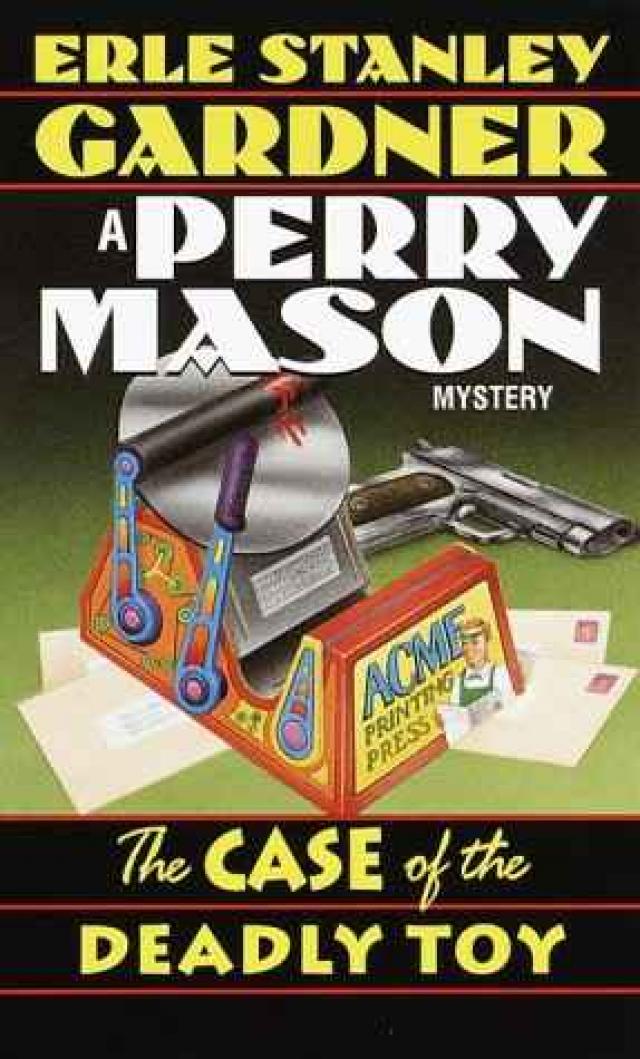
Sergeant Holcomb glanced triumphantly at Perry Mason. “Concealed in the brush, within a hundred yards of the place where the automobile was parked, and just a few yards off a service road which skirts the hill on a lower level, I found a printing press.”
“What sort of a printing press?” Marshall asked.
“A portable printing press of a very good quality which was capable of doing good work. It weighed in the vicinity of eighty-five pounds, I would say.”
“What else can you tell us about that printing press, Sergeant?”
“A name and address had been set in type in that press. The name was the name of the defendant in this case and the address was her address in San Francisco.”
“Did you find anything else significant about that printing press?”
“I did.”
“What?”
“There was the imprint of a fingerprint in the ink on the steel table over which the rollers ran when the press was operated.”
“That was a circular table?”
“It was.”
“And it revolved with each impulse of the press; that is, each time the press was used the round steel table revolved?”
“It did.”
“And there was black ink on this round steel plate?”
“There was.”
“Can you describe that ink?”
“It is a very thick, sticky ink such as is used in printing presses of that type. When the rollers move over the steel table the ink clings to the rollers; that is, a small coating of ink clings to the rollers, and then as the rollers go down over the type, the type is inked just enough to make a legible print on the paper.”
“That ink was thick enough and sticky enough to hold a fingerprint?”
“It held it very well, yes, sir.”
“And were you able to identify the fingerprint which was on that table?”
“Yes, sir, absolutely.”
“Whose print was it?”
“It was the print of the middle finger of the defendant in this case.”
“Now then, Sergeant Holcomb, you described the operation of the press. Do I understand that whenever this press was put in operation the rollers moved over this steel table?”
“Yes, sir.”
“And the table itself revolved?”
“Well, it didn’t make a complete revolution, but it moved a few degrees of arc.”
“Then, as I understand it, if the press had been actuated after that print had been made, the print would have been obliterated by the joint action of the rubber rollers, of which I believe there are two, and the rotation of the steel table?”
“That is correct.”
“Did you find anything else in your search of the premises, Sergeant Holcomb?”
“I did.”
“What?”
“I found an empty cartridge case.”















