The case of the deadly t.., p.21
The Case of the Deadly Toy,
p.21


“Well, what if I did?”
“Then you couldn’t have been asleep while Robert was relating his dream,” Mason said.
“All right,” Barton Jennings said, “I wasn’t asleep. I had taken the dog to the veterinarian just as you suggest.”
“You were wakened by the shot?”
Jennings hesitated, then said, “Yes, I was wakened by the shot.”
“And dressed?”
“Yes.”
“And then went out to the tent to see what had caused the shot?”
“No, I went to the wounded dog.”
“And where was the wounded dog?”
“Lying by the car.”
Mason smiled and shook his head. “You’re wrong, Jennings. The wounded dog wouldn’t have gone to the car unless you had taken him to the car. The wounded dog would have gone to the house, looking for help. The fact that the dog went directly to the car and that there was a trail of blood on the lawn leading to the car indicates that you were with the dog at the time he was shot.”
“That question is argumentative, if the Court please,” Hamilton Burger said.
“It may be argumentative, but its logic is so forceful that the Court will take judicial cognizance of it,” Judge Kent said.
He leaned forward. “Mr. Jennings.”
“Yes, Your Honor.”
“Look at me.”
The witness turned to look at the Court.
“You have already contradicted yourself upon two or three vital points. Those contradictions when a person is under oath constitute perjury, and perjury is punishable by imprisonment. Now I want to know what happened. Did you take the dog to the car after the dog was shot?”
Jennings hesitated, looked down at his feet, looked at Hamilton Burger, then hastily avoided his eyes, turned to Perry Mason, found no comfort there, and remained silent with his eyes downcast.
“Did you?” Judge Kent asked.
“Yes,” Barton Jennings said after a moment.
“In other words,” Mason said, “you went out to the tent to get that gun from under Robert’s pillow, didn’t you?”
“Well… all right, I did.”
“You listened at the tent and heard Robert breathing regularly and thought he was sleeping?”
“Yes.”
“You didn’t realize until afterward that Robert, not recognizing you and utterly terrified, was feigning sleep, but had the gun in his hand.”
“I guess so, yes.”
“So you entered the tent with the dog either at your heels or just in front of you. You reached out toward the pillow and it was then that Robert shot.”
“All right.”
“As you heard the bullet hit the dog, you turned and raced out of the tent and saw that the dog was injured. You remembered that your automobile was parked there at the curb and you raced toward the automobile with the dog following you.
“While you were getting the door of the automobile open, the dog stood there, and there was a pool of blood at the curb where he stood. Then you wrapped the dog in a blanket, got him in the automobile and hurried to the veterinarian. You left the dog and then returned as fast as you could to your home. You found your wife had comforted Robert and had put him back to bed. Your wife had told Robert that you were sleeping in the bedroom, but actually she knew better.”
Jennings was silent.
“Is that what happened?” Mason asked.
“Yes,” Jennings said, “that’s what happened.”
“So then,” Mason said, “you took the gun which your wife had taken from Robert. What did you do with it?”
“My wife had put it on the hall stand. I picked it up and looked at it, then left it on the hall stand and went back to bed.”
“And when you put it back on the hall stand, you must have loaded the magazine and put the clip of ammunition back in the gun.”
“I guess I must have. I guess that’s right.”
“And then you went to bed?”
“Yes.”
“And you believe that sometime during the night the defendant got up, left her bedroom, went down to the hall stand, got the gun, went out to your car with license plate bearing the number JYJ 113 which you had left parked at the curb, drove out to the San Sebastian Country Club and killed Mervin Selkirk.”
“She must have. There’s no other explanation. The evidence shows she did.”
“How did she know that Mervin Selkirk was to be at the San Sebastian Country Club?”
“I don’t know.”
“How did she know that your car was left at the curb with the key in it?”
“She saw me park the car there.”
“And leave the key in it?”
“I don’t know, I may have—No, wait a minute, I left the key in it when I returned from the veterinarian’s office. I was excited.”
“And who used a rattail file to roughen up the barrel of the gun so that the ballistics experts could not tell what gun had fired the fatal bullet?”
“I presume she did.”
“Why?”
“So that the gun couldn’t be traced to her.”
“Then having done that, she deliberately left the gun under the pillow of the bed where she had been sleeping?”
“She probably did that inadvertently.”
Mason smiled and shook his head. “The gun was registered in your name, Mr. Jennings. You were the one who would be more interested than anyone in making it impossible for the fatal bullet to be traced.”
Jennings said nothing.
“And you now think that you must have loaded the gun after your wife put it on the hall stand?”
“Yes. I must have.”
“Then where did you get the shells? You surely didn’t go to the defendant’s room?”
Jennings rubbed his cheek with a nervous hand. “I guess I was mistaken. I couldn’t have loaded the gun.”
“Then if the defendant fired the gun, she must have descended the stairs, found the gun, inspected it, found it was unloaded, then climbed the stairs to her room, found the box of shells, loaded the gun and then gone to the country club to kill Mervin Selkirk?”
“I… I guess that’s right.”
“How would she have known there was ammunition in the room?”
“She must have found it.”
“How would she have known the gun was on the hall table?”
“She must have seen it when she started out.”
“How would she have known it was unloaded?”
“She must have inspected it.”
“And then climbed the stairs to her room to get shells?”
“Of course. Why don’t you ask her?”
“I’m asking you.”
“I don’t know what she did.”
“Now, when your dog was shot at perhaps twelve-thirty to one o’clock on the morning of the eighteenth, the barrel of the gun hadn’t been tampered with, had it?”
“No.”
“Then if the bullet is still in the dog, that bullet can be recovered by a surgical operation and the individual characteristics of the barrel of your gun can be determined just the same as though a test bullet had been fired from it. In other words, the bullet which was fired into the dog would then become a test bullet.”
“I guess so.”
“And how do you know that the barrel of the gun hadn’t been tampered with at the time the dog was shot?”
“I… I don’t know.”
“Yes, you do,” Mason said. “You know because you were the one who tampered with the barrel. You were the one who used the rattail file. You were the one who knew that Mervin Selkirk was to be at the San Sebastian Country Club and you went out there to kill him.”
“I didn’t do any such thing,” Barton Jennings said, “and you can’t prove it.”
“Then,” Mason asked smilingly, “why did you go out to Robert’s tent at twelve-thirty-five on the morning of the eighteenth to get the gun which was under Robert’s pillow?”
“Because I didn’t think it was a good thing for the boy to sleep there with a gun.”
“Then why didn’t you get the gun before you had gone to bed?”
“I didn’t think of it.”
“You knew he had the gun?”
“Well, yes.”
“But you didn’t think of it until after you went to bed?”
“Well, it wasn’t until after I went to bed that I … well, that’s right, I got up and dressed and went out to get the gun.”
“Did you waken your wife when you dressed?”
“No, she was sound asleep.”
“But she wakened when she heard the shot?”
“I don’t think so. She wakened when Robert came running into the house, telling the story of his nightmare.”
“Of what you have characterized as his nightmare,” Mason said. “Actually, Robert told exactly what had happened; that he had wakened to find a man groping his way toward his bed, that he had instinctively thrown up the gun and pulled the trigger.”
Barton Jennings was silent.
“I think,” Mason said, “I have no further questions of this witness.”
“I have no questions on redirect examination,” Hamilton Burger said. “I may state to the Court that while this cross-examination has revealed many unexpected developments, the fact remains that the positive identification of the defendant speaks for itself.”
“I’m not certain it does,” Judge Kent said.
“I would like to ask a few more questions of Millicent Bailey on cross-examination,” Mason said.
“Very well. Mrs. Bailey, you may return to the witness stand,” Judge Kent ruled.
“Your Honor, I object,” Hamilton Burger said. “This is a piecemeal cross-examination and—”
“And it is entirely within the control of the Court,” Judge Kent ruled. “Recent developments have made the testimony of this witness appear in an entirely different light. Return to the stand, Mrs. Bailey. Mr. Mason, you may proceed with your cross-examination.”
Mason said, “Mrs. Bailey, you state that you saw the defendant at around three or three-thirty on the morning of the eighteenth?”
“Yes, sir.”
“When did you next see her?”
“On the morning of the nineteenth, at about ten o’clock.”
“Where did you see her?”
“I picked her out of a line-up at police headquarters.”
“How many other people were in that line-up?”
“There were five women in all.”
“And you picked the defendant as being the one you had seen?”
“Yes.”
“Now that was the next time you had seen the defendant?”
“Yes.”
“You hadn’t seen her after that time when you saw her in the morning at about three or three-thirty, or somewhere in there?”
“Well, I… I had had a glimpse of her.”
“Oh, you had had a glimpse of her. Where was that?”
“At police headquarters.”
“And where did you see her at police headquarters?”
“I saw her when she was being escorted into the show-up box.”
“Was anyone with her at that time?”
“A police officer.”
“Were there any other people in the showup box?”
“Not at that time, no.”
“The defendant was put in there by herself?”
“Yes.”
“And you had a good look at her?”
“Yes.”
“And then afterwards four other women were brought into the showup box?”
“Yes.”
“And then the officers asked you to pick out the one that you had seen out there at the San Sebastian Country Club?”
“Yes.”
“And you unerringly picked the defendant?”
“Yes.”
Mason said, “I am going to ask Mrs. Barton Jennings to please stand.”
There was silence in the courtroom.
“Please stand, Mrs. Jennings,” Mason said.
Lorraine Jennings made no move to get to her feet.
“Stand up, Mrs. Jennings,” Judge Kent ordered.
Reluctantly Lorraine Jennings stood.
“Will you come forward, please?” Mason asked.
“Come forward,” Judge Kent ruled.
“Now then,” Mason said to Mrs. Bailey, “is there any chance that this is the person whom you saw getting out of the car and approaching the car that was parked at the San Sebastian Country Club?”
The witness studied Mrs. Jennings for a long moment, then said, “I… I don’t think so.”
“But it could have been?”
“Well, she’s got very much the same build and complexion as the defendant, but I… no, I don’t think so.”
“That’s all, Mrs. Jennings,” Mason said.
Lorraine Jennings turned abruptly and walked so rapidly she was almost running.
“Wait! Wait!” the witness said.
“Wait, Mrs. Jennings,” Mason said.
Mrs. Jennings paid no attention.
“Now that she walks rapidly,” the witness said excitedly, “I know that it was this woman. There’s a peculiar way she has when she walks; that hurrying walk, that was just the way she walked when we saw her.”
Mason smiled and said to Hamilton Burger, “That, Mr. District Attorney, concludes my cross-examination. Do you have any redirect examination?”
Hamilton Burger slowly got to his feet. “If the Court please,” he said wearily, “I suggest that this matter should be adjourned until tomorrow morning at ten o’clock. There are some things which I feel should be investigated.”
“I think so, too,” Judge Kent said dryly. “The case is adjourned until tomorrow morning at ten o’clock, and in the meantime this defendant is released on her own recognizance.”
Chapter 18
Mason and Della Street were in the lawyer’s private office when Drake’s code knock sounded on the door.
“Let Paul in,” Mason said wearily.
Della Street opened the door.
Drake, grinning broadly, said, “Well you did it, Perry.”
“What happened?” Mason asked.
“Complete confessions,” Drake said. “Also, you have a suit against Horace Livermore Selkirk. He filed a complaint charging you with kidnaping, then it turned out you had sent the boy to the place where his mother told him to go, and Hamilton Burger’s face is red over that.”
“But what about the case itself? What about the murder?” Mason asked.
“Mervin Selkirk was a cold-blooded, highly efficient individual. I guess he took after his dad as far as his efficiency and ruthlessness were concerned,” Drake said. “When Lorraine left him and married Barton Jennings, Selkirk quietly proceeded to get all the information he could on Barton Jennings. It was plenty. He found that Jennings was treasurer and manager of the Savings and Loan Corporation. Selkirk deliberately schemed to get Jennings to invest in some so-called sure things, and before Jennings knew it, he was hopelessly involved. Then Mervin Selkirk began to put on the pressure. He owned Barton Jennings, body and soul.
“Lorraine had no idea there was any contact between the two men, but her husband was reporting regularly to her ex-husband.
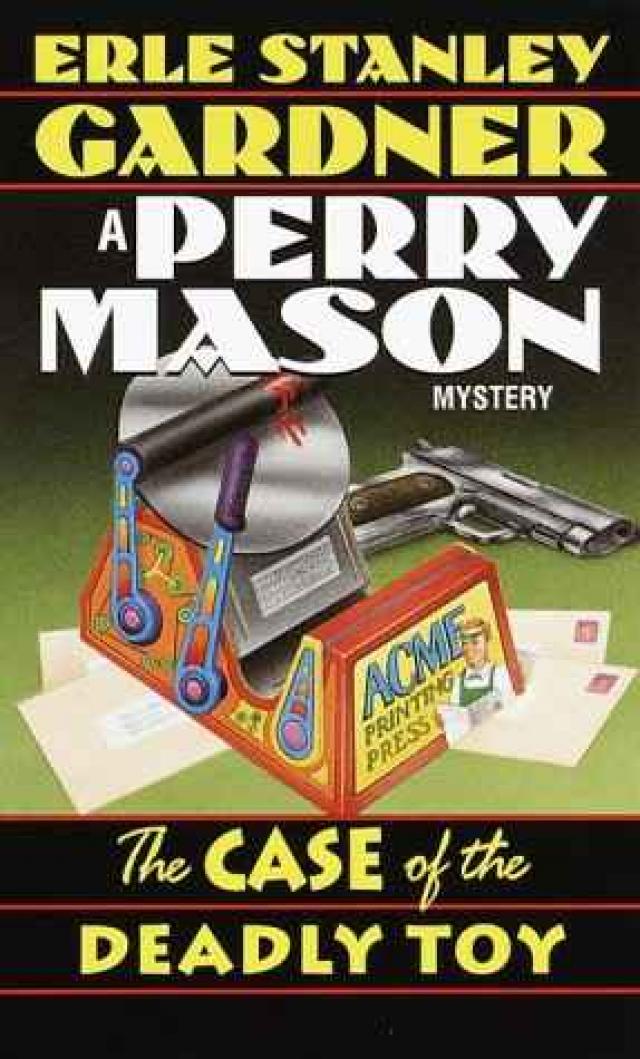
“When Lorraine got together with Norda Allison and wanted to get sole custody of Robert, Selkirk cracked the whip. He had previously forced Barton Jennings to get a printing press and print the envelopes which had been used to mail the threatening letters to Norda Allison. That press had been at Jennings’ office, concealed in a closet, until the day before the murder. At that time Jennings’ secretary had announced she was planning to clean out the closet and get rid of a lot of junk that had been accumulating over the years.
“So, while Lorraine Jennings was away that afternoon, Barton Jennings had taken the printing press and the envelopes to a temporary place of concealment in his basement. He had previously reported to Selkirk that Norda was going to join his wife in Los Angeles and that a move was to be made to get sole custody of Robert for Lorraine.
“Mervin Selkirk ordered Barton to listen in on their plan and then sneak out of the house to meet him at the San Sebastian Country Club at one-thirty in the morning. He gave Barton an ultimatum. Either Barton Was to fix things so that Lorraine gave up all claim to Robert, or Selkirk was going to expose Barton Jennings, have him sent to prison, and use that to defeat the application for custody of the child.
“That evening, on the way back from the airport, was when Jennings made up his mind to kill Selkirk but the only gun that he could put his hands on was under Robert’s pillow. He went out to get the gun. Robert was panic-stricken and fired the gun. The bullet hit the dog.
“Jennings took the dog to the veterinarian, came back, found his wife had quieted Robert, and then confessed everything to his wife. He went out for a showdown with Mervin Selkirk. In the course of that showdown he shot Selkirk, probably just a few minutes before Millicent Bailey and her boy friend drove up. Then Jennings returned to the house. His wife was waiting up for him. He told her what had happened. Then he went down to his workshop to rough up the barrel of the gun.
“While he was doing that, Lorraine decided to frame the crime on Norda Allison. She still had Norda Allison’s airplane ticket. She got in the car, went out to the place where the death car was parked and dipped Norda Allison’s ticket into the pool of blood on the floor of the car, then put it in the side pocket of Selkirk’s coat. She didn’t realize that Millicent Bailey and her boy friend were doing a little necking and that they had seen her drive up. When Millicent drove out, Lorraine was in a panic. But she still went ahead with her plan to frame the crime on Norda Allison because that was the only thing left for her to do.
“When Barton Jennings had roughed up the barrel of the gun with a rattail file, Lorraine placed it under Norda’s pillow after Norda had left. In their anxiety to make the case look good they overdid it.
“However, the police played right into their hands. Having come to the conclusion that Norda Allison was guilty, they virtually forced Millicent Bailey’s identification.
“After they had planted the gun under the pillow, Barton Jennings suddenly remembered the printing press down in the spare room, the one he had used in printing the envelopes which he sent to Norda Allison in San Francisco.