

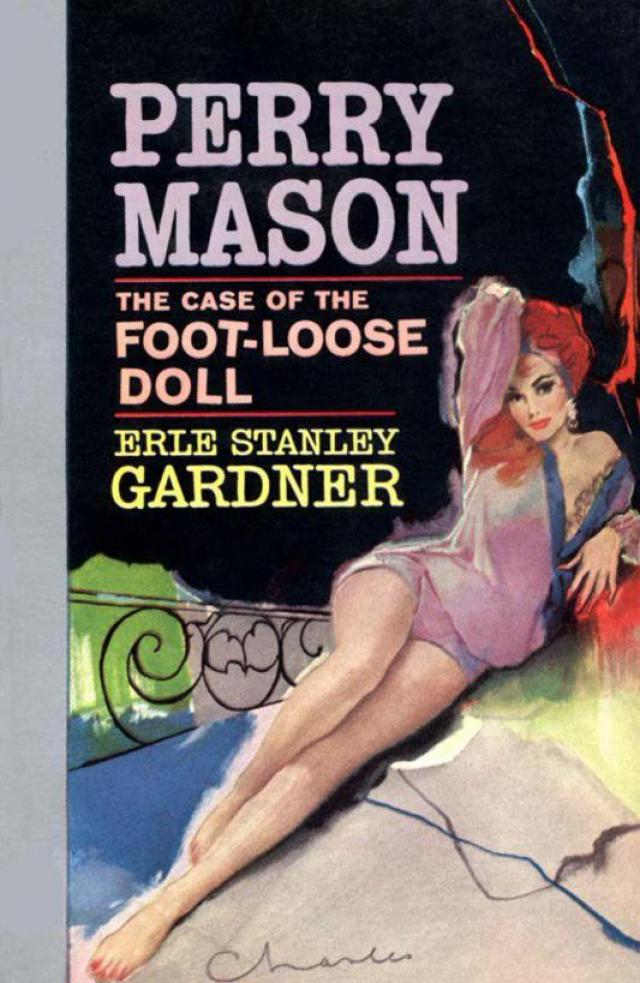
The case of the foot loo.., p.15
The Case of the Foot-Loose Doll,
p.15


“About a week.”
“You assumed the name of Nellie Harrod purely as a matter of convenience?”
“Yes.”
“Calling your attention to the second of this month, you were then living with Carl Harrod at the Dixiecrat Apartments as his wife?”
“I was using his name. We were going to be married. There were some legal complications. We didn’t wait for those to be ironed out.”
“Well,” Calvert said, his voice radiating approval, “thank you for being so frank, Miss Elliston, even at the expense of your good name and reputation. I am sure the Court will appreciate it. Now, can you tell us exactly what happened on the night of the second?”
“Carl had been out. He came back about—Oh, I don’t know, about eight-thirty or nine o’clock. He had had a nosebleed. He got some fresh handkerchiefs and changed his shirt. I asked him what had happened and he said a girl had smashed him; that she had taken him entirely by surprise.”
“Then what?”
“I asked him what he did to her and he said nothing; that she had slammed the door before he had a chance.”
“And then what?”
“Then he went out again. I had an idea he was going back—”
“Never mind your ideas,” Calvert interrupted. “Just answer questions and give us the facts. The Court isn’t interested in what you may have thought, only in the facts.”
“Yes, sir.”
“Now, he went out and then what happened? When did you see him again?”
“He came back in about—Oh, I don’t know, about something over an hour, perhaps an hour and a half. I didn’t check the time.”
“And what was his condition at that time?”
“He was coughing. He coughed up a speck or two of blood. At first I thought it was from the—”
“Tut, tut,” Calvert chided, holding up his finger and smiling. “Not your thoughts, Miss Elliston, just what you know.”
“Yes, he came back and told me—”
“Now, just a moment. At that time, did he say anything to you about the fact that he thought he might be going to die?”
“No.”
“Do you know from anything he said whether he thought any injury he might have had at that time was fatal?”
“He didn’t think it was fatal. He was thinking only in terms of collecting damages. He actually was jubilant. He said we’d have some real money coming in and that then he could get the legal difficulties straightened out and then we could be married and go abroad on a honeymoon.”
“Very well. Then I don’t think it is proper for you to tell the Court anything he may have said at that time. You can tell us what happened and that’s all.”
“Well, he telephoned the Drake Detective Agency and said he wanted to get in touch with Mr. Perry Mason. Then when he got Perry Mason on the telephone he told him—”
“Now, there again, I doubt if that is pertinent,” Calvert said. “And, of course, you don’t know of your own knowledge that he had Mr. Mason on the other end of the telephone, do you? You simply heard one end of the conversation?”
“Yes.”
“So you can’t testify that Mr. Mason was on the other end of the line. After that, what happened?”
“Then Mr. Mason came and his secretary, Miss Della Street, was with him.”
“And what happened at that time?”
“Well, Carl told Mr. Mason that he had been stabbed—”
“Now, just a minute. Did he expect to die at that time? That is, did he believe death was imminent because of some wound he had received?”
“No, sir, he did not. He was still trying to lay the foundation for collecting big damages.”
“Then I feel that is not a proper statement. In other words, it was not a dying declaration within the meaning of the law. Just go ahead and tell us what happened. Did Mr. Mason and Miss Street leave?”
“They left.”
“And then what happened?”
“Carl had been putting on an act to impress Mr. Mason. He said he was having a chill. At least, I thought it was an act, and—”
“Not your thoughts, please,” Calvert interrupted. “We want the facts—only the facts.”
“Well, after Mr. Mason left, he said he was cold and I suggested a hot bath. I drew the bath and told him it was ready.
“Then Carl started to get up out of the chair and then all of a sudden he began to feel worse. He almost collapsed. His face became pale as ashes and a look of the most horrible surprise came over his face and he said, ‘Nellie, Nellie, I’m dying!’”
“Then at that time did he go on and make any statement to you as to what had happened at the time he had received the wound or injury?”
“Yes, sir.”
“Now then, I believe that is a dying declaration within the meaning of the law. I believe that you are entitled to relate what he said; just tell us what he said had happened.”
Judge Bolton looked down at Perry Mason. “Any objection from the defense?”
“No objection,” Mason said, “but I would like to examine the witness for the purpose of laying the foundation as to a dying declaration.”
“Proceed,” Judge Bolton said.
“He told you he was going to die?” Mason asked.
“At that time, yes.”
“And how long was that before he died?”
“Only a few minutes. I don’t believe it was over ten minutes.”
“There had then been a sudden change in his condition from the time I saw him?”
“Yes. It started when he tried to get up. He got partway up and then fell back. It was then that look of horrible consternation, surprise, and I think a little of terror, came over his face.”
“He said he was dying?”
“He said, ‘Nellie, that damned wound is—Something’s happened. It’s reached my heart, I guess. I’m … I’m dying.’”
“And then what?”
“Then he clutched his chest and said, ‘Nellie, I don’t want to die.’”
“And then what happened?”
“Then is when he made the statement.”
Mason nodded to Calvert. “It would seem to be a dying declaration within the meaning of the law. I have no objection. Let her go ahead and tell what happened.”
“Very well,” Calvert said. “I am satisfied that it is a dying declaration. Just go ahead, Miss Elliston, and tell what happened. At this time you may relate what he said; use his exact words if you can remember them. If you can’t, give your best recollection of what he said.”
“He said that he had gone back to the defendant’s apartment, that he had decided to show her who was boss, that if she would give him the letters she had, he wouldn’t expose her.
“He said that she was using Fern Driscoll’s name but she was really Mildred Crest. He said she had murdered Fern Driscoll and he felt he could prove it.”
“Did he say anything about accusing her of murder?”
“Yes. He said that she came to the door; that she finally let him in; that he made his proposition to her.”
“Then what?” Calvert asked.
“He said she laughed at him, that she told him he was a blackmailer, that she felt he had a police record, that if he didn’t get out and stay out, she would claim she had found him burglarizing her apartment and shoot him.
“He said they had words and that she was holding the door open for him, telling him to get out. He said that suddenly, just as he was leaving, she swung her fist against his chest, then slammed and locked the door.
“He said that he didn’t realize she had had an ice pick in her hand until he was almost to the elevator, that then he saw the ice pick sticking in his chest.
“He said that he didn’t think he was badly hurt, but he felt he could use the girl’s action as a lever to make her lawyer, Perry Mason, turn over the letters to him, that he could then get a large sum of money, either from the magazine, or from Mr. Baylor.”
“What happened to the ice pick?”
“He brought it home with him.”
“He told you that the pick he brought home was the one with which he had been stabbed?”
“Yes.”
“Where is that ice pick now?”
“I gave it to the police.”
“Did you mark that ice pick in some way so that you would know it again if you saw it?”
“Yes.”
“What did you do?”
“I scratched my initials on the wooden handle.”
“When?”
“Before it left the apartment.”
“I now show you an ice pick and ask you if that is the ice pick you have been referring to?”
“That is the one.”
“I will show that to counsel for the defense,” Calvert said, “and then ask that it be introduced in evidence.”
Calvert stepped over to the counsel table and handed the ice pick to Mason.
Mason studied the ice pick carefully. “May I ask a few questions on the exhibit, Your Honor?”
“Certainly,” Judge Bolton said.
Mason turned to the witness. “I notice that this ice pick has a price mark on it, a price tag which is placed on with some sort of adhesive and covered with a piece of transparent tape. This price tag bears the label of the Arcade Novelty Company and the mark ‘forty-one cents.’ Was this price tag on the ice pick when you received it from Carl Harrod?”
“Yes.”
“You are positive this is the ice pick that Carl Harrod gave you?”
“Yes.”
“This is the ice pick Carl Harrod told you had been pushed into his chest?”
“Yes.”
“He handed you this ice pick?”
“Yes.”
“And you marked it?”
“Yes.”
“When did you mark it?”
“When the police came.”
“One of the officers suggested that you should mark this ice pick?”
“Yes, sir.”
“So that you wouldn’t be confused when it came time to give your testimony?”
“So that it could be identified.”
“Were there any other ice picks in your apartment?”
“Yes, there was one other.”
“Where?”
“In the kitchen drawer.”
“By that you mean a utility drawer in the kitchen?”
“Yes.”
“What else did that drawer contain?”
“Some cooking spoons, a bottle opener, a few little things of that sort.”
“Very good,” Mason said. “Now, I’m anxious to get this straight: were there two ice picks in this utility drawer?”
“Yes.”
“Do you mean that you put the ice pick with which Carl Harrod had been stabbed in the utility drawer?”
“Yes.”
“How did that happen? Didn’t you realize that—?”
“Carl came home. He seemed to be high.”
“What do you mean by being high?”
“I mean high! You know the way a person is when he’s high.”
“He’d been drinking?”
“No.”
“Marijuana?”
“Yes.”
“And what did he say?”
“He seemed very jubilant. He told me that he’d really hit the jackpot.”
“And then what?”
“He told me that he was a good provider. He said he’d bought me an ice pick, and he tossed that ice pick in the sink.”
“And then?”
“I asked him what on earth we wanted an ice pick for. I told him we used ice cubes and had no need for an ice pick.”
“And then?”
“Then he went in the other room, sat down, and we talked for a while. Then I went back to the kitchen. I noticed there was a little pinkish stain in the sink where the point of the ice pick had rested in a drop of water, but I thought nothing of it. I picked the ice pick up, washed it, and put it in the drawer.”
“You washed it?”
“Yes, I washed it!”
“Why?”
“I didn’t know where Carl had secured it or anything, and he’d been carrying it around with him. I always wash dishes and utensils before putting them away.”
“Did you at that time know there was an ice pick in the drawer?”
“Very frankly, Mr. Mason, I didn’t. It came as a great surprise to me after the police had asked me to produce the ice pick, when I opened the kitchen drawer and found that there were two of them.”
“Is there any chance—Now I want you to listen to this very carefully,” Mason said, “and I want you to consider your answer very carefully—is there any chance, any possible chance that you got the ice picks confused?”
“Absolutely not!”
“How do you know you didn’t?”
“Because the ice pick that I put in that drawer was put in at a certain place, right near the front of the drawer, and this second ice pick was way in the back of the drawer. Moreover, there was no price tag on the other ice pick. I remember distinctly that the ice pick Carl brought home with him had this price tag on it.”
“You’re positive?”
“I’m absolutely positive.”
Mason nodded to the prosecutor. “Under the circumstances, I have no further questions and no objection to the ice pick being received in evidence.”
“The ice pick will be received,” Judge Bolton said.
“That concludes my direct examination of the witness, Your Honor,” Calvert said.
“Cross-examine,” Judge Bolton said to Perry Mason.
Mason regarded the witness thoughtfully for a moment, then said, “While I was talking with Carl Harrod, didn’t he admit that the light was dim and he couldn’t be certain that it was the defendant who had stabbed him? Didn’t he admit there was a possibility that Katherine Baylor had opened the door and stabbed him?”
“Just a moment! Just a moment!” Calvert shouted. “Don’t answer that question, Miss Elliston. Now then, Your Honor, I wish to interpose an objection on the ground that this is incompetent, irrelevant, and immaterial, that it is not proper cross-examination.
“It appears now conclusively that, at the time Mr. Mason was talking with Carl Harrod, Carl Harrod was only putting on an act. He was trying to collect damages. He had no idea that he was about to die. The whole theory of the law under which dying declarations are permitted to be received in evidence is that the law presumes that a person who is about to die, knowing that nothing he can say or do will give him any material advantage, having been brought face to face with a situation where only spiritual assets can count, is going to tell the truth, at least to the same extent that he would if he were testifying under oath on the witness stand.”
“I understand the theory of the law in regard to dying declarations,” Judge Bolton said drily. “I think you may rest assured that the Court understands the elemental principles of law.”
“Yes, Your Honor, I merely commented on it in order to show that there is a great difference between a true, dying declaration which is made when a person thinks he is going to die, and a spurious dying declaration which is a part of a fraudulent scheme by which a person is trying to get damages.”
“I understand all that,” Judge Bolton said, “but let us suppose that a dying declaration is given the force of testimony under oath. If Carl Harrod had testified under oath, Mr. Mason would have been permitted to ask him if he hadn’t made some different statement at a different time, wouldn’t he?”
“Certainly, Your Honor, but that’s a different situation. Mr. Mason would then be asking Carl Harrod himself, and Carl Harrod would have the opportunity to explain any seeming inconsistencies. Now he is asking a third party about some so-called contradictory statement made by Harrod. It seems to me we are getting into the realm of hearsay.”
“Nevertheless,” Judge Bolton said, “I am interested in hearing the answer of the witness. I’d like to have the question answered. The objection is overruled.”
“Very well,” Calvert said, yielding with poor grace.
Judge Bolton turned to the witness. “Did he make some such statement, Miss Elliston?”
“I don’t think so, Your Honor. I know that Mr. Mason was trying to mix him up and—”
“Now, never mind what you think Mr. Mason was trying to do,” Judge Bolton said sternly. “I want to know what Carl Harrod said.”
“Well, Mr. Mason brought out the fact that the light was rather poor, and then asked Carl how he could be certain it hadn’t been Katherine Baylor who had stabbed him.”
“And what did Mr. Harrod say?”
“Well, he became indignant and said he didn’t intend to have Mr. Mason cross-examine him.”
“Very well,” Judge Bolton said to Mason. “Continue with your cross-examination, Counselor.”
“Did Carl Harrod telephone Mr. Baylor after I left and in connection with the suggestion I had made?”
“He—”
“Just a minute!” Calvert interrupted. “Refrain from answering, if you will, until I have an opportunity to put in an objection. … If the Court please, I object to that question on the ground that it is incompetent, irrelevant, and immaterial, that it calls for hearsay evidence, that it calls for a conclusion of the witness, that it assumes a fact not in evidence, and that it is not proper cross-examination. I didn’t go into any of these matters on direct examination. My direct examination was confined to the dying declaration with sufficient factual background of what had gone before to explain the situation.”
“Well, let’s consider this as part of the factual background,” Judge Bolton said.
“Moreover, Your Honor, it calls for a conclusion of the witness, and it’s argumentative. She doesn’t know who was on the other end of the line.”
“Do you know whether Carl Harrod called up Mr. Harriman Baylor after Mr. Mason left?” Judge Bolton asked the witness.
“No, sir.”
“You don’t know?”
“No, sir.”
“Continue with your cross-examination, Mr. Mason,” Judge Bolton said.
“Did he call up someone?”
“He used the telephone. Yes.”
“Did you see the number he dialed?”
“No.”
“Did you hear the person he asked for?”















