

The case of the foot loo.., p.3
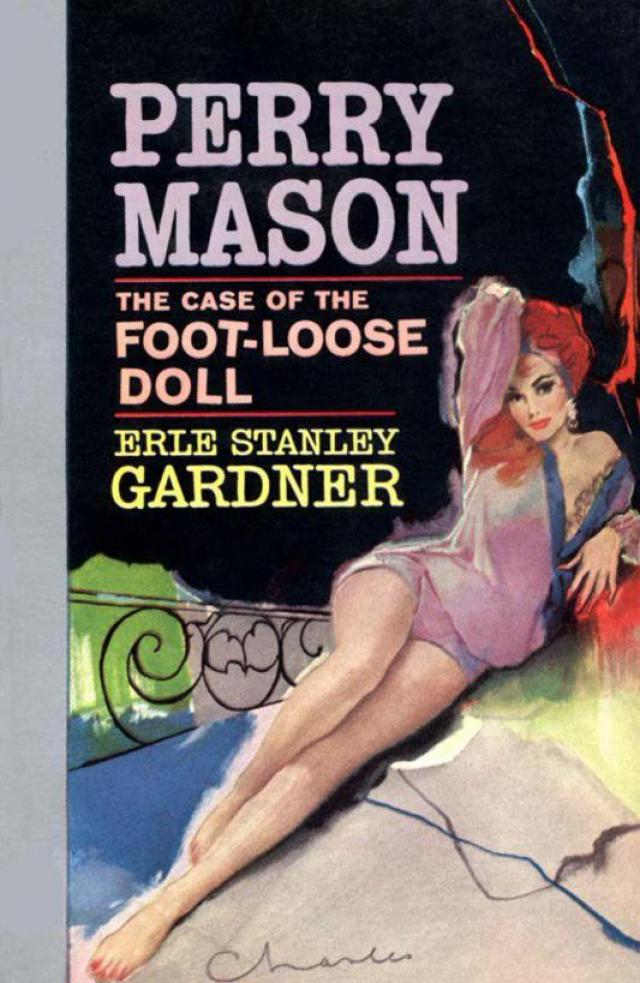
The Case of the Foot-Loose Doll,
p.3


Chapter 2
The offices of the Consolidated Sales and Distribution Company where Mildred worked happened to be in the same building and on the same floor as offices occupied by Perry Mason, the famous lawyer. Mildred had noticed Mason’s name on the door to his offices, and she had often heard stories of the daring exploits of the famous lawyer and his ingenious defense of innocent persons accused of crime.
Once she had ridden up in the elevator with the attorney and, as she stood beside him, looking up at the keen, piercing eyes, the rugged, granite-hard features, she experienced a strange feeling of confidence.
Almost without realizing that she had done so, Mildred had made up her mind that, if the worst ever came to the worst, she would turn to Perry Mason for help.
Twice she actually had been on the point of going to Mason’s office, asking his secretary, Della Street, to arrange an appointment.
Each time she desisted because of a subconscious fear that Mason might tell her that what she was doing was wrong, insist that she go to the authorities and make a clean breast of the situation.
The more Mildred thought that possibility over, the more such a course seemed absolutely suicidal. She had reached a decision and she resolved never to turn back. She couldn’t and wouldn’t retreat.
Mildred Crest had no close relatives. Her father had died before she was born, her mother when she was five. She had been raised by an aunt who had died three years ago, so Mildred was on her own in every sense of the word.
Occasionally, there was a twinge of conscience as Mildred wondered about the background and connections of the dead girl whose name she had taken. But as day after day passed in a placid routine, she saw no reason for taking any radical step.
She practiced signing the name “Fern Driscoll,” using the signature on the driving license as a pattern.
After repeated attempts, she was able to dash off a fairly good replica of Fern Driscoll’s signature.
The forty one-hundred-dollar bills were still intact.
Mildred had secured a very satisfactory apartment. There was one long bus ride and then a short walk. The supermarket where she shopped was only two blocks away. Getting to and from the office and shopping represented Mildred’s sole excursions into public life. She cooked her own meals in the apartment, kept to herself, formed no friendships at the office, but slowly and surely established her identity as Fern Driscoll.
Then one night out of a clear sky the blow fell.
It had been a hard day at the office. Mildred had worked overtime getting out some important letters. She had missed her regular bus. Dog-tired, she entered her apartment house. She had intended to stop by the supermarket, but she knew there were enough leftovers in the icebox to carry her through the evening, and there were eggs, bacon and toast for breakfast. She needed no more.
She hadn’t even seen the man until she fitted her key to the door of the apartment. Then he materialized as from nowhere.
“Miss Driscoll?” he asked.
Something about the way in which he had been so inconspicuous as to defy notice and then the tense menace of his voice warned Mildred that this was no casual pickup.
She flashed him a quick look from behind her dark glasses.
“Well?” she asked.
The man nodded toward her key in the door of her apartment.
“Open the door,” he said. “I’m coming in.”
“Oh, no, you’re not,” she said, standing her ground. “Who are you? What do you want? How did you get in here?”
“The name wouldn’t mean anything to you.”
“Then you mean nothing to me.”
“I think I do.”
She shook her head angrily. “I’m not accustomed to being accosted by strangers in this manner. I’m going into my apartment and you’re going to stay on the outside.”
“I want to talk to you,” he said, “about a certain automobile accident which took place near Pala; an accident where Mildred Crest met her death.”
“I’ve never heard of Mildred Crest,” she said. “I don’t know about any accident.”
He smiled condescendingly and said, “Listen, I don’t want to make any trouble, but you and I have certain things to discuss and we’d better talk them over quietly.”
“What is this, blackmail?”
His laugh showed genuine amusement. “Certainly not. I merely wanted to discuss the accident with you. I promise to be a gentleman, and if I’m not, you have the phone at your elbow. You can call the manager or the police—if you want the police.”
“But I haven’t the faintest idea what you’re talking about.”
“You will have, after you give me a chance to explain.”
She remembered the woman who had the apartment across the hall, and Mildred had the uneasy feeling that she was listening. This woman was a thin, nervous busybody who had on several occasions tried to get acquainted, and the more reserved Mildred became, the more inordinate had been the other’s curiosity.
She reached a swift decision.
“Very well. Come in,” she said. “I’ll listen to what you have to say and that’s all. Then you’re going out.”
“Fair enough,” the man said. “Just so you listen.”
Mildred opened the door of the apartment.
Her visitor got down to brass tacks with a glib swiftness that indicated he had rehearsed the part he was to play.
“I’m Carl Harrod,” he said, “an insurance investigator.
“We carried insurance on Mildred Crest’s automobile. I was assigned to investigate the accident. The first thing I noticed was that Mildred had not been driving the automobile at the time it went over the bank. The next thing I noticed was that tracks indicated someone could well have walked away from the wreckage and gone down the canyon in the dark.”
He paused and smiled apologetically. “I’m an investigator, I’m not a very good woodsman, and not a very good tracker, Miss Driscoll. But I did the best I could. I found tracks going down the canyon and finally I found what I was looking for; the place where you had climbed up out of the canyon.
“There was no money in Mildred’s purse; that is, just a very small amount of change, yet I found she had gone to the bank and drawn out every cent she had on deposit, prior to the time she left Oceanside. There should have been more than five hundred dollars in the purse.
“For your information, Mildred Crest had received quite an emotional shock the day of her death. She had been keeping company with a young man who turned out to be an embezzler. He is now a fugitive from justice.”
Carl Harrod settled back in the chair and smiled.
“Now then,” he said, “it is quite apparent that Mildred Crest was dead before the fire was started. The trachea—the windpipe to you, Miss Driscoll—did not contain the faintest trace of the by-products of combustion. There were other things that the autopsy surgeon could tell, but I suppose you’re not interested in the technical details. I think probably you know by this time that Mildred Crest was, unfortunately, in the second month of pregnancy.
“Putting these things together, it’s possible to reach a very interesting and highly dramatic conclusion, a story which unfortunately is all too common.”
Harrod smiled affably. “I’m not boring you, am I?”
“Go ahead,” Mildred said.
“Our investigation was largely routine,” Harrod said, “until I discovered the service station where Mildred had made her last purchase of gasoline. The attendant told me she had picked up a hitchhiker; that the hitchhiker had asked her where she was going and Mildred had said that she wasn’t going anywhere.
“After I saw what had happened at the scene of the wreck, I naturally became interested in the hitchhiker. It really took only a slight effort to find you, Miss Driscoll. Your suitcase was in the car when it went off the road. The exterior was damaged by the fire, but I was able to trace the suitcase and finally to find the retailer who had sold it. His records disclosed your name.
“I felt perhaps you would come to the city and that you would look for work. It has taken me this long to locate you.”
“What do you want?” Mildred asked.
“At the moment I want a signed statement from you,” Harrod said.
“What sort of a statement?”
“I want a statement that you were driving the car at the time of the accident, I want a statement in your own handwriting as to just what happened and how it was that you left the automobile, stumbled down the canyon, finally climbed the bank and came here, all without reporting to the authorities anything that had happened.
“I would also like a signed statement from you that you took the money from Mildred’s purse. This statement would also release the insurance carrier from any liability, since you would admit that the accident was your fault.
“Now then, we come to a rather sordid part of the entire affair. Since you had an opportunity to take the money from Mildred’s purse, since you had the opportunity to retrieve your own purse from the wreck, it is quite apparent that the fire didn’t break out until an appreciable interval after the car had gone over the bank. It is, therefore, quite apparent that the fire was deliberately set in order to conceal the evidence of the theft.
“I would like a statement from you to that effect.”
“Do you think I’m crazy?” Mildred asked.
Harrod shrugged his shoulders. “After all, these things are self-evident, Miss Driscoll. Why shouldn’t you sign such a statement?”
“Don’t be silly,” she said. “I never knew Mildred Crest in my life. I wasn’t in any automobile. I didn’t—”
Her voice trailed away into silence.
Harrod’s smile was patronizing. “Just stopped to think, didn’t you, Miss Driscoll? You felt the fire would destroy a great deal of evidence. It destroyed very little, if any. A passing motorist who carried a fire extinguisher put out the fire in the car. Most of the gasoline had been spilled out of the tank when the car hit a rock at the top of the hill. That fire got out of control, but thanks to the fire extinguisher, the flames in the back of Mildred’s car were extinguished.
“So I found the suitcase was sold to you in Lansing, Michigan. I made a little investigation at Lansing. You had charge accounts and an excellent credit rating. You left a good position in Lansing overnight without telling anyone where you were going.”
“What do you intend to do with this statement if I should give it to you?” Mildred asked.
“Well,” Harrod said, “that’s an interesting question. Quite frankly. Miss Driscoll, I don’t know myself. Theoretically I’m supposed to make a complete report on the situation and append the statement to the report. … Actually I don’t think I’ll do it.”
“Why not?”
“I find you quite intelligent. You are very good-looking. Someday you will marry. You may even marry money. In short, I see unlimited possibilities.”
“Blackmail!” Mildred said.
“Now, blackmail is a very crude and a very ugly word. Please remember, Miss Driscoll, that I haven’t asked you for anything except a signed statement.”
“I have no intention of writing any such statement.”
“That, of course, would be your first reaction,” Harrod said. “Well, you just got back from the office. I know that you’re tired. You probably want to get your dinner and I see you would prefer to be alone.
“I’ll let you think things over for a day or two, and then I’ll be in touch with you again.”
Harrod walked to the door, turned and smiled at Mildred. “I’ll be back, Miss Driscoll,” he said, “and please, please remember that I have asked you for nothing except a signed statement as to the facts. I am making that request in my capacity as an investigator for an insurance company. It is a thoroughly legitimate request, particularly in view of the fact that you might try to make a claim against my employer, Mildred Crest’s insurance carrier.
“I mention this in case you should consult with some private detective agency, a lawyer, or even, in fact, the police. All I am asking for is a signed statement as to what happened. I would like to have you tell me this in your words.
“Anyone will tell you that is a customary procedure in cases of this sort.
“Thank you very much, Miss Driscoll. I’ve enjoyed our little visit. I’ll see you again. Good night.”
Harrod eased himself out of the door.
Mildred stood watching the closed door with sickening apprehension.
She had, indeed, burned her bridges.
What Harrod evidently didn’t know as yet, but would probably find out, was about the forty hundred-dollar bills in Fern Driscoll’s purse.
In view of her actions, it would now be impossible to explain how the fire had started. Harrod quite naturally assumed she had rifled the other girl’s purse and had then started the fire to conceal the theft.
Either in the identity of Mildred Crest, who had stolen four thousand dollars from Fern Driscoll, or in the borrowed identity of Fern Driscoll, who had stolen some five hundred dollars from Mildred Crest, she was between two fires.
And, in the background, was the possibility of her being charged with first-degree murder.
Chapter 3
Della Street, Ferry Mason’s confidential secretary, said, “There is a young woman employed by the Consolidated Sales people down the hall who wants an appointment. She says it will only take a few moments and she’d like to run in and talk with you whenever it’s convenient. She says she can get away for ten or fifteen minutes whenever we phone.”
“Say what it’s about?” Perry Mason asked.
“Only that it was a personal matter.”
Mason looked at his watch, then at his appointment schedule, said, “These things that take only fifteen or twenty minutes quite frequently take an hour, and you don’t like to throw a girl out right in the middle of her story. We have a half-hour, though…. Give her a ring, Della. Ask her if she can come in right away. What’s her name?”
“Fern Driscoll.”
“Do you know her?”
“I don’t think so. She says she’s seen me in the elevator. I think she’s new with the company.”
“Give her a buzz,” Mason said, “tell her I can see her right away if she wants to come in now. Tell her that’s with the understanding it will only take twenty minutes; that I have another appointment.”
Della Street nodded and went to the telephone.
A few moments later she was back saying, “She’s coming in right away. I’ll go to the reception office and meet her.”
“Skip the preliminaries,” Mason said, “getting her name, address and all that. We’ll get them when she comes in. I want to hear her story and rush things along as much as possible.”
Della Street nodded, went to the reception office and within less than a minute was back. Turning to the young woman she had escorted into the office, Della Street said, “This is Mr. Mason, Miss Driscoll-—Fern Driscoll, Mr. Mason.”
“Sit down, Miss Driscoll,” Mason said. “You’re working for the Consolidated Sales and Distribution Company, I believe.”
“Yes, sir.”
“Where is your residence, Miss Driscoll?”
“309 Rexmore Apartments.”
“What did you want to see me about?” Mason asked. And then added in a kindly manner, “I specialize mostly in trial work and a good deal of it is criminal work. I think perhaps you’re in the wrong law office, but I may be able to help you get in touch with the right man.”
She nodded briefly, said, “Thank you,” then went on, “you’ll have to pardon my dark glasses. Ever since I came to California some two weeks ago I’ve been having eye trouble—I hitchhiked and I feel as if the retina of my eyes became sunburned. Did you happen to read in the paper some two weeks ago about a Mildred Crest of Oceanside who was killed in an automobile accident?”
Mason smiled and shook his head. “These automobile accidents are a dime a dozen. They are usually all grouped together on an inside page. Was there something special about Mildred Crest’s death?”
“I was riding with her when she was killed.”
“I see,” Mason said, eying her sharply. “Were you hurt?”
“Fortunately I was only bruised a little. I was sore for a day or two, but that was all.”
Mason nodded.
“Mr. Mason,” she said, “so that you can understand the situation, I have to tell you certain things.
“I lived in Lansing, Michigan. I wanted to disappear for reasons of my own. I can assure you I haven’t violated any laws. I just wanted to get away where I could begin all over again. I was restless and nervous. I had sufficient funds to buy a ticket to any place I wanted to go, but the point was I didn’t know where I wanted to go. I was drifting aimlessly. I was hitchhiking.”
“Go on,” Mason said.
“I went to Phoenix, stayed there for a few days, then went to San Diego, stayed there for only a few hours, got a ride out of San Diego and got as far as a little place called Vista and I was, for the moment, stranded there. It was about … oh, I don’t know, seven-thirty or eight o’clock in the evening. It was dark and this Mildred Crest drove up.”
“You knew her?” Mason asked.
“No, I was simply waiting there at the service station for a ride. You see, a young woman on the highway is a little different from a man. A man will stand out by a boulevard stop and try to thumb a ride. Anyone who stops is a good ride. But not many people stop.
“However, a young woman on the highway has plenty of rides. Almost every car stops and offers her a lift, but—Well, I don’t care to play it that way. I like to be at a service station where I can size up the person and then ask if I may ride.”
“So you asked Mildred Crest for a ride?”
“Yes.”
“And what happened?”
“I sensed at the time that Mildred Crest was running away from something, that she was very much upset and—Well, for instance, I asked her where she was going and she said, ‘Away.’”















