The case of the negligen.., p.18
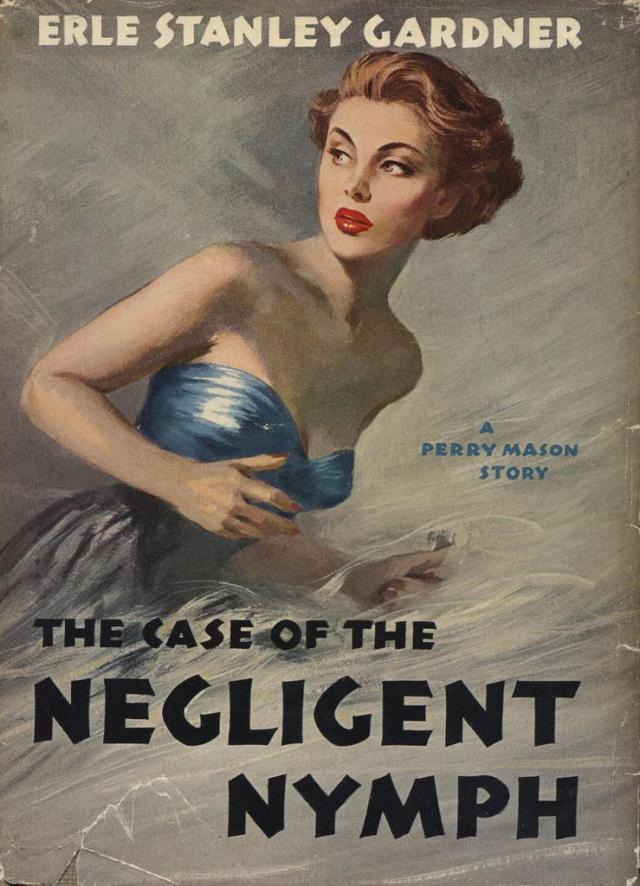
The Case of the Negligent Nymph,
p.18


“The defendant had an opportunity to inspect them while she was murdering George Alder,” Gloster said.
“And I’ll assign that remark as prejudicial misconduct on the part of the district attorney,” Mason said, “and ask the Court to admonish the jury to disregard such remark and … ”
“I’ll withdraw the remark,” Gloster said contritely.
“I was angry. The remark was made in the heat of the discussion.”
“Well,” Judge Garey said, “the Court will make an order that you and your experts may have a right to inspect the premises, Mr. Mason. What time would be convenient?”
“This afternoon?” Mason asked.
“Oh, if the Court please,” Gloster protested, “we’ve just started in with this case. If counsel is permitted to go out and inspect the premises this afternoon, we won’t be able to resume testimony in the case until Monday.”
As the Court hesitated, Mason said, “I have repeatedly requested the sheriff to permit experts for the defense to see these premises.”
“Permission which should have been granted,” the Court remarked. “The Court will adjourn at twelve o’clock noon until Monday morning at ten o’clock. During the afternoon, and during tomorrow, which is Saturday, the Court will make an order that the defense may be admitted to the premises at all seasonable times, subject, of course, to the right of the prosecution to have officers there to maintain supervision. Now, then, gentlemen, are you finished with this witness, and, if so, are there any other witnesses?”
Mason smiled at the discomforted man on the stand, and said, “Oh, I guess as far as I’m concerned I have no further cross-examination. I think the jury understands the situation.”
“No questions,” Gloster said angrily, “but since counsel is having so much fun I’ll call a witness that will … ”
“That will do,” Judge Garey interrupted. “I have repeatedly admonished counsel to refrain from these comments. A continued and persistent refusal to follow the instructions of the Court will result in drastic action. Now, gentlemen, let’s proceed with the trial of this case in an orderly manner. Mr. District Attorney, call your next witness.”
Chapter 18
Gloster, on his feet, jaw thrust forward, said belligerently, “My next witness is Oscar Linden. Oscar Linden, take the stand.”
Linden, a tall, loose-jointed, middle-aged man with a tattooed star plainly visible on the back of his left hand, took the witness stand and after the usual preliminaries, Gloster started a barrage of quick, pounding questions.
“What’s your occupation, Mr. Linden?”
“I operate the boathouse at the Yacht Club.”
“And were you doing that on the first of August of this year? That was a Saturday, you’ll remember.”
“Yes, sir.”
“Did you have occasion on that date, or very shortly afterwards, to look over the canoes you had rented during the evening?”
“Yes, sir.”
“How many canoes had you rented that night?”
“Twelve.”
“How many of them were back at the hour of ten o’clock?”
“Eight.”“That left four out at that time?”
“Yes, sir.”
“Now, of those canoes—those four canoes, was there anything distinctive about any one of them?”
“Yes, sir.”
“What?”
“As a special deluxe service I have carpets which I put on the bottom of the canoes.”
“Did you notice anything peculiar about any of these canoes when it was returned?”
“Yes, sir.”
“What?”
“There was considerable water on the top of the carpet and in the bottom of one of the canoes. It was one numbered 0961. The number was painted on it in green paint.”
“What did you do with reference to that?”
“Nothing at the time, but shortly after Alder’s murder I was in touch with the authorities. They wanted to go over my stock of canoes.”
“Now then, within the next two or three days did you make any further investigation?”
“Yes, sir.”
“What?”
“I turned this canoe over to a fingerprint expert at the request of the sheriff.”
“And do you keep a name list of the people who rent the canoes?”
“No sir, I do not. There are numbers on the canoes and I keep a record of the numbers on those canoes. We charge either by the hour, by the evening, or by the half day.”
“How was this particular canoe in question rented?”
“By the evening. The person who rented it was entitled to stay out until one-thirty in the morning.”
“After you rented that canoe when did you next see it?”
“When I found it tied up to my dock next morning.”
“Up to the time that you turned that canoe over to the fingerprint expert and after it had been rented that evening, had anyone else been in the canoe?”
“Not to my knowledge.”
“Had it been rented?”
“No.”
“Now then, would you know the person who rented that canoe from you again, if you saw him?”
“Yes, sir.”
“Do you see that person?”
The boatman promptly pointed his finger at Perry Mason, and said, “Mr. Mason, the attorney there.”
“Cross-examine,” Gloster said.
“No questions,” Mason said, smiling affably, to the puzzlement of the jury and spectators. “There can be no question but what I rented a canoe from this gentleman.”
Gloster said, “Call Sam Durham to the stand.”
Sam Durham took the stand and qualified himself as an expert on fingerprints.
“Now then,” Gloster said, “did you have occasion sometime after the third of August to examine a canoe marked with the numerals 0961 in green paint on the bow and stern in a search for fingerprints?”
“I did, yes sir.”
“What did you find?”
“I found numerous latent fingerprints which I photographed.”
“Subsequently did you identify any of those fingerprints?”
“I did, yes sir.”
“What ones did you identify?”
“I identified certain latents which I have here in photographs numbered one, four, six and eight.”
“Whose fingerprints were they?”
“The fingerprints of the defendant.”
“Did you subsequently identify any of the other fingerprints?”
“At the time I was unable to do so, but later I identified fingerprints two, three, five and seven as shown in these photographs.”
“And when did you make that identification?”
“Last night.”
“And whose fingerprints are they?”
There was a dramatic silence in the courtroom as the witness turned to face Perry Mason. “Those are the fingerprints of Perry Mason, the attorney for the defendant.”
Judge Garey pounded with his gavel, trying in vain to subdue the clamor in the courtroom. Finally he declared a fifteen-minute recess as newspaper reporters, disregarding the admonition of the Court, streaked through the crowd and out of the doors searching for telephones from which they could rush the news to their papers.
One of the newspaper reporters who had hurriedly left the courtroom for a telephone, came pushing his way back, bringing a photographer with him.
“How about a statement, Mr. Mason?” he asked.
The photographer raised the camera and the glare of a flashlight etched the scene into momentary brilliance.
Mason’s grin was completely carefree. “What sort of a statement?” he asked.
“What’s the effect of this evidence?”
“You mean the fingerprint evidence?”
“Of course.”
Mason grinned, and said, “I rented a canoe. I left my fingerprints on that canoe. There’s no question about that. I’d have stipulated it if the district attorney hadn’t wanted to make such a grandstand.”
“But how about the fingerprints of the defendant?”
“Quite apparently,” Mason said, affably, “the fingerprints of the defendant are on that canoe also.”
“Then do you admit that you picked up the defendant after she tried to steal … ?”
“Come, come,” Mason said, “let’s be fair about the thing. In the first place there’s no proof the defendant tried to steal anything, and in the second place, ask the district attorney how he intends to prove that the fingerprints were made at the same time.
“You might stick around for the next fifteen minutes,” Mason said, grinning broadly, “and learn something about fingerprint testimony.”
“Don’t think I won’t,” the reporter said. “Is that all the statement you have to make?”
“That’s it,” Mason said. “What more do you want?”
The reporter thought over Mason’s statement. “But the witness said the canoe hadn’t been rented since you took it out.”
“Exactly,” Mason smiled, as though enjoying some joke which would soon be apparent to the reporter.
Chapter 19
The bailiff called in the jury.
Judge Garey returned from his chambers and settled himself on the bench.
Gloster said, “I had finished my direct examination of the witness, Sam Durham.”
“Cross-examine,” Judge Garey said.
Mason said, with a quiet smile, “You examined this canoe for fingerprints at what time, Mr. Durham?”
“Well, it was the evening of the third. Very late in the evening. Nearly midnight, and the examination continued over until the morning of the fourth.”
“Now the third was the night of the murder.”
“Yes, sir.”
“And you understand that the first was the night the canoe had been rented?”
“Yes, sir.”
“Where did you find these fingerprints?”
“In various places.”“Now how long, in your opinion, would a fingerprint, that is a latent fingerprint, last on a surface of that nature?”
“Well, it would depend somewhat on atmospheric conditions and various circumstances, but I would say that one could expect to find fingerprints over a four-day period.”
“You are prepared to state that those are my fingerprints? “ Mason asked.
“I have compared them with an inked card containing an authentic set of your fingerprints. There can be no question as to the points of identity. If you wish, I have prepared enlarged photographs showing the … ”
“No, thank you,” Mason said, smiling. “I am not questioning the fingerprints. I am merely trying now to fix the time element.”
“Yes, sir.”
“So that sometime within four days before the hour of midnight of the third of August you would say that I had handled that canoe.”
“Yes, sir.”
“It could have been any time up to four days before you examined the canoe for fingerprints?”
“Yes, sir.”
“It could have been before that?”
“Conceivably it could have been, but I would say that around four days would be the extreme time that fingerprints would be preserved under those circumstances.”
“And sometime within four days of the time you made the examination around midnight of the third, the defendant had also left her fingerprints on that canoe?”
“Yes, sir.”
“Now my fingerprints could have been made at any time during that four-day period?”
“Yes, sir.”
“As recently as ten minutes before you arrived to test the latents?”
“Well … I … I’m not prepared to say.”
“Why not?”
“Well, I … I suppose that could have been the case.”
“And the fingerprints of the defendant could have been made at any time within the four-day period.”
“Yes, sir.”
“As much as four full days before you made your test?”
“Yes.”
“So,” Mason said, triumphantly, “according to your own testimony the fingerprints of the defendant could have been made four days before you made your tests, and mine could have been made when I was looking the canoe over for evidence not more than ten minutes prior to the time you made your tests.”
“Your Honor, I object to that line of questioning. I object to that as assuming a fact not in evidence,” Gloster shouted. “I object because there is no evidence and there can be no evidence indicating that Mr. Perry Mason was looking that canoe over for evidence. Why, I can prove … ”
Mason grinned broadly, and said, “I was merely asking questions as to the time element.”
“I defy you to state in court and in front of this jury that you ever examined that canoe for evidence,” Gloster said. “And if you did, I demand to know what caused you to … ”
“Don’t get excited,” Mason told him. “My questions of this witness relate merely to the time element. I’m trying to find the margin of time. You would like to be very dramatic and make it appear that because my fingerprints and the fingerprints of the defendant are on the same object, they must have been made at the same time. All that I’m trying to show on cross-examination is that they could have been made at any time over a ninety-six hour period and could have been made ninety-six hours apart. So if you want to put me in that canoe at the same time the defendant was in it, Mr. District Attorney, you are going to have to do a lot more than that.”
Gloster’s face showed that that phase of the case had dawned on him for the first time.
Mason turned back to the witness. “Do you know, Mr. Durham, that the authorities searched the apartment of this defendant for evidence?”
“Yes sir. I was there.”
“And District Attorney Gloster was also there?”
“Yes, sir.”
“So that if you examined that apartment now, you could reasonably expect to find objects bearing the latent fingerprints of both the District Attorney and of the defendant?”
“Why, I … I guess so … yes … Only they would have been made at different times.”
“Exactly,” Mason said, smiling. “And now, Your Honor, we’re quite willing to adjourn until Monday morning.”
Judge Garey smiled. “The Court will take a recess until Monday morning at ten o’clock.”
Chapter 20
Sheriff Keddie, stiff with official anger, took the key from his pocket, unlocked the gate in the stone wall which enclosed the land side of the big house and said, “Now, I’m a busy man. I haven’t got all day. The Court said to let you inspect the premises and … ”
“And we’ll want to inspect them,” Perry Mason interrupted.
“It depends on what you mean by ‘inspect,’ “ the sheriff said.
“On the contrary,” Mason told him, smiling, “it depends on what the judge meant by the word ‘inspect.’ “
“Well, I don’t think you need to be very long here,” the sheriff said.
“That’s your interpretation,” Mason told him. “The Court gave us all this afternoon and all day tomorrow.”
A second car drew up and men carrying mine detectors debouched from the car.
“What’s all this?” the sheriff asked.
“The experts who are going to help me inspect the premises,” Mason said.”The hell they are.”
“That’s right,” Mason said, still smiling. “Many hands make light work, you know, Sheriff, and I take it you’d like to have the inspection over with as soon as possible.”
“What are they going to look for with those things?”
“We’re searching for metal,” Mason said, “metal which may have been buried a foot or so under the surface of the soil.”
“What sort of metal?”
“Any metal.”
The sheriff thought things over. “You can look,” he said, “but you can’t go digging.”
“We’re looking,” Mason said. “Those things are to help us look.”
“The judge didn’t say anything about that. When you look, you’re supposed to use your eyes, not any instrument.”
Mason took a magnifying glass from his pocket, said, “How about this? Can I look through this?”
“Of course, if you want to,” the sheriff said with sarcasm. “I didn’t find it necessary to use one.”
“It’s an instrument,” Mason said.
The sheriff thought that over.
“Of course,” Mason pointed out, “you have the keys, and if you want to eject us from the premises, why that’s fine. Then I’ll go into court Monday morning and ask for a further continuance of the case until we have an opportunity to make a reasonably satisfactory inspection of … ”
“Oh, go ahead,” the sheriff said, and then added grimly, “after the way you treated me, I don’t aim to go out of my way to do anything for you. I’ll do what the judge said, and that’s all.”
“That’s all we expect you to do,” Mason told him.
“As a matter of fact,” the sheriff went on, “you’ll find your attack on me didn’t do you any good. People on that jury live in this county and they’re taxpayers. I’m popular with the taxpayers.”
“I’m glad to hear it, Sheriff.”
“You start throwing mud at me and those people are going to resent it.”
“I’m quite certain they will.”
“Now, what was the idea throwing dirt at me about that envelope?”
“I wasn’t throwing any dirt,” Mason said. “I was merely trying to clarify your testimony. I think I did that.”
“You sure as hell did,” the sheriff said. “Come on in.”
They trooped in through the gate which the sheriff locked behind him.
Mason said to the men who carried the mine detectors, “Over there in that sandy patch, boys. You can begin over there, and then work around the yard over toward the lawn, and then make a swing around by the landing pier over there.
“Paul, you and Della stay with me.”
The sheriff said, “I don’t know what you want to keep fighting this case for. She’s guilty. We have evidence we’re going to put on that will knock you right out of your chair. If you want to cop a plea you could make a deal with the D. A. for second degree. He’s reasonable about things like that.”