

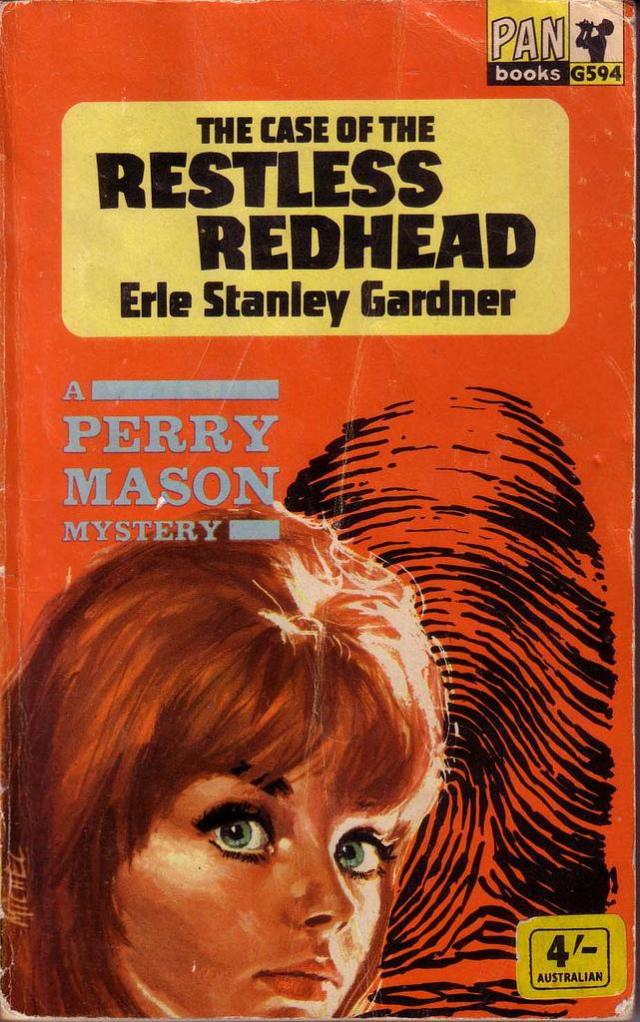
The case of the restless.., p.20
The Case of the Restless Redhead,
p.20


“Well, after those developments took place those people should have been subpoenaed,” Judge Kippen snapped.
Burger’s face flushed. “Of course, Your Honor,” he said, “I could have subpoenaed them. I assumed they were under subpoena. On the other hand, the Court could simply and very readily have directed all witnesses to return today and that would have been a Court order. I do not think my office should take the sole responsibility in the matter. Since neither of those things was done I assume that Mr. Passing is correct in his assumption that these people were free to leave the state.”
Judge Kippen replied tartly, “The Court didn’t make such an order because it assumed the office of the prosecutor had done what would ordinarily have been expected under the circumstances.”
“I’m sorry, Your Honor,” Burger snapped in a tone which showed far more anger than sorrow.
“Well, where does that leave the case?” Judge Kippen asked.
Burger said, “As far as the prosecution is concerned, it appears that a prima-facie case has been made out. This defendant told a story which was manifestly false.”
“How do you know it was manifestly false?”
“Why, Your Honor, her story was that this man was wearing the pillow slip. The fact is that the pillow slip was put over his head after death. She was, moreover, carrying a gun which had been discharged twice—”
“A gun which had nothing to do with the death of the decedent in this case,” Judge Kippen snapped.
“Oh, Your Honor,” Hamilton Burger said, suddenly realizing his position, “I think it is quite apparent that someone substituted weapons. I am not in a position to name names at the present time, but my office is certainly going to make an investigation and I am hoping we can fix the responsibility.”
Burger turned to glower at Mason.
“Don’t be too sure,” Judge Kippen retorted. “The only person who could have substituted weapons was someone who had access to both wea-pons.”
“But, Your Honor,” Hamilton Burger said, “it is obvious that the substitution must have been made after the two shells were fired. The defendant admitted to officers that she had fired those shells. Since it now appears that those shells must have been discharged from the murder gun, the fact that another gun had been substituted by the time the authorities got possession of the weapon certainly isn’t absolving the defendant. In fact, it indicates a consciousness of guilt and a very expert and adroit attempt to confuse the issues.”
“Well, this Court isn’t going to bind anyone over for a crime until it has more evidence than it has now,” Judge Kippen retorted. “That substitution was made for a purpose and was made by someone who had an opportunity to make the substitution.”
“Exactly,” Hamilton Burger said, and again glanced at Perry Mason.
Perry Mason met Burger’s accusing eyes and merely smiled.
Burger’s face reddened. “I am going to find out who made that substitution,” he shouted, “if I have to devote the entire facilities of my investigative staff to it for a year, and when I find out I am going to take steps to have that person disbarred.”
“Disbarred?” Judge Kippen asked, raising his eyebrows. “Are you making a definite accusation, Mr. Prosecutor?”
“I mean,” Burger amended hastily, “if the person is an attorney, I intend to have him disbarred, and if he is not, I intend to have him prosecuted.”
Judge Kippen looked at Perry Mason. “Do you have any statements you wish to make at this time, Mr. Mason?”
“Yes, Your Honor.”
“Mr. Burger will be seated. Mr. Mason, what statement do you wish to make?”
Mason said, “I merely wanted to state that I had a witness I wished to call.”
“Very well, the Court will hear any witness you may care to produce, Mr. Mason.”
Mason said, “Call Irene Keith to the stand.”
Irene Keith came forward, was sworn, took the witness stand and sat looking at Mason, her eyes sharp with antagonism.
“You are a close friend of Helene Chaney?” Mason asked.
“I was.”
“And of Mervyn Aldrich?”
‘Yes.”
“I show you a Colt revolver, marked People’s Exhibit A, and ask if you’ve seen that weapon before.”
“I don’t know.”
“I show you a Colt revolver, marked People’s Exhibit E, and ask you if you’ve ever seen that revolver before.”
“I don’t know.”
“You have seen weapons which look like these?”
“I have seen revolvers, yes.”
“You have seen weapons which look like these?”
“Yes.”
“Which were exactly similar in appearance?”
“Yes.”
“Did you ever have one of those weapons in your possession?”
“I don’t know.”
“I am not referring to these two specific weapons,” Mason said. “I am referring to any weapon which was identical in appearance.”
“Yes.”
“Did you have such a weapon in your possession on the tenth of this month?”
“Oh, Your Honor,” Hamilton Burger said, “Counsel is now seeking to cross-examine his own witness.”
“I think it’s quite apparent that she’s a hostile witness,” Mason said.
“The objection is overruled,” Judge Kippen snapped.
“I’m afraid I can’t answer that question,” Irene Keith said.
“Helene Chaney loaned you a revolver, didn’t she?”
“Yes.”
“On the tenth of this month?”
“I believe so.”
“The gun she loaned you could well have been this revolver marked Exhibit E?”
“I—well, yes.”
“What did you do with that revolver?”
“I … I can t say.”
Judge Kippen leaned forward, glared down at the witness, said to Perry Mason, “I’ll examine this witness, Mr. Mason. Miss Keith, this is a serious matter. The patience of the Court has been worn very, very thin. The Court doesn’t want any quibbling. Now tell us what you did with that revolver.”
Irene Keith looked down at the; floor, suddenly raised her eyes to Judge Kippen. “I refuse to answer,” she said, “on the ground that the answer might incriminate me.”
A gasp of startled surprise went through the courtroom.
Judge Kippen recoiled as though he had been struck. “You refuse to answer?” he asked incredulously.
“That’s right.”
“On the ground that to do so may incriminate you?”
“Yes.”
“Now you have already admitted,” Judge Kippen said, “that you had such a weapon in your possession.”
“I had a weapon in my possession.”
“Was it similar in appearance to these two weapons here?”
“I am not an expert on guns.”
“Never mind whether you’re an expert or not. Was it similar in appearance?”
“Yes.”
Judge Kippen drummed with the tips of his fingers on the mahogany desk. His face was flushed with anger.
“Do you have an attorney present in court?” he asked. “No.”
“Have you consulted an attorney in regard to your testimony?”
“Yes.”
“And are you acting under advice of counsel in refusing to answer on the ground that the answer may incriminate you?”
“I have been advised by counsel that I had that right if I wished to accept the responsibility.”
“Well, I’d like to discuss that matter with your attorney,” Judge Kippen said. “It is the Court’s offhand opinion that, having answered the question that you had such a weapon in your possession on the day of the murder, you can’t refuse to tell what you did with the weapon on the ground that the answer might incriminate you. There is nothing in the nature of any possible answer which could incriminate you. That is, if you gave the weapon to someone—unless, of course—”
Judge Kippen was silent for a moment. Abruptly he said, “Did you have anything to do with the murder of Stephen Merrill?”
“No, Your Honor.”
“Were you present at the time he was killed?”
“No, Your Honor.”
“Did you have any idea that he was going to be killed?”
“No, Your Honor.”
“Did you conspire with anyone to bring about the death of Stephen Merrill?”
“No, Your Honor.”
“Under those circumstances,” Judge Kippen said, “I don’t think that you are entitled to invoke the constitutional amendment in order to purge yourself of any contempt. If you gave that weapon to someone but did not have any guilty purpose in giving that weapon to this person, you aren’t entitled to shield yourself behind the amendment. An attempt to do so, where there are no grounds for doing so, would be a contempt of court. Now I am going to ask you once more, to whom did you give that weapon?”
“I refuse to answer on the ground that my answer may tend to incriminate me.”
Judge Kippen said, “This is a most peculiar situation. The Court is about to take a very drastic step. The Court is not going to be trifled with in this matter.”
Mason arose. “Perhaps, Your Honor,” he said, “I may be able to clear up a situation which seems to be puzzling the Court. I would like to ask the witness a question if I may.”
“Go ahead,” Judge Kippen snapped.
Mason said, “When you invoke your rights under the Fifth Amendment to keep from incriminating yourself, isn’t it a fact that you fear that your answer, while it may not have anything to do with the murder, may incriminate you by establishing a connection with some other crime?”
Irene Keith flared into rage. “You’re responsible for this whole—”
Judge Kippen banged his gavel. ‘The witness will answer that question,” he said.
“I don’t think I have to,” she said.
“I do,” Judge Kippen retorted.
“I’ve said that my answer might incriminate me and that’s all you’re going to get out of me. I have told my attorney the full facts and I am acting under his advice.”
Judge Kippen hesitated, apparently debating whether to hold the witness in contempt of court. His eyes turned to Mason.
“Mr. Mason,” he said, “you seem to have some definite idea in mind in regard to this witness. Perhaps you can ask additional questions which will tend to clarify the situation.”
Mason turned to Irene Keith. “On or about the tenth of this month did you have some discussion with Stephen Merrill about some jewelry?”
“I refuse to answer on the ground that to do so might incriminate me.”
Judge Kippen looked at Mason in surprise. “What is all this?” he asked. “What is this leading up to?”
Mason said, “Perhaps, Your Honor, I can bring it out.”
Hamilton Burger jumped up. “Your Honor, I object to counsel going on a fishing expedition. I object to him cross-examining—”
“Your objection is overruled,” Judge Kippen snapped without even looking at Hamilton Burger. “Go ahead, Mr. Mason. Ask your questions.”
Mason said, “Isn’t it a fact, Miss Keith, that you gave Stephen Merrill a large sum of money in cash on the tenth of this month?”
“I refuse to answer on the ground that the answer may incriminate me.”
“Isn’t it a fact that you had a revolver on the tenth of this month and that you gave Stephen Merrill this gun?”
“Oh, Your Honor,” Hamilton Burger said, “I object to this type of examination.”
“The objection is overruled.”
“Please, Your Honor, may I be heard?”
Judge Kippen didn’t even look at him. His eyes were fastened on Irene Keith’s defiant countenance. He said, “I won’t preclude you from argument, Mr. Prosecutor, but I think your objection is not well taken and the Court intends to get at the bottom of this thing.”
“Your Honor,” Burger protested, “it is obvious as can be what Mr. Mason is doing. Knowing that this witness is in a position where she won’t answer any questions relating to this weapon, he is seeking to try the case in the newspapers by putting all sorts of absurd combinations together. It is just the same as though I would ask her, ‘Isn’t it a fact that on the tenth day of this month you bribed Judge Kippen to kill Stephen Merrill with a weapon which you furnished him which was exactly similar in appearance to the weapons marked for identification in this case?’ Since the witness obviously feels that she cannot answer any questions concerning a gun being in her possession on the tenth of this month without incriminating herself, she will again invoke the protection of the amendment and counsel will have made a telling point in that it will appear he has made an accusation which the witness has been unable, or has been afraid, to deny.
“It is a well-known fact that counsel for the defense is noted for his adroit ingenuity, his ability to capitalize on the dramatic. Here we have once more a case which should have been a routine matter in a preliminary examination. It has, however, been handled in such a manner that this courtroom has been turned into a three-ring circus for the benefit of publicity and for the purpose of obscuring the issues.”
“Are you finished, Mr. District Attorney?” Judge Kippen asked, still with his eyes on the witness.
“Yes, Your Honor.”
“Your objection is overruled. The witness will answer the question.”
“I refuse to answer on the ground that my answer may incriminate me.”
“Go on, Mr. Mason,” Judge Kippen said.
“I have no further questions.”
Hamilton Burger said, “I would like to ask a question on cross-examination.”
“Go ahead,” Judge Kippen said.
“Miss Keith, isn’t it a fact that on or about the tenth day of this month you conspired with Stephen Merrill to assassinate the President of the United States, and that for the purpose of carrying out this assassination you gave to Stephen Merrill a gun which you had in your possession which was exactly similar in appearance to one of the weapons marked for identification in this case?”
Judge Kippen said, “I consider that question impertinent, Mr. Prosecutor. I consider that it dangerously borders on a contempt of this court.”
Burger stuck by his guns. “I am simply trying to make my point in regard to these questions asked by counsel for the defense,” he said. “I want to show that since this witness does not dare to answer any question concerning a gun being in her possession on the tenth, it is simply a matter of forensic ingenuity to tie up any sort of an absurd question covering anything that Counsel wants to establish, and have the witness, by her refusal, give some semblance of plausibility to a hopelessly absurd theory, a theory advanced purely for the purpose of securing publicity favorable to the defendant.”
“I see your point,” judge Kippen said. “I saw it the first time, but in view of the attitude of this witness, the Court feels that the situation should be thoroughly explored. Your question is so completely frivolous, specious and absurd that it is annoying to the Court.”
“I was only trying to establish a point,” Burger said.
“You can establish it in a more dignified manner.”
Mason said, “I beg the Court’s pardon, but in connection with this colloquy between Court and counsel it may not have occurred to the Court that the witness has not as yet answered that question.”
“Well, of course,” Hamilton Burger aid, “she’ll adopt the same position. She has to. She—”
“Are you qualifying as a clairvoyant,” Mason asked, “or have you been advising this witness to refuse to answer questions?”
“I object to that,” Hamilton Burger shouted. “Your Honor, this is an insinuation that—”
“That is perfectly justified under the circumstances,” Judge Kippen snapped. “The Court begs your pardon, Mr. Mason. The witness was not given an opportunity to answer that question. Go ahead and answer the prosecutor’s question, Miss Keith.”
“No,” she said.
Mason smiled.
Hamilton Burger looked crestfallen.
Judge Kippen said, “Look here, Miss Keith, you apparently feel that there was some contact between you and Mr. Merrill which you don’t care to disclose at this time, some relationship which you had in connection with some other matter. Did you give Stephen Merrill approximately seven thousand five hundred dollars on the tenth of this month?”
“I refuse to answer on the ground that my answer may incriminate me.”
Judge Kippen said, “Mr. Mason, apparently you have at least the inkling of a solution as to the conduct of this witness. The Court is simply unable to establish any valid reason for her conduct.”
Mason said affably, “If the Court please, all I can say is that I think this witness has probably sought the advice of very competent counsel and that her position, within the technical limits of the law, is well taken.”
Hamilton Burger jumped to his feet. “Your Honor, this is simply another grandstand. Now we have counsel for the defense coming in and stating that this witness is well within her rights in refusing to answer questions which certainly are pertinent—”
Judge Kippen banged his gavel. “The prosecutor will desist from any comments as to the tactics of the counsel for the defense. If you have any explanation as to the conduct of this witness, I would like to hear it.”
Hamilton Burger said, “Very well, Your Honor. I’d like to ask one question. Miss Keith, have you at any time consulted Mr. Perry Mason, attorney for the defendant, as to your testimony in this case?”
“No.”
“Have you consulted Mr. Perry Mason with reference to any other matter? Is he your attorney in any way?”
“No.”
Burger hid his embarrassment by turning to confer in a whisper with Strawn.
Judge Kippen said, “The Court is going to take a thirty-minute recess. During that time the Court would like to confer with counsel for both sides in chambers. The Court specifically directs each and every person who is a witness in this case, or who has been a witness in this case, who is present in court, to be available when court reconvenes in approximately thirty minutes. Under no circumstances are witnesses to absent themselves from further attendance on the court. I trust that is plain.”















