The case of the restless.., p.3
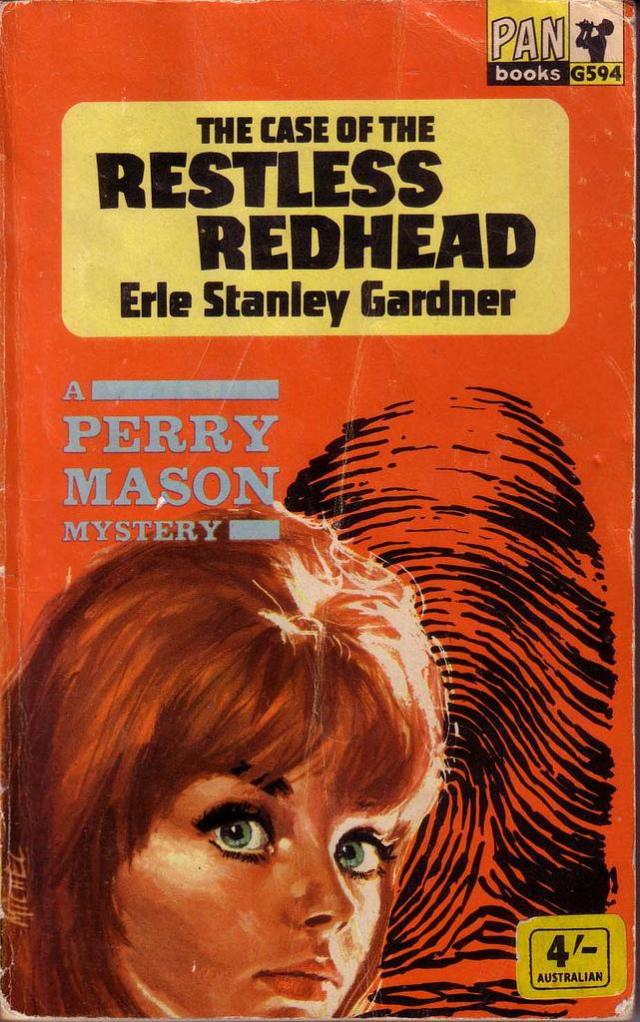
The Case of the Restless Redhead,
p.3


“Just a couple of local people,” Mason said.
“The income tax department would like a little more information than that,” she reminded him.
Mason laughed. “This is personal. Don’t charge it. A chap by the name of Frank Neely and the young woman he expects to marry, Estelle Nugent.”
Della Street picked up the expense account. “I thought so,” she said, and left the office.
A few moments later she returned with a smile. “Well, Mr. Good Samaritan, I see you’ve cast your bread upon the waters and you’re now in the garbage-disposal business.
“How come?”
“In the outer office,” she said, “is a very starry-eyed young redhead with a figure that is much more important than her clothes would indicate, who gives the name of
Evelyn Bagby. She says that she simply must, and I quote, thank Mr. Mason personally, unquote. She’s redheaded and determined.”
Mason frowned. “She wasn’t supposed to know that I had anything to do with it.”
“Well, she does.”
“Bring her in, Della,” Mason said. “We’ll acknowledge her thanks and then send her on her way. Unless I’m greatly mistaken she’s in need of finding work and I’m in need of doing some.”
“That pile of mail at your left,” Della Street reminded pointedly.
“Yes, yes, I know. I’ll get at it some time today. Send her in, Della.”
Evelyn Bagby, seeming much taller standing alongside Della Street than when she had been sitting beside her lawyer in court the day before, came striding across the office. Her steady blue eyes rested unwaveringly on Mason’s face. Her handclasp was simple, strong and direct as she gripped the lawyer’s hand.
‘Thanks.”
“For what?” Mason asked, smiling down into the frank blue eyes.
“As though you didn’t know.”
“Do you?”
“Certainly.”
“How?”
“Mr. Neely told me.”
Mason frowned. “He shouldn’t have.”
“He told me that he was going to be frank with me. I—well, I was terribly grateful and I was a little curious.”
“About what?”
“About the way he went after that witness in the afternoon. He seemed to have an entirely new approach. He’d been floundering around in the morning, and then right after lunch he started in just as full of confidence as though he’d been a veteran. After about four questions he had this man Boles all mixed up. Then Boles started kicking the case all around the courtroom. I asked Neely about it afterward and he told me what had happened.”
“Sit down,” Mason invited.
She shook her head, said, “You’re too busy. I wasn’t at all certain you’d see me. I understand a client has to have an appointment in order to get even a foot inside the door. But I wanted you to know that I did understand and I do appreciate.”
“Thanks a lot,” Mason said. “Neely said you were looking for work.”
She nodded.
“Think you can find some?”
“Sure. I’ll get by.”
“Do you have any idea how it happened that the witness Boles identified you?”
She shook her head. “He didn’t either after Frank Neely finished with him yesterday afternoon, but he sure was going strong in the morning. That’s the way with his type. They make a great showing when things are going good, but when the going gets tough they certainly run for cover. That’s one thing you learn being on your own and dealing with all sorts and all types. You get so you can classify them pretty fast. The only thing I’m sorry about is that they have my fingerprints on file now, and whenever anybody wants to know anything about me, why there’ll be a record reading, ‘Arrested but acquitted,’ as though somehow the jury had been at fault.”
“Did your attorney say anything about the possibility of some compensation to you to make up for all this annoyance, publicity and all of that?”
“Why, no. They acted as though they were doing me a great favor turning me loose. The matron certainly hated to let go of me and give me back the few dollars I had in cash.”
Mason said to Della Street, “Get Frank Neely on the phone for me, Della. He’s the attorney at Riverside.
“Sit down, Miss Bagby. This will only take a few minutes.”
Evelyn Bagby looked at him with thoughtfully speculative eyes while Della Street was putting through the call. She lowered herself into the clients’ big chair.
“If you feel that I’m entitled to ask for anything, there’s one thing I want and only one thing.”
“What’s that?” Mason asked.
“You’ll laugh when you hear this one,” she said, “and probably throw me out of the office.”
“Go on,” Mason told her. “What is it?”
“I’m not interested in money—that is, I am, but there’s something I want more than money.”
“What?”
“Don’t laugh. I want a screen test.”
Mason looked her over with critical appraisal. He slowly nodded his head.
“You might be good,” he said, “but don’t think that—”
“Oh, I know,” she told him, “you’re going to tell me that I mustn’t think screen tests are easy or that anything will come of them even if I make a good test. Hollywood is overcrowded. It takes luck, brains, ability, good looks, poise, influential contacts, and even then the chances are one in a million.”
Mason smiled. “Something like that.”
“I know, I’ve heard it all. I’ve read it all. It’s taken me seven years to get here.”
Mason raised his eyebrows.
Della Street interposed, “The Riverside circuits are busy. It will be two or three minutes, Chief.”
Mason, without taking his eyes from his visitor, said, “Tell Gertie to keep trying, Della. Why did it take you seven years to get here, Miss Bagby?”
She laughed and said, “Seven years ago I was a girl eighteen years old. I was rather striking. Most redheads have freckles. I didn’t. I had pretty good features and a very good figure.”
“You still have a good figure.”
“Not like it was, Mr. Mason. Seven years of hard work, waiting on tables, knocking around, learning about the world the hard way, have levied a toll. I thought I was all over my ambition, but what you said just now suddenly caused it to flare up.”
“What did I say?”
“That I might be entitled to something.”
“I was talking about some pecuniary compensation. That’s a possibility that may be rather remote under the circumstances but we might get enough to give you some get-by money.”
“Well,” she said, “the figures in this case are prominent in Hollywood. Helene Chaney should have a lot of influence.”
“If she wants to use it,” Mason said.
“Well, I thought I’d let you know what I had in mind. You see, Mr. Mason, I was very ambitious and very determined at the age of eighteen. I had some money that had come to me on my father’s death. My mother died when I was ten, my father when I was seventeen. I was going to Hollywood and make good, and then I met a man named Gladden. I still have one of his cards as a souvenir. Staunton Vester Gladden.”
“Who is he?”
“He was the dazzling sun who moved into my young life. He was on intimate terms with all of the great and near-great in Hollywood. He was a dramatic coach. He breathed the atmosphere of the theater. He was the man whose genius had made half a dozen actors and actresses. He called all of the principal figures of Hollywood by their first names. He was—”
“I never heard of him,” Mason interrupted.
“Neither did anyone else.” She laughed bitterly. “He was a man who was just as stage-struck as I was, only he was just a natural-born confidence man and a perfect heel. Of course I didn’t know it at the time. I was a wide-eyed girl of eighteen who thought I knew my way around from what I had gathered from magazines, motion pictures, and the amateurish passes that the small-town guys made at me. I wasn’t hep to this high-powered stuff.”
“What happened?” Mason asked, interested.
“Oh,” she said, “Gladden did the usual. Look, I mustn’t take up your time with this.”
Mason waved his hand in the direction of the telephone. “We’re waiting for a call, Miss Bagby, and you interest me. After all, a lawyer has to know a lot about human nature—and if I’m going to try to get you a screen test I should know something of your background.”
“That last does it,” she said, smiling. “Well, Gladden laughed at my ambitions. He told me I wouldn’t stand a ghost of a chance in Hollywood with my unsophisticated background and girlish dreams. He said I must become a polished young woman. Well, of course, you know the answer. There was only one person who could do the polishing and that was Staunton Vester Gladden. He gave me a ninety-day course. By the time he had finished, I had lost a lot of things. I’d picked up some polish and a lot of wisdom. He had absconded with all of my little inheritance and I was flat broke, disillusioned, and had to take a job as waitress.”
“Did you go to the police?”
“Oh sure,” she said. “I went to the police. Of course I didn’t tell them the whole story. I told them the high lights about how he had got control of my money and had skipped out. He played it very skillfully. At first he told me money wouldn’t enter into it at all. Then he said he wanted to be my permanent agent. He wanted twenty per cent of my earnings when I hit the big time. He was to be my manager, agent, dramatic coach and all the rest of it.
“He started in very smoothly and easily, laughing at me, then gradually rubbing his eyes as he became convinced that I had ‘great natural talent,’ then going into enthusiastic rhapsodies about my potential ability. He had my head completely turned. I was, of course, developing my dramatic art, and you can put that in quotes, Mr. Mason, under his tutelage. I was also becoming a young woman. I was learning about emotion. I was getting a mature outlook. I was becoming conditioned for Hollywood. And all the line that goes with it.
‘Then he got a brilliant idea. He had an opportunity to get in on one of the big studio deals. It was going to take a little money. But I would become a stockholder. That would be a short cut. That would catapult me into fame. I gave him my money to make the investment, and you can also put that in quotes, Mr. Mason.”
“And then?” Mason asked.
“Then he vanished. That was the last I ever saw of him,” she said. “Of course the police investigated. They found out that Hollywood had never heard of Staunton Vester Gladden. The people whom he was calling by their first names didn’t even know he existed. The police told me it wasn’t a particularly novel approach.”
“And so you lost your Hollywood ambitions?”
“I thought I had. I waited on tables. I learned about life the hard way, and I suppose it did things to me. I would look at myself in the mirror and compare what I saw with the fresh, young girl I’d been when I was thinking of a career on the screen and building all those air castles. Well, that’s the way it goes, Mr. Mason.
“However, I was always restless. I never want to stay in one place. I keep roaming around the country. So finally I asked myself, “Why not see Hollywood after all?’ So I made it in two hops.”
“Two?” Mason asked.
“First,” she said, “I went to Needles. I worked there, acquired a little dough for a stake, and then I got sick. By the time I finished with doctor and hospital bills, I had a jalopy that will get you over the road if you’re patient and persevering, a few clothes and nothing else.
“I should have known the answer then. I should have known that Hollywood was a hoodoo. But I decided I would never be any younger and that I’d start for Hollywood. I got as far as Corona. The jalopy’s rear end went out and I had to wait while they sent to Los Angeles for parts. So I stopped at this motel. Well, you know the rest of it.”
Mason regarded her thoughtfully. “They did find an article of the stolen jewelry in your suitcase?”
“Sure,” she said. “I was broke. I was desperate. I had just about enough money to pay for the car repairs, to pay for the motel, and get to Hollywood. Then I was hoping to get a job. I knew that wouldn’t be easy. They say that the town is filled with broken-hearted girls who come on here to be prima-donnas and wind up being waitresses—provided they can get jobs.
“Well, the second day I was there I went into the bathroom to take a shower. I noticed a drawer in the chest of drawers in the bathroom was open a little way and there was a gleam of light reflected back from the interior of the drawer. It came from this diamond bracelet.”
She hesitated, thinking back over the occurrence.
“Go on,” Mason said.
“Well, there I was, broke, desperate, and suddenly filled once more with that ambition that I’d had years before.”
“And you intended to appropriate the bracelet?” Mason asked sharply.
“Don’t be silly! I thought I could get a reward. I thought that some rich woman had been in that motel the day before I took the place and had taken off her bracelet when she started to take a shower. Then she’d gone away and forgotten it. I also felt pretty certain that she didn’t know where she’d left it because if she had she’d have telephoned back to the motel and the motel would have recovered it.”
Mason nodded.
“At first, of course, my idea was to dress and go to the office of the motel and explain to them what I’d found, ask them to notify the person who had last occupied the motel. Then I thought, Why be foolish? That bracelet probably belongs to some rich woman. She’d be grateful. She’d give a fifty-or a hundred-dollar reward. The manager of the motel would pocket the reward and I wouldn’t even get a thin dime, or so much as a thank you. No one would know I even existed.”
“So you decided to find out who had been in there before and collect the reward?”
“That’s right. I didn’t think they’d tell me if I asked, and if I asked I knew the manager would get suspicious. So I intended to take the bracelet to Los Angeles with me, then get someone who had some official position, an attorney or a detective or something, to get the information for me. Then I’d approach the woman directly, return the bracelet and everything would be swell. Well, you know what happened. I—”
The phone rang and Della Street nodded to Mason. “Here’s your party.”
Mason took the telephone. “Good morning, Counselor,” he said, “and congratulations. This is Perry Mason talking.”
Frank Neely was all but inarticulate with his thanks. “You know,” he said, “you were right, Mr. Mason. That fellow Boles was a phony. At least he was testifying to something he couldn’t substantiate. I am completely satisfied that he couldn’t identify the person he saw, and the jury was, too. Thanks to the line of attack you worked out for me.”
“I’m afraid you’re taking too little credit for yourself,” Mason said. “What about the defendant?”
“She left town right after her release.”
“She’s in my office,” Mason said.
There was a moment of embarrassed silence, and then Neely said, ‘Well, of course, I couldn’t resist telling her about you, and what you had done for her.”
“You didn’t tell anyone else, did you?”
“No, not a soul.”
“Don’t,” Mason said, “because I didn’t do much and you’re the one who secured the verdict.”
Neely said, “I wish I could tell you how much it meant to me, Mr. Mason. You’ll never know. It wasn’t only this case but my entire career. I felt so helpless standing up there trying to ask questions and getting nowhere, and then all of a sudden after you talked to me it seemed as though the scales had dropped from my eyes, and then-well, I guess I got fighting mad. The first thing I knew I had ceased to think about myself any more. I was simply standing up there throwing questions at him and he was squirming and twisting all over the witness stand. I could see the jurors beginning to believe he was a terrific liar. It gave me my self-confidence back.”
“What,” Mason asked, “are we going to do with Evelyn
Bagby? She tells me she would like to have things cleared up.”
“You do anything for her that you can,” Neely said. “I’ve done everything I can.”
“Have you talked with any of the parties interested about—?”
“No, I haven’t talked with anyone.”
“I’ll see what I can do at this end,” Mason said. “You’ll be associated with me.”
“Please remember me to her,” Neely said. “I don’t suppose there’s anything more that can be done.”
“I’ll keep you posted,” Mason promised and hung up. He smiled at Evelyn Bagby. “Neely wants to be remembered to you.”
“He’s a nice young fellow,” she said. “I’m everlastingly grateful to him, but—well, I know who inspired him.”
Mason frowned thoughtfully. “Who signed the complaint which resulted in your arrest?”
“Irene Keith. She was the bridesmaid. That is, she was to have been the bridesmaid. It was one of those movie affairs. Helene Chaney, the actress, and Mervyn Aldrich, the boat manufacturer. I’d been reading about it just the day before in one of the Hollywood columns. I certainly didn’t think I’d ever get mixed up in it. I—”
The telephone rang, a series of quick, short rings.
Della Street picked up the instrument, said, “Yes, what is it, Gertie …? Oh, tell him to hold on.”
She turned to Perry Mason and said, “Frank Neely from Riverside is calling you back, says he has to speak with you right away.”
Mason nodded, picked up the extension telephone, said, “Yes, hello, Neely. What is it?”
Neely’s voice was excited. “Irene Keith is calling on the other line,” he said. “She said that since Evelyn Bagby had been acquitted she was thinking about giving her a little money to use in getting out of town. She mentioned a figure of seventy-five or a hundred dollars. What shall I tell her?”
Mason grinned. “Tell her that Perry Mason is your associate in the matter and that she is to call me. But don’t get your mind set on any big fee because I doubt if it’s in the cards. Don’t discuss any figures with Irene Keith. Just tell her to call me; that you’re associated with me in the matter.”