

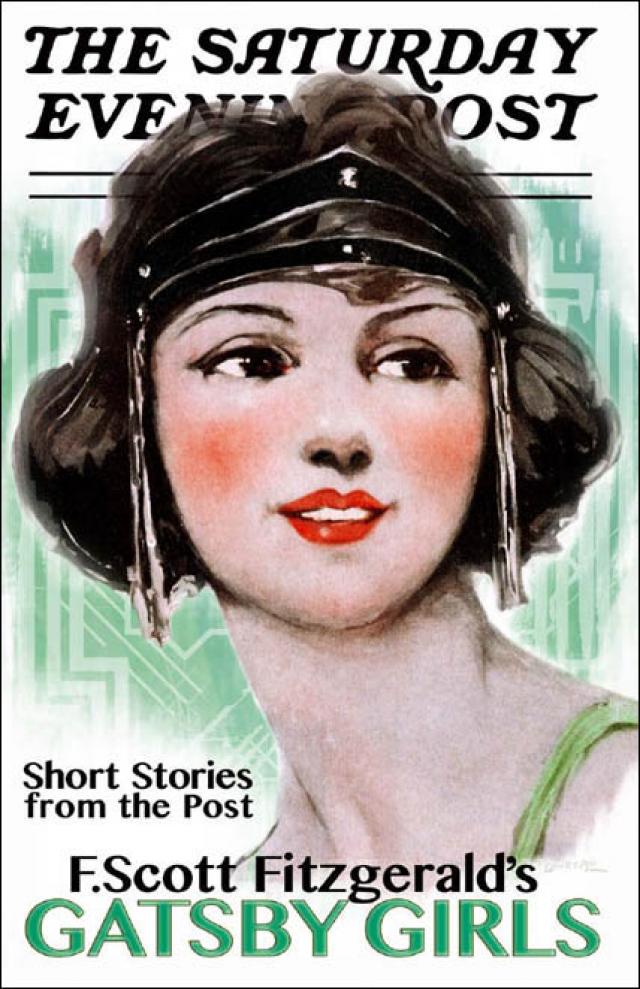
Gatsby girls, p.13
Gatsby Girls,
p.13


“Give up and get down! You tried to buck me and I called your bluff. You see you haven’t got a prayer.”
And some last energy rose up in Bernice, for she clenched her hands under the white cloth, and there was a curious narrowing of her eyes that Marjorie remarked on to someone long afterward.
Twenty minutes later the barber swung her round to face the mirror, and she flinched at the full extent of the damage that had been wrought. Her hair was not curly, and now it lay in lank lifeless blocks on both sides of her suddenly pale face. It was ugly as sin—she had known it would be ugly as sin. Her face’s chief charm had been a Madonna-like simplicity. Now that was gone and she was—well, frightfully mediocre—not stagy; only ridiculous, like a Greenwich Villager who had left her spectacles at home.
As she climbed down from the chair she tried to smile—failed miserably. She saw two of the girls exchange glances; noticed Marjorie’s mouth curved in attenuated mockery—and that Warren’s eyes were suddenly very cold.
“You see”—her words fell into an awkward pause—”I’ve done it.”
“Yes, you’ve—done it,” admitted Warren.
“Do you like it?”
There was a half-hearted “Sure” from two or three voices, another awkward pause, and then Marjorie turned swiftly and with serpent like intensity to Warren.
“Would you mind running me down to Derry’s shop?” she asked. “I’ve simply got to get a hat there before supper. Roberta’s driving right home and she can take the others.”
Warren stared abstractedly at some infinite speck out the window. Then for an instant his eyes rested coldly on Bernice before they turned to Marjorie.
“Be glad to,” he said slowly.
VI
Bernice did not fully realize the outrageous trap that had been set for her until she met her aunt’s amazed glance just before dinner.
“Why, Bernice!”
“I’ve bobbed it, Aunt Josephine.”
“Why, child!”
“Do you like it?”
“Why, Bernice!”
“I suppose I’ve shocked you.”
“No, but what’ll Mrs. Deyo think tomorrow night? Bernice, you should have waited until after the Deyos’ dance—you should have waited if you wanted to do that.”
“It was sudden, Aunt Josephine. Anyway, why does it matter to Mrs. Deyo particularly?”
“Why, child,” cried Mrs. Harvey, “in her paper on The Foibles of the Younger Generation that she read at the last meeting of the Thursday Club she devoted fifteen minutes to bobbed hair. It’s her pet abomination. And the dance is for you and Marjorie!”
“I’m sorry.”
“Oh, Bernice, what’ll your mother say? She’ll think I let you do it.”
“I’m sorry.”
Dinner was an agony. She had made a hasty attempt with a curling iron, and burned her finger and much hair. She could see that her aunt was both worried and grieved, and her uncle kept saying, “Well, I’ll be darned!” over and over in a hurt and faintly hostile tone. And Marjorie sat very quietly, entrenched behind a faint smile, a faintly mocking smile.
Somehow she got through the evening. Three boys called; Marjorie disappeared with one of them, and Bernice made a listless mechanical attempt to entertain the two others—sighed thankfully as she climbed the stairs to her room at half past ten. What a day!
When she had undressed for the night the door opened and Marjorie came in.
“Bernice,” she said, “I’m awfully sorry about the Deyo dance. I’ll give you my word of honor I’d forgotten all about it.”
“’S’all right,” said Bernice shortly. Standing before the mirror she passed her comb slowly through her short hair.
“I’ll take you downtown to-morrow,” continued Marjorie, “and the hairdresser’ll fix it so you’ll look slick. I didn’t imagine you’d go through with it. I’m really mighty sorry.”
“Oh, ‘sall right!”
“Still it’s your last night, so I suppose it won’t matter much.”
Then Bernice winced as Marjorie tossed her own hair over her shoulders and began to twist it slowly into two long blond braids until in her cream-colored negligee she looked like a delicate painting of some Saxon princess. Fascinated, Bernice watched the braids grow. Heavy and luxurious they were, moving under the supple fingers like restive snakes—and to Bernice remained this relic and the curling iron and a tomorrow full of eyes. She could see G. Reece Stoddard, who liked her, assuming his Harvard manner and telling his dinner partner that Bernice shouldn’t have been allowed to go to the movies so much; she could see Draycott Deyo exchanging glances with his mother and then being conscientiously charitable to her. But then perhaps by to-morrow Mrs. Deyo would have heard the news; would send round an icy little note requesting that she fail to appear—and behind her back they would all laugh and know that Marjorie had made a fool of her; that her chance at beauty had been sacrificed to the jealous whim of a selfish girl. She sat down suddenly before the mirror, biting the inside of her cheek.
“I like it,” she said with an effort. “I think it’ll be becoming.”
Marjorie smiled. “It looks all right. For heaven’s sake, don’t let it worry you!”
“I won’t.”
“Good night, Bernice.”
But as the door closed something snapped within Bernice. She sprang dynamically to her feet, clenching her hands, then swiftly and noiselessly crossed over to her bed and from underneath it dragged out her suitcase. Into it she tossed toilet articles and a change of clothing. Then she turned to her trunk and quickly dumped in two drawerfuls of lingerie and summer dresses. She moved quietly, but with deadly efficiency, and in three-quarters of an hour her trunk was locked and strapped and she was fully dressed in a becoming new traveling suit that Marjorie had helped her pick out.
Sitting down at her desk she wrote a short note to Mrs. Harvey, in which she briefly outlined her reasons for going. She sealed it, addressed it and laid it on her pillow. She glanced at her watch. The train left at one, and she knew that if she walked down to the Marlborough Hotel two blocks away she could easily get a taxicab.
Suddenly she drew in her breath sharply and an expression flashed into her eyes that a practiced character reader might have connected vaguely with the set look she had worn in the barber’s chair—somehow a development of it. It was quite a new look for Bernice—and it carried consequences.
She went stealthily to the bureau, picked up an article that lay there, and turning out all the lights stood quietly until her eyes became accustomed to the darkness. Softly she pushed open the door to Marjorie’s room. She heard the quiet even breathing of an untroubled conscience asleep.
She was by the bedside now, very deliberate and calm. She acted swiftly. Bending over she found one of the braids of Marjorie’s hair, followed it up with her hand to the point nearest the head, and then holding it a little slack so that the sleeper would feel no pull she reached down with the shears and severed it. With the pigtail in her hand she held her breath. Marjorie had muttered something in her sleep. Bernice deftly amputated the other braid, paused for an instant, and then flitted swiftly and silently back to her own room.
Downstairs she opened the big front door, closed it carefully behind her, and feeling wildly happy and exuberant stepped off the porch into the moonlight, swinging her heavy grip like a shopping bag. After a minute’s brisk walk she discovered that her left hand still held the two blond braids. She laughed unexpectedly—had to shut her mouth hard to keep from emitting an absolute peal. She was passing Warren’s house now, and on the impulse she set down her baggage, and swinging the braids like pieces of rope flung them at the wooden porch, where they landed with a slight thud. She laughed again, no longer restraining herself.
“Huh!” she giggled wildly. “Scalp the selfish thing!”
Then picking up her suitcase she set off at a half run down the moonlit street.
In this story, Fitzgerald began his exploration of the differences between Southern and Northern culture. It was a theme that he would return to numerous times and variations of its heroine Sally Carrol would appear in a number of other stories, including “The Jelly Bean”, “Two For a Cent” and “The Last of the Belles.”
“The Ice Palace” made its appearance in the Post on May 22, 1920. Fitzgerald was paid $400 for its publication.
The Ice Palace
The sunlight dripped over the house like golden paint over an art jar and the freckling shadows here and there only intensified the rigor of the bath of light. The Butterworth and Larkin houses flanking were entrenched behind great stodgy trees; only the Happer house took the full sun and all day long faced the dusty road-street with a tolerant kindly patience. This was the city of Tarleton in southernmost Georgia—September afternoon.
Up in her bedroom window Sally Carrol Happer rested her nineteen-year-old chin on a fifty-two-year-old sill and watched Clark Darrow’s ancient flivver turn the corner. The car was hot—being partly metallic it retained all the heat it absorbed or evolved—and Clark Darrow sitting bolt upright at the wheel wore a pained, strained expression as though he considered himself a spare part and rather likely to break. He laboriously crossed two dust ruts, the wheels squeaking indignantly at the encounter, and then with a terrifying expression he gave the steering gear a final wrench and deposited self and car approximately in front of the Happer steps. There was a plaintive heaving sound, a death rattle, followed by a short silence; and then the air was rent by a startling whistle.
Sally Carrol gazed down sleepily. She started to yawn, but finding this quite impossible unless she raised her chin from the window sill changed her mind and continued silently to regard the car, whose owner sat brilliantly if perfunctorily at attention as he waited for an answer to his signal. After a moment the whistle once more split the dusty air.
“Good mawnin’.”
With difficulty Clark twisted his tall body round and bent a distorted glance on the window.
“’Tain’t mawnin’, Sally Carrol.”
“Isn’t it, sure enough?”
“What you doin’?”
“Eatin’ ‘n apple.”
“Come on go swimmin’—want to?”
“Reckon so.”
“How ‘bout hurryin’ up?”
“Sure enough.”
Sally Carrol sighed voluminously and raised herself with profound inertia from the floor, where she had been occupied in alternately destroying parts of a green apple and painting paper dolls for her younger sister. She approached a mirror, regarded her expression with a pleased and pleasant languor, dabbed two spots of rouge on her lips and a grain of powder on her nose and covered her bobbed corn-colored hair with a rose-littered sunbonnet. Then she kicked over the painting water, said, “Oh, damn!”—but let it lie—and left the room.
“How you, Clark?” she inquired a minute later as she slipped nimbly over the side of the car.
“Mighty fine, Sally Carrol.”
“Where we go swimmin’?”
“Out to Walley’s Pool. Told Marylyn we’d call by an’ get her an’ Joe Ewing.”
Clark was dark and lean and when on foot was rather inclined to stoop. His eyes were ominous and his expression rather petulant except when startlingly illuminated by one of his frequent smiles. Clark had what was locally called “an income”—just enough to keep himself in ease and his car in gasoline—and he had spent the two years since he graduated from Georgia Tech in dozing round the lazy streets of his home town discussing how he could best invest his capital for an immediate fortune.
Hanging round he found not at all difficult; a crowd of little girls had grown up beautifully, the amazing Sally Carrol foremost among them; and they enjoyed being swum with and danced with and made love to in the flower-filled summery evenings—and they all liked Clark immensely. When feminine company palled there were half a dozen other youths who were always just about to do something and meanwhile were quite willing to join him in a few holes of golf or a game of billiards or the consumption of a quart of “hard yella licker.” Every once in a while one of these contemporaries made a farewell round of calls before going up to New York or Philadelphia or Pittsburgh to go into business, but mostly they just stayed round in this languid paradise of dreamy skies and firefly evenings and noisy street fairs—and especially of gracious soft-voiced girls who were brought up on memories instead of money.
The flivver having been excited into a sort of restless resentful life Clark and Sally Carrol rolled and rattled down Valley Avenue into Jefferson Street, where the dust road became a pavement; along opiate Millicent Place, where there were half a dozen prosperous substantial mansions; and on into the downtown section.
Driving was perilous here, for it was shopping time; the population idled casually across the streets and a drove of low-moaning oxen were being urged along in front of a placid street car; even the shops seemed only yawning their doors and blinking their windows in the sunshine before retiring into a state of utter and finite coma.
“Sally Carrol,” said Clark suddenly, “it a fact that you’re engaged?”
She looked at him quickly. “Where’d you hear that?”
“Sure enough, you engaged?”
“’At’s a nice question to ask a girl!”
“Girl told me you were engaged to a Yankee you met up in Asheville last summah.”
Sally Carrol sighed. “Never saw such an old town faw rumors.”
“Don’t marry a Yankee, Sally Carrol. We need you round here.”
Sally Carrol was silent ‘a moment. “Clark,” she demanded suddenly, “who on earth shall I marry?”
“I offah my services.”
“Honey, you couldn’t suppawt a wife,” she answered cheerfully. “Anyway, I know you too well to fall in love with you.”
“’At doesn’t mean you ought to marry a Yankee.”
“S’pose I love him?”
He shook his head. “You couldn’t. He’d be a lot different from us, every way.”
He broke off as he halted the car in front of a rambling dilapidated house. Marylyn Wade and Joe Ewing appeared in the doorway.
“’Lo, Sally Carrol.”
“Hi!”
“How you-all?”
“Sally Carrol,” demanded Marylyn as they started off again, “you engaged?”
“Lawdy, where’d all this start? Can’t I look at a man ‘thout everybody in town engagin’ me to him?”
Clark stared straight in front of him at a bolt on the clattering wind shield. “Sally Carrol,” he said with a curious intensity, “don’t you like us?”
“What?”
“Us down here?”
“Why, Clark, you know I do. I adore all you boys.”
“Then why you gettin’ engaged to a Yankee?”
“Clark, I don’t know. I’m not sure what I’ll do, but—well, I want to go places and see people. I want my mind to grow. I want to live where things happen on a big scale.”
“What you mean?”
“Oh, Clark, I love you, and I love Joe here, and Ben Arrot, and you all, but you’ll—you’ll —”
“We’ll all be failures?”
“Yes. I don’t mean only money failures but just sort of—of ineffectual and sad and—oh, how can I tell you?”
“You mean because we stay here in Tarleton?”
“Yes, Clark; and because you like it and never want to change things or think or go ahead.”
He nodded and she reached over and pressed his hand.
“Clark,” she said softly, “I wouldn’t change you for the world. You’re sweet the way you are. The things that’ll make you fail I’ll love always—the living in the past, the lazy days and nights you have, and all your carelessness and generosity.”
“But you’re goin’ away?”
“Yes—because I couldn’t ever marry you. You’ve a place in my heart no one else ever could have, but tied down here I’d get restless. I’d feel I was—wastin’ myself. There’s two sides to me, you see. There’s the sleepy old side you love; an’ there’s a sawt of energy—the feelin’ that makes me do wild things. That’s the part of me that may be useful somewhere, that’ll last when I’m not beautiful any more.”
She broke off with characteristic suddenness and sighed, “Oh, sweet cooky!” as her mood changed.
Half closing her eyes and tipping back her head till it rested on the seat back she let the savory breeze fan her eyes and ripple the fluffy curls of her bobbed hair. They were in the country now, hurrying between tangled growths of bright-green coppice and grass and tall trees that sent sprays of foliage to hang a cool welcome over the road. Here and there they passed a battered Negro cabin, its oldest white-haired inhabitant smoking a corncob pipe beside the door and half a dozen scantily clothed pickaninnies parading tattered dolls on the wild grown grass in front. Farther out were lazy cotton fields, where even the workers seemed intangible shadows lent by the sun to the earth not for toil but to while away some age-old tradition in the golden September fields. And round the drowsy picturesqueness, over the trees and shacks and muddy rivers, flowed the heat, never hostile, only comforting like a great warm nourishing bosom for the infant earth.
“Sally Carrol, we’re here!”
“Poor chile’s soun’ asleep.”
“Honey, you dead at last outa sheer laziness?”
“Water, Sally Carrol! Cool water waitin’ faw you!”
Her eyes opened sleepily.
“Hi!” she murmured, smiling.
II
In November Harry Bellamy, tall, broad and brisk, came down from his Northern city to spend four days. His intention was to settle a matter that had been hanging fire since he and Sally Carrol had met in Asheville, North Carolina, in midsummer. The settlement took only a quiet afternoon and an evening in front of a glowing open fire, for Harry Bellamy had everything Sally Carrol wanted; and, besides, she loved him—loved him with that side of her she kept especially for loving. Sally Carrol had several rather clearly defined sides.


