

Gatsby girls, p.14
Gatsby Girls,
p.14
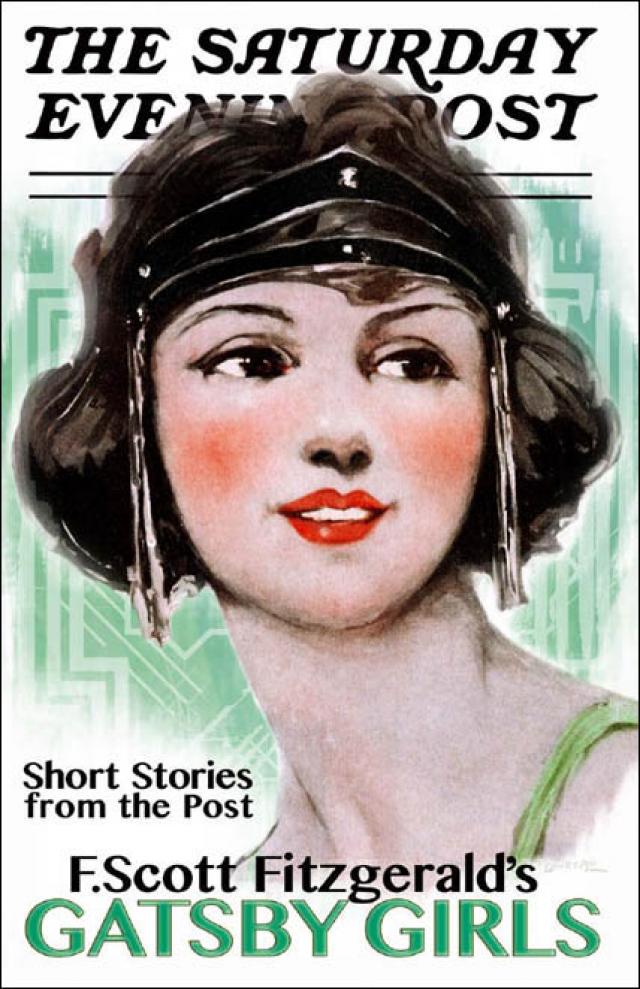


On his last afternoon they walked, and she found their steps tending half-unconsciously toward one of her favorite haunts, the cemetery. When it came in sight, gray-white and golden-green under the cheerful late sun, she paused irresolute by the iron gate.
“Are you mournful by nature, Harry?” she asked with a faint smile.
“Mournful? Not I.”
“Then let’s go in here. It depresses some folks, but I like it.”
They passed through the gateway and followed a path that led through a wavy valley of graves—dusty-gray and moldy for the fifties; quaintly carved with flowers and jars for the seventies; ornate and hideous for the nineties, with fat marble cherubs lying in sodden sleep on stone lows and great impossible growths of nameless granite flowers. Occasionally they saw a kneeling figure with tributary flowers, but over most of the graves lay silence and withered leaves with only the fragrance that their own shadowy memories could waken in living minds.
They reached the top of a hill where they were fronted by a tall round headstone, freckled with dark spots of damp and half grown over with vines.
“’Margery Lee,’” she read; “’1844-1873.’ Wasn’t she nice? She died when she was twenty-nine. Dear Margery Lee,” she added softly. “Can’t you see her, Harry?”
“Yes, Sally Carrol.”
He felt a little hand insert itself into his.
“She was dark, I think; and she always wore her hair with a ribbon in it, and gorgeous hoopskirts of bright blue and old rose.”
“Yes.”
“Oh, she was sweet, Harry! And she was the sort of girl born to stand on a wide pillared porch and welcome folks in. I think perhaps a lot of men went away to war meanin’ to come back to her; but maybe none of ‘em ever did.”
He stooped down close to the stone, hunting for any record of marriage.
“There’s nothing here to show.”
“Of course not. How could there be anything there better than just ‘Margery Lee,’ and that eloquent date?” She drew close to him and an unexpected lump came into his throat as her yellow hair brushed his cheek. “You see how she was, don’t you, Harry?”
“I see,” he agreed gently. “I see through your precious eyes. You’re beautiful now, so I know she must have been.”
Silent and close they stood, and he could feel her shoulders trembling a little. An ambling breeze swept up the hill and stirred the brim of her floppity hat.
“Let’s go down there!”
She was pointing to a flat stretch on the other side of the hill where along the green turf were a thousand grayish-white crosses stretching in endless ordered rows like the stacked arms of a battalion.
“Those are the Confederate dead,” said Sally Carrol simply.
They walked along and read the inscriptions, always only a name and a date, sometimes quite indecipherable.
“The last row is the saddest—see, ‘way over there. Every cross has just a date on it and the word ‘Unknown.’”
She looked at him and her eyes brimmed with tears.
“I can’t tell you how real it is to me, darling—if you don’t know.”
“How you feel about it is beautiful to me.”
“No, no, it’s not me, it’s them—that old time that I’ve tried to have live in me. These were just men, unimportant, evidently, or they wouldn’t have been `unknown’; but they died for the most beautiful thing in the world—the dead South. You see,” she continued, her voice still husky, her eyes glistening with tears, “people have these dreams they fasten on to things, and I’ve always grown up with that dream. It was so easy because it was all dead and there weren’t any disillusions comin’ to me. I’ve tried in a way to live up to those past standards of noblesse oblige—there’s just the last remnants of it, you know, like the roses of an old garden dying all round us—streaks of strange courtliness and chivalry in some of these boys an’ stories I used to hear from a Confederate soldier who lived next door, and a few old darkies. Oh, Harry, there was something, there was something! I couldn’t ever make you understand, but it was there.”
“I understand,” he assured her again quietly.
Sally Carrol smiled and dried her eyes on the tip of a handkerchief protruding from his breast pocket.
“You don’t feel depressed, do you, lover? Even when I cry I’m happy here, and I get a sawt of strength from it.”
Hand in hand they turned and walked slowly away. Finding soft grass she drew him down to a seat beside her with their backs against the remnants of a low broken wall.
“Wish those three old women would clear out,” he complained. “I want to kiss you, Sally Carrol.”
“Me, too.”
They waited impatiently for the three bent figures to move off, and then she kissed him until the sky seemed to fade out and all her smiles and tears to vanish in an ecstasy of eternal seconds.
Afterward they walked slowly back together, while on the corners twilight played at somnolent black-and-white checkers with the end of day.
“You’ll be up about mid-January,” he said, “and you’ve got to stay a month at least. It’ll be slick. There’s a winter carnival on, and if you’ve never really seen snow it’ll be like fairyland to you. There’ll be skating and skiing and tobogganing and sleigh riding and all sorts of torchlight parades on snowshoes. They haven’t had one for years, so they’re going to make it a knock-out.”
“Will it be cold, Harry?” she asked suddenly.
“You certainly won’t. You may freeze your nose, but you won’t be shivery cold. It’s hard and dry, you know.”
“I guess I’m a summer child. I don’t like any cold I’ve ever seen.”
She broke off and they were both silent for a minute.
“Sally Carrol,” he said very slowly, “what do you say to—March?”
“I say I love you.”
“March?”
“March, Harry.”
III
All night in the Pullman it was very cold. She rang for the porter to ask for another blanket, and when he couldn’t give her one she tried vainly, by squeezing down into the bottom of her berth and doubling back the bedclothes, to snatch a few hours’ sleep.
Sally Carrol wanted to look her best in the morning.
She rose at six and sliding uncomfortably into her clothes stumbled up to the diner for a cup of coffee. The snow had filtered into the vestibules and covered the floor with a slippery coating. It was intriguing, this cold, it crept in everywhere. Her breath was quite visible and she blew into the air with a naive enjoyment. Seated in the diner she stared out the window at white hills and valleys and scattered pines with each branch a green platter for a cold feast of snow.
Sometimes a solitary farmhouse would fly by, ugly and bleak and lone on the white waste; and with each one she had an instant of chill compassion for the souls shut in there waiting for spring.
As she left the diner and swayed back into the Pullman she experienced a surging rush of energy and wondered if she was feeling the bracing air of which Harry had spoken. This was the North, the North—her land now!
Then blow, ye winds, heigho!
A-roving I will go,
she chanted exultantly to herself.
“What’s ‘at?” inquired the porter politely.
“I said, `Brush me off.’ ”
The long wires of the telegraph poles doubled; two tracks ran up beside the train—three—four; came a succession of white-roofed houses, a glimpse of a trolley car with frosted windows, streets—more streets—the city.
She stood for a dazed moment in the frosty station before she saw three fur-bundled figures descending upon her.
“There she is!”
“Oh, Sally Carrol!”
Sally Carrol dropped her bag.
“Hi!”
A faintly familiar icy-cold face kissed her, and then she was in a group of faces all apparently emitting great clouds of heavy smoke; she was shaking hands. There was Gordon, a short, eager man of thirty who looked like an amateur knocked-about model for Harry; and his wife Myra, a listless lady with flaxen hair under a fur automobile cap. Almost immediately Sally Carrol thought of her as vaguely Scandinavian. A cheerful chauffeur adopted her bag and amid ricochets of half phrases, exclamations and perfunctory, listless “my dear’s” from Myra they swept each other from the station.
Then they were in a sedan bound through a crooked succession of snowy streets where dozens of little boys were hitching sleds behind grocery wagons and automobiles.
“Oh,” cried Sally Carrol, “I want to do that! Can we, Harry?”
“That’s for kids. But we might —”
“It looks like such a circus!” she said regretfully.
Home was a rambling frame house set on a white lap of snow, and there she met a big, gray-haired man of whom she approved, and a lady who was like an egg and who kissed her—these were Harry’s parents. There was a breathless, indescribable hour crammed full of half sentences, hot water, bacon and eggs and confusion; and after that she was alone with Harry in the library asking him if she dared smoke.
It was a large room with a Madonna over the fireplace and rows upon rows of books in covers of light gold and dark gold and shiny red. All the chairs had little lace squares where one’s head should rest, the couch was just comfortable, the books looked as if they had been read—some—and Sally Carrol had an instantaneous vision of the battered old library at home with her father’s huge medical books and the oil paintings of her three great-uncles and the old couch that had been mended up for forty-five years and was still luxurious to dream in. This room struck her as being neither attractive nor particularly otherwise. It was simply a room with a lot of fairly expensive things in it that all looked about fifteen years old.
“What do you think of it up here?” demanded Harry eagerly. “Does it surprise you? Is it what you expected, I mean?”
“You are, Harry,” she said quietly, and reached out her arms to him. But after a brief kiss he seemed anxious to extort enthusiasm from her.
“The town, I mean. Do you like it? Can you feel the pep in the air?”
“Oh, Harry,” she laughed, “you’ll have to give me time. You can’t just fling questions at me.”
She puffed at her cigarette with a sigh of contentment.
“One thing I want to ask you,” he began rather apologetically; “you Southerners put quite an emphasis on family and all that—not that it isn’t quite all right, but you’ll find it a little different here. I mean—you’ll notice a lot of things that’ll seem to you sort of vulgar display at first, Sally Carrol; but just remember that this is a three-generation town. Everybody has a father and about half of us have grandfathers. Back of that we don’t go.”
“Of course,” she murmured.
“Our grandfathers, you see, founded the place, and a lot of them had to take some pretty queer jobs while they were doing the founding.
“For instance, there’s one woman who at present is about the social model for the town; well, her father was the first public ash man—things like that.”
“Why,” said Sally Carrol, puzzled, “did you s’pose I was goin’ to make remarks about people?”
“Not at all,” interrupted Harry; “and I’m not apologizing for anyone either. It’s just that—well, a Southern girl came up here last summer and said some unfortunate things, and—oh, I just thought I’d tell you.”
Sally Carrol felt suddenly indignant—as though she had been unjustly spanked—but Harry evidently considered the subject closed, for he went on with a great surge of enthusiasm.
“It’s carnival time, you know. First in ten years. And there’s an ice palace they’re building now that’s the first they’ve had since Eighty-five. Built out of blocks of the clearest ice they could find—on a tremendous scale.”
She rose and walking to the window pushed aside the heavy Turkish portieres and looked out.
“Oh!” she cried suddenly. “There’s two little boys makin’ a snow man! Harry, do you reckon I can go out an’ help ‘em?’
“You dream! Come here and kiss me.”
She left the window rather reluctantly.
“I don’t guess this is a very kissable climate, is it? I mean, it makes you so you don’t want to sit round, doesn’t it?”
“We’re not going to. I’ve got a vacation for the first week you’re here, and there’s a dinner dance to-night.”
“Oh, Harry,” she confessed, subsiding in a heap, half in his lap, half in the pillows, “I sure do feel confused. I haven’t got an idea whether I’ll like it or not, an’ I don’t know what people expect or anythin’. You’ll have to tell me, honey.”
“I’ll tell you,” he said softly, “if you’ll just tell me you’re glad to be here.”
“Glad—just awful glad!” she whispered, insinuating herself into his arms in her own peculiar way. “Where you are is home for me, Harry.”
And as she said this she had the feeling for almost the first time in her life that she was acting a part.
That night, amid the gleaming candles of a dinner party where the men seemed to do most of the talking while the girls sat in a haughty and expensive aloofness, even Harry’s presence on her left failed to make her feel at home.
“They’re a good-looking crowd, don’t you think?” he demanded. “Just look round. There’s Spud Hubbard, tackle at Princeton last year, and Junie Morton—he and the red-haired fellow next to him were both Yale hockey captains; Junie was in my class. Why, the best athletes in the world come from these states round here. This is a man’s country, I tell you. Look at John J. Fishburn!”
“Who’s he?” asked Sally Carrol innocently.
“Don’t you know?”
“I’ve heard the name.”
“Greatest wheat man in the Northwest, and one of the greatest financiers in the country.”
She turned suddenly to a voice on her right.
“I guess they forgot to introduce us. My name’s Roger Patton.”
“My name is Sally Carrol Happer,” she said graciously.
“Yes, I know. Harry told me you were coming.”
“You a relative?”
“No, I’m a professor.”
“Oh,” she laughed.
“At the university. You’re from the South, aren’t you?”
“Yes; Tarleton, Georgia.”
She liked him immediately—a reddish-brown mustache under watery blue eyes that had something in them that these other eyes lacked, some quality of appreciation. They exchanged stray sentences through dinner and she made up her mind to see him again.
After coffee she was introduced to numerous good-looking young men who danced with conscious precision and seemed to take it for granted that she wanted to talk about nothing except Harry.
“Heavens,” she thought, “they talk as if my being engaged made me older than they are—as if I’d tell their mothers on them!”
In the South an engaged girl, even a young married woman, expected the same amount of half-affectionate badinage and flattery that would be accorded a debutante, but here all that seemed banned. One young man, after getting well started on the subject of Sally Carrol’s eyes and how they had allured him ever since she entered the room, went into a violent confusion when he found she was visiting the Bellamys—was Harry’s fiancée. He seemed to feel as though he had made some risque and inexcusable blunder, became immediately formal and left her at the first opportunity.
She was rather glad when Roger Patton cut in on her, and suggested that they sit out a while.
“Well,” he inquired, blinking cheerily, “how’s Carmen from the South?”
“Mighty fine. How’s—how’s Dangerous Dan McGrew? Sorry, but he’s the only Northerner I know much about.”
He seemed to enjoy that.
“Of course,” he confessed, “as a professor of literature I’m not supposed to have read Dangerous Dan McGrew.”
“Are you a native?”
“No, I’m a Philadelphian. Imported from Harvard to teach seventeenth-century French. But I’ve been here ten years.”
“Nine years, three hundred an’ sixty-four days longer than me.”
“Like it here?”
“Uh-huh. Sure do!”
“Really?”
“Well, why not? Don’t I look as if I were havin’ a good time?”
“I saw you look out the window a minute ago—and shiver.”
“Just my imagination,” laughed Sally Carrol. “I’m used to havin’ everythin’ quiet outside, an’ sometimes I look out an’ see a flurry of snow, an’ it’s just as if somethin’ dead was movin’.”
He nodded appreciatively.
“Ever been North before?”
“Spent two Julys in Asheville, North Carolina.”
“Nice-looking crowd, aren’t they?” suggested Patton, indicating the swirling floor.
Sally Carrol started. This had been Harry’s remark.
“Sure are! They’re—canine.”
“What?”
She flushed.
“I’m sorry; that sounded worse than I meant it. You see I always think of people as feline or canine, irrespective of sex.”
“Which are you?”
“I’m feline. So are you. So are most Southern men an’ most of these girls here.”
“What’s Harry?”
“Harry’s canine, distinctly. All the men I’ve met to-night seem to be canine.”
“What does “canine’ imply? A certain conscious masculinity as opposed to subtlety?”
“Reckon so. I never analyzed it—only I just look at people an’ say ‘canine’ or `feline’ right off. It’s right absurd, I guess.”
“Not at all. I’m interested. I used to have a theory about these people. I think they’re freezing up.”
“What?”
“I think they’re growing like Swedes—Ibsenesque, you know. Very gradually getting gloomy and melancholy. It’s these long winters. Ever read any Ibsen?”
She shook her head.
“Well, you find in his characters a certain brooding rigidity. They’re righteous, narrow and cheerless, without infinite possibilities for great sorrow or joy.”


