Murder can be fun aka a.., p.14
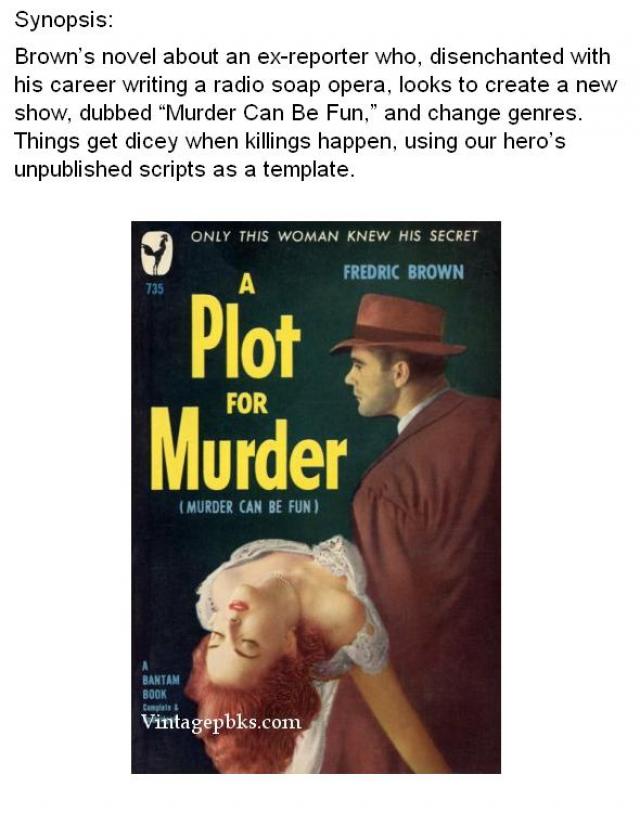
Murder Can Be Fun # aka A Plot for Murder,
p.14


“I'm so excited, Bill, I don't care if I ever eat.”
“All right.” Tracy opened the brief case and pulled out the scripts. He put them on the desk in two piles, a big one and a little one. “These are old scripts, in order, in case you want to refer back to anything. They go back three weeks — if you have to look up any dope further back than that, you'll have to use the files at the studio. And these” — he pointed to the smaller stack — “are the five scripts for this coming week, Monday through Friday. Not played yet. You've read them all, I think, while we were working on the patching up. What you're writing is the week following that, and here's half a script to start on — and the synopsis for the sequence. Wilkins has approved the synopsis, at least enough of it to cover the first week's scripts.”
Dotty, her eyes still glowing with excitement, took the uncompleted script and the synopsis.
Tracy said, “Okay, read those if you want, so you can get started thinking about it. I'll start dinner.”
“You really wouldn't mind? I would like to read these now. And — oh, one thing I should ask. Is the studio to know about this, or don't you want them to?”
“Why not? Sure, I'll tell Wilkins. And I'll arrange to get you a week's leave from your stenographic job if — if I have to cover it myself. No reason why he should object, if the scripts are okay. And I'll go over them and be sure they are.”
“But if he doesn't agree?”
“We'll do it anyway, except that you'll have to do it evenings instead of getting the week off work. That is, if you can. But don't worry; he won't object. Now I'll rustle us some grub.”
Whistling, feeling that tons of weight were off his shoulders, he went to the kitchenette and started opening the packages he had brought.
He kept on whistling while he worked. He felt happier than he had felt in weeks. He heard Dotty go over to the desk and heard keys start to click.
He stuck his head out of the kitchenette. “Starting already?”
“Just retyping the part of a script you wrote, Bill, to get the feel of it. Say, that's a wonderful idea of yours for the quarrel between Millie and Dale. I mean, Millie thinking Dale is making passes at a girl at the office. The redheaded comptometer operator.”
“Yeah,” said Tracy.
“Is he really making passes, do you think, or does Millie just think so?”
“Well—” said Tracy. “And how did Millie find out?”
“I've been wondering that myself. Listen, young lady, maybe you can write radio continuity and talk at the same time, but I've got to concentrate in order to get us a dinner here. How long do you have to boil water before you pour it through a dripolator? All right, don't tell me. Let me guess.”
Outside the kitchenette there was silence except for the clicking of keys.
CHAPTER 11
TRACY KEPT on whistling, not too far off key, while he worked. This was wonderful, he thought. Out there a typewriter was clicking out Millie continuity — retyping it, anyway — and he I didn't have to think about it at all. A week of absolute, heaven-sent freedom from soap operas.
A little while later, with a pair of cube steaks beginning to sizzle appetizingly on the stove, he peered around the corner of the kitchenette again. He had a side view of Dotty at the desk, and he leaned against the door jamb to watch.
Dotty, working hard, was a pretty picture. Somehow she managed to give the impression of a little girl doing her lessons. But, even if she did thrust out her lower lip like a child, the typewriter was taking real punishment. He wished he could type that fast.
Yes, she was cute all right. Cute as a little red wagon. Maybe—
But no, dammit, not this evening. If he made a pass at her now, it would look like a crude demand for repayment for the favor he was doing her by giving her a real chance at radio writing. He'd have to wait a while now. Dammit, why hadn't he made the pass first and then the business proposition?
A smell of something burning made him pull his head back into the kitchenette. He shoved the skillet off the fire with one hand, with the other he grabbed a fork and speared the steaks to lift them from the too-hot skillet. But the bottom sides of the steaks were black and charred, and salvage was hopeless.
Well, luckily he'd bought four of them. He put the burned ones in the step-on can and the remaining steaks into the skillet. And this time he watched the steaks instead of Dotty.
He had the table folded down from the door, set, and ready before he called her. She looked up, startled, as though surprised to see he was still there.
Then she smiled contritely. “Oh, Bill, I should have helped you. I meant to work just a little while and then—”
“I liked doing it,” Tracy said. “Anyway, it's ready. Come and get it.”
“Mmmm,” said Dotty, when she had taken her first bite. “It's good.”
“I'll make a fine wife for somebody,” Tracy admitted modestly. “How goes the script?”
“I was just starting the second one. I'd like you to read over the first one when we finish eating, Bill. You can do that while I wash the dishes.
Tracy's face went black. “The second one? You mean in that little while you typed the half I had done, wrote the second half of it, and started another script? While I was rustling grub?”
He looked up at the clock in consternation. It was just eight o'clock; she'd been working less than an hour.
“Uh-huh. And I made a few little changes in retyping the part you wrote; I particularly want to know what you think of them. Just a plant or two to lead to things that will come into the next scripts. And listen, Bill, when we get to the actual accident, don't you think it would be a good idea to have it a hit-run case? And then you've got another complication we can use later. The search for the guilty driver. Whether or not Dale dies, we can use it to lead into another sequence if we wish.”
“Sure, why not? Nothing to lose if we don't follow up on it. But dammit, Dotty, in less than an hour, you wrote — say, do you mind if I read that script while I eat?”
She didn't mind.
Tracy read it while he ate. The first part was familiar — too familiar for comfort after the three and three-quarter hour tussle he'd had with it. The changes were minor, as Dotty had said. He spotted a plant or two — a mention of a new girl in Dale's office. A touch of peevishness on Millie's part.
What few changes had been made in the wording were minor improvements. But all of that was easy; almost anybody can improve a script. One can hardly retype one without seeing a phrase or a sentence here and there that can easily be strengthened. It was when he got to the new part, the part that was all Dotty's, that he began to read carefully and with such absorption that he forgot to eat. He read it through, slowly.
It was lousy. It smelled. It—
But, wait a minute — did it? Leafing back to the middle — partly to reread it, partly to postpone discussing it while he thought — he sat there staring at it. He tried to analyze what was wrong with it, why it smelled.
The writing was good. The language was good. Conversation was natural. The plot was what he'd already approved.
Then why in hell—?
It wasn't until he was almost finished with the second reading that the answer came to him.
It wasn't Dotty's script that he didn't like — it was simply that it was soap opera, and that soap opera itself was such a ghastly travesty of life. Even Millie's Millions. Maybe especially Millie's Millions.
Good Lord, while he himself was writing it, he'd been too close to it to see it for what it really was. He'd known that soap opera in general was an insult to the adult intelligence, but he'd kidded himself into thinking that Millie's Millions was different and better.
Dammit, he'd been hypnotizing himself; he realized that now. He'd known that he'd been writing trash, but he'd kidded himself out of thinking about it. This half a script of Dotty's was as good — every bit as good — as the ones he'd written. But he'd made the mistake of looking at it objectively because it wasn't' his own.
He cut back a couple of pages and read again, this time trying to ignore his own point of view and read it from the point of view of his moronic listeners.
He breathed freely again. Yes, it was good. At any rate, it was up to standard, and that was quite something for anybody's first try. He reached for the opening of the second script and read that. Yes, it was all right, too.
He looked up — daring to do so for the first time — and saw that Dotty was looking at him expectantly and a bit anxiously. “This is swell, Dotty,” he told her. “You do it every bit as well as I do — and a hell of a lot faster.”
“Thanks, Bill. You're exaggerating, but — Gee, the way you looked when you read that the first time, I was afraid I'd done it all wrong.”
Tracy grinned at her. “That glower was jealousy. Had to read it again to find a few minor flaws to restore my ego. Well, you're off to a flying start with a swell evening's work. And it's early yet; even after we clean the dishes it'll still be early. Shall we see a show? Night club? Take a look at Harlem? Or what?”
“Oh, not tonight, Bill. I'm much too excited about this chance you've given me. I want to stay right at it. I want to finish that second script.”
Tracy looked at her incredulously. “You aren't kidding? You mean you really want to work? A girl can look like you do and • actually enjoy working?”
“That isn't work, Bill! Why, it's fun. Really fun, to write a play that you know thousands and thousands of people are going to hear on the radio and enjoy and—”
“Whoa,” said Tracy. “Let's get this straight. You mean that you really like writing this sort of thing? And listening to it?”
“Why, of course. I listened to Millie's Millions almost every day, before I started working at the studio. I never dreamed, then, that someday I'd actually write some scripts for it, Bill. Why, I think that the radio—”
And for the next half hour, Tracy heard quite a bit of what Dotty thought about radio, for she could talk almost as fast as she could write. He heard it and shook his head in blank amazement.
At the end of that time — for Dotty could work and talk simultaneously, and she wouldn't let him help, or even wipe — the dishes were done and the room in order again.
And Tracy found himself being pushed — verbally, if not physically — out of the door so Dotty could go back to work on the second script.
He reached the sidewalk in somewhat of a daze. He walked home because he wanted to think. He felt slightly drunk with the sheer joy of freedom — of being able to go to bed tonight without Millie's Millions hanging over his head. Freedom for a whole blessed week.
Real freedom, for he felt sure now that he wouldn't really have to read the scripts Dotty would write for him, or think a single thought about them. Oh, he'd look them over so he'd have excuses to see Dotty again a few times. He'd even read them, but he wouldn't have to think or worry about them.
And later in the week, when she'd written the full quota of scripts and the business deal was over with —
He got. home before nine o'clock.
It was a ghastly hour for Tracy to get home, but he was dead tired, he found. Maybe it was the aftermath of the horrible afternoon he'd spent trying to write. Maybe it was the reaction to the sudden freedom.
He didn't even try to read a while. He almost fell into bed and he was asleep almost before he landed there. He slept dreamlessly; no mares of night perched upon the footboard of his bed to gibber at him that his real troubles hadn't started yet.
Maybe by now it has occurred to you that Tracy would not have made a good detective. He was a nice guy, but he just wasn't the type. He was too easy going. He hadn't the least inclination, ordinarily, to go hunting for trouble. There were so many better things in life for a man to hunt — and not only what you're thinking about. He liked good books and good music and playing cards and chess and seeing plays, if they were good ones, and drinking good liquor in good company. He liked to talk and — when he was with someone who knew something he didn't know and was willing to talk about it — he was even a good listener.
He didn't like people to enact, in bloody reality, murder plans that had been figments of his imagination. They hadn't been very good scripts anyway, he saw now. The more he thought about them, the less he liked them. Would Arthur Dineen and Frank Hrdlicka have been alive today, he wondered, if he had never thought to write scripts about a murderer wearing a Santa Claus suit and about a murderer stuffing a janitor into a cold furnace?
It was a crazy thought, but then the whole setup was crazy. He lay in bed Sunday morning thinking about it and getting himself into a mild case of the willies.
To make things worse, it was seven o'clock of a Sunday morning — an utterly ungodly hour. But he'd gone to sleep at nine the evening before, and he couldn't get back to sleep after ten hours of it.
Resolutely, he pushed murder out of his mind. There wasn't a damn thing he could think of to do about it anyway. And today was his first day in a long time in which he'd have utter freedom from the thought of having to write radio continuity. He meant to enjoy it to the fullest.
And the fullest measure of enjoyment, he thought, would be in doing absolutely nothing at all. At least in planning nothing at all.
He dressed and showered in more leisurely fashion than was his wont and then went downstairs for coffee and the Sunday papers. The latter to read while he drank the former.
Discovery of the theft of the Santa suit from Seabright's had put the Santa Claus murders, as the press now called them, back on the front page. Police promised new developments soon; the nature of the developments was not specified. Tracy read the story in one of the papers, frowning, and then the one in the second paper he'd bought.
The last sentence of the second paper's story made Tracy quit frowning and chuckle instead. “Police are holding an unnamed radio actor as a material witness.” Served Jerry Evers right! With a lighter heart, he turned to the theatrical section.
Three cups of coffee later — it was nine-thirty by more conventional reckoning — he went back to the Smith Arms.
The door of his apartment was slightly ajar. He'd closed and locked it when he left. A little chill of fear went down Tracy's back, and then he pushed the door farther open, and looked in.
Inspector Bates was sitting in the Morris chair, his hat on the desk, and his legs comfortably sprawled out in front of him as he leaned back.
Tracy said, “I really should have knocked, but the door was open. May I come in?”
Bates smiled. “Thought you wouldn't mind if I waited inside instead of out. I still have a passkey.”
Tracy went on in and shut the door. He said, “Most Sunday mornings at this time I'm just getting my second wind on sleeping. Anything new?”
“Nothing very startling. I figured you'd be up early; you turned in so early last night.”
“Did I?”
“Your light went out at nine twenty-eight. Thought you might like to know we released your friend Jerry Evers this morning. He's in the clear — on the Dineen business anyway. And by my figuring that clears him on the others.”
“Others?”
“The other, I mean. Is Evers a publicity hound?”
“Well — he likes ink.”
Bates nodded. “I thought so. Then he was probably holding back deliberately on that alibi. He was at his hairdresser's place” — a faint curl of the Inspector's lip commented eloquently — “at the time Dineen was shot. He told us he couldn't remember where he'd been.”
'And then changed his mind when you actually held him?”
“No. It came out through routine. We were checking on all his contacts and the hairdresser was on the list. He looked back in his records to see when he'd seen Evers last — and that's how we got it. It seems to be on the up-and-up, too. I was just wondering whether Evers had really forgotten — or if he was just holding back the alibi for an ace in the hole and hoping we'd charge him. Which do you think?”
Tracy said, “I object to the question on the ground that it calls for a statement of opinion on the part of the witness.”
Bates stood up and took his hat from the desk. “That's a good enough answer. You should have told us sooner though. That is, if you really want us to find out who did those killings. Well, I'll be seeing you.”
He went to the door and put his hand on the knob, then looked around. “By the way, you left your brief case last night.”
Tracy didn't think of a good answer until after the door had been closed from the outside. Even then, it wasn't too good an answer.
He sat down and tried to finish reading the papers, but it was tough going. His mind kept asking questions.
Why was Bates having him tailed? Well, he could figure that out without a blueprint. But why had Bates gone out of his way to let him know that he was being tailed? That was tougher. In fact, he couldn't even guess a halfway sensible reason.
And if he was being tailed, then Bates must have known he was in Thompson's just now. Why had Bates come up here to wait for him? The conversation had been such that it could have crossed a restaurant table, and the place had been nearly empty, anyway.
He glanced at his desk and saw that the bottom drawer was a little open. He was pretty sure he'd left it closed. He went over to the desk and rummaged through the bottom drawer. The manuscripts were definitely not in the same order in which he'd left them.
All right, that answered that. Bates had come here to check up on Tracy's writing, to make sure he hadn't been dabbling in any more Murder Can Be Fun scripts or such.
But why had Bates been careless about how he put the stuff back and closed the drawer? Bates didn't look or act careless. If he hadn't wanted Tracy to know that the desk had been searched, he'd have been careful about it. All right, then, Bates must have wanted him to know.
That settled — or was it? — he managed to finish the parts of the paper he wanted to read.