Murder can be fun aka a.., p.9
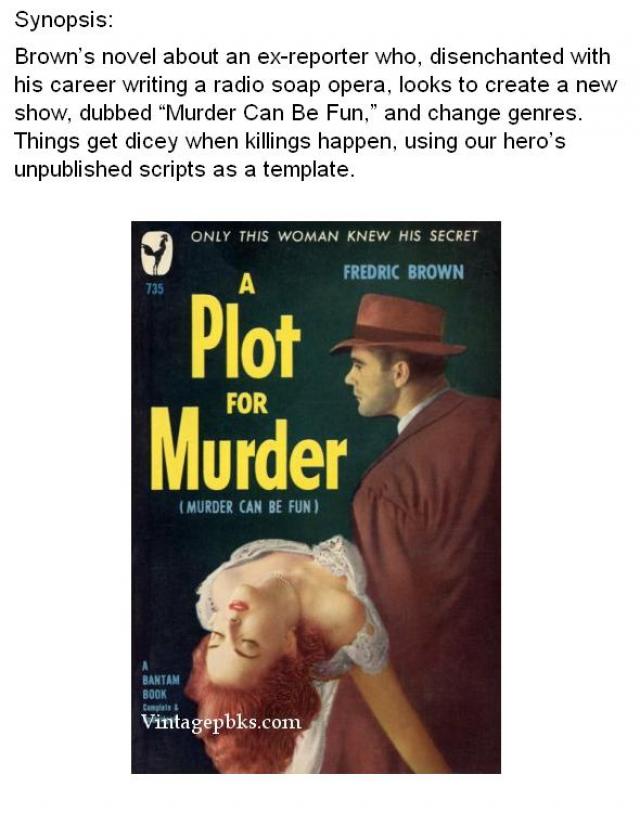
Murder Can Be Fun # aka A Plot for Murder,
p.9


“What? I thought you said this was Mr. Tracy.”
“Oh, no. I thought you asked for Mrs. Tracy. This is Mrs. Tracy.”
There was a second's silence. He could almost hear the wheels going around at the other end of the line. Then the voice said, “I didn't know he was married.”
Tracy said, “I'm not. This is my mother speaking.” He put the receiver gently back on the hook.
He went back to the typewriter and sat down. Nothing had happened to the sheet of yellow paper. Nothing at all. It was still blank.
He lighted a cigarette.
The telephone rang.
He let it ring a while. The hell with it. It would just be — But maybe it could be Millie or Dotty or — He got up and went over to the phone again. He picked up the receiver and said, “Mamie's beauty shop,” in a high-pitched, singsong voice.
“Huh?” said a voice. It was a male voice and he didn't recognize it.
He put back the receiver and went back to his desk. The phone started ringing again. He didn't answer it. He lighted another cigarette and stared at the blank paper. After a while the phone stopped ringing.
He found he was humming to himself, “The moon was yellow—” Only it was the damn paper that was yellow and not the moon and what had either of them got to do with an idea for Millie's Millions? A trip to the moon? Nope, you couldn't run science-fiction angles into a soap opera. Maybe — no.
He needed some coffee; that's what was wrong. Maybe Millie was home across the hall and would have some on the stove, or would make some. He went out into the hall and knocked on her door.
There wasn't any answer.
While he was out in the hall, of course, he might as well go down and see if there was any mail in his box. He did. There wasn't.
He came back and sat down at the typewriter. The paper in it was still yellow and still blank. It leered at him. All right now, the seat of the pants to the seat of the chair — that's the formula. Concentrate.
But he began to wish the phone would ring again. Even a reporter. Just the sound of a human voice. Anybody. He wished a salesman would come to the door.
Suppose Millie got hit by a — That was silly. Dammit, was he burned out as a writer? It had been tough before, but never as bad as this. Of course, he had more on his mind this time. Frank Hrdlicka kept getting in the way, and Dineen — and Millie Wheeler and Dotty and Jerry Evers. Was Jerry really crazy to want to be suspected? Or was he being smart? Show business is a screwy thing; maybe Jerry knew what he was doing after all.
How about those old stories and stuff in the back of the big bottom drawer? Maybe there was something there he could use for an idea for Millie. One of the detective stories he'd written and never sold, maybe.
He dug them out and skimmed through the titles, remembering the plots vaguely. No, not an idea in a carload, as far as a Millie sequence was concerned. Some things there he could use for the Murder Can Be Fun series, though, if he ever wrote any more of them.
Only he'd change the damn title, even if he did write any more of them. Murder wasn't fun. Frank wouldn't ever marry his little blonde Polish girl now; he'd never write the book he was going to write — and Tracy had a hunch it might have been a good book. He'd never again drink any more of Tracy's bourbon nor play him a game of noisy chess. He'd never hear—
That reminded him of something he'd wanted to do ever since Sunday. It was crazy, but he wanted to do it. He got out the chessboard and men and set up a game on the card table.
He moved for white, then black, alternately. A standard four-knights opening and then down toward mid-game until he got both sides into a fairly even position with most of the strong pieces in play.
Then he sat and stared at it, studying and feeling the forces of the men, the checks and threats and balances. The white king's pawn threatened by a black bishop and a knight, protected by the white queen's pawn and a rook.
No, it didn't work for him. He could feel those forces all right; he could even persuade himself that he could — figuratively — see them as radiant lines of force, diagonal for the bishops and straight for the rooks.
But hear them? No. Funny how different people's brains worked in such different ways. Their senses, too, probably. You could never tell, really, how something actually felt or smelled or tasted, to someone else. No two people, for instance, could ever compare their taste sensations of apple pie to see how divergent or similar those impressions might be.
He thought about a science-fiction story he'd once read, a screwy one, in which a mad scientist had operated on a victim and short-circuited his sensory nerves so each nerve connected with the wrong part of his brain; so that the poor guy's eye nerves connected with the part of his brain that recorded smells, his auditory nerves with the taste buds, and so on.
And a horrible mess it had made of the guy. Darkness always smelled like rotten eggs to him, and a bright light smelled like frying steak; middle C tasted like fish, and drinking cold water nearly blinded him; the touch of a smooth surface was shrill in pitch, and sandpaper sounded like a tuba.
Now there was something that hadn't happened to Mr. Hie. Only Pussycat Wilkins wouldn't like it. Neither would Millie's dear public, damn them.
He put away the chessmen and board, folded up the card table, and went back to the yellow sheet in the typewriter. He wasn't getting anything done this way.
He tried limbering up his fingers by typing “Now is the time for all good men to come to the aid of the party” a few times, and then took that paper out and put in a fresh one.
He sat staring at it, trying to concentrate. He lighted a cigarette.
Picture Wilkins with a blacksnake whip. Wilkins wanted a synopsis of the next sequence. And the synopsis had better be good, because Wilkins was going to be plenty mad about that story in today's papers. Wilkins with a blacksnake whip — “Yes, sir, I'm working.”
Try hard enough and something would come. It had to, or he was done as a writer. A burned-out shell.
Who in hell would have had a reason to kill both Frank and Dineen?
Forget that, and concentrate on Millie. Millie Mereton. He put his hands over the keyboard. He hit the tab key for a paragraph indention. Slowly he typed “Millie” and kept his hands there waiting for the next word. It didn't come. His wrists got tired and he put his hands down again.
He got up and walked around the room a while. His cigarette had dropped off the edge of the ash-tray stand and had burned a brown groove in the carpet. He picked up the cigarette and scuffed the hole with his shoe. He stubbed out the cigarette in the ash receiver and lighted another one, and sat down again. He wondered what sensory impression that guy in the science-fiction story would have got out of a sheet of yellow paper. Let's see; sight had been short-circuited to smell. The paper would smell, to him. Maybe like Dotty's perfume, or like—
Cut it out.
Get going. Maybe he could think with his fingers. He put them on the keyboard and started typing “Milliemillie-milliemilliemilliemillie" all across a line and the next line.
He jerked the paper out of the machine and put in another one. He lighted a fresh cigarette. Keep the seat of the pants to the seat of the chair, and—
There were footsteps in the hall outside. Footsteps that clicked, high-heeled footsteps.
Tracy almost fell over his feet rushing to the door and opening it. Millie Wheeler — the real Millie — was just reaching a key for the keyhole of her door.
“Millie!” Tracy said.
She turned, a bit startled. He grabbed her arm and pulled her partly through the doorway. “Come in, for heaven's sake come in, and talk to me before I go nuts. I thought I was the last person left on ea — No, let's go to your apartment. I want to get out of mine.” He shuddered.
“Tracy, have you been drinking?”
“No, but it's an idea. Shall we?”
She got her door unlocked and he followed her in. She headed for the kitchenette. “Coffee?”
“Sure, swell.”
“Hungry?”
“I don't know. I don't think so.”
“All right, I'll start some coffee perking. Then you can sit down and tell mama what's bothering you. Wait — isn't that your phone ringing?”
He got across the hall in time to answer it.
“Tracy talking.”
“This is Inspector Bates, Tracy. Do you know a man named Walther Mueller? Ever hear the name?”
“Ummm — has a vaguely familiar ring to it. Might have heard of him or met him, but I don't think I ever knew anyone by that name. Who is he?”
Bates was evasive. “Just a name that came up in the course of our investigation. Have you written any more murder scripts?”
“Hell, no.”
“Maybe you're wise. If I were you, I wouldn't — until after we find out a little more than we know now.”
“And what do you know now?”
Bates chuckled. “Confidentially, nothing at all. By the way, where did Dineen get that Doberman of his? Do you happen to know? His wife says he brought it home from the studio, that somebody there gave it to him when the dog was a puppy.”
“Must have been before I worked there. Wait a minute — it might have been Pete Meyer. Pete has a police dog — I guess it's a Doberman. And it's a bitch; likely she had a litter and he polished an apple by giving one to the boss.”
“Pete Meyer? That's the hero of Millie's Millions, isn't it?”
“Yeah. Dale Elkins of the air waves — as we of radio never say. But that's just a guess about its being Pete; ask somebody who worked there longer if you want to be sure.”
“I'll try Dineen's secretary; she's been there four years, and the dog is only two. By the way, is she going to be Wilkins' secretary?”
“I haven't an idea,” Tracy said. “By the way, how is the dog?”
“Okay, I hear. It's still at a vet hospital, but just because they figure it's best to leave it there until after the funeral. It was just creased, the vet says. Tracy, where were you the first week in June this year? In New York?”
“Let's see — believe I was. I spent two weeks in June up on Cape Cod for a vacation, but that was starting the tenth, I think. That'd mean I was in New York the first week. Why?”
“Just checking up,” Bates said. “Something happened then that might possibly have been connected with — uh — subsequent events. By the way, have you thought of anything you haven't told me that might possibly have a bearing on the case?”
“One little thing. I thought over your question about who at the studio might have a grudge against Dineen. The best bet would be Jerry Evers — he takes character parts in Millie and other serials. He had a blowup with Dineen over a contract. I think he went over Dineen's head on the matter, and Dineen didn't like that so he rode Jerry every chance he had. I don't think there's anything in it — from a murder point of view. But you might talk to Evers, just to be sure.”
“We'll do that. Anything else?”
“Ummm. Probably this doesn't mean anything either. But if remember that Sunday Frank told me he'd met a girl he hoped! to marry after he got his second citizenship papers.”
“We didn't know that,” Bates said. “His brother didn't know it, either. We asked him if Frank had any woman on the string and he said not. Did Frank tell you her name?”
“No, he didn't tell me anything about her. Small, and blonde, and he thought she had Polish ancestry. And I gathered that it wasn't a two-way romance, yet.”
“We'll try to find her. Thanks, Tracy. Be seeing you.”
Tracy stood there a minute after he'd put the receiver back, trying again to place the name Walther Mueller. But he couldn't.
He turned and thumbed his nose at the typewriter with the blank sheet of yellow paper in it, and then went back across the hall to have coffee with Millie.
It was dusk, and there was a cool drizzle. Tracy stood watching as the street light on the corner went on and gathered itself a yellow halo that it didn't deserve. There's nothing holy, he thought, about an electric light — a glowing filament that manages, despite its yellow heat, to give a cold impersonal radiance — a light to see by, not to live by.
He wondered what the devil had made him think that. Hell's bells, he wasn't a romanticist. He was—
What the hell was he?
Just now, he decided wryly, he was a guy standing outside a doorway in a thin drizzle of rain, wondering where to go and what to do, now that Millie had given him the brush-off so she could get dressed for an appointment. A business appointment, she'd said. But where did that leave Tracy? A little black sheep who has gone astray, baaa, baaa — Bah. Why did Millie Have to see a photographer this evening?
Or why wasn't his date with the dimpled Dotty tonight instead of tomorrow night?
Well, he had to do something. Eat? No, he wasn't hungry. Get a drink? He didn't really want one, but what the hell, he had to do something or else face the thought of going back up to his apartment and looking at a jaundiced sheet of paper in a typewriter. And that was a horrible thought.
Better to be driven to drink. Better even to walk to drink, if a taxi didn't come along. And it probably wouldn't; taxis always hide the moment it starts to rain. Better far to—
“Pardon me,” said a voice beside him. '“Aren't you Mr. Tracy?”
Tracy turned and saw a dowdy, dumpy woman looking at him through wide eyes behind rain-spattered glasses. She wore a greenish mottled babushka and the stringy hair that pushed out in front of it was beaded with rain. “Yes, ma'am,” Tracy said.
“I thought you must be, because I know nearly everybody in the building except you and when I read your name in the paper and this address I thought — well, it can't be the bald man on the fifth floor because he couldn't possibly be a writer, as dumb as he looks, and it can't be the plump man in two-eighteen, I don't know his name either, because's he's married ~ — or I guess they're married — and while it didn't just come out and say in the paper that you weren't married, I sort of got that impression from it, and anyway he doesn't look like a writer either, and I've seen you in the hallway and always figured you must be a newspaperman or something. So it had to be you.”
“Marvelous deduction,” Tracy said. “But I don't—”
“I'm Mrs. Murdock, Mr. Tracy.”
“Mrs. — Oh, you're the woman who found—?”
“The body, yes. Wasn't it horrible? I nearly keeled over when I opened the door of that furnace and — well, you can imagine what an awful shock it was. But, like my husband always says, you never know. In the middle of life you are in death, isn't it so? Mr. Murdock sells insurance, you know, and only last month he suggested to Mr. Hrdlicka that he ought to take out a policy, even a small policy, since being a janitor couldn't have paid very much; I don't know how much, but, of course, he had a place to live thrown in with it, and he said he'd think about it, but he didn't. And now look, he's dead and he didn't.”
She stopped for a moment to sigh; it was a brief moment. Tracy opened his mouth — but too late. She was off again. “Keeping you in the rain like this, talking. I don't mind rain; I like rain. I like to take long walks in the rain even when it's raining hard; my husband says I'm always wanting to go out the minute it even gets cloudy. But I'm keeping you, Mr. Tracy — Won't you come on up to our apartment and meet my husband? We were saying we'd like to know you. We're in five-fifteen. He's home now; we ate and then I went out for a walk in the rain; he'd be just crazy about it if I brought you up with me. We're both awful radio fans, you know, and we listen to — What is the program you write, Mr. Tracy?”
“Millie's Mil—”
“Millie's Millions? Why, I listen to that one every day. My husband doesn't; he's working that time of day and he likes the crime ones and the horror ones best, anyway. Like Suspense. They give me the creeps; I don't like things like that, but it had to be me that opened the furnace door and saw — why, it was just like one of those programs my husband listens to, and that I have to listen to, too, because when a radio's on, you can't help but hear it, and because he isn't home very much — selling insurance, you've got to make evening calls, too — I can't very well not want him to listen to the programs he wants to hear when he is home when I have the radio all to myself all the rest of the time. Don't you think so?”
“Of course,” said Tracy, rather vaguely, not quite sure what he was agreeing to. He hurried on: “But I'm afraid, Mrs. Murdock, that I can't meet your husband now. I have an appointment. I—”
“Oh, that's too bad. He'd so like to meet you. And he wouldn't” — she simpered a little — “try to sell you an insurance policy. I mean, he used to talk insurance sometimes to people who came to see us socially. But I put my foot down. Business is business, but home is no place for it, even if I do, naturally, have an interest in how much money he makes. Don't you think so? Well, it's too bad; after your having written about it and all, I wanted to tell you just how I found Mr. Hrdlicka and all the circumstances and everything. Then you'd know how close you guessed.”
“How close I—”
“Of course. In your story for the radio. But here I am keeping you standing in the rain. I'm so sorry you haven't time to come up and spend the evening with us. My husband would be so — Mr. Tracy, have you been down there in the basement since it happened? I mean, in the furnace room where I found him? It was so horrible and exciting. I wonder if you'd like to have me show you just where he was, and everything; I mean, a man like you who writes about those things, you might be able to figure out what happened, even better than the police. I don't like that Mr. Corey at all, do you? And in the stories you read and on the radio, the police never find out what really happened, do they? They always want to arrest somebody who • didn't have anything to do with it — like you or me. Would you?”
“Beg pardon,” Tracy said. “Would I what?”
“Like to have me show you down in the furnace room?”
“I'm sorry, but — Wait, I think I would. If you'd be so kind, Mrs. Murdock, I think I would.”
He took her firmly by the arm and led her into the building. “We'll take the elevator down, then,” she was saying. “Not because one flight down is far to walk, but because that's the way I went down yesterday when I found it — him, I mean. I was taking some papers down to be burned, and of course because it was five nights down, I took the elevator and—”