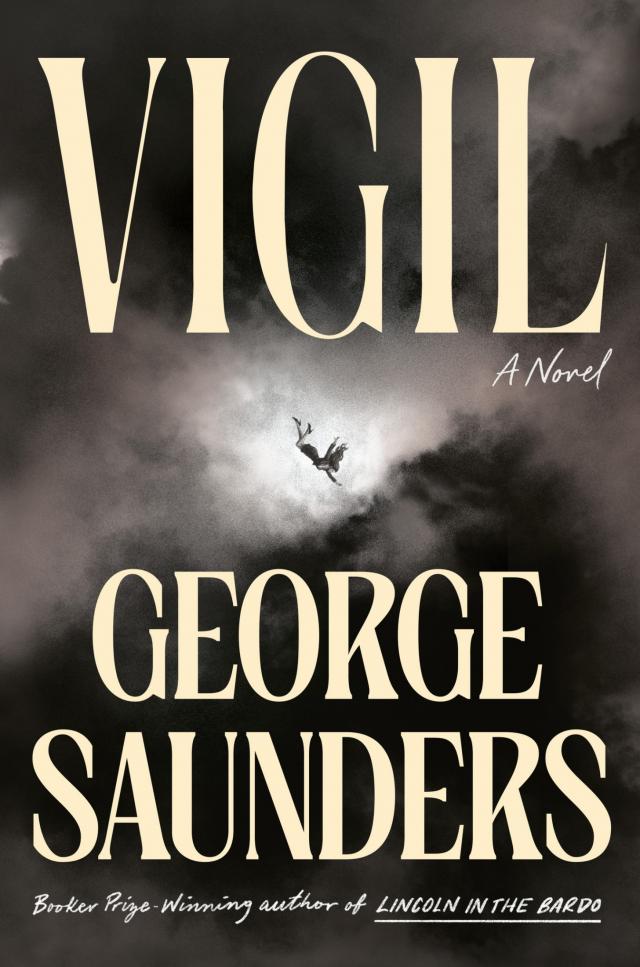
Vigil, p.1
Vigil,
p.1


By George Saunders
Fiction
CivilWarLand in Bad Decline
Pastoralia
The Very Persistent Gappers of Frip
The Brief and Frightening Reign of Phil
In Persuasion Nation
Tenth of December
Fox 8
Lincoln in the Bardo
Liberation Day
Vigil
Nonfiction
The Braindead Megaphone
Congratulations, by the Way
A Swim in a Pond in the Rain
Random House
An imprint and division of Penguin Random House LLC
1745 Broadway, New York, NY 10019
randomhousebooks.com
penguinrandomhouse.com
Copyright © 2026 by George Saunders
Penguin Random House values and supports copyright. Copyright fuels creativity, encourages diverse voices, promotes free speech, and creates a vibrant culture. Thank you for buying an authorized edition of this book and for complying with copyright laws by not reproducing, scanning, or distributing any part of it in any form without permission. You are supporting writers and allowing Penguin Random House to continue to publish books for every reader. Please note that no part of this book may be used or reproduced in any manner for the purpose of training artificial intelligence technologies or systems.
Random House and the House colophon are registered trademarks of Penguin Random House LLC.
Hardcover ISBN 9780525509622
Ebook ISBN 9780525509639
Book Team: Production editor: Evan Camfield • Managing editor: Rebecca Berlant • Production manager: Richard Elman • Copy editor: Bonnie Thompson • Proofreaders: Chuck Thompson, Tricia Wygal
Book design by Simon M. Sullivan, adapted for ebook by Arienne Dinh
Cover design and illustration: Rodrigo Corral Studio
The authorized representative in the EU for product safety and compliance is Penguin Random House Ireland, Morrison Chambers, 32 Nassau Street, Dublin D02 YH68, Ireland. https://eu-contact.penguin.ie
ep_prh_7.3a_154779011_c0_r0
Contents
Dedication
Chapter 1
About the Author
_154779011_
To Paula (this one, especially)
What a lovely home I found myself plummeting toward, acquiring, as I fell, arms, hands, legs, feet, all of which, as usual, became more substantial with each passing second.
Below: a fountain.
At the center of the fountain: a gold-plated statue.
Of a dog. (Someone must have really loved that dog.)
In the mouth of the golden dog: a golden duck. The duck’s beak was hanging open in death and a pocked area in its flank seemed meant to represent the entry-field of the shot-cluster.
I observed all of this as I plummeted past and then my head and torso pierced the asphalt crust of a semicircular drive and lodged in the dirt below.
My rear was in the air, my fresh new legs bicycling energetically. I found myself alternately clothed and unclothed. That is to say: one instant naked and the next clothed. Or to be more precise: partly clothed. (Over time, that is, the elements of my outfit grew more reliably visible.)
My beige skirt soon became a near constant.
Meanwhile, here was a burrowing worm to consider and a brown bottle-shard and the rich smell of the loam now completely encasing my (inverted) upper half.
Once in Tennessee, having landed in the more conventional upright posture, I spent six hours in a paddock, my head protruding above the surface of the earth, being trotted through again and again by three black horses and one roan, who never, during those hours, ceased being panicked by my presence.
And yet I had a fine success on that occasion.
My charge being greatly comforted.
* * *
—
Tonight, blessedly, the thaw proceeded quickly.
And I found myself able, by sheer force of will, to bolt up out of the ground gymnastically and stand upright, both fully and consistently clothed.
Beige skirt, pale pink blouse, black pumps.
The golden dog shone in the glare of an ornate carriage lamp.
I made for the front door and, not yet walking competently, collapsed to the earth like a just-unstrung puppet, then leapt to my feet and moved on relentlessly to my work.
The door (immense, heavy, dead-bolted) presented no meaningful impediment. Passing through, I emerged into a magnificent entryway, then ascended a spacious stairwell lined with image after image of my charge:
Leaning confidently against a podium, speaking to a tremendous crowd.
Squatting with a kaffiyeh-wearing fellow before the Great Pyramid of Giza.
Knee-deep in the shallows of some high mountain lake, beside a young woman I took to be his daughter.
Driving (pretending to drive) a piece of heavy machinery, wearing a hard hat and a three-piece suit.
Posing before an oil rig.
And another.
And another.
Standing with his wife on the Great Wall of China, both beaming as if this represented a singular moment in their union.
Arm in arm with her in what looked to be the Rose Garden of the White House.
With her again, before what I understood to be a second home, in Colorado.
And a third, in Hawaii.
A fourth, in Key West.
Often, on his face, the same look: more grimace than smile, albeit shot through with a measure of forced goodwill.
Reaching the second floor, I moved along a hallway hung with numerous paintings in gilt frames, each marked by a plaque mentioning some experience our charge and his wife associated with its acquisition:
“Lovely cliffside dinner, Positano.”
“Catacomb tour, Paris, Mr. Pavarotti sang beautifully for us after dinner.”
“Guest of Senator Jepps and Maria in their fabulous desert home.”
At the end of the hall hung a double door of sturdy oak.
A familiar tan purse now appearing over my shoulder, I patted it (once, twice) as I would in the bygone days when about to embark on a challenging task, then passed through, knowing that my charge must be found on the other side.
* * *
—
And here he was.
A tiny, crimped fellow in an immense mahogany bed.
I was not too late.
Neither was I too early.
His wife, exhausted by care, slept fully dressed on a love seat near the bed. Her slippers lay on the floor, turned in toward each other as if being worn by some invisible pigeon-toed individual.
But she was not my concern.
My charge’s sleeping clothes were of silk, his initials monogrammed above the heart.
Moving closer, I entered the orb of his thoughts.
Within him abided a formidable stubbornness. A steady flow of satisfaction, even triumph, coursed through him, regarding all he had managed to do, see, cause, and create, especially given his humble origins.
I scanned for doubts regarding things he had done or left undone; things he might have said but had not; mistakes to which he had not yet fully admitted, any of which might keep him from attaining that state of total peace so to be desired at this juncture.
And found nothing, or nearly nothing.
He was as sure of himself as ever a charge of mine had been.
Even now, as the terrible illness overtook him.
I felt again the old, familiar, generalized fondness:
Before me lay a person who had not willed himself into this world and was now being taken out of it by force, the many subsystems within him that had always given him so much satisfaction shutting down agonizingly. Soon it would come, accompanied by disbelief and panic, and he would find himself on the wrong side of a rapidly closing door, everything he had ever known and loved out of reach, over there, beyond it.
At such moments, I especially cherished my task.
I could comfort.
I could.
* * *
—
I moved to the window to energize and activate that part of myself from which I comforted, by glimpsing out indulgently at the glory of all-that-is.
To my surprise, down below, near the statue of the golden dog, stood one of our ilk, looking up.
He must be one of us, for he seemed able to see me.
And began beseeching me, by way of a complicated series of gestures, to indulge him, by exiting the home and floating down for a quick word, if I would be so kind.
I passed out through the wall, the stale quiet of the death room giving way to the smell of the humid air without and the lovely nighttime sound of cicadas, all my clothes now properly affixed and permanent, a happy development, since I must now greet this new acquaintance.
The fellow appeared exhausted, as if he had traveled a great distance to be here. Wearing the rough garb of a mechanic or railway engineer, he struggled under the weight of a tremendous stack of papers, the top of which was invisible among the low-hanging midsummer clouds. Its great height causing the stack to exist in a continual state of sway, he must, to prevent it from toppling, continuously be adjusting his posture.
He was indeed one of us.
/> For I could see, through his body, the trunk of an oak across the street.
He implored me, in fluent but accented English: Might I allow him up into that room, briefly, as a courtesy? Est-il possible? He understood that this might represent an inconvenient interruption of my work. Which, perhaps, had not yet begun in earnest? He possessed certain information he felt would prove beneficial. To my charge. Also, if he was being entirely transparent—
You are, I said. Entirely.
We shared a laugh.
If I am being entirely frank, he restated, it would benefit me as well. I would be most grateful. I assure you I will do no harm: Je vous promets.
His forlorn appearance engaged my compassion. His clothing was in tatters, he was filthy with the dust of the road, his shoes mere flaps of leather, his feet blistered and bloody.
And, if possible, he said, I would prefer to go up alone.
Alone, I said.
S’il vous plaît, he said.
It was an immense task we of our ilk were engaged upon. We constituted a guild of sorts, that depended for its work upon such mutual gestures of courtesy.
I indicated with a slight inclination of my head that I would allow it.
Kindly be quick, I said.
Up the Frenchman leapt, showing a surprising agility for one so burdened, his immense stack of papers seeming to inhibit him not a bit.
From the backyard of the house next door came a burst of music and the low murmur of a crowd.
A party, it seemed.
Seated on the edge of the fountain, hearing these sounds (my task suspended, entering a dangerous, purpose-free state of lull), I began to experience familiar symptoms of an affliction that, when upon me, always caused me to become less powerful and effective than was desirable.
For example:
Near the golden statue, in a swath of tree-created moon-shadow, was what I knew, of the instant, to be “auto.” I myself, I recalled, had, in that previous realm, driven several “autos,” the first of which had been “Chevelle.” “Chevelle,” packed with “girlfriends,” as well as my cousin, “Steve,” would be positioned so as to face a “movie-film” unscrolling upon a distant wall of white, surrounded by other autos, all of us learning from the movie-film such things as: Rome is romantic and interesting. And: when someone is lovely, the household staff may exchange happy glances regarding one’s sunny insouciance. And: later, those servants will help one achieve one’s fondest dreams, by keeping one’s confidence regarding a secret rendezvous.
All of this, just because one was lovely.
Therefore, sitting in Chevelle, watching those movie-films, I wished to be lovely.
Was I?
Had I been?
At this remove, I couldn’t recall. I could only recall dear Chevelle and those movie-films and my aspiration to be lovely.
More such recollections would soon be forthcoming.
Though they were harmful.
Ugh.
Here came one now:
I am digging away at the surface of “school desk” with the point of “compass” from “Sears” as “Mrs. Kiley” drones on. The lesson, as always, eludes me. What I want is to go home and play “PrettyPetals.” That, at least, I am good at. Through a nearby window (so close I might reach over and touch it, if I dared, which I don’t), three children too young for school play among gently swaying “swing set” seats. Lucky ducks! Butterflies dart about, seemingly more quickly or slowly in proportion to the joy in the children’s voices.
The more joy, the more agitated the butterflies.
Darn.
Darn it.
To my chagrin, I now recalled:
“Jill.”
“Jill Blaine.”
“Jill ‘Doll’ Blaine.”
In the bygone days, that (alas) had been me.
* * *
—
Sitting on the edge of the fountain, I resisted several additional recollections:
The feeling of toting in two bags of “groceries,” one in each arm; the “glassclunk” (one, then the second) as these are set down in sequence.
No, no, no.
Dangling one’s feet in the “new aboveground pool” as crazy light-stars danced across the surface of the “heavily chlorinated water.” Having “hopped right in,” one felt, through “plastic liner,” one’s footprints imprinting upon the soft swells of underlying sand.
Oh gosh, oh dear.
Surely that Frenchman must be done by now.
I vaulted up, passed through the bedroom wall, found him standing on the bed sweating profusely, treading on the feet of my charge while rapidly reading aloud from his tremendous stack of papers.
No sooner would he finish and drop a page than it would, as if guided by a gentle human hand, slowly descend and add itself neatly to the accruing stack on the floor.
What he was reading was nonsense, a fantastical poem or rambling drunken narrative.
The cardinal, he shouted, feeds on bits of plastic piping. In a ballroom filling with mud, chairs squeak in objection. A groggy hippo (What hippo, I wondered, why speak of hippos in this fearful place, at this somber moment?) rolls yellow eyes up at a hunter seeking its ivory canines. A juvenile jaguar creeps forward, dismembers a poodle in a bright pink jacket.
Clearly the fellow was unhinged.
Among our ilk, many were.
(Ours was not an easy road.)
Fish nibbling corpses in a lakeside graveyard, he shouted. A squalling infant borne away on a gray-black mudflow.
Enough, I said. Please.
But he only began reading faster, soon too fast to be understood.
From the house next door came a great cry, as if many individuals all at once had glimpsed something pleasing to them.
This celebratory sound appealed to me very much.
How I longed to be over there instead.
Well, why not?
I was serving no useful purpose here and could serve none until he was gone.
* * *
—
I cast myself out through the wall, looped over the neighboring yard, had a look down.
A wedding.
An evening wedding by torchlight.
I hovered above at that exact breathless moment before the service was to begin. A crowd of two hundred or more sat in chairs organized into rows, flaring torches forming the aisle. The bride, awaiting the first notes of the march, standing beside her father, gave their joined hands a nervous, confirmatory shake, eliciting a ringing of sympathetic laughter from the congregants.
Adorable.
She was a beauty. As for the groom, he was nervous, attentive, awash in an undisguised reverence for his bride, clearly feeling himself the most fortunate of men.
I landed softly among the congregants, finding much that was familiar, even dear:
The impatient flick of a program that one had already read three times.
The tap tap tap of one’s shoetip against the metal chair just in front but one must immediately stop tapping if the fellow sitting there turned his head even slightly.
The urge one sometimes got, for no reason at all, to scrunch up one’s toes inside one’s pumps.
The sudden cessation, just then, of all talk (all chitchat, all gossip; no more leaning over to say to so-and-so, Wow, what a dress, or, Hat doesn’t quite work, or, Can’t believe that homely kid grew into such a looker, or, The mom’s fresh out of the drunk tank but based on the look of her you’d think she just shot over from the beauty spa).
The wedding march began, played by a string quartet.
Oh gosh, goodness.
This wasn’t—this wasn’t good for me.
I burst up and into the bedroom of my charge, cheeks aglow with the joy of it all.
Welcome back, the Frenchman said dryly.
The last of his pages had just been read. He leapt down from the bed as if made spry by this discharge of his duty. The towering stack, reconstituted on the floor, ascended up through the ceiling.
Rather than comforting him, he said, I advise you to lead him, as quickly as possible, to contrition, shame, and self-loathing.