

Myth of the rain forest.., p.1
Myth of the Rain Forest Monster,
p.1
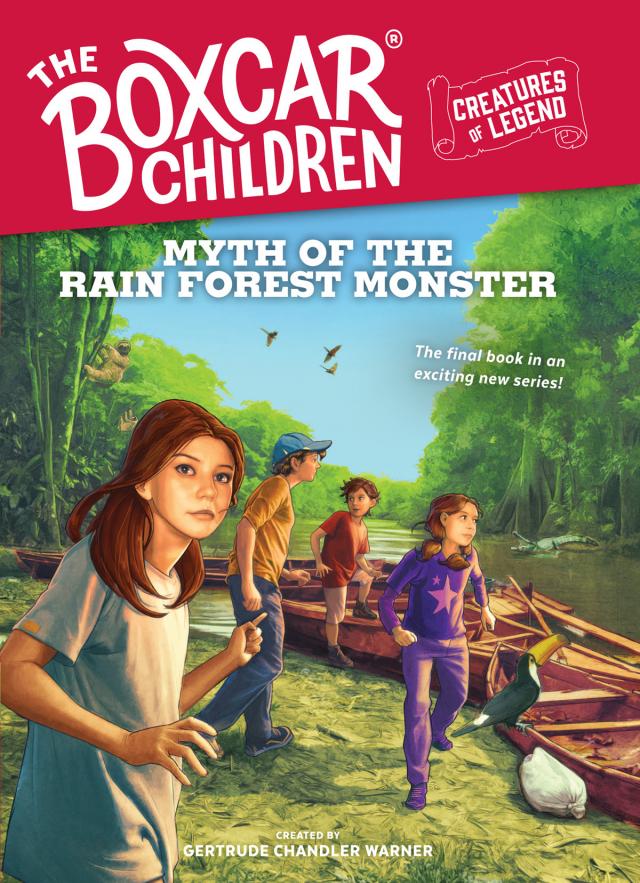


The Boxcar Children investigate legendary creatures
The hike led the Aldens up and down hills, over mossy logs, and across streams. The ground in the rain forest was slippery with mud and fallen leaves.
“Are we almost there?” Jessie asked.
“We’re very close now,” said their guide, Nigel. He pointed to a hill across the clearing. At its base was a large, dark opening.
“Wow, is that a cave?” Benny asked.
“A tunnel,” said Nigel.
“It looks like the tunnels that machines make,” Henry said when they got close enough to get a good look.
“Except there were never any machines out here,” Nigel said. “We believe an animal made this. A big animal.”
Violet looked into the dark opening. “Is it still in there?”
Copyright © 2021 by Albert Whitman & Company
First published in the United States of America in 2021 by Albert Whitman & Company
ISBN 978-0-8075-0807-7 (hardcover)
ISBN 978-0-8075-0817-6 (paperback)
ISBN 978-0-8075-0819-0 (ebook)
All rights reserved. No part of this book may be reproduced or transmitted in any form or by any means, electronic or mechanical, including photocopying, recording, or by any information storage and retrieval system, without permission in writing from the publisher.
THE BOXCAR CHILDREN® is a registered trademark of Albert Whitman & Company.
Printed in the United States of America
10 9 8 7 6 5 4 3 2 1 LB 26 25 24 23 22 21
Illustrations by Thomas Girard
Visit The Boxcar Children® online at www.boxcarchildren.com.
For more information about Albert Whitman & Company, visit our website at www.albertwhitman.com.
CONTENTS
1.Concrete Jungle
2.A Mega Clue
3.Stories from the Forest
4.Visitors
5.Into the Wild
6.Base Camp
7.An Expedition
8.In the Dark
9.A Close Call
10.Revealed
CONCRETE JUNGLE
I don’t see any rain forest.” Six-year-old Benny Alden pressed his face against the car window. Outside, the streets were lined with buildings so tall Benny could not see the tops. The only trees in sight were palms, growing along the sidewalk.
“We’ve still got a long way to go before we get to the rain forest,” Benny’s older brother, Henry, said from the next row of the taxi van.
“That’s right,” said Dr. Iris. “Brazil is a very large country. São Paulo is almost as far away from where we are going as Greenfield is from Camp Quest, where we met. But this place is an important stop for our next investigation.”
“It is? Are we looking for a creature that lives in the city?” Benny looked back out the window and searched for any sign of wildlife.
Over the summer, he had gotten used to keeping his eye out for unusual things. He and his siblings were helping Dr. Iris investigate reports of mysterious creatures around the world. Their findings would help her prepare a television series for children. So far, the Aldens had looked for Bigfoot in the Rocky Mountains, elves in Iceland, and mermaids in Puerto Rico. Brazil was the last stop in the children’s summer of travel. And Benny was determined to find the best proof yet that the creature was real—whatever it was.
“You won’t see it in the streets, I’m afraid,” Dr. Iris said. “We’re actually going to the zoo.”
Benny’s eyes got big. “The creature is at the zoo?”
“That wouldn’t be much of a mystery, would it?” Henry chuckled and put down a map of the city. At fourteen, he was the oldest of the Alden children. He had been helping Dr. Iris navigate the busy city, and he was the only other one who knew what they were going to see.
“I love zoos,” said Violet. “But aren’t we going to see lots of the animals in the rain forest, where they live?”
Dr. Iris nodded. “We will see many animals there,” she said. “But it can be hard to spot animals in the Amazon. And there’s one animal in particular that is good at hiding in plain sight. It just so happens to have some things in common with the creature we’ll be looking for.”
“Sounds like a sneaky animal,” said Benny. He bounced in his seat with excitement.
Violet wrung her hands. She was ten, and even though she was excited to be going to the rain forest, she also knew how wild it could be.
The taxi dropped off the children with Dr. Iris at the zoo. Once everyone had their tickets, the group walked inside. Immediately, they were surrounded by trees and vines and bright flowers.
“It’s like stepping into a different world,” said Jessie. She was twelve. Usually on the children’s adventures, she was the planner. It was exciting for her not to know what they were going to do for a change.
Henry led them down a winding path through the zoo. Benny followed close behind, looking for a clue about what they were trying to find. They came to an enclosure of monkeys.
“Oh! Does the creature have really long arms and swing from the treetops?” Benny asked.
Dr. Iris shook her head. “We aren’t here to see the monkeys.”
Next, they passed an enclosure with a pair of yellow-and-blue birds.
“I know!” said Benny. “It’s like a giant parrot with a big beak!”
One of the birds tilted its head from side to side.
Jessie laughed. “I don’t think he liked you calling him a parrot, Benny.” She pointed to the sign. “It says those are blue-and-yellow macaws.”
“Oh.” Benny turned to the enclosure. “Sorry, Mr. and Mrs. Macaw!”
“Just a little farther,” said Henry.
He stopped at the end of the row and stood in front of the sign that said the name of the animal, so the others could not see. The enclosure had a grove of low-growing trees that shaded the whole area. Everyone gathered around and peered in. Even Jessie was excited to find what they were looking for.
Benny leaned on the railing. “I don’t see anything in there. Are we looking for an invisible animal?”
Dr. Iris gave them a hint. “Look closely at the trees.”
The children squinted as they scanned the treetops. Then Violet noticed something move among the leaves, and her eyes widened in surprise. “I see it!”
“I do too,” Jessie said. “It just barely moved.” She pointed up to an animal hanging from a branch. “See, Benny?”
“Yes!” Benny said. “It looks like a big monkey.”
“Except its face is different,” Violet said. She thought it looked kind of cute and was happy the animal they had come to see was not scary.
“That would be a sloth,” said Dr. Iris. “Sloths are a little like monkeys. Both live in trees. But they move in very different ways.”
Benny looked back at the monkey enclosure. One monkey climbed to the top of a tree in a blink. Another took a giant leap from one treetop to the next. Benny turned back to the sloth. “I think Mr. Sloth must be tired,” he said. “Maybe he just woke up.”
“Even when they are wide-awake, they don’t jump like monkeys,” Dr. Iris said. “Sloths sleep most of the time, so they don’t have to spend as much energy looking for food as monkeys do.”
“I like sleeping,” said Benny. “But I thought the animal was going to be more…exciting.”
“Well, sloths may not move fast,” said Dr. Iris. “But that does not mean they aren’t exciting. Moving slowly helps sloths stay hidden from predators. In fact, they move so slowly that green algae grows in their fur. That makes them almost impossible to see in the green forest. So sloths may be slow, but they are masters of survival.”
Benny looked up at the sloth. Staying hidden from other animals did sound exciting. “Sorry, Mr. Sloth,” Benny said. “I didn’t know you were a master survivor.”
Jessie turned to Dr. Iris. “You said the animal would have something in common with the creature we’ll be looking for. Is the creature good at staying hidden?”
“Or is it really slow and cute?” Violet asked.
Dr. Iris shook her head. “The creature we’re here to learn about is sometimes said to be related to tree sloths. But it is much, much bigger. And it doesn’t live in trees. It’s called a mapinguary.”
“Ma-ping-wahr-EE.” Benny repeated the word part by part. “Does it have something to do with maps?”
“That’s a good guess,” Dr. Iris said. “No one is quite sure where the name comes from. You see, there are several languages spoken in the Amazon, including some that aren’t very well-known to outsiders. What we do know is that many groups living around the Amazon have stories of this creature.”
Another sloth emerged from the treetops. The children watched as it slowly climbed its way toward the other sloth on the branch.
“It’s hard to think of a scary sloth,” Benny said. He turned back to the enclosure. “No offense, Mr. and Mrs. Sloth.”
Dr. Iris smiled. “Our next stop might help you imagine it more clearly. Where are we headed, Henry?”
“A natural history museum,” said Henry, taking the city map back out. “That’s where we’ll see the skeleton.”
“Skeleton!” said Violet. She remembered back to when they had been looking for Bigfoot. Dr. Iris had told them that they needed a real bone to show that the creature could be real. “Does that mean the creature is real?”
“Not necessarily,” said Dr. Iris. “We
’re going to see a very old relative of the tree sloth—a giant ground sloth.”
“There are sloths that live on the ground too?” said Benny.
Dr. Iris shook her head. “Most people believe that the last giant sloths went extinct thousands of years ago. But some say the creature is still alive and that it is actually what the stories of the mapinguary are talking about.”
Jessie took out her notepad and pen. “So we’ve got three different questions to answer,” she said. “The first question is about this creature, the mapinguary: Is it real? The second is about this animal: Are there still giant ground sloths alive in the Amazon? And the third question is whether the mapinguary and the ground sloth are the same thing.”
Dr. Iris nodded. “Perfectly stated, Jessie! That is just how we should open this episode of the television show. Now, we should be on our way.”
As the Aldens were leaving the zoo, another animal caught Benny’s eye. The creature walked on all four legs and had a long snout. “What is this guy’s name?” Benny asked. “His nose is like an elephant’s.”
The others stopped and looked in the enclosure. Violet read the sign. “It says here that it’s a giant anteater,” she said. “It lives in the Amazon too.” She read off the extra information about the animal. “It can eat thirty thousand insects a day! Its snout helps scoop them up.”
Benny watched as the animal snuffled its nose along the ground. “So far we’ve seen one animal that likes to sleep a lot,” he said. “And another one that likes to eat a lot. I think I want to live in the Amazon too.”
Dr. Iris chuckled. “It is not so easy for humans,” she said. “The anteater has had a long time to adapt, just like the sloth.”
“What do you mean?” Henry asked.
“The Amazon is unlike any other place on Earth,” Dr. Iris said. “Every animal in the rain forest has changed over time so it can live in the rain forest’s unique conditions. The anteater has found a way to take advantage of all the insects in the forest. His snout makes him a master at scooping them up.”
“Like how the sloth adapted to become a master of disguise,” said Jessie.
“Correct again!” said Dr. Iris. “Now, let’s move along. I don’t want to be late for our next appointment.”
As the rest of the group headed toward the exit, Jessie paused to write on her notepad. Their conversation seemed like an important thing to remember.
“Come on, Ms. Sloth!” Benny called back to her.
Jessie laughed. She closed her notepad and ran to catch up.
A MEGA CLUE
Look!” Violet said. “That building has a mural painted on it. And there’s another one on that building! The flowers on it are pretty.”
“There’s one with monkeys!” Benny said. “They’re everywhere!”
“São Paulo is famous for its street art,” Dr. Iris said. “The artwork reminds everyone of the country’s most fabulous treasure.”
“They have a treasure?” Benny asked. “What kind of treasure?”
“The rain forest is Brazil’s greatest treasure,” Dr. Iris answered. “Really, it’s a treasure for everyone on Earth. But we’ll have to talk about that later. We’re here!”
The taxi let everyone out in front of a white stone building. “What does that sign say?” Violet asked. “I can’t read any of those words.”
“I am not surprised!” said Dr. Iris. “It’s written in Portuguese, the official language of Brazil.”
“‘Museu de Zoologia da Universidade de São Paulo,’” Henry read off the words slowly. “I think I know what that means. The words almost look like Spanish: Museum of Zoology at the University of São Paulo.”
“That’s right. Portuguese and Spanish are alike in some ways,” Dr. Iris said. “But most people in Brazil do not speak Spanish. Lucky for us, the man we are meeting is an old friend, and he speaks English.”
A man wearing a bow tie and a white suit came through the door of the museum.
“Hello!” Dr. Iris called.
“Welcome, Iris,” the man said as he came over to her. “It’s been too long.” He kissed her on both cheeks.
“This is Professor Cardoso,” Dr. Iris said to the Aldens. The man had white hair and dark-brown eyes. “He’s an expert on animal species in the Amazon.” She introduced each of the children.
“I’m so pleased to meet you,” he said to them. However, as the man shook each of their hands, his eyebrows wrinkled. Violet thought he looked worried.
Professor Cardoso turned to Dr. Iris. “You didn’t mention the age of your young companions.” He looked down at Benny. “Camping in the Amazon can be dangerous. There are enough animals, reptiles, and insects to cause problems for the most experienced of campers.”
“We’ve been on lots of adventures!” Benny said. He raised his arm and flexed his muscles.
“So Iris has told me.” The professor gave a friendly smile, but Violet still thought he looked worried.
“Nigel Livingstone will be along with us,” Dr. Iris said. “I haven’t met him, but I know he’s an expert.”
“I was surprised to hear you were traveling with Nigel,” the professor said. “I thought he’d given up on those trips after the attack.”
“Attack?” Violet asked.
“Yes, he had an unfortunate run-in with a caiman,” said the professor. “Last I heard, he still walks with a limp.”
“Oh dear, I didn’t know about that,” said Dr. Iris. “He seemed excited to go on the expedition in his emails. He never mentioned any trouble.”
“A caiman?” Henry asked. “That’s like an alligator, isn’t it?”
Professor Cardoso nodded. “They are very similar to alligators. Except they don’t grow as large.”
“Why did a caiman bite him?” Benny asked. “Did it sneak up on him at night?”
“No, caiman don’t do that,” Professor Cardoso said. “He said he just wasn’t paying close enough attention. Caiman don’t usually attack humans, though it’s best to stay out of their way.”
“We are always careful,” Dr. Iris said with a bright smile. “Now, why don’t we have a look inside? Thank you for opening the museum for us.”
“Of course,” Professor Cardoso said. “This way.”
“That’s what we are looking for?” said Benny.
The skeleton was in the center of a large hall, and it stood at least three times as tall as Professor Cardoso. The creature’s two front legs grasped a thick tree. Its back legs were planted on the ground with a sturdy-looking tail between them. The children walked around the skeleton. It was as big as some of the dinosaurs they had seen at other museums.
“There were once more than twenty species of giant ground sloths, including some that lived in North America,” Professor Cardoso said. “The species that lived here in South America was the largest though. It’s called the Megatherium. That means giant beast. We think it weighed about seven tons.”
Jessie did the math out loud. “If one ton is two thousand pounds, that means it weighed fourteen thousand pounds!”
“That sounds like a lot,” Benny said.
The professor nodded. “It weighed about as much as a Tyrannosaurus rex. Or you can think of it another way: if you stacked four cars on top of each other, the stack would weigh about the same amount.”
Benny nodded. “Definitely a lot.”
“I’m not sure I want to go looking for something that big,” said Violet. “Plus, the front claws are scary looking.”
“We don’t think ground sloths were dangerous to humans,” Professor Cardoso said. “They were herbivores. That means they only ate plants.”
“How do scientists know that?” asked Violet.
“Good question,” Professor Cardoso said. “The skeletons include jaws and teeth. Teeth tell us quite a bit about an animal. I know it’s hard to see the teeth in this one because it’s so tall, but we have photographs on the display.”
The professor pointed at one of the images. “See how the teeth are flat? If the animals had eaten meat, they’d need some sharper teeth in front. They don’t have any pointed or sharp teeth. That tells us they ate plants.”
“Dr. Iris said that some people think there could be an animal like this still out there,” said Henry. “It’s odd to think that no one has seen or photographed something so big.”


