Luda, p.20
Luda,
p.20
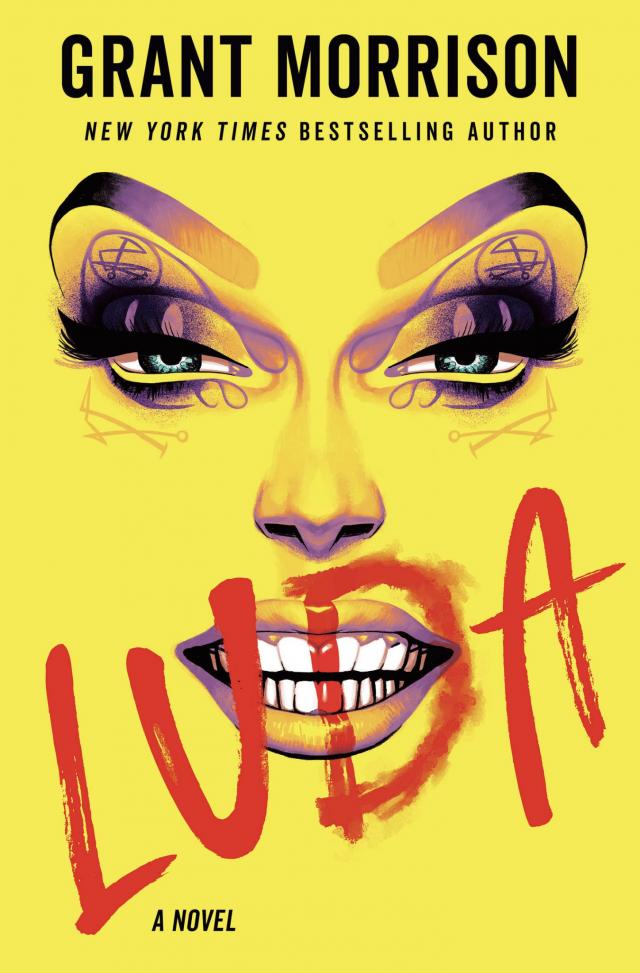


Who needs Botox when you have the Glamour?
* * *
—
Dom’s choreographer, a formidable Romanian matron with the equally formidable name of Elena Marilena Mia Novac, came with a colorful background in experimental interpretative dance productions. She worked with the chorus at a big new studio by the old dry docks out past Dareport, developing The Phantom’s set-piece song-and-dance numbers.
She’s getting better—Dom nodded, stroking the cinders-and-ash beard he’d allowed to accumulate, a furry jabot to discreetly obscure the union of neck and chin that was fast becoming one of his distinguishing features. She might just be the genuine triple threat we talked about.
I’m teaching her—I said, reminding him who was in charge.
She’s getting better than you—he said, without any regard for my feelings. Can you believe we’ve been so lucky?
The dance went on, the staccato pterodactyl cries of Madame Novac shocking young limbs into robot lockstep. Stop. Start. Repeat. She brought to piano rehearsals the single-minded ruthlessness of a sadistic drill sergeant on a parade ground.
* * *
—
Following a spectacular all-singing, all-dancing opening scene depicting the hurly-burly of “The Market in Peking,” we’re introduced to Aladdin and Widow Twankey in full flood.
I’ve just arrived in a rainbow rickshaw drawn by Buttercup the frisky multipurpose pantomime cow, I should add. If I could arrive everywhere in a rickshaw I would. Descended on four-inch platform soles, I take a bow, fold down my parasol, and use it to whack the head of my lazy good-for-nothing son, Aladdin—as I introduce him, currently reclining among the laundry baskets preoccupied by passing clouds and idly polishing an old peanut butter jar when he should be grafting.
Don’t just lie around there dreaming!—Twankey urges. There’s work to be done, Aladdin!
What’s wrong with dreaming!—he yelps.
It’s not the dreaming I’m bothered about—Twankey shoots back, flapping her apron. It’s the lying around! And what good’s an empty jar! Get rid of it.
He comes right back all indignant as if his killjoy mother just interrupted his discovery of electricity—I’ve heard sometimes there’s magic in ordinary things if you know how to unlock it!
Never mind that! I say to trumpet accompaniment. Can’t you hear those trumpets?
I thought that was you after a curry!—he says.
I grab a prop broom and swing it around wildly, shifting litter and rubbish from one spot to another.
The Royal Carriage has been shunted down our alley—I tell him with a rising rocket-fueled whine of hysteria. This place looks like a junkyard!
That’s because it’s full of junk! Aladdin points out.
From offstage left come much louder Whoopee Cushion trumpet voluntaries as the Royal Party trundles closer.
I have to look my best!—the Widow frets and fusses. They might be on the lookout for a good washerwoman!
They’ve come to the wrong place—says Aladdin.
Twankey lifts a palm, all set to clip the lad’s ear, as the horns repeat their brazen annunciation, cueing the fussy arrival of the Vizier, unrolling a scroll.
By express order of her mother, the Empress herself, anyone caught gazing or otherwise sneaking an unsolicited peek in the direction of the young princess will face immediate execution without trial. It comes across as harsh I agree but you wouldn’t be royalty if you couldn’t abuse your authority now and again, would you?
Why can’t we look at the princess?—Aladdin inquires. Is there something wrong with her?
I heard she’s got cock eyes, a pig’s snout, and a laugh like a horse—Twankey replies, struggling not to mix it up. And that’s before we get to the bits you won’t see at the window!
She’s hoping this mental picture of a farmyard monstrosity might do the trick to discourage her son’s potentially fatal curiosity, for it’s all eyes down on pain of death, the Vizier assures us once again.
Naturally, Aladdin can’t keep his eyes to himself.
As the Royal Carriage rattles across the stage, our young hero risks a furtive peek, anticipating at best a forbidden glimpse of spoiled fruit, a stolen gawp at the misshapen harvest of centuries of inbreeding.
Instead, he locks eyes with the radiant living playing card that is Jasmine Princess of Hearts, and as he does, Aladdin falls immediately and conclusively in love.
No more immune to the heart-seeking missiles of Cupid than her guppy-mouthed besotted admirer, Jasmine too finds herself instantly, catastrophically smitten.
And in that searing instant of eye-to-eye contact the peanut butter jar slips from Aladdin’s fingers and smashes into sugar glass fragments.
Guards!—the Vizier cries out in horror, one bony finger targeting the boy.
Palace bully troops surround Aladdin, deadly numerals on a clock face counting down to checkout, the spokes of their spears aimed at the hub of his heart, awaiting the order to thrust and be done with this flagrant transgressor.
Here, Twankey utters an ululating cry and throws herself between the guards and her boy, only to be manhandled away.
Surrounded by piercing symbolic lances, the Principal Boy is saved from certain death by the arrival of a familiar figure, a tall fastidious man we recognize from the prologue as the ambitious conjurer Abanazar.
I’m your uncle, Aladdin! Your long-lost uncle Abanazar—the wiry liar is quick to assure Aladdin and Twankey as he discombobulates the guards with a few mystic flaps and third-rate illusions courtesy of Aiysha Dyce’s jaded, deadpan Slave of the Ring and the prop team.
I don’t remember any long-lost brother! Then again, I do have a terrible memory! I repeated the line for the fifth time.
Come with me!—the Wizard cries while—Come with who?—says Twankey.
Abanazar!—he repeats.
Gesundheit!—Twankey replies, hauling from her cleavage a huge polka-dotted hankie she hands to the baffled conjurer as he hurries the Widow and her son to safety.
* * *
—
Back at the Vall on press day after another mostly abstract lunch, I couldn’t help registering a new addition to the elaborate stage layout.
There was Dominick Float having his photograph taken next to a remarkable item of anti-spook technology he’d had installed and was keen to show off: a tall pole on a circular weighted base with a soft forty-watt bulb glowing on top, like a standard lamp missing its shade. I shuddered, shook my head, and sighed, in that order.
In the biz, we call this arrangement a Ghost Light, kept permanently lit onstage to provide illumination for benign spirits and a deterrent to any harmful unseen influences.
Was this your idea?—I said, confronting Float as photographer and newshounds dispersed with full bellies. Why would you encourage this Curse thing?
Float’s eyes lit up like Hiroshima lanterns; his scruples took to the night air. I don’t want to say it—he said, saying it—but this is actual box-office gold.
And I said—You didn’t actually say that—but he had, and it was too late to stop him.
Indignation aside, it was easy to see what he meant.
We couldn’t have asked for better publicity—he went on. Ticket sales are through the roof! They’re doing a whole feature—you need to talk to them!
I made a mental note to stay out of it; I could see the snappers had an uneasy Luda posed in her Aladdin costume, vamping mock terror with a prop ghost on a wire for the morning edition. I observed that she was using her hand to obscure her face and break up its lines.
Won’t be so funny if you’re next, Dom—I pointed out, and his mouth formed a rueful tight smile I’d have cause to remember. You’re in a dangerous age bracket. Which he was, and that’s before you bring his weight into it!
Float stood firm. The production needs all the help it can get. We play up the Curse, we pack the house every night! I guarantee it.
It’s hardly a Curse!—I pointed out reasonably. No one’s died, have they?
And I was right, they hadn’t.
Nevertheless, the doors to the Dancehall of Death would be opening soon enough.
* * *
—
I seasoned my recitation of the latest headlines with a camped-up Vampira sarcasm, bringing an arch and rolling horror host tone intended to reduce the headlines to absurdity.
PANTO SHOW CURSE!—I enunciated in a suggestive dominatrix register. TOP DIRECTOR CALLS ON GOOD SPIRITS TO SAVE SHOW!
Below these words, next to a before-and-after shot of Dom goggling askance at the Ghost Light, was a portrait of the lead suspect in a haunting, looking his brooding best in daguerreotype from March 1900; the handsome, worried face of Murdo McCloudie, enigmatic and preoccupied, illustrating a sub-headline—
MCCLOUDIE—VENGEFUL? DID TROUBLED ARCHITECT JINX HIS GREATEST CREATION?
It went on in an unrestrained torrent of undulating, insinuating prose as cultivated by generations of tabloid reporters.
“…fans of the creepy smash hit musical are pointing out how recent events closely mirror the onstage action…”—and here’s you scared out of your wits by a sheet on a string.
Only partially listening, Luda clutched her scuffed script pages in one hand, opening and slamming drawers on the desk with the other, as she searched impatiently for a paper clip to hold her lines together—her brow corrugated, a certain sign she was struggling with a complex arrangement of doubts and uncertainties.
I’m trying to make sense of the end of the story—she said indignantly. Is it that you go mad and we all come back as ghosts to haunt you?
By “you,” she meant the Phantom in the play, who as I like to think I explained earlier is the alter ego of Widow Twankey, as portrayed by yours truly, Your Humble Narrator and like droogie.
You can think of them as ghosts—I tried to explain. Maybe he’s gone mad, then killed himself, and now he’s teaming up with them in the afterlife for the big closing number. He’s a ghost himself! The Phantom.
I thought it was something like that—she said though the frown remained ruched in place. So how come he’s alive in the next scene?
He’s not—I pointed out. In response, Luda rattled the loose pages of the script like a gris-gris as if to magic me wrong.
In the show’s bravura crescendo that seeks to combine surreal physical comedy with the horrors of one terrified human being’s catastrophic cheerio to sanity, the Phantom aka Twankey is left alone spotlit onstage before attempting to play every part for a critical audience—making us cringe and beg for mercy as the fool exhausts the last of his dwindling energies across the entire stage to scoffs and taunts.
In a strobe-sliced nervous breakdown, the Phantom undergoes cellular division into his component parts, one role, one singular self at a time as the original actors return to dramatize the Phantom’s dissociation.
The show closes with a fabulous upbeat song-and-dance number—the catchy chorus repeats, then repeats again then again, each time a little more ominous, to make the point before everyone freezes mid-line and whirling emergency lights of blue and red race around the walls of the auditorium. Then curtains, house lights, and music plays…
* * *
—
There I was, selflessly waltzing my pretty Padawan through the choreography for the Cave of Jewels one more time when Luda decided she’d been starved of fresh air and personal space, so I tucked some cash into her purse for wine and roll-up papers and aimed her at the local bodega.
While she was out, I noticed she’d left the door to her room tantalizingly partly open. It took five seconds flat for me to wrestle my conscience to the mat, before swiping her tablet open and checking her search history, only to discover a representative selection of Pussyfever music videos.
Every chart hit on Luda’s playlist was distinguished with a lead vocal by Molly Stocking, so keeping my mental health at the forefront, I fast-forwarded through Molly throwing shapes and lip-syncing “Tigress,” “Boy Season,” and “Queens in the Clone Age,” the title track of their second album. I struggled to understand what Luda imagined she could learn from Molly’s remorselessly predictable stage routines and warbling auto-tuned vocals that called to mind the painful struggle toward self-awareness of a Speak & Spell machine.
What’s up?—said Luda, bursting into the living room wearing the kind of scowl that only works on a boy as she caught sight of her kit in my hands.
Your tablet started singing—I said, covering with a lie followed by a swerve. You won’t learn much from watching Molly Stocking acting out symptoms of Saint Vitus’s dance crossed with Saint Elmo’s fire—I said, throwing down the lace gauntlet.
Luda relaxed into a smile. It all made sense, which was all it needed to do.
I wanted to see how someone else does it, that’s all—she explained. I like how she dances even if you don’t. It’s modern. Audiences like that.
I believed her but when I looked back an hour later, she was running the footage again, leaning in close to study a freeze frame.
As she mapped the screen with her scanning eyes, Luda raised and rotated her left arm, locking it into an exact copy of Molly’s paused gesture. Angling her chin just so to balance out the pose. I’m sure it must have occurred to me that this clip was different from the performances she’d been researching, and, unlike those, was picked out from a TV chat-show interview—but the thought didn’t stay around long enough to register on a CAT scan.
I closed the door quietly so she wouldn’t know I was there.
* * *
—
Luda was wired to the Sea of Tranquility like a child counting down each second of the infinite seventy-two hours before Christmas. The days rattled by in chorus rehearsals and run-throughs. I could see Luda burning like Joan of Arc with anticipation for her public debut.
The brief Molly Stocking fixation had left no unsightly marks. To my great relief, none of what she’d learned from dissecting the dance routines in the “Sextin’ with my Exes” promo had made its way into her own performance.
With Float’s critique of her authenticity ringing in my ears, my mission was to teach Luda how to dredge real emotions up from her gut to load the first line of the song with feeling, and how to make the lyrics tell her personal story.
You have to connect what Aladdin’s going through to your own emotions—I explained, as if sketching a broad outline of calculus meant for dogs.
How do you do it?—she wanted to know, as if there was a procedure, a reliable formula.
I try to imagine how someone might feel in that situation, based on things I’ve been through in my own life. If the character’s sad, then I think about a time when I’ve been sad. It’s not much more than that.
I made my best effort to demonstrate, and I won’t deny that each time we rehearsed, she got better at sampling the nuances of gesture and expression that made it seem real. But she was only ever copying. It seemed to me her emotions were simulations of such high-fidelity exactitude, only an expert could tell them apart from the real thing.
Something happened to you—you don’t talk about it—were you sad then?
The older you get, the more things “happen”—I said sagely. You’re trying to avoid work.
Were you married?—she said. I had no idea where that came from.
It might as well have been marriage—I corrected her. We were quite young.
We’re talking the war years then—she sneered. The Trojan War years! I let her get away with it; shade is one of the most devastating weapons in any queen’s verbal munitions stockpile. One of the martial arts of the Glamour, its mastery is to be encouraged.
Luda persisted; how, she asked, could anyone identify with the malignant Phantom, a masked supervillain with only evil on his mind.
Think about it this way—I said. The Phantom’s not a monster, he’s an actor having a nervous breakdown. Luda gave a vacant nod. I was treated for mental health problems after I left the Troupe—I went on, baring my soul like a centerfold bares her bum for the cameraman. That helps me as an actor to understand a little of where my character’s coming from.
Luda, frowning, unconvinced, consulted her script—That’s not what it says here—she argued. He kills everybody and they come back to life.
Only if you want to take it literally—I stressed. Everything you say might be in his head.
So, it means a lot of different things at once—Luda said and I nodded, seduced by the rising dawn of an insight whose brilliance bleached out the scrunched exasperation from her expression—I like that.
I felt a rich encouraging throb beneath my ribs, knew the unselfish golden pride of a teacher illuminating a student, opening conceptual doors, uncovering new expanses of possibility.
The primary fairy story plot with Aladdin and the princess is the sturdy cement that holds the narrative together for the kids; when the Phantom meets his nigh-on Faustian demise, youngsters can read it on a surface level as the moment the Aladdin/Genie tag team breaks the wizard’s bad spell and everyone comes back to life, even Abanazar, who now has a twinkle in his golden eye for Twankey, all happily ever after singing and dancing in the endless finale.
If you were older, maybe a little bit religious, and inclined to read between the lines, I went on—and on—you might decide to observe the happy ending through biblical opera glasses as a story of judgment playing out; the vain murderer faces well-deserved punishment, where all his victims rise from the grave as ghosts and drag him to Hell, trapped in the final chorus for all eternity—redoing the big outro number forever, knowing he can never get it perfect because perfection doesn’t exist anywhere except maybe in the form of everywhere and everything.