Luda, p.27
Luda,
p.27
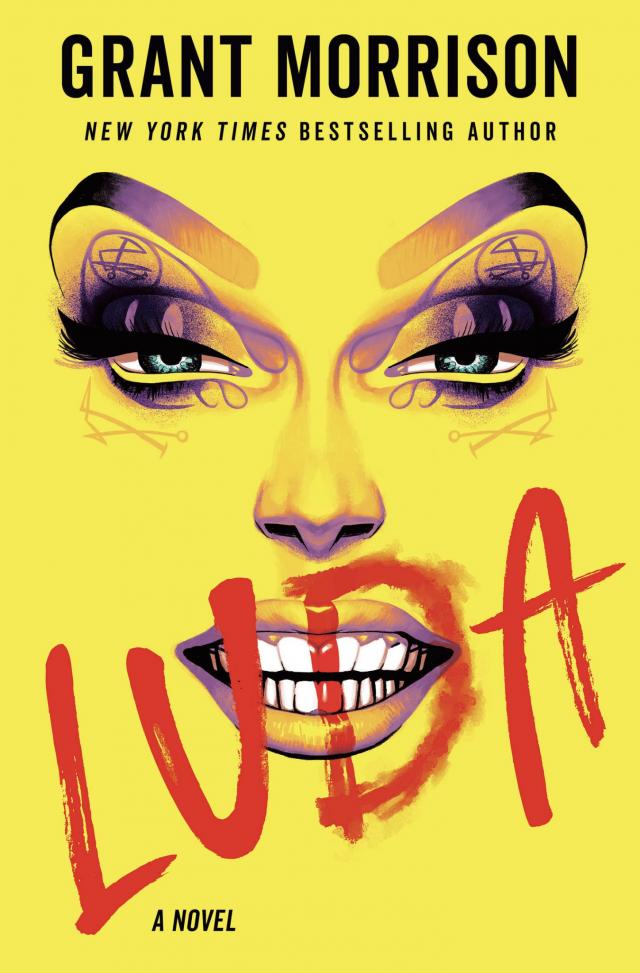


I tidied. Set the mood lighting to “opaque” and then, on further consideration to “stygian” so that I could exist only as a perceptual smear on glass, lacking all identifying detail and outline. A mere prompt. A vague notion. Pepper’s Ghost.
I was still there when the locks unlatched, and the door opened, breathing Luda’s scent of Daisy Dream into the apartment.
So, it worked out that Luda was first to see what I’d done up close.
With sinking heart, I registered each swallowed gasp—her pupils expanding.
You look amazing—she breathed.
* * *
—
I talked about this up front, and I’ve known pro dames who’ll swear they can do stage-ready makeup in fifteen minutes.
Maybe, and obviously I could if I had to, but I call that a stark lack of commitment.
It’s not a dash to the final period of an appliquéd beauty spot, I tell myself and my listeners; it’s not about how hurriedly you can slap on some tarantula lashes and lip gloss and secure a place in the Guinness World Records, it’s about responsibility to the role, about vanishing into Twankey, becoming the makeup. It’s a rubbing-out and a filling-in.
What do I know?
It’s not boasting to say I’ve been blessed with textbook cheekbones, but I like to accentuate them to achieve the Widow Twankey’s trademark gaunt and hollow-cheeked pout, making her face an X-ray of her vanity. In certain lights she’s a fashion skull in a frock. Maleficent of the laundry biz.
Me in a chair, on the throne, shitting it all out for the last time.
It’s funny what you’re prepared to spill to a stranger. There are no strangers, they say, just friends you haven’t let down yet.
I told Elspeth how, in a distant epoch bracketed by my twenty-third and twenty-eighth birthdays, I’d made up my mind to give it a go as a traditionally gendered young man on the alternative arts scene. I’d fallen head over heels for a design school girlfriend with the lips and bed-tousled hair of Brigitte Bardot, the eyes of a lamia from mythology, chain-smoking roll-ups with a fuzz-toned voice and a laugh like champagne bubbling in the gutter.
Over time I tried to convince us both it was her I wanted, but in truth, in retrospect I may just have coveted her wardrobe—the clingy Gaultier dresses, the sheer stockings, the spiky boots, the opera gloves—but I endeavored to be the model man in our relationship, the breadwinner, the stoic, the rock, as based on some blueprint of masculinity I’d inherited from Dad and the dominant pa culture where I’d been grown like an experimental virus on a dish.
In truth, it might as well have been marriage and Rose encouraged me all the way, adding her social worker’s wage to a weekly check from my job in the bookstore for six years while I honed my skills in bars doing comedy and music; I wanted to break new ground, to be beautiful and deadly like a Pop Art bacillus, an infection of unclassifiable positivity, non-duality, and sexual ambiguity. Rose hoped for a successful career, children, security. She wasn’t boring, just practical in ways I still haven’t mastered. She was fantastic. I wouldn’t want that to be forgotten.
Rose spiked me with rocket fuel, and I left her behind on the launchpad. I put myself and my self-expression first and I’m not sure how I feel about that now.
We planned to get married, me and Rose. Rose and I. We became fiancé and fiancée in a Leap Year exchange of intent beneath overhead girders I’d strung with candles and swags of tinsel and foil. There were always plans to tie a knot in it, to choke off all other possibility, but the closer they came to fruition, the more I became harder than frogspawn to hold in place.
Just Rosie and me and baby makes wee!
I couldn’t face the oncoming tidal wave of nappies; I was twenty-seven years old. I couldn’t cope with the freezing process I told myself was taking place. I was terrified I’d harden like cement, spending my imagined potential, setting into one permanent shape, one specialized role before I’d tried all the others and found the one that made sense of me. The prospect of being some ungrateful brat’s dull dad for the rest of my life brought on ice-cold flop sweats, 3 A.M. to 4 bleak roundelays of recrimination.
I couldn’t talk Rose out of it, not at first, so of course I had to bring it all down. I felt the need to make rubble of possibility. Reduce the girl I loved and her imagined future to a debris of impossible fragments. This was my last chance to prove to myself there was more to me than her and our rented flat.
Enter Jet, Rose’s younger brother by six years; Jet was the sort of man who could straighten out an engine, score a winning goal, command a room, but there was a part of him, a little ingress point I recognized as potentially queer.
I held off for a long time. I really did. But there came a brisk shining day in May with the blossom on the apple tree like Queen Anne’s lace in that Larkin poem.
Jet had sourced some MDMA from a mate at work and turned up in our little backyard on a mission of home improvement. I’d promised Rose I’d put my back into it and help her brother till the soil and plant some shrubs and lay some tiles.
As for backs, it takes at least two to make a beast.
At the risk of slipping into Twankey as easily as Jet found himself slipping into me three hours later, it wasn’t the tiles that got laid that day.
Jet convinced us both the powders would turn the work of setting paving from a chore to a pristine expression of our creative souls. He had a surreal sense of humor I liked although he skewed toward being a bit crude even for me. It wasn’t a problem; I saw it as my duty to be the entertaining one and kept volleying setups in a quick-change revue of madcap scenarios, a jumble of accents—Geordie, Boston, Thai pimp—harvesting blue lines from him that I’d keep in storage and thaw out for Twankey to use all those years later.
In the intensely meaningful and heartfelt counseling session intimacy that followed the peak of our trip, Jet articulated at great length all the ways in which he was straight. Whatever had happened between us at chemical Ground Zero could be filed under the not unexpected effects of disinhibiting love drugs, whose complex molecules were in the process of stripping our workaday selves back to pure libido and steam engine flesh. He was a highly sexed individual, he assured me. That didn’t make him gay. I agreed wholeheartedly—we were straight by convenience, straight as the line of least possible resistance—as we knotted our bodies quite naturally into a wet blue passionate kiss under the garage rafters where I’d pledged my future to Rose.
To her credit, Rose saw through the matey wink-wink banter when she found us some time later, like ruffians on a Caravaggio canvas, hoplites lolling spent and self-satisfied in the garden with its half-done path. By the time we followed her into the kitchen, clattering and bedazzled, practically hand in hand and twining posies into each other’s hair, she was determined to make light of her obvious suspicions.
When she questioned him about the florid love bites blooming on his neck, Jet muttered something about his girlfriend’s tooth-grindy passionate nature and fled. After a few inept attempts to lie by editing the truth, persisting over three days of strenuous cross-examination, I confessed. Looking back, I did it to be cruel. I did all of it to make sure there was no way home for any of us.
Naturally, this unrepenting confirmation that her fiancé had on that day sucked her little brother’s cock with vim, vigor, gusto, and brio was one more betrayal than Rose could bring herself to forgive or overlook.
She wanted to make it clear that she had nothing against boy-on-boy action. She just didn’t think it made a good foundation for a long-term monogamous heterosexual relationship. A point I was obliged to concede even as I assured her that Jet most definitely wasn’t gay! He’d told me so.
And I’d be lying if I said I was gay, either.
I’m fine with making up my face; making my mind up is beyond my capabilities. I hope that’s clear by now.
I’ve always known I lack the commitment to be any one thing or the other. Selected as a spokesperson for any specific viewpoint, I’d be an affront to the faithful. The chances of ever doing my homework to the required standard were slimmer than the influencers on eating-disorder websites. I preferred to have options. I was queer. I was a living mess of contradictions. I felt like an alien peeking through circular spaceship windows at the world and its folly. That was the best I could come up with.
* * *
—
Then came that final argument—where the compacted energy of our first meeting was all used up at last, dissipated to hoarse indifference—where everything we’d seen and done together was squashed down into the sad, awkward interlude between first kiss and last curse.
After my breakup, after the agonizingly unsuccessful next attempt to form a partnership with a ten-years-younger, more brilliant, tortured, and perverse iteration of Rose’s basic type who came with the addition of a prominent shaved penis, the Imperial Years arrived, all massed platinum trumpets, pomp, and distracting dazzle.
At the height of the Troupe’s TV success, I found myself in bed with underwear models, male and female, a film star, rock singers, two supremely evil, corrupt, and inked oligarchs, and a famous married footballer who was later captured for all to see splayed with mental black pupils staring into the true-life floodlights of some afterparty hotel suite, arms around two underaged wild-boy hookers.
On the day Rose walked out, all that hedonistic abandon was still in the future, an adolescent dream of disregard, a rejection of convention only attainable after years of toil through a wall of plaited thorns, regrets, recriminations, and emotional denial.
I’d gotten what I wanted. Self-expression at all costs.
It was only much, much later that it was pointed out to me, during a course of Reichian body therapy, how radically dissociated I was from my behavior, how easily I’d justified the pain I was causing to people around me as collateral damage from my fierce commitment to individualism. What a terrible cunt I’d been!
It’s been a long time and now I’m trying to be honest. I’m not proud. When it comes down to it, I had terrible rock-and-role models and no stop button.
She was better off without me.
But that’s never a good enough excuse for selfishness, is it?
So then, what happened?
Luda’s voice shocked me out of my disoriented, high-heeled stumble down the vomit-varnished cobbles of Memory Lane, after dark when it got rapey.
What happened was Rose sent “Luci” a final message, availing her soon-to-be-ex-fiancé of her decision not to have the frightful baby after all. My baby. Her baby. Rose wasn’t having it.
Me? I hadn’t known there was a baby. By the time I found out, it was too late to stop the abortion.
That’s what I told myself anyway.
Like me and Jet during those gilded, ill-fated hours of innocent pharmaceutical love in the Garden, you can see how it all starts to come together, how the cracks spread in all directions from the point of collision, setting off the unstoppable concentric avalanche of cause and consequence that is karma.
Karma is as good a cue as any for you and I to circle back on the map to Mercy Mansions. Maybe you remember the place from before, or maybe you’re checking your notes and your little charts to be sure.
Think of an ivy-scrambled red sandstone enclosure in the Gasglow Gothic style, near Spiral Park on the city’s South Side where I took you all for coffee at the Rendezvous. Picture iron railings containing a concrete courtyard, with shaved lawns and tended trees, willows mostly, hung heavy with that Pre-Raphaelite melancholy and grace they’re serving up; they wore late Ariel Communion dresses of powderpuff-colored blossoms that day, like the Lady of Shallot in her lonely canoe.
A neat sign affixed to the brickwork requested QUIET from passing motorists.
Heather, who might have become anything she wanted to be, was edited from the narrative here, all placenta and possibility, a bloody afterbirth gathered into its bucket taxi by the prayer-scarred hands of silent nuns in the sacred awful compassionate heart of Mercy Mansions.
I fully support every woman’s right to choose, don’t get me wrong.
What I’m saying is no matter what, something always survives.
* * *
—
I’d done my time, those years after the fall of the Troupe where I could be found most days buried up to my neck in bleak volumes of pessimist philosophy, anti-natalism, speculative realism, and nihilism.
After the breakdown, I walked shellshocked and medicated out of Luci’s frozen bombshell image, and left her behind, pinned there on the mood board of nostalgia.
David Bailey shot me for GQ when I staggered out of the Superstar Survival compound with my brittle broken crown askew on my brow, cruelly quoting those Altered Image drag photos of Warhol, taken by Christopher Makos in 1981. My thousand-parsec stare identified me as a pop culture martyr, a media refugee, survivor of some irresistible glitterdammerung, some unimaginable apocalipstick, a ruination.
* * *
—
I think of my voice cracking as I read the eulogy at Mum’s funeral, carrying her film and fashion books and her perishing spider plant “Steadfast” back to the apartment on Prospero Road.
Waterproof black liner for the eyes now, sweeping down the runway to take off at the tips.
There was no hint of magic in my life between the disintegration of the Troupe into five disgruntled awkwardly shaped pieces and Dom Float’s call to arms, only stark reality, pure unalloyed being that felt like a daily sandpapering down to the exposed nerves. There was no Glamour, I told myself. The Glamour was the gutted space left after a narcissistic bereavement. Stripped of his illusions, me, him, Graeme Mott was a mousy little creep who’d tricked and ensnared others in his unsettling web of make-believe.
Mine was the sobbing pain behind the tattooed mask, the greasepaint grin daubed over melancholy, the Harlequin’s checkerboard armor, the jester’s makeup deliquescent with newsprint tears of ink. All of that, all the time.
Where I’d admired people having fun, always smoother, slicker, and more worldly than I could ever hope to be, I now saw in my friends drunks and addicts who fell to bits at the end of the night, cracked masks and bleeding hearts cursing taxis, sick into glass slippers.
Where I’d seen heroism, rebellion, I saw instead fragility. I’d failed to register the damage trailed in my wake like a surf-white bridal train yellowed at the fringes by debris and puke. I replayed every offhand remark I’d dropped to cut someone to the quick, every nasty comment, every expertly thrown six-pointed dart of wounding shade I’d been so proud of at the time.
Where pretense had reigned, cold reality swept through the broken backstreets of Luci LaBang.
Every sad small attempt my peers made to disguise their bulimia with a baggy hoodie and an upbeat fist bump, every stab at being brave about the unexpected cancer diagnosis, every refusal to knuckle down and accept their loneliness or their failure to succeed in spite of all that talent—all futility, all dwindling, all radiating potential lost, all visible to me as sickening roentgen emissions.
The friends who fell behind, who stumbled, whose great paintings were never seen, whose heartbreaking poetry went unread, whose unforgettable songs were never played.
And there was nothing I could do about it, except cry my eyes out so I couldn’t see properly anymore through a gelatin blur, a smudge across the camera lens that helped soften the heartless edges.
In later years, I came to classify my positively Christlike sense of hopeless compassion as more sentimental projection; my unquestioned certainty that to have a talent go unrecognized by the masses was just about the worst thing that could possibly happen to anyone was not necessarily shared by others with different priorities. Under the self-congratulating guise of empathy, I was reverting to my usual snobbery and writing people off for nothing more awful than failing to be famous like me.
That’s how it was, in those T. S. Eliot “Wasteland” desert days when I was dying somewhere between the ages of thirty-eight and forty-four, before the Phantom wafted into my life, when I checked out of my right mind whatever that was. I chose to confront the void and face the absence of meaning head-on.
I had that T-shirt I wore throughout my mental health crisis—DEATH IS THE NEW BLACK.
If it can’t condense to a slogan punchy enough to scrawl across your tits, is it a philosophy worth expressing? That’s what I always say, but here I was screaming for help in Verdana Pro Black two-inch type.
Without Luci LaBang, to hold my hand and guide my steps, I was out of control on the existential dance floor. My moves, once admirable, were the out-of-touch contortions of age, the cringey twists of the dad I’d never be. Past a certain birthday, even the most seductive disco shimmy turns sleazy, ill-advised, lacking in charm.
It was all of it pyrotechnics to distract us from that flaking perimeter of a black crater at the center of everything, that waits for us to catch up to the hospital bed at the end where the days of our lives concertina behind us, when the claustrophobic collapse of possibilities into one terminal state, one inescapable impossible now, draws to its conclusion. Here. Now. Staring you in the face.
Steady on, Lu—I hear you say. Why don’t we all just slit our wrists if that’s all we have to look forward to?
And I know what you’re saying, you’re saying—I thought this was funny drag queen stuff. All quips and innuendos, not this heavy-going.
Well, look at it this way, babes: The universe is laughing and that can mean only one thing—if you’re not laughing along, it’s laughing at you!
* * *
—
Twankey quivers with excitement as she hovers behind Aladdin, a carnival balloon inflated to emblazoned glory.