

Gunning for ho 25th anni.., p.1
Gunning For Ho, 25th Anniversary Edition,
p.1
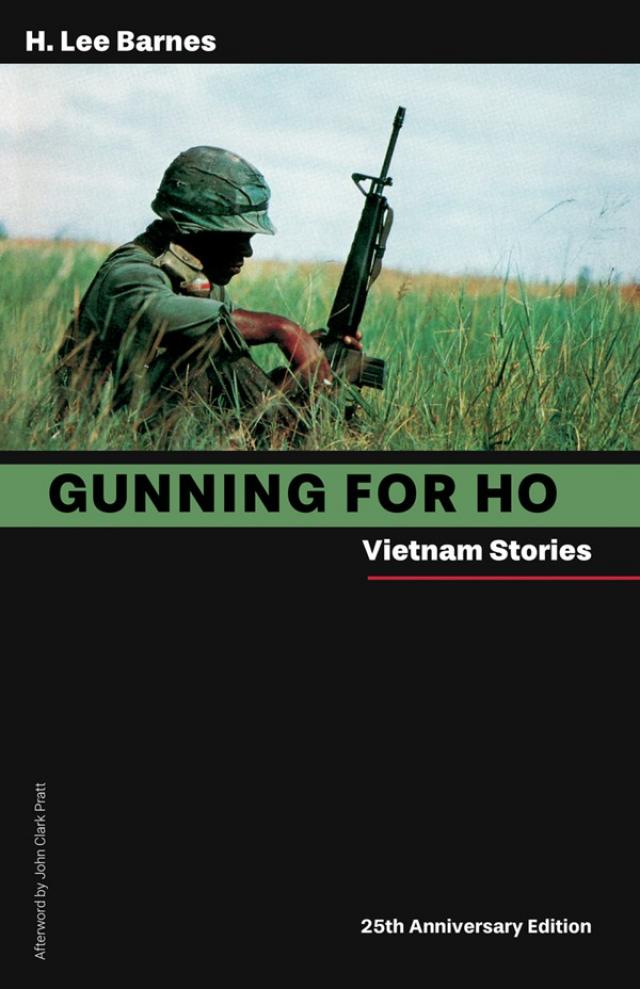


Western Literature Series
GUNNING FOR HO
Vietnam Stories
25th Anniversary Edition
H. Lee Barnes
Afterword by John Clark Pratt
University of Nevada Press
Reno & Las Vegas
University of Nevada Press | Reno, Nevada 89557 USA
www.unpress.nevada.edu
Copyright © 1991, 1997, 1998, 1999, 2000, 2025
by H. Lee Barnes
All rights reserved
Manufactured in the United States of America
Design by Carrie Nelson House
Library of Congress Cataloging-in-Publication Data
Barnes, H. Lee, 1944–
Gunning for Ho : Vietnam stories /
H. Lee Barnes ; afterword by John Clark Pratt.
p. cm. - (Western literature series)
ISBN 978-1-64779-247-3 (paperback)
ISBN 978-1-64779-248-0 (ebook)
1. Vietnamese Conflict, 1961-1975-Fiction.
2. Vietnamese Conflict, 1961-1975-United
States-Influence Fiction. I. Title. II. Series.
PS3552.A673854G86 2000 99-37249
813’ .54-dc21
With thanks for thirty years of loyal friendship, this book is dedicated to Larry M. Gandy, veteran of Vietnam and the many silent wars that followed.
Contents
Preface
Acknowledgments
A Lovely Day in the A Shau Valley
Stonehands and the Tigress
The Cat in the Cage
A Return
Plateau Lands
Tunnel Rat
Gunning for Ho
Afterword by John Clark Pratt
Preface to the 25th Anniversary Edition
The year 2025 marks the twenty-fifth anniversary of Gunning for Ho’s publication. It also marks the fiftieth year since the last American soldiers left Vietnam. Both timelines give pause to reflect, not on any impact the collection may have had, but on the enduring legacy of the “War We Couldn’t Win” on literature and society. In the decades following the war, those who served in Nam for the most part faded into society. Some rarely or never mentioned their service. I was one of those, in part, because of a 1967 visit to a Las Vegas Veterans of Foreign Wars Lodge where I asked how I could join the organization. The men seated at the bar, World War II and Korean War vets, looked me over skeptically. One said, “Vietnam isn’t a war. It’s a police action.” I left, never to return. Then twelve years later I wrote my first novel manuscript titled “A Medal for Joey.” The work was shaped around characters similar to those Tim O’Brien much later projected in The Things They Carried. The manuscript attracted the attention of Phyllis Tornetta, a literary agent, who sent it out to three major publishing houses where it was rejected by editors, all expressing in different words that in their opinion times were not favorable for a novel written about the war.
Over the next decades bodies came home to a nation that did not mourn them. The war was behind the country. It was time to rock out. Time to put Vietnam aside. So I too put it aside and went on to other writing, publishing pieces in literary journals. While I put Vietnam aside, it would not do the same for me. I was too often reminded of its cost—the tens of thousands of American lives, including six men I served with, and the estimated quarter of a million American casualties. I was bothered by one truth that applies to all wars: politicians start them and soldiers fight them. I encountered many former soldiers as veterans who struggled to talk about it, who were disabled, who were haunted, ghost riders without a voice, especially in government.
Not long after the collapse of South Vietnam, something significant occurred among a small group who had served. They formed the Vietnam Veterans of America and lobbied on behalf of fellow veterans. They addressed Congress and the VA undauntingly about the improper treatment of veterans. PTSD entered the American vocabulary. Their voices stirred gradual changes, policies that would later affect those who served in the Mideast following 9/11. When those veterans returned, America greeted them with respect. That deference soon translated to respect for all veterans, including Vietnam vets. Today, those vets who never spoke of the war wear hats marking their Vietnam service and receive a belated “Thank you for your service,” an appreciation that may sometimes sound insincere, but one that’s a substantial improvement over being spit on.
As much as the Vietnam War fractured society, it also brought about change. The war as depicted early on in literature and film rang the “Bad Warriors Bell” and gave impetus to anti–Vietnam vet attitudes. Vietnam’s most lasting result, however, is on politics and military policy. Vietnam was the overriding reason Jimmy Carter, against the advice of his Chiefs of Staff, refused to send soldiers into Tehran during the embassy hostage crisis. Even as the crisis dragged on, he repeatedly said that he didn’t want America in “another Vietnam.” When he finally relented and committed troops, the action was a bungled mess that cost the lives of five airmen and three marines. On occasion, succeeding presidents and congressional members have invoked the “No more Vietnam” argument.
In terms of art, while many of the books about the Vietnam War focus on characters who serve in battle, others were driven by the writer’s political views. I am, of course, using loose categories. Readers will use their discretion to determine how any book, including this one, fits within those categories. I wrote the stories over a span of four years, along the way publishing some in literary journals, one receiving the Willamette Fiction Award. They were written to be viewed as fiction reflecting human truth unburdened by any political slant. The stories range from realism to allegory to ironic depictions of battle. Some are sprinkled with the kind of humor soldiers trade.
Released in 2000 to reviewers, Gunning for Ho was generally well received, but often compared to preceding works the reviewers admired more. One late review came from a former student of mine who had been called to active duty following 9/11. As he packed to report for duty, his wife handed him a copy of Gunning for Ho that he had bought but never read. He took it with him on his deployment to Iraq where he passed it around to his squad mates to read on the rare occasions they had a break from battle. A couple of years later, the student knocked on my office door and handed me the book to sign. As I did, he told me how much it had meant to him and his fellow soldiers who, as they battled their way through Iraq, came to see the stories less as a diversion from battle and more as a mirror in which they saw themselves.
His was the best review the book ever garnered. Now, twenty-five years later, the book along with its “truth” exist again in a special edition, and what matters is what value readers glean from the stories contained in its pages.
H. Lee Barnes
Acknowledgments
Stories in Gunning for Ho first appeared, some in slightly different versions, in the following journals: “A Lovely Day in the A Shau Valley,” Clackamas Literary Review 1 (1997); “Stonehands and the Tigress,” Clackamas Literary Review 2, no. 1 (1998); “The Cat in the Cage,” Flint Hills Review (1999); “A Return,” Lost Creek Letters (Autumn 1991); “Plateau Lands,” Echoes no. 17 (1997); “Tunnel Rat,” Clackamas Literary Review 3, no. 1 (1999); “Gunning for Ho,” Flint Hills Review (1999).
I wish to express appreciation to the editors who selected these stories for publication, and special thanks to Tim Schell, who nominated “A Lovely Day in the A Shau Valley” and “Stonehands and the Tigress” for the Pushcart Prize.
I am pleased to mention, in this first book, people who have assisted, guided, or otherwise supported my writing efforts or the publishing of this collection: Tonja Page, for insisting I could write when I couldn’t; Joyce Standish, for her long-standing support and keen eye; Ron Carlson, friend and mentor, for his sage counsel and skilled readings; Alberto (Tito) Ríos, for his tough criticism and kind reassurance; Valerie Miner, for her sensibilities and many generous praises; Richard Wiley, for investing time and friendly advice; Trudy McMurrin, for seeing the vision in these stories; John Clark Pratt, for coming aboard and offering important suggestions; and Rich Logsdon, Chuck Adams, and Bob Dodge, for being superb teachers and loyal friends, and for thinking me much better at this writing game than I am.
I thank you for gifts given that I can never repay.
A Lovely Day in the A Shau Valley
Marines at Marble Mountain claimed A Shau was filled with juju; MACV Intelligence said it was filled with a regiment of North Vietnamese. In either case, it was one bad place to go. The men of Delta Company, Fourth Battalion, knew a fierce battle had been waged there four years before and another two years after that. From time to time thereafter NVA had used it as a staging ground, for A Shau remained a primary infiltration route on the Ho Chi Minh Trail.
One at a time the helicopters angled northward, tilted their noses and began the descent. They followed an azimuth north by northwest so as to come out of the rising sun. Ahead on the port side Anderson could see the ghostlike shadows of the craft slipping across the lush green canopy. So, this was A Shau Valley. His wife would love to fly over this. She talked often about exotic lands, the Amazon and the Congo.
He glanced at Candy and Small. Small chewed gum and winked to mollify fear. Candy licked his teeth to do the same. Everyone had a ritual to calm his private dread. As he always did before hitting an LZ, Anderson chambered a round in
his M-16 and pictured his wife oscillating beneath a parachute, waving and smiling at him, when they had been in Acapulco on their honeymoon. He framed the image of her in his mind and fixed it there. If it was time for him to die, he wanted to take that one moment with him. It was only fancy now, a fiction to relieve fear, but not then, not when she’d gone up, not once but three times.
Small chewed gum and winked again. Candy ran his tongue over his teeth and squirmed. Anderson clutched his M-16 and watched the ground rush by. As the Huey approached the LZ, it trembled, rotors flattening the tall grass, struts leveling just above ground. Small was out first. The rest of Fire Team Alpha quickly followed. Candy dropped to the ground and flipped the safety catch of his M-60.
The next chopper landed as the first lifted off, and another after that, and another. As each landed, the men flying out of the belly took possession of another small plot of ground. The LZ was cold, a good sign, and when the last of the choppers had landed its cargo of men, the pilots screwed their Hueys down the valley floor, gaining speed for the steep climb over the Annamese peaks.
The men of Delta Company formed two columns and headed west. They marched an hour before the captain brought them to a halt on a rocky crest that overlooked the deep recesses of the valley, a stretch of jungle marred with craters. The camp and airstrip were obtrusive landmarks. Here a pilot had won a Medal of Honor, as had the Green Beret captain who’d led a company of Chinese mercenaries into the camp to save the few Americans who’d survived the siege. Captain Salazar ordered up Fire Team Alpha to scout the camp.
Spec Four Phillips, the rifle leader, squatted beside Lieutenant Lamb and Captain Salazar, who pointed out land features leading to the camp. “Can you scout it in, say, an hour?” Phillips looked at the dense growth on the valley floor and replied, “Yes, sir, if no one trips a mine.”
Fire Team Alpha moved out, Small taking point, Anderson behind him, followed by Candy with his M-60 and Rutkowski with the M-79 grenade launcher, then Phillips, T.P. with the radio, and Sensibar bringing up the rear. Small, Phillips, and T.P. were bloods, and Rutkowski and Sensibar were white, while Anderson was half Mexican and Candy was half Shoshone, but showed none of his father’s white blood.
Field-hardened, conditioned like tennis players, they carried somewhere around sixty pounds of gear on their shoulders as they moved steadily but with great deliberation through the undergrowth. The dense forest swallowed the sounds of their footsteps but not the clatter of metal. Caution marked every movement. Each man watched where the man in front stepped, for there were land mines. Each was guarded by the one behind and protected by the one in front, as it was essential to survival that every man depend on every other man. They were grunts, armed beasts of burden, individuals and not individuals. Names and numbers, each with his own history, they faced the same uncertain future. They believed in luck and signs. They believed in each other when there was nothing else to believe in. And that’s what made them men.
Sensibar was the professor, always reading. He was a natural killer. T.P., a great basketball guard in high school, had flunked out his freshman year at St. Joseph’s because he never got around to attending class. T.P. and Sensibar were buddies. That’s why Sensibar followed behind, keeping careful watch.
Phillips, who hailed from Arkansas, had apprenticed as a carpenter and wished only to go home to a girl named Louisa who’d promised to give him ten children. Candy was the quiet one, staying to himself. He seemed to most like Rutkowski, who was from Massachusetts and told stories about his father and uncles, who were cops. Candy wanted to be a cop. Rutkowski wanted to be a craps dealer on the Strip in Las Vegas and make fifty thousand a year. Candy was the newest man. T.P. had called him Chief the first day Candy arrived. Candy had asked if it was okay to call T.P. Nigger, which caused a moment of strained silence. T.P. shook his head. Other than his wanting to be a cop and not wanting to be called Chief, not much was known about Candy. He’d replaced Gable, who’d gone home without a scratch.
Small had large greenish-yellow eyes that showed in striking contrast to his caramel complexion. He planned to be a lawyer someday. He was uncanny at point. He had a beautiful wife who as a fashion model earned ten times his soldier’s salary. Small and Anderson, the only draftees in the squad, were best friends. Anderson, called Chico by his squad mates, was the handsome one. He had dark wavy hair and white teeth that glistened when he smiled. His wife was a bank teller in Tucson who wrote him approximately the same letter twice a week.
They moved without resting and without speaking, taking cues from Small, who seemed to have 360-degree vision. The valley was still—no bird sounds, not even an occasional monkey screech—quiet and unnerving. At one point T.P. whispered to Sensibar that it was worse than spooky. Sensibar nodded and said he had the feeling they were being followed, but he could neither see nor hear anything.
Small was the first to spot the edge of the camp and called Phillips forward. On that perimeter four years before, a Green Beret sergeant had single-handedly held off two NVA companies, and North Vietnamese bodies had piled up so high that a pilot flying close air support had named it the Wall of Dead.
Now, four years later, the forest was reclaiming the land that the Americans had cut out of its tentacles. Where the earth was charred from nitrates, brush and vine and even a few stunted trees grew, some out of bunkers, some out of bomb craters. The barbed wire had long ago rusted.
Phillips called the rest of the squad forward and asked for two men to scout the camp. Sensibar, standing next to T.P., volunteered the two of them, but Phillips wanted T.P. on the radio. He called up Captain Salazar and told him they were going in and sent Anderson with Sensibar.
Tall grass and brush covered their approach to the edge of the camp, but there the ground had been so defoliated that only a few sickly looking stems grew and everything else was withered and brown. In the open now, they belly-crawled under the rusted wire. The damp red clay smelled of mildew and nitrates. The old bunkers, wood beams splintered and rotting, reeked of stale water.
Anderson viewed the devastation and shook his head, wondering if soldiers had been buried under the rubble. For an instant he swore he felt something brush his ear and cheek. Sensibar held his M-16 at his waist and turned from north to east to south to west. Everywhere they looked, they saw evidence of a great struggle that oddly seemed unfinished.
The two of them advanced, one moving as the other covered. They found craters and rot and vegetation asserting itself through the crust of red clay, and more rot and more destruction, a graphic record of events—a bunker where a young Green Beret took a direct hit from a rocket-propelled grenade; the Wall of Dead where, nourished by human blood, clumps of grass grew thick; another bunker where a commo man destroyed the coded pads and blew himself up before the enemy got to him. At that very spot, after the camp had been overrun, the North Vietnamese had gathered to celebrate. In the midst of their celebration a downpour of incendiaries and five-hundred-pounders had fallen out of the clouds.
A thousand North Vietnamese had died taking a strip of earth they couldn’t hold. Sensibar and Anderson were like bats without sonar. Sensibar sank to his knees at the apex of the camp, took off his steel pot, and rubbed his forehead. Anderson squatted beside him. Sensibar shook his head. Anderson understood. They could comprehend bullets and shrapnel from mortars or grenades, but this ruin was not war as they knew it. Sensibar claimed he didn’t believe in ghosts but said they should leave before he started to. What would they tell the others? Nothing there, was all they could report, so Anderson told Phillips the camp was creepy but clear of vc. Phillips radioed the captain.
The fire team formed a tight circle, facing outward. Phillips and Sensibar smoked. Sensibar’s hands trembled. Anderson rested his head against the trunk of a tree and tried to picture his wife. He couldn’t. The sun was overhead and crisp in a pastel-blue sky. The day, though hot, was not sweltering. Flies buzzed about, annoying the fire team as they waited in the shade for Delta Company.
An hour later the company arrived. They took ground by advancing one squad at a time until they occupied the camp and the edge of the airstrip. Like the members of Fire Team Alpha, the rest of the soldiers in the company appeared to be affected by the devastation. Told by the first sergeant to dig in, they kept an eye out for mines and booby traps. One man uncovered an arm bone, quickly buried it, and moved two steps away. Once fields of fire were laid out, the officers went about checking on their platoons.


