Omoo, p.2
Omoo,
p.2


Introduction
I. HISTORICAL BACKGROUND
The events of Herman Melville’s life between July and October 1842 would seem overwrought even in a racy historical novel. At the age of twenty-two, Melville packed that four-month period with desertion from a whaleship, captivity among “savages,” escape, mutiny, incarceration, a second escape, and flight from island to island. These events formed the basis of his first two books, Typee (1846) and Omoo (1847). To appreciate fully the development of Melville’s art as a novelist, it is important to understand the personal experiences he reimagined and blended with other material to create his early works.
What appears in his first two books to be a whimsical account of personal experience is enriched by deft fictionalization, seamless incorporation of factual information from nonfiction sources, and the author’s increasingly confident observations on the social and metaphysical implications of the events he recounts. Melville continued to refine this formula in his later works, achieving an extraordinarily complex narrative voice that operates on many levels, at once profound and entertaining.
The following historical record has been documented. Twenty-one-year-old Herman Melville sailed on the January 3, 1841, maiden voyage of the whaleship Acushnet out of Fairhaven, Massachusetts. The vessel was commanded by Valentine Pease Jr. Eighteen months later, on July 9, 1842, Melville deserted the Acushnet at the island of Nuku Hiva in the Marquesas. In that same month, the French took control of Nuku Hiva and within the year of all the islands that now compose French Polynesia. The exact details of Melville’s month on Nuku Hiva are uncertain. All that is documented is his signing aboard the Australian whaleship Lucy Ann at Nuku Hiva on August 9, 1842.
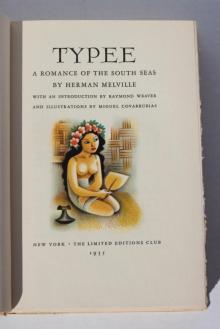
Melville’s first book, Typee, is based on his time on Nuku Hiva. Tommo, the novel’s narrator, deserts the whaleship Dolly with a shipmate, Toby, and eventually the two make their way to the island’s Typee valley. Toby embarks in search of medicine for an injury sustained by Tommo and never returns. Tommo is held in kind but irrevocable captivity. After four months, he makes a dramatic escape, narrowly evading recapture by throwing a boat-hook at the throat of his terrifying pursuer, the one-eyed Mow-Mow.
What and how much of this story is based on fact is still debated. Typee encompasses a much longer period than Melville actually spent on the island. He did desert the Acushnet in company with Richard Tobias Greene and three other men on July 9, 1842, and joined the Lucy Ann on August 9, 1842. The Acushnet apprehended the other three absconding whalemen through the ruse of raising anchor and departing Taioha’e Bay, only to slip back three days later; Melville and Greene remained at large. Here a break appears in the historical record.
There are several bays on the south coast of Nuku Hiva. Each bay has deep valleys stretching inland from its shores, and each valley was the home of a distinct group. Eastward of Taioha’e Bay, where the Acushnet anchored, lies Comptroller’s Bay, home of the Ha’apa’a and Taipi tribes, living in valleys separated by high, precipitous, volcanic walls. In October 1813—almost thirty years before Melville’s visit—the American naval captain David Porter arrived at Nuku Hiva with a squadron of ships. He claimed the Marquesas as a possession of the fledgling United States and required the native peoples to reprovision his ships. The Ha’apa’a resisted, but after a fight in which five Ha’apa’a were killed, the tribe agreed to provide food. The Taipi, however, continued to thwart Porter’s demands. Porter therefore fought the Taipi, and they were the only indigenous people to best him in battle. Porter retaliated by leading a force overland and into the valley, burning ten villages, destroying breadfruit trees, and killing and wounding “great numbers” of the Taipi (Porter, II, 103). As Greg Dening writes in Islands and Beaches: Discourse on a Silent Land: Marquesas 1774–1880 (1980), “By being Porter’s enemy the Taipi became a savage, treacherous, sullen group of warriors whose ferocity was a compliment to those who defeated them” (28). In his Journal of a Cruise Made to the Pacific Ocean (1815, 1822), later used as a source by Melville, Porter portrays the Taipi as the most ferocious and cannibalistic of the Marquesan tribes, thereby minimizing the embarrassment of being defeated by “savages” and justifying his subsequent retaliation.
Following their desertion in Typee, Tommo and Toby make their way to the Typee valley (Melville follows Porter’s spelling). There, Tommo’s discovery that this reportedly most ferocious tribe is filled with a gentle and kind people leads him to question the assumptions of civilization and savagery, Christianity and paganism, outsider and islander. Typee raises questions, troubling in the nineteenth century and today. At the same time, the plot is driven by Tommo’s growing fear of being devoured by his hosts. Melville draws on the fearsome reputation of the Taipi established by Porter and the universal deep-seated horror of cannibalism to provide the rationale for the violent acts Tommo employs in his escape.
There is no known documentation to verify how much of Typee is fictional and how much is autobiographical. In contrast, Omoo is heavily documented. Melville’s second novel parallels the actual events following his departure from Nuku Hiva as a newly signed hand aboard the Australian whaleship Lucy Ann. The following account of the voyage and subsequent mutiny aboard the Lucy Ann is based on information found in France’s archives of the Ministère de la France d’Outre-mer, Australia’s Sydney Morning Herald, and especially the extensive official records of the revolt kept by the acting British consul at Tahiti, Charles B. Wilson, now in the collection of the Mitchell Library, State Library of New South Wales, Sydney, Australia.
The Lucy Ann left Sydney on February 14, 1842, under the command of Captain Henry Ventom and an insufficient number of officers. Each of her four whaleboats required a six-man crew, including two officers: the mate (or “boatheader”) and the harpooneer (or “boatsteerer”). The ship, therefore, optimally would have carried four mates and four harpooneers; instead, she left port with only two mates and four illiterate harpooneers in her thirty-one man crew.
After five months of largely unsuccessful cruising for whales, Captain Ventom lost ascendancy over his crew. At the island of Santa Christina (Tahuata) in the southern Marquesas, the Lucy Ann stopped to take on water, wood, and pigs. Nine men deserted, including the second mate, the carpenter, and two of the harpooneers.
Three deserters were captured with the help of the French commandant, who held two of them in manacles aboard the French transport La Bucéphale. The crew rebelled at the treatment of their shipmates, and another eight were seized and imprisoned aboard the La Bucéphale. Finally, his provisioning completed, Captain Ventom had eight of his men returned from the La Bucéphale, hoisted anchor, and headed for open sea. He left two men he considered troublemakers, George Lefevre and John Peter, imprisoned aboard the French vessel, an act that outraged the returned crew.
The Lucy Ann stopped at the nearby island of La Dominica (Hiva Oa) long enough to hire a harpooneer, John Garritson, on August 2, 1842. She then headed for Nuku Hiva in order to recruit men to replace the deserters. Instead, three additional men deserted when the ship arrived on August 7, but all were caught and returned the next day. That same day, August 8, Captain Ventom signed on a new carpenter and two foremast hands.
The next day, Herman Melville signed the ship’s articles and joined a crew torn by dissent. The refractory members of the crew, especially those in the fo’c’s’le (forecastle), outnumbered those who remained loyal. After returning to La Dominica, Captain Ventom signed four more foremast hands before, optimistically and unrealistically, continuing the whaling cruise.
Captain Ventom soon became ill with an extremely painful abscess in his perineum. Alarmed, First Mate James German headed for Tahiti, where the now desperately ill captain was rowed ashore and treated. The Lucy Ann was kept at sea, sailing back and forth off Papeete, Tahiti. The captain sent out the acting British consul, Charles B. Wilson, to inform the men that they were to proceed on a whaling cruise under the command of German.
Before the consul left the ship, four men refused duty and six others, including Melville, tried to obtain medical leave. The next few days were a time of confusion. Two junior mates and two Polynesian seamen were signed on. One of the illiterate boatsteerers, New Zealand Maori Bembo Byrne, was promoted to acting third mate. One night, German left Byrne in charge of the deck with directions to set the jib and foresail. Byrne ordered seaman James Watts to assist with setting the sails. When Watts replied, “Ask my arse,” Byrne struck him. Watts’s fellow watch standers left the deck, swearing they would no longer serve aboard the Lucy Ann.
When German mustered the crew early the next morning, ten men still refused duty. German then brought the vessel into Papeete harbor, disobeying his captain’s orders and enraging Acting Consul Wilson. Wilson had the ten revolters, including the newly signed harpooneer Garritson, arrested and held aboard the French frigate La Reine Blanche. There the new prisoners joined the still-manacled Lefevre and Peter, who had been brought to Tahiti from Santa Christina. Two days later, the French commander, Rear Admiral Abel Aubert Dupetit-Thouars, ordered the revolters delivered to the British consulate. After once more refusing duty, they were confined in a Tahitian calaboose (or jail).
A few days later, the men were again marched to the British consulate, where they yet again refused duty. At the consulate, Melville joined the revolters. He had circumspectly awaited the results of the uprising before taking sides. All eleven men continued to refuse duty at a final interview with Acting Consul Wilson several days later. Captain Ventom, cutting deeply into his profits, offered sufficiently liberal advances to recruit enough men from shore to fill out his crew. When the Lucy Ann left Tahiti ten days later, Captain Ventom sailed with a full complement of officers, shipping three mates and five harpooners. Wilson was left to figure out what to do with the recalcitrant seamen languishing in the calaboose.
The mutiny aboard the Julia portrayed in Omoo closely follows that which occurred on the Lucy Ann. The protagonist, now calling himself Typee, escapes from Nuku Hiva and joins an Australian whaleship, only to become embroiled in mutiny. Even the first mate in Omoo is named Jermin, a homophone of German. But there are important differences between the Melville tale and his experience. In Omoo, the desertion of the seamen at Santa Christina follows the rescue of the protagonist at Nuku Hiva, when in reality the desertion occurred before Melville joined the crew. Two men die at sea aboard the Julia during the voyage to Tahiti; there were no deaths aboard the Lucy Ann. Seeing the increasing weakness of the Julia’s captain, Omoo’s Jermin tries to enlist the narrator, Typee, and his comrade, Doctor Long Ghost, in a plan to voyage to an unknown whaling ground. In reality, German had headed the Lucy Ann toward Tahiti even before receiving orders to do so, because he had seen how ill Captain Ventom was. The acting third mate in Omoo, Bembo, a New Zealand Maori (or “Mowree”), does indeed fight a shipmate—in the case of Omoo, a runaway ticket-of-leave Australian convict, Sydney Ben, rather than the real-life James Watts—but his subsequent attempt to wreck the Julia on a reef is completely fictional. Unlike the protagonist of Omoo, Melville was not incarcerated aboard the French frigate La Reine Blanche; he did not join the revolters until after they had been put ashore and confined in the Tahitian calaboose. Nonetheless, despite these minor differences, the actual events on board the Lucy Ann clearly influenced those aboard Omoo’s fictional Julia.
Melville’s writing in Omoo, then, is a mixture of fact and fiction. While Charles Roberts Anderson in Melville in the South Seas (1939) calls Omoo “perhaps the most strictly autobiographical of all Melville’s works” (199), much of Omoo, especially in the second half, is borrowed. Melville even borrowed portions of the book from himself. He confessed to his British publisher, John Murray, that the description of the dance in Omoo is salvaged from a discarded chapter of Typee: “You will perceive that there is a chapter in the book which describes a dance in the valley of Tamai. This discription [sic] has been modified & adapted from a certain chapter which it was thought best to exclude from Typee. In their dances the Tahitians much resembled the Marquesans (the two groups of islands are not far apart) & thus is the discription [sic] faithful in both instances” (Corr 78). Melville borrowed much more from contemporary written sources. Yet often what most seems borrowed and fictional is factual.
In Omoo, the narrator and Doctor Long Ghost effect a nocturnal escape from the Tahitian jail at the instigation of twin brothers from the neighboring island of Imeeo. (Melville employs a variant spelling of Eimeo, the former name of the island now known as Moorea.) The twins had been sent by planters on Imeeo to find two white men for field laborers to assist with the potato crop. This incident appears absurd or contrived. Who would work so hard to grow potatoes in the Tahitian islands when fruit and fish are abundant? The episode seems to have been inserted by Melville for comic effect, but surprisingly it is based in fact. The scholar Rita K. Gollin found a memoir in the 1878 Shaker Manifesto written by William G. Libbey describing how Libbey and his brother had enticed Melville and the Lucy Ann’s steward, John Troy, to come to Eimeo shortly after October 19, 1842, as field laborers for an Englishman, Edward, and an American, James Martin. Except for the fact that the Libbey brothers were not twins, the details in Melville’s fictional story are factual, including the information that the brothers had deserted their ship at Fanning’s Island.
Wilson Heflin, an authority on Melville’s whaling years, has also verified details of Melville’s time on Imeeo through a marked copy of Omoo in the St. John’s College library in Annapolis, Maryland. The markings rectify Melville’s spelling of Polynesian words and correct and verify events on the island. They had been copied into the St. John’s Omoo in 1848 by the passed midshipman Samuel Marcy from an edition of Omoo owned by the missionary Alexander Simpson, who had served on Eimeo since 1829. Simpson’s ownership of Omoo is noteworthy considering that Melville subjects Simpson to withering criticism. In the novel, Melville recounts how Simpson and his wife run a seminary on Eimeo exclusively for missionary children, where they are taught only the rudiments of knowledge yet are kept separate from native children and not allowed to learn the native language out of fear of “moral contamination.”
Another reality-based encounter in Omoo occurs late in the book when Typee and Doctor Long Ghost encounter a runaway ship’s carpenter, Willie, who has fallen in love with a native girl, the negligent Lullee, and is waiting out the three years required by Tahitian law before he can marry her. The disconsolate Willie and the giddy, inconstant Lullee seem introduced for comic effect. Nonetheless, theirs is a true story. Charles Roberts Anderson found in chapter 21 of Edward T. Perkins’s Na Motu: or, Reef-Rovings in the South Seas (1854) a record of Perkins’s 1853 visit to Eimeo, during which Perkins met the carpenter and his wife, now long married—although the poor wife had aged prematurely and lost an eye in the eleven years since Melville’s visit.
Once Typee and Doctor Long Ghost arrive on Eimeo, the close ties between Melville’s life and Omoo begin to stretch. Melville spent two weeks or less on Eimeo before signing on to the Nantucket whaleship Charles and Henry, Captain John B. Coleman Jr., master, on November 3, 1842. Therefore, he had few adventures to transcribe. In order to fill out the second half of Omoo, Melville borrowed extensively from other writers on the South Pacific: Georg H. von Langsdorff ’s Voyages and Travels in Various Parts of the World (1813), Michael Russell’s Polynesia (1843), Charles S. Stewart’s A Visit to the South Seas (1831), Charles Wilkes’s Narrative of the United States Exploring Expedition (1844), and especially the second edition of William Ellis’s Polynesian Researches (1833). As Harrison Hayford, editor of the 1969 Hendricks House edition of Omoo, states:
Melville fastened upon the pages of Ellis, and Ellis proved to be a bounteous guide, if not philosopher and friend. Not once did Melville cite Ellis as his authority: he simply set down Ellis’s information without credit, or claimed it as his own observation, or credited it to a native informant—to “Captain Bob,” or “Tonoi,” for example. Little reverence as Melville paid him, Ellis was his historian, geographer, botanist, anthropologist, dictionary of native words common and proper, and even his eyes and ears….[T]he pages of Ellis soon suggested whole chapters of Omoo with only a slight infusion of [Melville’s] memories. (Editors’ Introduction, xxv)
Melville borrowed from other writers in all his works. For example, he found much of the information for the middle chapters of Moby-Dick (1851), often called the “cetological chapters,” in the second edition of Thomas Beale’s The Natural History of the Sperm Whale (1839). He also extensively appropriated for Moby-Dick from William Scoresby Jr.’s An Account of the Arctic Regions (1820). Melville’s short story “Benito Cereno”(1855) is so closely rewritten from chapter 18 of Amasa Delano’s A Narrative of Voyages and Travels (1817) that it follows the Narrative line by line. Israel Potter (1854–1855), the only one of Melville’s full-length works to be serialized, is a reworking of the Life and Remarkable Adventures of Israel R. Potter, ghostwritten by Henry Trumbull (1824). Melville infused the dry information of his sources with his own humor and philosophical ponderings, transforming the original into literature of the highest order. As T. S. Eliot asserts in The Sacred Wood, “One of the surest of tests is the way in which a poet borrows. Immature poets imitate; mature poets steal” (125).
II. HISTORY OF THE TEXT
Melville returned to Charleston, Massachusetts, on October 3, 1844, after almost four years at sea. His family was still in the financial straits that had engulfed them after the bankruptcy and subsequent death of his father in 1832. With his family’s encouragement, Melville commenced writing a book based loosely on his time in the Marquesas. Typee was published in 1846 and sold approximately eleven thousand copies, an impressive number for its time. With Typee’s success, Melville began work on a sequel, which he entitled Omoo.