Omoo, p.20
Omoo,
p.20


One day a new comer proposed, that two or three of us should pay him a sly, nocturnal visit aboard his ship; engaging to send us away well freighted with provisions. This was not a bad idea; nor were we at all backward in acting upon it. Night after night every vessel in the harbor was visited in rotation, the foragers borrowing Captain Bob’s canoe for the purpose. As we all took turns at this—two by two—in due course it came to Long Ghost and myself, for the sailors invariably linked us together. In such an enterprise, I somewhat distrusted the doctor, for he was no sailor, and very tall; and a canoe is the most ticklish of navigable things. However, it could not be helped; and so we went.
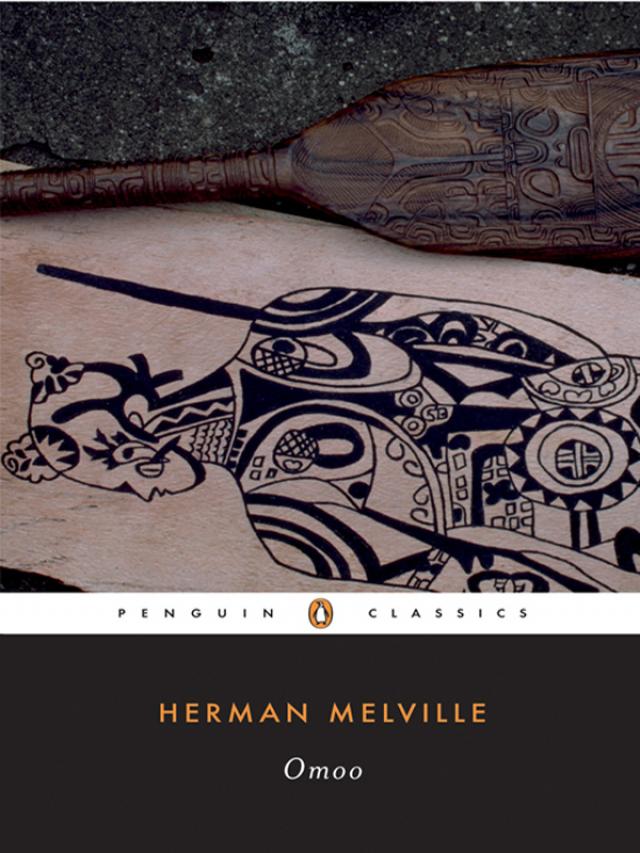
But a word about the canoes, before we go any further. Among the Society Islands, the art of building them, like all native accomplishments, has greatly deteriorated; and they are now the most inelegant, as well as the most insecure of any in the South Seas. In Cook’s time, according to his account, there was at Tahiti a royal fleet of seventeen hundred and twenty large war-canoes, handsomely carved, and otherwise adorned. At present, those used are quite small; nothing more than logs hollowed out, sharpened at one end, and then lanched into the water.
To obviate a certain rolling propensity, the Tahitians, like all Polynesians, attach to them what sailors call an “outrigger.” It consists of a pole floating alongside, parallel to the canoe, and connected with it by a couple of cross sticks, a yard or more in length. Thus equipped, the canoe can not be overturned, unless you overcome the buoyancy of the pole, or lift it entirely out of the water.
Now, Captain Bob’s “gig” was exceedingly small; so small, and of such a grotesque shape, that the sailors christened it the Pill Box; and by this appellation it always went. In fact, it was a sort of “sulky,” meant for a solitary paddler, but on an emergency, capable of floating two or three. The outrigger was a mere switch, alternately rising in air, and then depressed in the water.
Assuming the command of the expedition, upon the strength of my being a sailor, I packed the Long Doctor with a paddle in the bow, and then shoving off, leaped into the stern; thus leaving him to do all the work, and reserving to myself the dignified sinecure of steering. All would have gone well, were it not that my paddler made such clumsy work, that the water spattered, and showered down upon us without ceasing. Continuing to ply his tool, however, quite energetically, I thought he would improve after a while, and so let him alone. But by and by, getting wet through with this little storm we were raising, and seeing no signs of its clearing off, I conjured him, in mercy’s name, to stop short, and let me wring myself out. Upon this, he suddenly turned round, when the canoe gave a roll, the outrigger flew overhead, and the next moment came rap on the doctor’s skull, and we were both in the water.
Fortunately, we were just over a ledge of coral, not half-a-fathom under the surface. Depressing one end of the filled canoe, and letting go of it quickly, it bounced up, and discharged great part of its contents; so that we easily baled out the remainder, and again embarked. This time, my comrade coiled himself away in a very small space; and enjoining upon him not to draw a single unnecessary breath, I proceeded to urge the canoe along by myself. I was astonished at his docility, never speaking a word, and stirring neither hand nor foot; but the secret was, he was unable to swim, and in case we met with a second mishap, there were no more ledges beneath to stand upon. “Drowning’s but a shabby way of going out of the world,” he exclaimed, upon my rallying him; “and I’m not going to be guilty of it.”
At last, the ship was at hand, and we approached with much caution, wishing to avoid being hailed by any one from the quarter-deck. Dropping silently under her bows, we heard a low whistle—the signal agreed upon—and presently a goodly sized bag was lowered over to us.
We cut the line, and then paddled away as fast as we could, and made the best of our way home. Here, we found the rest waiting impatiently.
The bag turned out to be well filled with sweet potatoes boiled, cubes of salt beef and pork, and a famous sailors’ pudding, what they call “duff,” made of flour and water, and of about the consistence of an underdone brick. With these delicacies, and keen appetites, we went out into the moonlight, and had a nocturnal picknick.
CHAPTER 42
MOTOO-OTOO • A TAHITIAN CASUIST
The Pill-Box was sometimes employed for other purposes than that described in the last chapter. We sometimes went apleasuring in it.
Right in the middle of Papeetee harbor is a bright, green island, one circular grove of waving palms, and scarcely a hundred yards across. It is of coral formation; and all round, for many rods1 out, the bay is so shallow, that you might wade anywhere. Down in these waters, as transparent as air, you see coral plants of every hue and shape imaginable:—antlers, tufts of azure, waving reeds like stalks of grain, and pale green buds and mosses. In some places, you look through prickly branches down to a snow-white floor of sand, sprouting with flinty bulbs; and crawling among these are strange shapes:—some bristling with spikes, others clad in shining coats-of-mail, and here and there, round forms all spangled with eyes.
The island is called Motoo-Otoo;2 and around Motoo-Otoo have I often paddled of a white moonlight night, pausing now and then to admire the marine gardens beneath.
The place is the private property of the queen, who has a residence there—a melancholy-looking range of bamboo houses—neglected and falling to decay among the trees.
Commanding the harbor as it does, her majesty has done all she could to make a fortress of the island. The margin has been raised and leveled, and built up with a low parapet of hewn blocks of coral. Behind the parapet, are ranged at wide intervals, a number of rusty old cannon, of all fashions and calibres. They are mounted upon lame, decrepit-looking carriages, ready to sink under the useless burden of bearing them up. Indeed, two or three have given up the ghost altogether, and the pieces they sustained lie half-buried among their bleaching bones. Several of the cannon are spiked; probably with a view of making them more formidable; as they certainly must be to any one undertaking to fire them off.
Presented to Pomaree at various times by captains of British armed ships, these poor old “dogs of war,” thus toothless and turned out to die, formerly bayed in full pack, as the battle hounds of Old England.
There was something about Motoo-Otoo that struck my fancy; and I registered a vow to plant my foot upon its soil, notwithstanding an old bareheaded sentry menaced me in the moonlight with an unsightly musket. As my canoe drew scarcely three inches of water, I could paddle close up to the parapet without grounding; but every time I came near, the old man ran toward me, pushing his piece forward, but never clapping it to his shoulder. Thinking he only meant to frighten me, I at last dashed the canoe right up to the wall, purposing a leap. It was the rashest act of my life; for never did cocoa-nut come nearer getting demolished, than mine did then. With the stock of his gun, the old warder fetched a tremendous blow, which I managed to dodge; and then falling back, succeeded in paddling out of harm’s reach.
He must have been dumb; for never a word did he utter; but grinning from ear to ear, and with his white cotton robe streaming in the moonlight, he looked more like the spook of the island than any thing mortal.
I tried to effect my object by attacking him in the rear—but he was all front; running about the place as I paddled, and presenting his confounded musket wherever I went. At last I was obliged to retreat; and to this day my vow remains unfulfilled.
It was a few days after my repulse from before the walls of Motoo Otoo, that I heard a curious case of casuistry argued between one of the most clever and intelligent natives I ever saw in Tahiti, a man by the name of Arheetoo, and our learned Theban3 of a doctor.
It was this:—whether it was right and lawful for any one, being a native, to keep the European Sabbath, in preference to the day set apart as such by the missionaries, and so considered by the islanders in general.
It must be known, that the missionaries of the good ship Duff,4 who more than half-a-century ago established the Tahitian reckoning,5 came hither by the way of the Cape of Good Hope;6 and by thus sailing to the eastward, lost one precious day of their lives all round, getting about that much in advance of Greenwich time. For this reason, vessels coming round Cape Horn7—as they most all do nowadays—find it Sunday in Tahiti, when, according to their own view of the matter, it ought to be Saturday. But as it won’t do to alter the log, the sailors keep their Sabbath, and the islanders theirs.
This confusion perplexes the poor natives mightily; and it is to no purpose that you endeavor to explain so incomprehensible a phenomenon. I once saw a worthy old missionary essay to shed some light on the subject; and though I understood but few of the words employed, I could easily get at the meaning of his illustrations. They were something like the following:
“Here,” says he, “you see this circle” (describing a large one on the ground with a stick): “very good; now you see this spot here” (marking a point in the perimeter): “well; this is Beretanee” (England), “and I’m going to sail round to Tahiti. Here I go, then” (following the circle round); “and there goes the sun” (snatching up another stick, and commissioning a bandy-legged native to travel round with it in a contrary direction). “Now then, we are both off, and both going away from each other; and here you see I have arrived at Tahiti” (making a sudden stop); “and look now, where Bandy Legs is!”
But the crowd strenuously maintained, that Bandy Legs ought to be somewhere above them in the atmosphere; for it was a traditionary fact, that the people from the Duff came ashore when the sun was high overhead. And here the old gentleman, being a very good sort of man, doubtless, but no astronomer, was obliged to give up.
Arheetoo, the casuist alluded to, though a member of the church, and extremely conscientious about what Sabbath he kept, was more liberal in other matters. Learning that I was something of a “mickonaree” (in this sense, a man able to read, and cunning in the use of the pen), he desired the slight favor of my forging for him a set of papers; for which, he said, he would be much obliged, and give me a good dinner of roast pig and Indian turnip in the bargain.
Now, Arheetoo was one of those who board the shipping for their washing; and the competition being very great (the proudest chiefs not disdaining to solicit custom in person, though the work is done by their dependents), he had decided upon a course suggested by a knowing sailor, a friend of his. He wished to have manufactured a set of certificates, purporting to come from certain man-of-war and merchant captains, known to have visited the island; recommending him as one of the best getters up of fine linen in all Polynesia.
At this time, Arheetoo had known me but two hours; and, as he made the proposition very coolly, I thought it rather presumptuous, and told him so. But as it was quite impossible to convey a hint, that there was a slight impropriety in the thing, I did not resent the insult, but simply declined.
CHAPTER 43
ONE IS JUDGED BY THE COMPANY HE KEEPS
Although, from its novelty, life at Captain Bob’s was pleasant enough, for the time; there were some few annoyances connected with it, any thing but agreeable to a “soul of sensibility.”
Prejudiced against us by the malevolent representations of the consul and others, many worthy foreigners ashore regarded us as a set of lawless vagabonds; though, truth to speak, better behaved sailors never stepped on the island, nor any who gave less trouble to the natives. But, for all this, whenever we met a respectably dressed European, ten to one he shunned us, by going over to the other side of the road. This was very unpleasant, at least to myself; though, certes, it did not prey upon the minds of the others.
To give an instance.
Of a fine evening in Tahiti—but they are all fine evenings there—you may see a bevy of silk bonnets and parasols passing along the Broom Road: perhaps a band of pale, little white urchins—sickly exotics—and, oftener still, sedate, elderly gentlemen, with canes; at whose appearance the natives, here and there, slink into their huts. These are the missionaries, their wives, and children, taking a family airing. Sometimes, by the by, they take horse, and ride down to Point Venus and back; a distance of several miles. At this place is settled the only survivor of the first missionaries that landed—an old, white-headed, saint-like man, by the name of Wilson, the father of our friend, the consul.
The little parties on foot were frequently encountered; and, recalling, as they did, so many pleasant recollections of home and the ladies, I really longed for a dress coat and beaver, that I might step up and pay my respects. But, situated as I was, this was out of the question. On one occasion, however, I received a kind, inquisitive glance, from a matron in gingham. Sweet lady! I have not forgotten her: her gown was a plaid.
But a glance, like hers, was not always bestowed.
One evening, passing the verandah of a missionary’s dwelling, the dame, his wife, and a pretty, blond young girl, with ringlets, were sitting there, enjoying the sea-breeze, then coming in, all cool and refreshing, from the spray of the reef. As I approached, the old lady peered hard at me; and her very cap seemed to convey a prim rebuke. The blue, English eyes, by her side, were also bent on me. But, oh Heavens! what a glance to receive, from such a beautiful creature! As for the mob cap,1 not a fig did I care for it; but, to be taken for any thing but a cavalier, by the ringleted one, was absolutely unendurable.
I resolved on a courteous salute, to show my good-breeding, if nothing more. But, happening to wear a sort of turban—hereafter to be particularly alluded to—there was no taking it off and putting it on again, with any thing like dignity. At any rate, then, here goes a bow. But, another difficulty presented itself: my loose frock was so voluminous, that I doubted whether any spinal curvature would be perceptible.
“Good-evening, ladies,” exclaimed I, at last, advancing winningly; “a delightful air from the sea, ladies.”
Hysterics and hartshorn! who would have thought it? The young lady screamed, and the old one came near fainting. As for myself, I retreated, in double quick time; and scarcely drew breath, until safely housed in the Calabooza.
CHAPTER 44
CATHEDRAL OF PAPOAR • THE CHURCH OF THE COCOA-NUTS
On Sundays I always attended the principal native church on the outskirts of the village of Papeetee, and not far from the Calabooza Beretanee. It was esteemed the best specimen of architecture in Tahiti.
Of late, they have built their places of worship with more reference to durability than formerly. At one time, there were no less than thirty-six on the island—mere barns, tied together with thongs, which went to destruction in a very few years.
One, built many years ago in this style, was a most remarkable structure. It was erected by Pomaree II.,1 who, on this occasion, showed all the zeal of a royal proselyte. The building was over seven hundred feet in length, and of a proportionate width; the vast ridge-pole was at intervals supported by a row of thirty-six cylindrical trunks of the bread-fruit tree; and, all round, the wall-plates rested on shafts of the palm. The roof—steeply inclining to within a man’s height of the ground—was thatched with leaves, and the sides of the edifice were open. Thus spacious was the Royal Mission Chapel of Papoar.2
At its dedication, three distinct sermons were, from different pulpits, preached to an immense concourse gathered from all parts of the island.
As the chapel was built by the king’s command, nearly as great a multitude was employed in its construction, as swarmed over the scaffolding of the great temple of the Jews.3 Much less time, however, was expended. In less than three weeks from planting the first post, the last tier of palmetto-leaves drooped from the eaves, and the work was done.
Apportioned to the several chiefs and their dependents, the labor, though immense, was greatly facilitated by every one’s bringing his post, or his rafter, or his pole strung with thatching, ready for instant use. The materials thus prepared being afterward secured together by thongs, there was literally “neither hammer, nor axe, nor any tool of iron heard in the house while it was building.”
But the most singular circumstance connected with this South Sea cathedral, remains to be related. As well for the beauty, as the advantages of such a site, the islanders love to dwell near the mountain streams; and so, a considerable brook, after descending from the hills and watering the valley, was bridged over in three places, and swept clean through the chapel.
Flowing waters! what an accompaniment to the songs of the sanctuary; mingling with them, the praises and thanksgivings of the green solitudes inland.
But the chapel of the Polynesian Solomon4 has long since been deserted. Its thousand rafters of habiscus have decayed, and fallen to the ground; and now, the stream murmurs over them in its bed.
The present metropolitan church of Tahiti is very unlike the one just described. It is of moderate dimensions, boarded over, and painted white. It is furnished also with blinds, but no sashes; indeed, were it not for the rustic thatch, it would remind one of a plain chapel at home.
The wood-work was all done by foreign carpenters, of whom there are always several about Papeetee.
Within, its aspect is unique, and can not fail to interest a stranger. The rafters overhead are bound round with fine matting of variegated dyes; and all along the ridge-pole, these trappings hang pendent, in alternate bunches of tassels and deep fringes of stained grass. The floor is composed of rude planks. Regular aisles run between ranges of native settees, bottomed with crossed braids of the cocoa-nut fibre, and furnished with backs.
But the pulpit, made of a dark, lustrous wood, and standing at one end, is by far the most striking object. It is preposterously lofty; indeed, a capital bird’s-eye view of the congregation ought to be had from its summit.