

Trends, p.2
Trends,
p.2
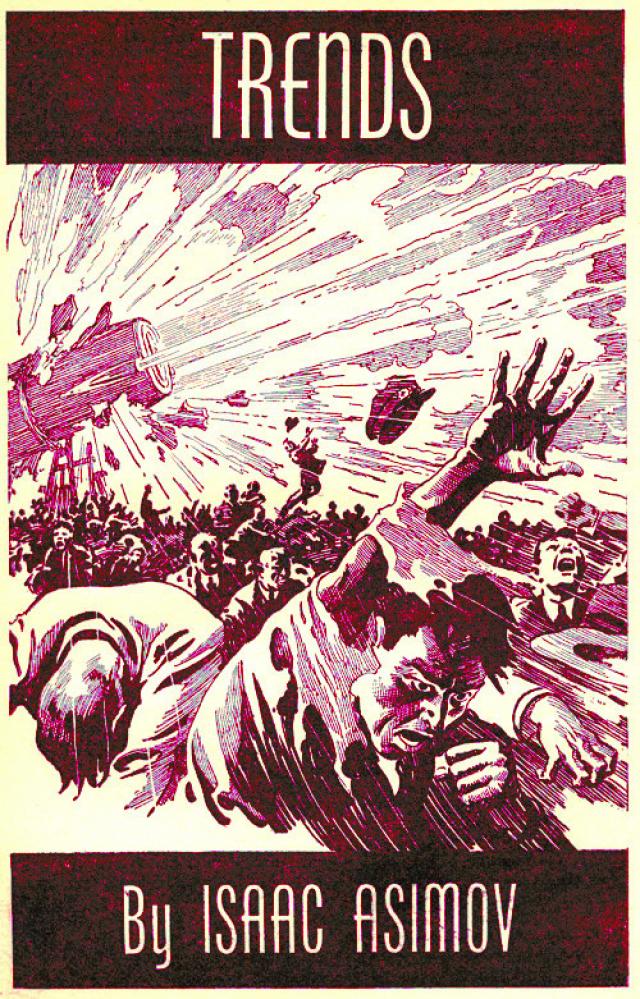


The crowd stirred. Upon a hastily erected platform of wooden planks piled in confusion by some in the mob, there rose up a striking figure. Tall and lean; with thin, ascetic countenance; deep-set, burning eyes, peering and half closed; a thick, white mane crowning all—it was Otis Eldredge. The crowd recognized him at once and many cheered. Enthusiasm waxed and soon the entire turbulent mass of people shouted themselves hoarse over him.
He raised a hand for silence, turned to Harman, who regarded him with surprise and distaste, and pointed a long, bony finger at him:
“John Harman, son of the devil, spawn of Satan, you are here for an evil purpose. You are about to set out upon a blasphemous attempt to pierce the veil beyond which man is forbidden to go. You are tasting of the forbidden fruit of Eden and beware that you taste not of the fruits of sin.”
The crowd cheered him to the echo and he continued: “The finger of God is upon you. John Harman. He shall not allow His works to be defiled. You die today. John Harman.” His voice rose in intensity and his last words were uttered in truly prophetlike fervor.
Harman turned away in disdain. In a loud, clear voice, he addressed the police sergeant: “Ts there any way. officer, of removing these spectators. The trial flight may be attended bv some destruction because of the rocket blasts, and they’re crowding too close.”
The policeman answered in a crisp, unfriendly tone: “If you’re afraid of being mobbed, say so, Mr. Harman. You don’t have to worry, though, we’ll hold them back. And as for danger—from that contraption—” He sniffed loudly in the direction of the Prometheus, evoking a torrent of jeers and yells.
Harman said nothing further, but climbed into the ship in silence. And when he did so. a queer sort of stillness fell over the mob; a palpable tension. There was no attempt at rushing the ship, an attempt I had thought inevitable. On the contrary, Otis Eldredge himself shouted to everyone to move back.
“Leave the sinner to his sins,” he shouted. “‘Vengeance is mine,’ saith the Lord.”
As the moment approached…Shelton nudged me. “Let’s get out of here.” he whispered in a strained voice. “Those rocket blasts are poison.” Saying this, he broke into a run. beckoning anxiously for me to follow.
We had not yet reached the fringes of the crowd when there was a terrific roar behind me. A wave of heated air swept over me. There was the frightening hiss of some speeding object past my ear, and I was thrown violently to the ground. For a few moments I lay dazed, my ears ringing and my head reeling.
WHEN I staggered drunkenly to my feet again, it was to view a dreadful sight. Evidently, the entire fuel supply of the Prometheus had exploded at once, and where it had lain a moment ago there was now only a yawning hole. The ground was strewn with wreckage. The cries of the hurt were heartrending and the mangled bodies—but I won’t try to describe those.
A weak groan at my feet attracted my attention. One look, and I gasped in horror, for it was Shelton, the back of his head a bloody mass.
“I did it.” His voice was hoarse and triumphant but withal so low that I could scarcely hear it. “I did it. I broke open the liquid-oxygen compartments and when the spark went through the acetyline mixture the whole cursed thing exploded.” He gasped a bit and tried to move but failed. “A piece of wreckage must have hit me, but I don’t care. I’ll die knowing that—”
His voice was nothing more than a rasping rattle, and on his face was the ecstatic look of a martyr. He died then, and I could not find it in my heart to condemn him.
It was then I first thought of Harman. Ambulances from Manhattan and from Jersey City were on the scene, and one had sped to a wooden patch, some five hundred yards distant where, caught in the treetops, lay a splintered fragment of the Prometheus’ forward compartment. I limped there as fast as I could, but they had dragged out Harman and clanged away long before I could reach them.
After that, I didn’t stay. The disorganized crowd had no thought but for the dead and wounded now, but when they recovered, and bent their thoughts to revenge, my life would not be worth a straw. I followed the dictates of the better part of valor and quietly disappeared.
The next week was a hectic one for me. During that time, 1 lay in hiding at the home of a friend, for it would have been more than my life was worth to allow myself to be seen and recognized. Harman, himself, lay in a Jersey City hospital, with nothing more’ than superficial cuts and bruises—thanks to the backward force of the explosion and the saving clump of trees which cushioned the fall of the Prometheus. It was on him that the brunt of the world’s wrath fell.
New York, and the rest of the world also, just about went crazy. Every last paper in the city came out with gigantic headlines, “28 Killed, 73 Wounded—the Price of Sin,” printed in blood-red letters. The editorials howled for Harman’s life, demanding he be arrested and tried for first-degree murder.
The dreaded cry of “Lynch him!” was raised throughout the five boroughs, and milling thousands crossed the river and converged on Jersey City. At their head was Otis Eldredge, both legs in splints, addressing the crowd from an open automobile as they marched. It was a veritable army.
Mayor Carson of Jersey City called out every available policeman and phoned frantically to Trenton for the State militia. New York clamped down on every bridge and tunnel leaving the city—but not till after many thousands had left.
There were pitched battles on the Jersey coast that sixteenth of July. The vastly outnumbered police clubbed indiscriminately but were gradually pushed back and back. Mounties rode down upon the mob relentlessly but were swallowed up and pulled down by sheer force of numbers. Not until tear gas was used, did the crowd halt—and even then they did not retreat.
The next day, martial law was declared, and the State militia entered Jersey City. That was the end for the lynchers. Eldredge was called to confer with the mayor, and after the conference ordered his followers to disperse.
In a statement to the newspapers. Mayor Carson said: “John Harman must needs suffer for his crime, but it is essential that he do so legally. Justice must take its course, and the State of New Jersey will take all necessary measures.*’
BY THE END of the week, normality of a sort had returned and Harman slipped out of the public spotlight. Two more weeks and there was scarcely a word about him in the newspapers, excepting such casual references to him in the discussion of the new Zittman anti-rocketry bill that had just passed both houses of Congress by unanimous votes.
Yet he remained in the hospital still. No legal action had been taken against him, but it began to appear that a sort of indefinite imprisonment “for his own protection” might be his eventual fate. Therefore, I bestirred myself to action.
Temple Hospital is situated in a lonely and outlying district of Jersey City, and on a dark, moonless night I experienced no difficulty at all in invading the grounds unobserved. With a facility that surprised me, I sneaked in through a basement window, slugged a sleepy interne into insensibility and proceeded to Room 15E, which was listed in the books as Harman’s.
“Who’s there?” Harman’s surprised shout was music in my ears.
“Sh! Quiet! It’s I, Cliff Mc-Kenny.”
“You! What are you doing here?”
“Trying to get you out. If I don’t, you’re liable to stay here the rest of your life. Come on, let’s go.”
I was hustling him into his clothes while we were speaking, and in no time at all we were sneaking down the corridor. We were out safely and into my waiting car before Harman collected his scattered wits sufficiently to begin asking questions.
“What’s happened since that day?” was the first question. “I don’t remember a thing after starting the rocket blasts until I woke up in the hospital.”
“Didn’t they tell you anything?”
“Not a damn thing,” he swore. “I asked until I was hoarse.”
So I told him the whole story from the explosion on. His eyes were wide with shocked surprise when I told of the dead and wounded, and filled with wild rage when he heard of Shelton’3 treachery. The story of the riots and attempted lynching evoked a muffled curse from between set lips.
“Of course, the papers howled ‘murder,’” I concluded, “but they couldn’t pin that on you. They tried manslaughter, but there were too many eyewitnesses that had heard your request for the removal of the crowd and the police sergeant’s absolute refusal to do so. That, of course, absolved you from all blame. The police sergeant himself died in the explosion, and they couldn’t make him the goat.
“Still, with Eldredge yelling for your hide, you’re never safe. It would be best to leave while able.”
Harman nodded his head in agreement. “Eldredge survived the explosion, did he?”
“Yes, worse luck. He broke both legs, but it takes more than that to shut his mouth.”
Another week had passed before I reached our future haven—my uncle’s farm in Minnesota. There, in a lonely and out-of-the-way rural community, we stayed while the hullabaloo over Harman’s disappearance gradually died down and the perfunctory search for us faded away. The search, by the way, was short indeed, for the authorities seemed more relieved than concerned over the disappearance.
PEACE AND QUIET did wonders with Hannan. In six months he seemed a new man—quite ready to consider a second attempt at space travel. Not all the misfortunes in the world could stop him, it seemed, once he had his heart set on something.
“My mistake the first time,” he told me one winter’s day, “lay in announcing the experiment. I should have taken the temper of the people into account, as Winstead said. This time, however”—he rubbed his hands and gazed thoughtfully into the distance—“I’ll steal a march on them. The experiment will be performed in secrecy—absolute secrecy.”
I laughed grimly. “It would have to be. Do you know that all future experiments in rocketry, even entirely theoretical research, is a crime punishable by death?”
“Are you afraid, then?”
“Of course not, boss. I’m merely stating a fact. And here’s another plain fact. We two can’t build a ship all by ourselves, you know.”
“I’ve thought of that and figured a way out, Cliff. What’s more, I can take care of the money angle, too. You’ll have to do some traveling, though.
“First, you’ll have to go to Chicago and look up the firm of Roberts & Scranton and withdraw everything that’s left of my father’s inheritance, which,” he added in a rueful aside, “is more than half gone on the first ship. Then, locate as many of the old crowd as you can: Harry Jenkins, Joe O’Brien, Neil Stanton—all of them. And get back as quickly as you can. I am tired of delay.”
Two days later, I left for Chicago. Obtaining my uncle’s consent to the entire business was a simple affair.
“Might as well be strung up for a herd of sheep as for a lamb,” he grunted, “so go ahead. I’m in enough of a mess now and can afford a bit more, I guess.”
It took quite a bit of traveling and even more smooth talk and persuasion before I managed to get four men to come: the three mentioned by Harman and one other, a Saul Simonoff. With that skeleton force and with the half million still left Harman out of the reputed millions left him by his father, we began work.
The building of the New Prometheus is a story in itself—a long story of five years of discouragement and insecurity. Little by little, buying girders in Chicago, beryl-steel plates in New York, a vanadium cell in San Francisco, miscellaneous items in scattered corners of the nation, we constructed the sister ship to the ill-fated Prometheus..
The difficulties in the way were all but insuperable. To prevent drawing suspicion down upon us, we had to spread our purchases over periods of time, and to see to it. as well, that the orders were made out to various places. For this we required the cooperation of various friends, who, to be sure, did not know at the time for exactly what purpose the purchases were being used.
We had to synthesize our own fuel, ten tons of it, and that was perhaps the hardest job of all; certainly it took the most time. And finally, as Harman’s money dwindled, we came up against our biggest problem—the necessity of economizing. From the beginning we had known that we could never make the New Prometheus as large or as elaborate as the first ship had been, but it soon developed that we would have to reduce its equipment to a point perilously close to the danger line. The repulsive screen was barely satisfactory and all attempts at radio communication were perforce abandoned.
And as we labored through the yearsf there in the backwoods of northern Minnesota, the world moved on, and Winstead’s prophecies proved to have hit amazingly near the mark.
THE EVENTS of those five years—from 1973 to 1978—are well known to the schoolboys of today, the period being the climax of what wc now call the “Neo-Victorian Age.” The happenings of those years seem well-nigh unbelievable as we look back upon them now.
The outlawing of all research on space travel came in the very beginning, but was a bare start compared to the anti-scientific measures taken in the ensuing could, and did, ban absolutely all such as it disapproved of.
The inevitable appeal to the supreme court came on November 9, 1974, in the case of Westly vs. Simmons, in which Joseph Westly of Stanford upheld his right to continue his investigations on atomic power on the grounds that the Stonely-Carter act was unconstitutional.
Haw we five, isolated amid the snowdrifts of the Middle West, followed that case! We had all the Minneapolis and St. Paul papers sent to us—always reaching us two days late—and devoured every word of print concerning it. For years. The next congressional elections, those of 1974. resulted in a Congress in which Eldredge controlled the House and held the balance of power in the Senate.
Hence, no time was lost. At the first session of the ninety-third Congress, the famous Stonely-Carter bill was passed. It established the Federal Scientific Research Investigatory Bureau—the FSRIB—which was given full power to pass on the legality of all research in the country. Every laboratory, industrial or scholastic, was required to file information, in advance, on all projected research before this new bureau, which the two months of suspense work ceased entirely 6n the New Prometheus. *
It was rumored at first that the court would declare the act unconstitutional, and monster parades were held in every large town against this eventuality. The League of the Righteous brought its powerful influence to bear—and even the supreme court submitted. It was five to four for constitutionality. Science strangled by the vote of one man.
And it was strangled beyond a doubt. The members of the bureau were Eldredge men, heart and soul, and nothing that would not have immediate industrial use was passed.
“Science has gone too far,” said Eldredge in a famous speech at about that time. “We must halt it indefinitely, and allow the world to catch up. Only through that and trust in God may we hope to achieve universal and permanent prosperity.”
But this was one of Eldredge’s last statements. He had never fully recovered from the broken legs he received that fateful day in July of 73, and his strenuous life since then strained his constitution past the breaking point On February 2, 1976, he passed away amid a burst of mourning unequaled since Lincoln’s assassination.
His death had no immediate effect on the course of events. The rules of the FSRIB grew, in fact, in stringency as the years passed. So starved and choked did science become, that once more colleges found themselves forced to reinstate. philosophy and the classics as the chief studies—and at that the student body fell to the lowest point since the beginning of the twentieth century.
These conditions prevailed more or less throughout the civilized world, reaching even lower depths in England, and perhaps least depressing in Germany, which was the last to fall under the “Neo-Victorian” influence.
The nadir of science came in the spring of 1978, a bare month before the completion of the New Prometheus, with the passing of the “Easter Edict”—it was issued the day before Easter. By it, all independent research or experimentation was absolutely forbidden. The FSRIB thereafter reserved the right to allow only such research as it specifically requested.
JOHN HARMAN and I stood before the gleaming metal of the New Prometheus that Easter Sunday; I in the deepest gloom, and he in almost jovial mood.
“Well, Clifford, my boy,” said he, “the last ton of fuel, a few polishing touches, and I am ready for my second attempt. This time there will be no Sheltons among us.” He hummed a hymn. That was all the radio played those days, and even we rebels sang them from sheer frequency of repetition.
I grunted sourly: “It’s no use, boss.’ Ten to one, you end up somewhere in space, and even if you come back, you’ll most likely be hung by the neck. We can’t win.” My head shook dolefully from side to side.
“Bah! This state of affairs can’t last, Cliff.”
“I think it will. Winstead was right that time. The pendulum swings, and since 1945 it’s been swinging against us. We’re ahead of the times—or behind them.”
“Don’t speak of that fool, Winstead. You’re making the same mistake he did. Trends are things of centuries and millenniums, not years or decades. For five hundred years we have been moving toward science. You can’t reverse that in thirty years.”
“Then what are we doing?” I asked sarcastically.
“We’re going through a momentary reaction following a period of too-rapid advance in the Mad Decades. Just such a reaction took place in the Romantic Age—the first Victorian Period—following the too-rapid advance of the eighteenth-century Age of Reason.”
“Do you really think so?” I was shaken by his evident self-assurance.
“Of course. This period has a perfect analogy in the spasmodic “revivals” that used to hit the small towns in America’s Bible Belt a century or so ago. For a week, perhaps, everyone would get religion and virtue would reign triumphant. Then, one by one, they would backslide and the Devil would resume his sway.


