

Trends, p.3
Trends,
p.3


“In fact, there are symptoms of backsliding even now. The L. R. has indulged in one squabble after another since Eldredge’s* death. There have been half a dozen schisms already. The very extremities to which those in power are going are helping us, for the country is rapidly tiring of it.”
And that ended the argument—I in total defeat, as usual.
A month later, the New Prometheus was complete. It was nowhere near as glittering and as beautiful as the original. and bore many a trace of makeshift workmanship, but we were proud of it—proud and triumphant.
“I’m going to try again, men*’—Harman’s voice was husky, and his little frame vibrant with happiness—“and I may not make it, but for that I don’t care.” His eyes shone in anticipation. “I’ll be shooting through the void at last, and the dream of mankind will come true. Out around the Moon and back; the first to see the other side. It’s worth the chance.”
“You won’t have fuel enough to land on the Moon, boss, which is a pity,” I said.
“That doesn’t matter. There’ll be other flights after this, better prepared and -better equipped.”
At that a pessimistic whisper ran through the little group surrounding him. to which he paid no attention.
“Good-by,*” he said. “I’ll be seeing you.” And with a cheerful grin he climbed into the ship.
Fifteen minutes later, the five of us sat about the living-room table, frowning, lost in thought, eyes gazing out the building at the spot where a burned section of soil marked the spot where a few minutes earlier the New Prometheus had lain.
Simonoff voiced the thought that was in the mind of each one of us: Maybe it would be better for him not to come back. He won’t be treated very well if he does, I think.” And we all nodded in gloomy assent.
How foolish that prediction seems to me now from the hindsight of three decades.
THE REST of the story is really not mine, for I did not see Hannan again until a month after his eventful trip ended in a safe landing.
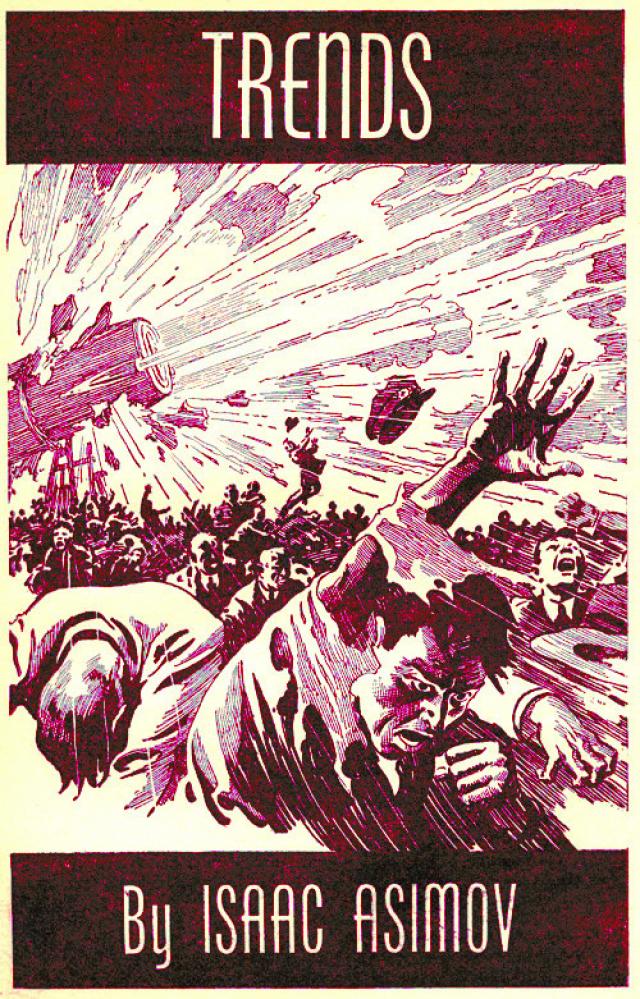
It was almost thirty-six hours after the take-off that a screaming projectile shot its way over Washington and buried itself in the mud just across the Potomac.
Investigators were at the scene of the landing within fifteen minutes, and in another fifteen minutes the police were there, for it was found that the projectile was a rocketship. They stared in involuntary awe at the tired, disheveled man who staggered out in near-collapse.
There was utter silence while he shook his fist at the gawking spectators and shouted: “Go ahead, hang me, fools.
But I’ve reached the Moon, and you can’t hang that. Get the FSRIB. Maybe they’ll declare the flight illegal and, therefore, nonexistent.” He laughed weakly and suddenly collapsed.
Someone shouted: “Take him to a hospital. He’s sick.” In stiff unconsciousness Harman was bundled into a police car and carried away, while the police formed a guard about the rocket-ship.
Government officials arrived and investigated the ship, read the log, inspected the drawings and photograph he had taken of the Moon, and finally departed in silence. The crowd grew and the word spread that a man had reached the Moon.
Curiously enough, there was little resentment of the fact. Men were impressed and awed; the crowd whispered and cast inquisitive glances at the dim crescent of Luna, scarcely seen in the bright sunlight. Over all, an uneasy pall of silence, the silence of indecision, lay.
Then, at the hospital, Harman revealed his identity, and the fickle world went wild. Even Harman himself was stunned in surprise at the rapid change in the world’s temper. It seemed almost incredible, and yet it was true. Secret discontent, combined with a heroic tale of man against overwhelming odds—the sort of tale that had stirred man’s soul since the beginning of time—served to sweep everyone into an ever-swelling current of anti-Victorianism.
And Eldredge was dead—no other could replace him.
I saw Hannan at the hospital shortly after that. He was propped up and still half buried with papers, telegrams and letters. He grinned at me and nod* ded. ’
‘Well, Cliff,” he whispered, “the pendulum swung back again.”
Isaac Asimov, Trends


