Close your eyes, p.5
Close Your Eyes,
p.5
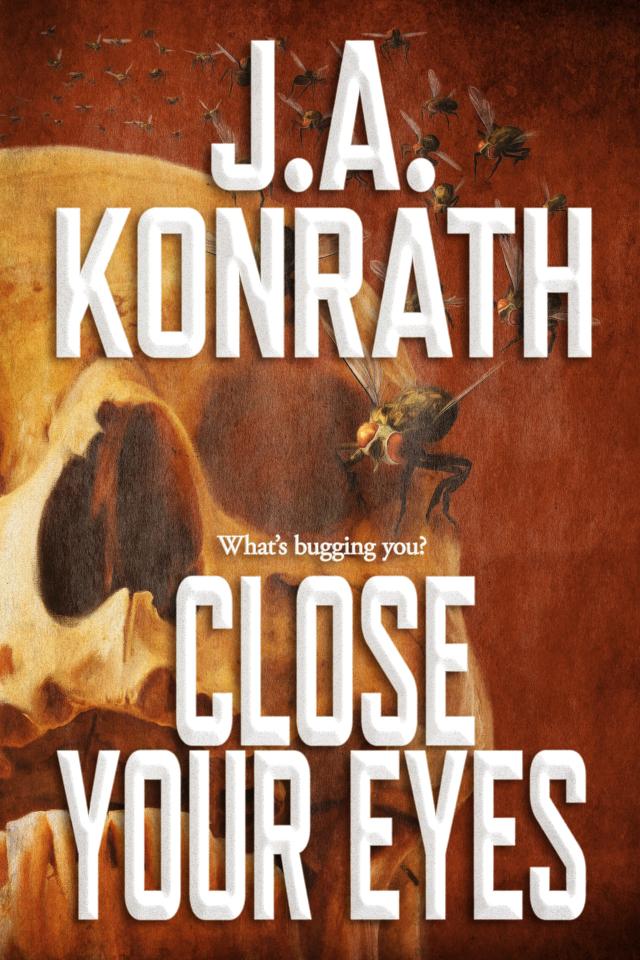


Twelve?
Counting pairs as individual openings, I believe it’s twelve.
The mouth, of course. The largest hole in the body. Jake had birthed many leeches through his mouth.
Thousands of eggs had dribbled from both nostrils, though Jake wasn’t sure what the eggs would become.
Mosquito larvae grew in both his ears, buzzing free after pupating, often returning to Jake to suck some blood before going off into the world to explore.
He cried worms of some kind, thin and long and wiggling out of his tear ducts. Some were several centimeters long. Perhaps nematodes. Or flukes.
Maggots, squirming in his swollen breasts, pushed out through his nipples, slick with Jake’s blood.
He pissed out black flies—though pissing might be too strong a word since they crawled out in a slow, steady parade—and every few hours had to turn over so his ass breached the surface of the water so he could release wasps, by the hundreds.
Jake didn’t like the wasps very much. Eager to escape his body, they stung multiple times as they made their way through his colon, and he had to bite his own arm to keep from screaming whenever a brood emerged. He’d bitten all the way to the bone.
The outer, thicker bone. The radius.
It’s like chewing electric rawhide, the pain white hot.
If I wasn’t already nuts, this would drive me there.
Jake had one final orifice, sealed since birth, but now open and gaping with something growing deep inside. He stared down at his distended stomach, half submerged in blackish water, and his red belly button opened and closed like a small mouth.
He stuck a finger inside, and let Him suckle, His needle-teeth tearing at Jake’s skin and gnawing at his bone.
“Soon,” Jake cooed. “Soon You will be born again.”
DUNCAN
SAME TIME, SAME PLACE…
“I guess we could try the marsh,” Duncan suggested.
Chuck made a face. “You said there’s nothing in the marsh but weeds and muck and flies.”
“I haven’t fished it since I was a kid.”
And that memory is among my worst, which is saying a lot.
“Did you catch anything?”
I remember clinging to Woof, the foul water clogging our noses and mouths, fearing we’d die there…
But even though that terror, fifteen years later, still felt fresh in Duncan’s mind, the marsh still called to him in a forbidden, primeval way.
Maybe the fish are in the bullrush, bellied down in the mud and milfoil, hiding from the blazing sun which the dirty air seems to be magnifying.
“I lost the biggest bass I ever had on, by the marsh.”
“Gotta risk it for the biscuit.” Chuck wiped his forearm over his brow.
“Marsh is tough fishing,” Duncan admitted. “Topwater only, buzz baits and scum frogs. Lots of places for a lure to get snagged. And a big fish in there could get tangled up in the weeds, be hard to pull out.”
Stu waved away a black fly. “That sounds like a quality problem.”
“Boat could stall, too. Happened when I was a kid.”
“You call for help?”
Not exactly.
“Sort of,” was all that Duncan would admit to. “Long story.”
“You lived, obviously.”
A memory of Duncan’s dog, Woof, came into his head. “Yeah. But it was a shit show.”
“I don’t want to have to swim for help if we get stuck,” Stu said.
“Swimming would be… problematic.” Duncan shrugged. “But I got a walkie-talkie in the tackle box.”
“Who are we supposed to call? Your parents aren’t home.”
“We have neighbors. Andy and Sun Dennison-Jones. They’re preppers, and have all sorts of radio equipment that they monitor. They’re flaky, but if they’re home, they’d help.”
“Before I came up I read all the back issues of the Lake Niboowin e-newsletter,” Stu said.
Chuck shook his head. “Of course you did.”
“This spring, some residents got DNR permits to use aquatic herbicide to kill water milfoil.”
Chuck scratched his head. “In English?”
“Weeds,” Stu said.
Duncan followed the thought train. “So maybe the marsh won’t be as marshy.”
Stu nodded. “That’s what I’m saying. The herbicide they use can be pretty strong.”
Chuck squinted at Duncan. “How’d you get stuck when you were a kid?”
“Intake clogged,” Duncan said. “If that happens again, I can fix it in two minutes. I’ve taken this outboard apart three times. Muck plugs up the thermostat coil, and engine warning siren trips. Four bolts, easy access, you can clean the spring with your fingers.”
Chuck nodded, then cleared his throat and spat in the lake. “I know motors. Compared to a modern F-150, this is cake.”
“So we doing this?” Duncan asked. “We all need to agree. All in.”
“All in,” Stu said. “Even if we don’t catch anything, I bet there are dragonflies. Dragonflies are apex predators, man. Those things are badass. After they hatch, they’re called nymphs and live underwater for a few years. They have this hinged jaw called a labium that shoots out like praying mantis arms and grabs water bugs. Some of the bigger ones can even eat tadpoles and fish. They don’t attack humans, but if they did, ooh boy that would be a one-sided fight.”
Stu stopped talking, his face creasing in a frown. “I’m talking like a bug lord again, aren’t I?”
“Yes you are, Bug Lord.” Duncan turned to Chuck. “How about you, man? Marsh?”
“I’m for giving it a shot,” Chuck said. “We came here to catch some bass, right?”
Duncan nodded. “Bass, perch, walleye, pike. The cast-iron skillet had no prejudice. But first we have to catch them.”
“And you can’t catch a fish unless you fish,” Chuck said.
Stu pointed at each of them. “So let’s fish.”
“Okay. Reel ’em in.”
The guys finished retrieving their baits, and Duncan twisted the ignition key. The engine caught on the second turn, and he pushed forward on the side mount control.
Stall.
He shifted back into neutral, pressed in the key to engage the choke and give it more gas, then fired it up again. The motor sputtered, sputtered, sputtered, and finally started, and Duncan eased the boat forward, slowly accelerating until the 25hp Mercury roared. Full speed wasn’t very fast on this old boat, but it was enough to blow Chuck’s cap off. It danced around the floor of the pontoon on the worn green carpeting, Chuck grasping for it, and eventually blew toward the stern where Stu stomped on the bill, preventing it from exiting the boat.
Around them, the lake appeared quiet and empty and endless, a bright mirror reflecting the murky sky and unyielding sun.
Brutal UV. I hope the SPF-50 is enough.
Duncan closed in on the marsh, throttling down, squinting for a good place to enter.
No good place existed. Whatever herbicide the DNR used must not have worked, because the weeds and muck seemed impenetrable. Duncan looked for the bass boat he’d spotted, judging it to be fifty meters away. But it was deep into the bullrush, and he couldn’t find the path it had taken to get there.
I lost that huge bass around here. I remember an opening, in the marsh.
If it still exists, we’ll be able to get a few casts in.
Duncan scanned the thick overgrowth until he saw it; a tiny path, half the width of the pontoon. He leaned over the starboard side, gazing into the murky lake. The electronic depth finder wasn’t working, and he judged they were at about three feet deep.
But things get shallow, fast.
Duncan pressed the electric motor tilt switch, slowly raising the plane so the propeller wouldn’t hit bottom, and then steered for the narrow path. As he approached, Duncan almost turned the watercraft away. The marsh was thicker than he’d expected. Florida everglades-slash-Amazon jungle-slash-New Orleans bayou thick. With so many tall reeds and dead sapling trunks and floating clumps of vegetation and mud, navigation would be difficult, and fishing would be almost impossible.
This is a bad idea.
But there’s another boat nearby.
They must be here to fish.
Duncan headed into the thick of the overgrowth, heading toward the boat. Reeds scraped along the two pontoon floats and under the raised hull, the dragging sounds amplified by the hollow aluminum. Duncan slowed their speed to a crawl, squinting at the biomass surrounding them, trying to spot the clearing while the brutal overhead sun seared his eyes.
It was near a submerged tree, which stuck out of the water at an angle. Like a Tommy Bartlett waterski ramp.
He put the boat in neutral, scanning the port-side horizon, looking for a clearing to make a few casts.
And then, like an oasis in the desert, it appeared.
Open water. Enough for all of us to throw a few.
Maybe one of us can pull a monster bass out of this slop.
Shifting the motor back into forward, Duncan weaved through the thickening weeds, keeping the spot in sight while remaining alert for obstacles. The pathway he’d entered had disappeared, and he’d begun to worry that the prop would get bound up with plant matter, but the reeds parted and they coasted into the clearing.
Perfect. This is perfect.
Every so often, Duncan would get what he called his fish feeling. It wasn’t any sort of psychic stuff—he didn’t believe in that—but maybe one in a thousand casts he would set eyes on a spot and know, for sure, that something hungry was there, watching, waiting for him to cast. He had that tingle as he cut off the motor and the pontoon glided to a slow stop.
“There’s something here,” he softly spoke, as if raising his voice would scare the fish away. “Top water lures, work the reed line, slow retrieve, make it look like your bait is injured.”
Opening his tackle box carefully so it didn’t make noise, Duncan switched lures, taking the Heddon Lucky 13 from his leader clip and replacing it with a Dying Flutter. The Flutter looked like a fluorescent green blunt, pinched at either end, with two metal propellers to churn up the water.
Not that bass’s natural prey had propellers, but the action mimicked a wounded baitfish.
If a lunker is nearby, this should entice it to strike.
Just as Duncan put on the bait and lifted it overhead to cast, Chuck pointed at the water and said, “Is that a bass?”
Duncan followed his friend’s finger, and saw something floating in the water two meters away from the boat.
Something big.
“Too large for a bass,” Stu said. “Right, Duncan?”
The floating, greenish white mass was over two feet long, and definitely a dead fish of some sort.
“Could be a pike. Or a sturgeon.”
“Musky?” Chuck asked.
“No musky in the lake.”
“Let’s net it and find out,” Stu said.
Duncan shook his head. “Leave it alone. Let’s fish.”
“It’s really big. I want to see what it is,” Stu said.
“It will stink up the boat.”
Duncan considered the debate over, and cast to the west. The Dying Flutter plopped next to a skinny, dead fir sapling sticking out of the water.
Fish like cover; weeds, logs, rocks, sunken watercraft. They’re ambush predators.
You have to lure them out.
Duncan let his bait rest for a few seconds, then gave it a twitch.
He paid scant attention to Stu and Chuck, making their casts, and then Duncan began a slow-and-stop retrieve, jerking the lure for maximum noise, then letting it rest like it was too wounded to continue.
Fish, like all predators, obey natural selection. When it comes down to survival of the fittest, the sick and the weak are picked off first.
I just need to keep tension on the line, to set the hook when I get a strike.
“Got it!”
Duncan turned to Stu, saw his pole bending. When someone hooked a fish, boat rule was everyone else reeled in to assist in landing it and to make sure lines didn’t get tangled. Duncan hesitated for half a second, because he’d really had a feeling about his cast, and then did a quick retrieve, ruining the dying baitfish illusion and scaring off any bass that could have been watching.
Setting down his rod, Duncan located the net by the port tailing and snatched it up, one eye on the bend in Stu’s pole.
But something wasn’t right. Whatever Stu had on wasn’t fighting back.
Like he’s reeling in dead weight.
Wait a sec…
Duncan scowled. “Stu, you jackass.”
“I was casting next to it and got snagged.”
“Snagged my ass.”
Stu had aimed for the dead fish and hooked it on one of the trebles.
“It’s a big one, Duncan. I’m gonna win biggest of the trip with this.”
“Bullshit,” Chuck said. “It has to be alive to win.”
“Then if this is still twitching, I win. Fifty bucks each.”
“Snags don’t count.”
“Rules don’t say that.”
Duncan sided with Chuck. “Hooking a floating fish in the side isn’t fishing, Stu. And if you get rotten fish guts all over the boat, you’re cleaning it.”
“Look! It is a bass!”
Duncan didn’t want to encourage this kind of behavior, but he couldn’t help but take a peek. Seeing a large bass, even a dead one, gave him hope that there were others of equal size in the area.
Stu dragged the corpse up to the edge of the starboard float, his line still tight, and the trio leaned over the aluminum guardrail for closer inspection.
It was the biggest bass Duncan had ever seen. As big as the one he missed when he was younger. Maybe even bigger.
Chuck whistled. “Eight pounds, at least.”
“Probably closer to ten.”
“What killed it?” Stu asked.
The bass didn’t have any apparent injuries on the side that was facing upward. Its eye was cloudy and protruding, but Duncan had seen many dead floating fish, and that was probably due to decomposition, or the searing summer sun, or both.
“Let’s bring it in.” Stu reached for the net.
Duncan vetoed that. “You ever smell rotting meat? It’s the worst stink ever.”
That was an understatement. Decomposing garbage was bad. Getting skunked was bad. The Porta-Potties at Coachella were bad. But decay…
Decay is the Mother of All Stenches.
If hell is real, it won’t be burning in flames or medieval tortures. It will be a billion people forced to smell each other as they rot.
“My hook is caught.” Stu gave a few feeble tugs on his pole to prove his point.
“Hand it over.”
Duncan took the rod and gave it several vicious yanks, causing the dead bass to bob up and down.
The hooks stayed hooked.
Duncan considered cutting the line. That was how much he hated the rancid odor of decay. Decay reminded Duncan of death, and he didn’t do well when being reminded of death.
But Stu was using one of Duncan’s lures; a vintage Creek Chub Injured Minnow that he’d paid fifteen bucks for on eBay. Replacing it would be expensive, if he could even find that same color.
“Get the net,” ordered Duncan. “You’re taking the hooks out.”
Net in hand, Stu leaned over the gunwale and scooped up the dead fish. As he brought it up, Duncan noticed the entire underside of the creature was covered in thick, black muck, and the stench was otherworldly. He dropped the net and turned away, retreating to the stern of the boat and putting a hand over his mouth and nose.
He heard Chuck swear, “Jesus, man! What the hell!”
“Hirudo medicinalis,” Stu said. Duncan heard something like awe in his friend’s voice. “They aren’t supposed to grow that big.”
“That’s disgusting! Those things are over a foot long?”
Those things? What the hell were they talking about?
Curiosity overtook revulsion, and Duncan chanced a look.
Revulsion instantly returned.
That isn’t lake mud on the underside of the bass.
It’s leeches.
A wriggling, slimy tangle of leeches, undulating like octopus tentacles.
And Stu, the moron, brought them onto my boat, gazing at them like he’s got a junior high crush.
“They’re hematophagous,” Stu said. “Blood drinkers. Their saliva has anesthetic and anticoagulant chemicals in it. You can’t feel it when they’re sucking on you, because they numb your skin while they feed. And your blood won’t clot. They keep sucking until they get their fill.”
Duncan could feel his stomach begin to cramp.
“Get them off the boat, Stu.”
“They shouldn’t be this size,” Stu said, reverently. “Haementeria ghilianii—the giant Amazon leech—can grow to eighteen inches. But these are even larger. This could be a new species.”
“I don’t give a shit about your new species. Toss the fish overboard.”
But Stu didn’t toss the fish overboard. Instead, he bent down—
—and touched the squirming mass.
Chuck slapped his thigh, grinning. “Man, there is something seriously wrong with you!”
Duncan couldn’t turn away, disgust churning inside of him as his entomologist friend pinched a leech between his thumb and forefinger. The leech responded by detaching from the bass and curling itself around Stu’s hand. When the worm contracted, it was the width of a hot dog.
A slimy, black, undulating hot dog that feasts on blood.
“These look like overgrown medicinal leeches. Hirudo medicinalis. They have a sucker on each end to secure themselves to their host, but only the anterior is used for feeding.” Stu stroked it with his other hand, like it was a pet. “Three sets of jaws, over a hundred teeth. Ten eyes. They can consume fifteen times their body weight in blood.”
Chuck appeared as creeped out as Duncan felt. “Don’t let it bite you, bro. I heard they lay eggs inside your body.”
“That’s a myth. Very few species lay eggs inside humans. Leeches are still used in medicine for reconstructive surgery. Look… it’s feeding on me.”