

The deathly hallows, p.29
The Deathly Hallows,
p.29
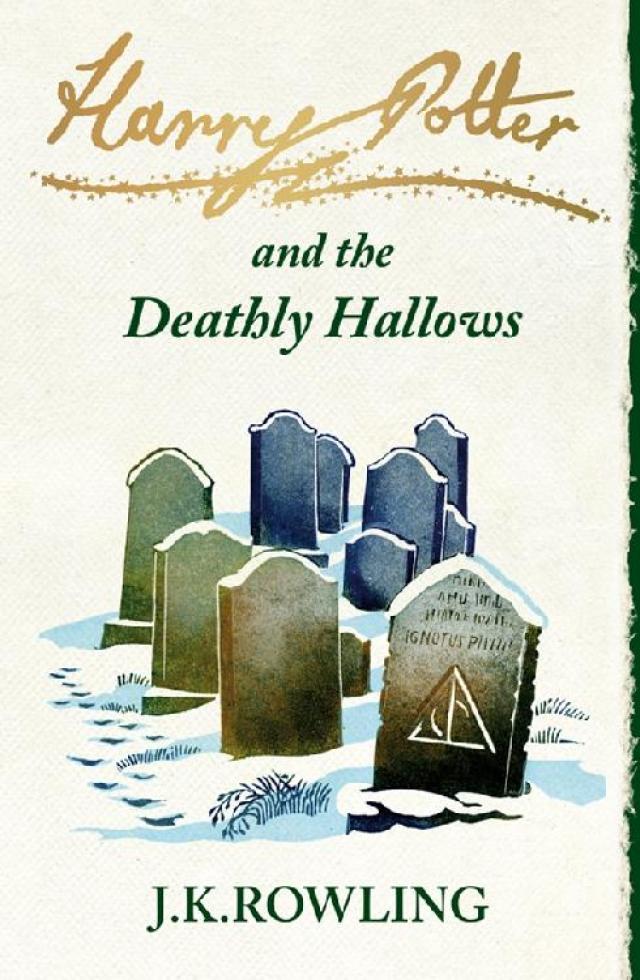


He did not want to be sidetracked again, and only grudgingly made his way back through the snow towards her.
‘What?’
‘Look at this!’
The grave was extremely old, weathered so that Harry could hardly make out the name. Hermione showed him the symbol beneath it.
‘Harry, that’s the mark in the book!’
He peered at the place she indicated: the stone was so worn that it was hard to make out what was engraved there, though there did seem to be a triangular mark beneath the nearly illegible name.
‘Yeah … it could be …’
Hermione lit her wand and pointed it at the name on the headstone.
‘It says Ig – Ignotus, I think …’
‘I’m going to keep looking for my parents, all right?’ Harry told her, a slight edge to his voice, and he set off again, leaving her crouched beside the old grave.
Every now and then he recognised a surname that, like Abbott, he had met at Hogwarts. Sometimes there were several generations of the same wizarding family represented in the graveyard: Harry could tell from the dates that it had either died out, or the current members had moved away from Godric’s Hollow. Deeper and deeper amongst the graves he went, and every time he reached a new headstone he felt a little lurch of apprehension and anticipation.
The darkness and the silence seemed to become, all of a sudden, much deeper. Harry looked around, worried, thinking of Dementors, then realised that the carols had finished, that the chatter and flurry of church-goers were fading away as they made their way back into the square. Somebody inside the church had just turned off the lights.
Then Hermione’s voice came out of the blackness for the third time, sharp and clear from a few yards away.
‘Harry, they’re here … right here.’
And he knew by her tone that it was his mother and father this time: he moved towards her feeling as if something heavy were pressing on his chest, the same sensation he had had right after Dumbledore had died, a grief that had actually weighed on his heart and lungs.
The headstone was only two rows behind Kendra and Ariana’s. It was made of white marble, just like Dumbledore’s tomb, and this made it easy to read, as it seemed to shine in the dark. Harry did not need to kneel or even approach very close to it to make out the words engraved upon it.
James Potter, born 27 March 1960, died 31 October 1981
Lily Potter, born 30 January 1960, died 31 October 1981
The last enemy that shall be destroyed is death.
Harry read the words slowly, as though he would have only one chance to take in their meaning, and he read the last of them aloud.
‘“The last enemy that shall be destroyed is death” …’ A horrible thought came to him, and with it a kind of panic. ‘Isn’t that a Death Eater idea? Why is that there?’
‘It doesn’t mean defeating death in the way the Death Eaters mean it, Harry,’ said Hermione, her voice gentle. ‘It means … you know … living beyond death. Living after death.’
But they were not living, thought Harry: they were gone. The empty words could not disguise the fact that his parents’ mouldering remains lay beneath snow and stone, indifferent, unknowing. And tears came before he could stop them, boiling hot then instantly freezing on his face, and what was the point in wiping them off, or pretending? He let them fall, his lips pressed hard together, looking down at the thick snow hiding from his eyes the place where the last of Lily and James lay, bones now, surely, or dust, not knowing or caring that their living son stood so near, his heart still beating, alive because of their sacrifice and close to wishing, at this moment, that he was sleeping under the snow with them.
Hermione had taken his hand again and was gripping it tightly. He could not look at her, but returned the pressure, now taking deep, sharp gulps of the night air, trying to steady himself, trying to regain control. He should have brought something to give them, and he had not thought of it, and every plant in the graveyard was leafless and frozen. But Hermione raised her wand, moved it in a circle through the air and a wreath of Christmas roses blossomed before them. Harry caught it and laid it on his parents’ grave.
As soon as he stood up, he wanted to leave: he did not think he could stand another moment there. He put his arm around Hermione’s shoulders, and she put hers around his waist, and they turned in silence and walked away through the snow, past Dumbledore’s mother and sister, back towards the dark church and the out-of-sight kissing gate.
— CHAPTER SEVENTEEN —
Bathilda’s Secret
‘Harry, stop.’
‘What’s wrong?’
They had only just reached the grave of the unknown Abbott.
‘There’s someone there. Someone watching us. I can tell. There, over by the bushes.’
They stood quite still, holding on to each other, gazing at the dense black boundary of the graveyard. Harry could not see anything.
‘Are you sure?’
‘I saw something move, I could have sworn I did …’
She broke from him to free her wand arm.
‘We look like Muggles,’ Harry pointed out.
‘Muggles who’ve just been laying flowers on your parents’ grave! Harry, I’m sure there’s someone over there!’
Harry thought of A History of Magic; the graveyard was supposed to be haunted: what if –? But then he heard a rustle and saw a little eddy of dislodged snow in the bush to which Hermione had pointed. Ghosts could not move snow.
‘It’s a cat,’ said Harry, after a second or two, ‘or a bird. If it was a Death Eater, we’d be dead by now. But let’s get out of here, and we can put the Cloak back on.’
They glanced back repeatedly as they made their way out of the graveyard. Harry, who did not feel as sanguine as he had pretended when reassuring Hermione, was glad to reach the gate and the slippery pavement. They pulled the Invisibility Cloak back over themselves. The pub was fuller than before: many voices inside it were now singing the carol that they had heard as they approached the church. For a moment Harry considered suggesting they take refuge inside it, but before he could say anything Hermione murmured, ‘Let’s go this way,’ and pulled him down the dark street leading out of the village in the opposite direction from which they had entered. Harry could make out the point where the cottages ended and the lane turned into open country again. They walked as quickly as they dared, past more windows sparkling with multicoloured lights, the outlines of Christmas trees dark through the curtains.
‘How are we going to find Bathilda’s house?’ asked Hermione, who was shivering a little and kept glancing back over her shoulder. ‘Harry? What do you think? Harry?’
She tugged at his arm, but Harry was not paying attention. He was looking towards the dark mass that stood at the very end of this row of houses. Next moment he had sped up, dragging Hermione along with him; she slipped a little on the ice.
‘Harry –’
‘Look … look at it, Hermione …’
‘I don’t … oh!’
He could see it; the Fidelius Charm must have died with James and Lily. The hedge had grown wild in the sixteen years since Hagrid had taken Harry from the rubble that lay scattered amongst the waist-high grass. Most of the cottage was still standing, though entirely covered in dark ivy and snow, but the right side of the top floor had been blown apart; that, Harry was sure, was where the curse had backfired. He and Hermione stood at the gate, gazing up at the wreck of what must once have been a cottage just like those that flanked it.
‘I wonder why nobody’s ever rebuilt it?’ whispered Hermione.
‘Maybe you can’t rebuild it?’ Harry replied. ‘Maybe it’s like the injuries from Dark Magic and you can’t repair the damage?’
He slipped a hand from beneath the Cloak and grasped the snowy and thickly rusted gate, not wishing to open it, but simply to hold some part of the house.
‘You’re not going to go inside? It looks unsafe, it might – oh, Harry, look!’
His touch on the gate seemed to have done it. A sign had risen out of the ground in front of them, up through the tangles of nettles and weeds, like some bizarre, fast-growing flower, and in golden letters upon the wood it said:
On this spot, on the night of 31 October 1981, Lily and James Potter lost their lives.
Their son, Harry, remains the only wizard ever to have survived the Killing Curse.
This house, invisible to Muggles, has been left in its ruined state as a monument to the Potters and as a reminder of the violence that tore apart their family.
And all round these neatly lettered words scribbles had been added by other witches and wizards who had come to see the place where the Boy Who Lived had escaped. Some had merely signed their names in Everlasting Ink; others had carved their initials into the wood, still others had left messages. The most recent of these, shining brightly over sixteen years’ worth of magical graffiti, all said similar things.
‘Good luck, Harry, wherever you are.’ ‘If you read this, Harry, we’re all behind you!’ ‘Long live Harry Potter.’
‘They shouldn’t have written on the sign!’ said Hermione, indignant.
But Harry beamed at her.
‘It’s brilliant. I’m glad they did. I …’
He broke off. A heavily muffled figure was hobbling up the lane towards them, silhouetted by the bright lights in the distant square. Harry thought, though it was hard to judge, that the figure was a woman. She was moving slowly, possibly frightened of slipping on the snowy ground. Her stoop, her stoutness, her shuffling gait all gave an impression of extreme age. They watched in silence as she drew nearer. Harry was waiting to see whether she would turn into any of the cottages she was passing, but he knew, instinctively, that she would not. At last she came to a halt a few yards from them, and simply stood there in the middle of the frozen road, facing them.
He did not need Hermione’s pinch to his arm. There was next to no chance that this woman was a Muggle: she was standing there gazing at a house that ought to have been completely invisible to her, if she was not a witch. Even assuming that she was a witch, however, it was odd behaviour to come out on a night this cold, simply to look at an old ruin. By all the rules of normal magic, meanwhile, she ought not to be able to see Hermione and him at all. Nevertheless, Harry had the strangest feeling that she knew that they were there, and also who they were. Just as he had reached this uneasy conclusion, she raised a gloved hand and beckoned.
Hermione moved closer to him under the Cloak, her arm pressed against his.
‘How does she know?’
He shook his head. The woman beckoned again, more vigorously. Harry could think of many reasons not to obey the summons, and yet his suspicions about her identity were growing stronger every moment that they stood facing each other in the deserted street.
Was it possible that she had been waiting for them all these long months? That Dumbledore had told her to wait, and that Harry would come in the end? Was it not likely that it was she who had moved in the shadows in the graveyard and had followed them to this spot? Even her ability to sense them suggested some Dumbledore-ish power that he had never encountered before.
Finally Harry spoke, causing Hermione to gasp and jump.
‘Are you Bathilda?’
The muffled figure nodded and beckoned again.
Beneath the Cloak, Harry and Hermione looked at each other. Harry raised his eyebrows; Hermione gave a tiny, nervous nod.
They stepped towards the woman and, at once, she turned and hobbled off back the way they had come. Leading them past several houses, she turned in at a gate. They followed her up the front path through a garden nearly as overgrown as the one they had just left. She fumbled for a moment with a key at the front door, then opened it and stepped back to let them pass.
She smelled bad, or perhaps it was her house: Harry wrinkled his nose as they sidled past her and pulled off the Cloak. Now that he was beside her, he realised how tiny she was; bowed down with age, she came barely level with his chest. She closed the door behind them, her knuckles blue and mottled against the peeling paint, then turned and peered into Harry’s face. Her eyes were thick with cataracts and sunken into folds of transparent skin, and her whole face was dotted with broken veins and liver spots. He wondered whether she could make him out at all; even if she could, it was the balding Muggle whose identity he had stolen that she would see.
The odour of old age, of dust, of unwashed clothes and stale food intensified as she unwound a moth-eaten, black shawl, revealing a head of scant white hair through which the scalp showed clearly.
‘Bathilda?’ Harry repeated.
She nodded again. Harry became aware of the locket against his skin; the thing inside it that sometimes ticked or beat had woken; he could feel it pulsing through the cold gold. Did it know, could it sense, that the thing that would destroy it was near?
Bathilda shuffled past them, pushing Hermione aside as though she had not seen her, and vanished into what seemed to be a sitting room.
‘Harry, I’m not sure about this,’ breathed Hermione.
‘Look at the size of her; I think we could overpower her if we had to,’ said Harry. ‘Listen, I should have told you, I knew she wasn’t all there. Muriel called her “gaga”.’
‘Come!’ called Bathilda from the next room.
Hermione jumped and clutched Harry’s arm.
‘It’s OK,’ said Harry reassuringly, and he led the way into the sitting room.
Bathilda was tottering around the place lighting candles, but it was still very dark, not to mention extremely dirty. Thick dust crunched beneath their feet and Harry’s nose detected, underneath the dank and mildewed smell, something worse, like meat gone bad. He wondered when was the last time anyone had been inside Bathilda’s house to check whether she was coping. She seemed to have forgotten that she could do magic too, for she lit the candles clumsily by hand, her trailing lace cuff in constant danger of catching fire.
‘Let me do that,’ offered Harry, and he took the matches from her. She stood watching him as he finished lighting the candle stubs that stood on saucers around the room, perched precariously on stacks of books and on side tables crammed with cracked and mouldy cups.
The last surface on which Harry spotted a candle was a bow-fronted chest of drawers on which there stood a large number of photographs. When the flame danced into life, its reflection wavered on their dusty glass and silver. He saw a few tiny movements from the pictures. As Bathilda fumbled with logs for the fire, he muttered, ‘Tergeo.’ The dust vanished from the photographs, and he saw at once that half a dozen were missing from the largest and most ornate frames. He wondered whether Bathilda or somebody else had removed them. Then the sight of a photograph near the back of the collection caught his eye, and he snatched it up.
It was the golden-haired, merry-faced thief, the young man who had perched on Gregorovitch’s window sill, smiling lazily up at Harry out of the silver frame. And it came to Harry, instantly, where he had seen the boy before: in The Life and Lies of Albus Dumbledore, arm in arm with the teenage Dumbledore, and that must be where all the missing photographs were: in Rita’s book.
‘Mrs – Miss – Bagshot?’ he said, and his voice shook slightly. ‘Who is this?’
Bathilda was standing in the middle of the room watching Hermione light the fire for her.
‘Miss Bagshot?’ Harry repeated, and he advanced, with the picture in his hands, as the flames burst into life in the fireplace. Bathilda looked up at his voice and the Horcrux beat faster upon his chest.
‘Who is this person?’ Harry asked her, pushing the picture forwards.
She peered at it solemnly, then up at Harry.
‘Do you know who this is?’ he repeated, in a much slower and louder voice than usual. ‘This man? Do you know him? What’s he called?’
Bathilda merely looked vague. Harry felt an awful frustration. How had Rita Skeeter unlocked Bathilda’s memories?
‘Who is this man?’ he repeated loudly.
‘Harry, what are you doing?’ asked Hermione.
‘This picture, Hermione, it’s the thief, the thief who stole from Gregorovitch! Please!’ he said to Bathilda. ‘Who is this?’
But she only stared at him.
‘Why did you ask us to come with you, Mrs – Miss – Bagshot?’ asked Hermione, raising her own voice. ‘Was there something you wanted to tell us?’
Giving no sign that she had heard Hermione, Bathilda now shuffled a few steps closer to Harry. With a little jerk of her head, she looked back into the hall.
‘You want us to leave?’ he asked.
She repeated the gesture, this time pointing first at him, then at herself, then at the ceiling.
‘Oh, right … Hermione, I think she wants me to go upstairs with her.’
‘All right,’ said Hermione, ‘let’s go.’
But when Hermione moved, Bathilda shook her head with surprising vigour, once more pointing first at Harry, then to herself.
‘She wants me to go with her, alone.’
‘Why?’ asked Hermione, and her voice rang out sharp and clear in the candlelit room; the old lady shook her head a little at the loud noise.
‘Maybe Dumbledore told her to give the sword to me, and only to me?’
‘Do you really think she knows who you are?’
‘Yes,’ said Harry, looking down into the milky eyes fixed upon his own, ‘I think she does.’
‘Well, OK then, but be quick, Harry.’
‘Lead the way,’ Harry told Bathilda.
She seemed to understand, because she shuffled round him towards the door. Harry glanced back at Hermione with a reassuring smile, but he was not sure she had seen it; she stood hugging herself in the midst of the candlelit squalor, looking towards the bookcase. As Harry walked out of the room, unseen by both Hermione and Bathilda, he slipped the silver-framed photograph of the unknown thief inside his jacket.
The stairs were steep and narrow: Harry was half tempted to place his hands on stout Bathilda’s backside to ensure that she did not topple over backwards on top of him, which seemed only too likely. Slowly, wheezing a little, she climbed to the upper landing, turned immediately right and led him into a low-ceilinged bedroom.


