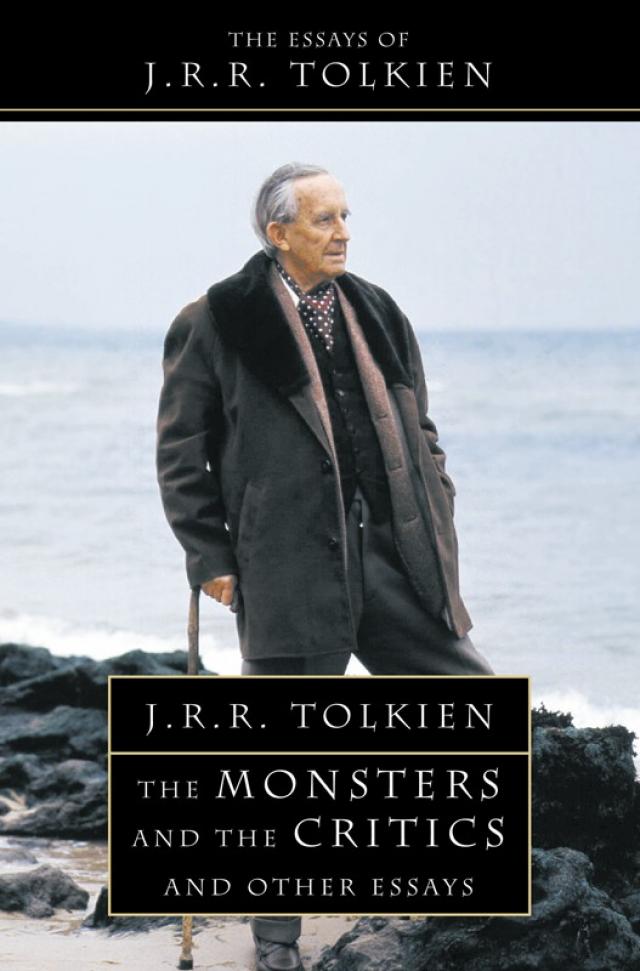
The monsters and the cri.., p.12
The Monsters and the Critics,
p.12


I am not at this time greatly concerned to answer such a question; for I am at the moment chiefly anxious to assert, to show (I hope), that this is what the author of Sir Gawain and the Green Knight has in fact done, and that his operations upon his material will be unintelligible or largely misunderstood if that is not recognized. But if the question were raised I would reply: There is a strength and life about this poem which is almost universally admitted. This is more likely to be due to the greater seriousness of the author than to have survived in spite of it. But much depends on what you want, or think that you want. Do you demand that the author should have the objects that you would expect him to have, or the views that you would prefer him to hold? That he should, for instance, be an anthropological antiquarian? Or that he should simply devote himself to telling an exciting fairy-story well, in such a way as to produce literary credibility sufficient for entertainment? And how will he do that, in terms of his own time and thought? Surely, if that simple object was his only object (unlikely enough in the complex and didactic fourteenth century), he would in the process of giving life to old legends inevitably slide into the consideration of contemporary, or permanent, problems of conduct? It is by that consideration that he has vivified his characters, and by that has given new life to old tales – totally different to their former significance (about which he probably knew, and certainly cared, much less than some men of this day). It is a case of pouring new wine into old bottles, no doubt, and there are some inevitable cracks and leaks. But I at any rate find this question of ethics both more vivid for its curious and bizarre setting, and in itself more interesting than all the guesses about more primitive times. But then I think the fourteenth century superior to barbarism, and theology and ethics above folklore.
I do not, of course, insist that the author must have had, as a conscious purpose, any such object as probing into the relation of real and artificial rules of conduct when he began to deal with this story. I imagine this poem took some time to write, was often altered, expanded here and cut down there. But the moral questions are there, inherent in the tale, and they will naturally arise and present themselves for attention in proportion as the tale is realistically handled, and in proportion as the author is a man of thought and intelligence, something more than a tale-pedlar. In any case it is clear that before he achieved his final version the author was fully aware of what he was doing: writing a ‘moral’ poem, and a study of knightly virtue and manners under strain; for he put in two stanzas (‘though it may tarry my story’, and though we may not now like it) about the Pentangle, as he sent off his knight to his trial. And before he puts in the passage about confession at the end of the major trial, he has already drawn our attention to the divergence of values, by the clear distinction expressed in lines 1773–4; lines which place the moral law higher than the laws of ‘courtesy’, and explicitly reject, and make Gawain reject, adultery as part of courtesy possible to a perfect knight. A very contemporary and very English point of view!16
But by the open invitation to adultery of lines 49.1237–40, and that is no doubt one of the reasons why it is placed at the beginning, we are able to see the hollowness of all the courteous fencing that follows. For Gawain from that moment can have no doubt whatever of the lady’s object: to haf wonnen hym to woze (‘to allure him to love-making’, 61.1550). He is attacked on two fronts, and has in reality abandoned from the outset ‘service’, the absolute submission of the ‘true servant’ to the will and wishes of the lady; though he strives throughout to maintain the verbal shadow of it, the gentleness of polite speech and manners.
By God, I would be glad, if good to you seemed
whatever I could say, or in service could offer
to the pleasure of your excellence – it would be pure delight
(50.1245–7)
But I am proud of the praise you are pleased to give me,
and as your servant in earnest my sovereign I hold you
(51.1277–8)
All your will I would wish to work, as I am able,
being so beholden in honour, and, so help me the Lord,
desiring ever the servant of yourself to remain
(61.1546–8)
All such expressions have become mere pretences, reduced to a level hardly above that of the Christmas games, when the wylnyng (1546) of the lady has been and is persistently rejected.
Sheer courtly practice in the game of manners and adroitness of speech enabled Gawain to avoid being openly craþayn, to eschew ‘vileinye’ in words, that is expressions that were boorish or brutally outspoken (whether just and true, or not).17 But even though he may do it with disarming gracefulness, the law of ‘service’ to the lady’s wishes is in fact broken. And the motive of the breach, of all his adroit defence, can from the first only be a moral one, though this is not stated until 71.1773–4. Had there been no other way out Gawain would have had to abandon even his technical courtesy of manners and lodly refuse (1772). But he was never ‘driven nearer to the line’ than to say: ‘Nay! lover have I none, and none will have meanwhile’ (71.1790–1), which in spite of his ‘smooth smile’ is plain enough and a worde þat worst is of alle (72.1792). But the lady drives him no further, for undoubtedly the author did not wish the gentleness of Gawain to be broken down. He approved gentle manners and absence of ‘vileinye’ when allied to, founded on, virtue, the distillation of the courtesy in ‘courtly love’ without adultery.18
We must then recognize that the intrusion of Sir Gawain’s confession and its precise placing in the poem was deliberate; and that it is an indication of the author’s opinion that games and manners were not important, ultimately (for ‘salvation’, 75.1879), and were in any case on an inferior plane to real virtue, to which they must in the case of conflict give way. Even the Green Knight recognizes the distinction, and declares that Gawain is ‘the most faultless man on earth’ (95.2363) with regard to the major moral issue.
But we have not done with the interesting minor issues. The Green Knight proceeds: Bot here yow lakked a lyttel, sir, and lewté yow wonted (95.2366). What was this lewté? The word is not well translated by ‘loyalty’, in spite of the kinship of the words; for ‘loyalty’ is now chiefly applied to honesty and steadfastness in some important personal or public relationship or duty (as to king or country, kin or dear friends). ‘Legality’ would be equally akin and better; for lewté might mean no more than ‘sticking to the rules’ of whatever grade or sanction. Thus our author can call the alliterations that occur in the proper places in a line, according to merely metrical rules, lel lettres ‘loyal letters’ (2.35).
What rules then is Gawain accused of breaking in accepting, keeping, and concealing the girdle? It might be three: accepting a gift without returning one; not surrendering it as part of the ‘gain’ on the third day (according to a jocular pact, definitely called a layke or game); using it as a protection at the tryst. It is plain, I think, that the Green Knight is considering only the second of these. He says:
The true shall truly repay,
for no peril then need he quake.
Thou didst fail on the third day …
(94.2354–6)
For it is my weed that thou wearest …
(95.2358)
It is as man to man, as opponents in a game, that he is challenging Gawain. And I think that it is plain that in this he expresses the opinion of the author.
For the author was not a simple-minded man. Those who take an ultimately stern and uncompromising moral view are not necessarily simple-minded. He might think the major issue clear in theory, but nothing in his handling of his tale suggests that he thought moral conduct a simple and painless thing in practice. And anyway he was, as we might say, a gentleman and a sportsman, and was intrigued by the minor issue. Indeed the moralitas of his poem, if complicated, is yet also enriched by this exhibition of a clash of rules on a lower plane. He has contrived or brought out a very pretty problem.
Gawain is induced to accept a parting gift from the lady. From the technical fault of ‘covetousness’ (taking without return) he has been explicitly acquitted: he had nothing he could give in return which would not by its disparity in value be insulting (72. 1798 ff.); he had no thought of the beauty or monetary value of the girdle (81.2037–40). But he was led into a position from which he could not withdraw by the thought that it might possibly save his life when he came to the tryst. Now the author nowhere examines the ethics of the Beheading Game; but if we do so, we shall not find that Gawain had broken any article of his covenant in wearing the girdle for that purpose. All he had promised to do was to come in person, not send a substitute (the probable meaning of line 17.384: wyth no wyz ellez on lyue, ‘in the world with none else but me’); to come at an appointed time, and then stand one stroke without resistance. He does not, therefore, on this count need an advocate; though one might quickly point out that Gawain was actually tricked into the covenant, before the Green Knight revealed that he was magically protected; and his promise might well be held ethically void, and even on the level of a mere ‘game’ a little private magic of his own could only be regarded as perfectly fair. But the author was not considering this case; though he was not unaware of the point, as we see in Gawain’s protest:
But if on floor now falls my head,
I cannot it restore.
(91. 2282–3)
We are thus merely considering the events in the castle, and the sporting pact with the lord. Gawain had accepted the girdle as a gift because of his dread of the beheading. But again he had been caught. The lady’s timing was cunning. She pressed the belt on him, and the moment he weakened she gave it to him, and then closed the trap. She begged him not to tell her husband. He agreed. He could hardly do anything else; but with his characteristic generosity, indeed impetuous excess, which we have already noted, he vowed never to tell anyone else in the world.19 Of course he desired the belt on the chance (he seems never to have rated it higher than that) that it might save him from death; but even if he had not, he would have been in a dilemma of ‘courtesy’. To have rejected the belt, once accepted; or to have refused the request: neither would have been ‘courteous’. It was not for him to enquire why he must keep the belt secret; presumably it was to save the lady from embarrassment, since there was no reason to suppose that it was not hers to give. At any rate it was quite as much hers to give as her kisses, and in that matter he had protected her already from embarrassment by refusing to say from whom he had obtained them.20 It is not said at this moment of acceptance and promise that Gawain recalled his game-compact with the lord at all. But he cannot be finally excused on that ground. For he could not long remain forgetful of the point. When the lord came home at night, he was bound to remember. And he did. It is not said so; but we see it clearly in stanza 77: in Gawain’s haste to get the business over. ‘This time I will pay first’ he cries (as usual going further than he need, whether in making or breaking a promise), as he goes to meet the lord half way (lines 1932–4).
It is at this point then, and at this point only, that we may detect Gawain in a fault, such as it is. ‘I shall first fulfil the compact that we made,’ he says, and for what that compact was worth he does not do so. He says nothing about the girdle. And he is uneasy. ‘Enough!’ he cries, when the lord (with a significance that he cannot yet perceive, nor we until we have read the whole tale) says that a fox-fell is poor pay for three such precious things as these kisses.
Well, there it is. Þrid tyme þrowe best, but at þe þrid þou fayled þore. It is not my part to argue that Gawain did not ‘fail’ at all; for neither was that the thesis of the author. But to consider in what degree and on what plane he failed, in the author’s view, so far as it can be discerned; for with such points he was deeply concerned. There were for him, it seems clear to me from his handling of this tale, three planes: mere jesting pastimes, such as that played between Gawain and the lord of the castle; ‘courtesy’,21 as a code of ‘gentle’ or polite manners, which included a special mode of deference to women, and could be held to include, as it was by the lady, the more serious, and therefore more dangerous, ‘game’ of courtly love-making, which might compete with moral laws; and finally real morals, virtues and sins. These might compete one with another. If so, the higher law must be obeyed. From the first arrival of Sir Gawain at the castle situations are being prepared in which such competitions, with dilemmas in conduct, will occur. The author is chiefly interested in the competition between ‘courtesy’ and virtue (purity and loyalty); he shows us their increasing divergence, and shows us Gawain at the crisis of the temptation recognizing this, and choosing virtue rather than courtesy, yet preserving a graciousness of manner and a gentleness of speech belonging to the true spirit of courtesy. I think it was his intention by the confession also to show that the lowest grade, ‘jesting pastime’, was not an ultimately important matter at all; but only after he had amused himself, as it were, by exhibiting a dilemma which artificial courtesy could produce even on a lower level. In this case, since questions of sin and virtue did not arise, Gawain placed the rules of courtesy higher, and obeyed the lady, even though it landed him in breaking his word (though that only in a game of no seriousness). But alas! as I think our author would have said, the rules of artificial courtesy could not really excuse him, not being of universal overriding validity, as are those of morality, not even if courtesy alone had been his motive for taking the girdle. But it was not. He would never have been in the position where he was bound to secrecy, contrary to the games-pact, if he had not wanted to possess the girdle for its possible power: he wished to save his life, a simple and honest motive, and by means that were in no way contrary to his original pact with the Green Knight, and conflicted only with the seemingly absurd and purely jocular pact with the lord of the castle. That was his only fault.
We may observe that each of these ‘planes’ has its own court of judgement. The moral law is referred to the Church. Lewté, ‘playing the game’ when it is a mere game, as man to man, is referred to the Green Knight, who indeed speaks of the procedure in mock-religious terms, though (it may be noted) he applies these only to the game: the higher matters have been already judged; ‘confession’ and a ‘penance’ at the point of his edge. Courtesy is referred to the supreme court of such affairs, the Court of King Arthur of kydde cortaysye; and the case against the defendant is laughed out.
But there is yet another court: Sir Gawain himself, and his own judgement. Let us say at once that he is not competent to judge this case impartially, and his judgement cannot be held valid. He is not unnaturally at first in an emotional state of mind, greatly disturbed, after having not only his whole ‘code’ pulled to pieces, but receiving sore wounds to his pride. His first outcry against himself is hardly more likely to be just than his bitter generalization against women.22 But it is none the less very interesting to consider what he has to say; because he is a very roundly drawn character, and not a mere vehicle of opinions and analyses. This poet had skill in character drawing. Though the lady, when she has a reported speaking part, has only a simple role, and only one line to follow (directed by an unexplained ‘enmity’), all that she says has an unmistakable tone of her own. Better still is Sir Bertilak, and greater the skill with which he is made to behave and speak credibly both as Green Knight and as Host, so that, if these two had not in fact been one, either would have been adequately drawn as an individual, yet at the end we are well able to believe that we have listened to the same character throughout: it is this as much as anything that makes a reader accept as unquestioningly as Gawain their identity without (in this poem) any disenchantment or change of shape after the revelation. But both these actors are secondary, and their main function is to provide the situation for Gawain’s trial. Gawain has full literary reality.
His ‘perfection’ is made more human and credible, and therefore more appreciable as genuine nobility, by the small flaw.23 But, to my mind, nothing makes him ‘come alive’ as a real man so much as the depiction of his ‘reactions’ to the revelation: here that grossly abused word ‘reaction’ can with some justice be used, for his words and behaviour are largely a matter of instinct and emotion. We may well consider the contrast between the stanzas in which these are exhibited and the lines in which his perilous journeys are described, lines at once picturesque and perfunctory. But this poet was not really interested in fairy-tale or in romance for their own sakes. It is also, I think, a final stroke of art in a poem that is so concentrated on virtue and problems of conduct that it should end with a glimpse of the ‘reactions’ of a man truly ‘gentle’, but not deeply reflective, to a fault in a part of his personal code that is not to a cool outside judge essential. That it should indeed end with a glimpse of that twofold scale with which all reasonably charitable people measure: the stricter for oneself, the more lenient for others.24 Þe kyng comfortez þe knyt, and alle þe court als laen loude þerat.
What does Gawain feel and say? He accuses himself of couardise and couetyse. He ‘stood in a study’ a long while.
in such grief and disgust he had a grue in his heart;
all the blood from his breast in his blush mingled,
and he shrank into himself with shame at that speech.
The first words on that field that he found then to say
were: ‘Cursed be ye, Coveting, and Cowardice also!
In you is vileness, and vice that virtue destroyeth.’
He took then the treacherous thing, and untying the knot