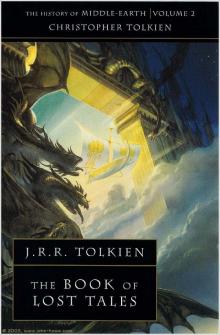
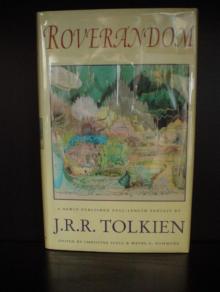
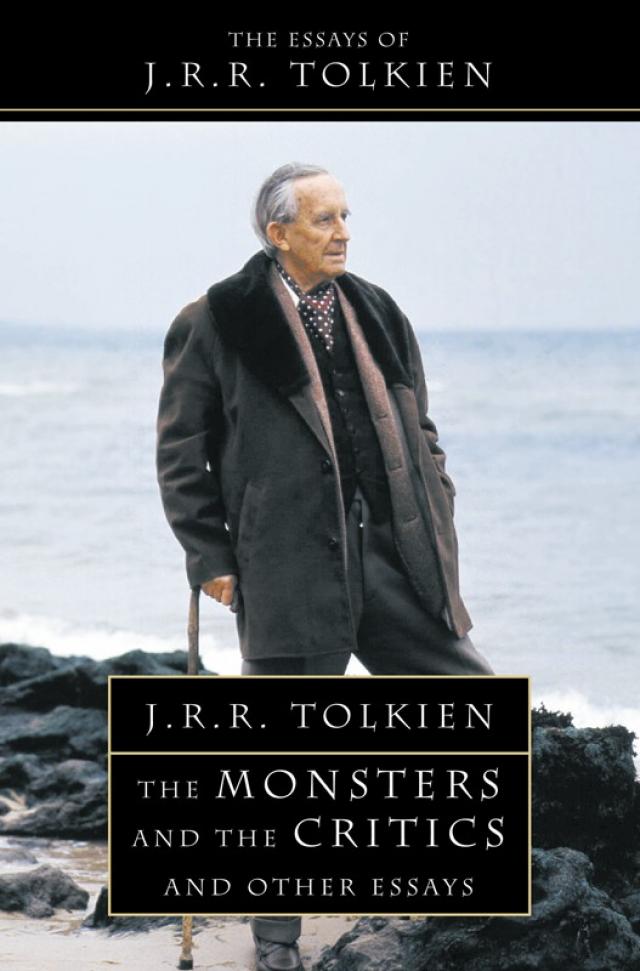
The monsters and the cri.., p.25
The Monsters and the Critics,
p.25


9 The shifts of language naturally do not present sharp boundaries between ‘periods’, but this second or ‘middle’ period of English ended in the thirteenth century; after which the third period began. Though this is not the division usually made.
10 These features are exemplified in ciwdod (cīuitāt-em), ciwed (cīuitās), gem (gemma); pader (Păter noster) beside yscawl, ysgol (scăla); ffydd (fides) beside swydd (sēdēs).
11 Whereas the remigrant British, the Breton of Armorica, has changed þ (th) to s and later z.
12 Though it may be noted that many of the things that strike the modern Saxon as insuperably odd and difficult about Welsh have no importance for the days of the first contacts of British and English speech. Chief among these are, I suppose, the alteration of the initial consonants of words (which revolts his Germanic feeling for the initial sound of a word as a prime feature of its identity); and the sounds of ll (voiceless l) and ch (voiceless back spirant). But the consonant-alterations are due to a grammatical use of the results of a phonetic process (soft mutation or lenition) that was probably only just beginning in the days of Vortigern. Old English possessed both a voiceless l and the voiceless back spirant ch.
13 Alfred was no doubt an exceptional person. But we see in him a case that shows how even bitter war may not wholly destroy the desire to know. He was engaged in a desperate conflict with an enemy that came very near to robbing him of all his patrimony, yet he reports his conversations with a Norseman, Ohthere, about the geography and economics of Norway, a land that he certainly did not intend to invade; and it is clear from Ohthere’s account that the king also asked some questions about languages.
14 This may seem probable enough; but it does not promise easy evidence to the historical philologist. He will be faced with Latin incorporated in Welsh, and in English (each with its own phonetic history), and with different kinds of Latin on either side of the Channel.
15 We here see the word applied to a tongue that was though Celtic not British. Wealhstod became the ordinary word in Old English for either an interpreter or a translator; but that was at a much later date. It seems never, however, to have been applied to communications with the ‘Danes’.
16 Latin Life, ch. xxxiv. ‘What follows occurred in the days of Coenred, king of the Mercians [704–9], when the pestiferous British foes of the Saxons were embroiling the English in piratical raids and organized devastation. One night at time of cockcrow, when according to his custom the hero Guthlac of blessed memory began his vigils, suddenly as if he were lost in a trance he seemed to hear the roaring of a tumultuous crowd. At that he started up from his light sleep and rushed from the cell where he sat. Standing with ears cocked he recognized words and the native mode of speech of British soldiers coming from the roof; for when in former times he had been isolated among them on his various expeditions he had learned to understand their cacophonous manner of speaking. Just as he had made sure that it came through the thatch of the roof, at that moment his whole settlement seemed to burst into flames.’ The devils then caught Guthlac with their spears.
17 Its origin is not of importance in this context. It is commonly supposed to be the same as that of the Celtic tribal name represented in Latin sources as Volcae: that is derived from it at a time sufficiently early to allow it to be germanicized in form.
18 Traces remain of the sense ‘Romans’. Widsith, which contains many memories of pre-migration days, has an archaic form mid Rumwalum, and mentions Wala rice as the realm ruled by Casere (Caesar); weala sunderriht and reht Romwala are found in two glosses on ius Quiritum. But these are not normal uses. Later applications to Gaul (France) are probably not derived from English tradition.
The men who established themselves at Richard’s castle in Hereford in 1052 were called Normanni and þa Frencyscan, but in the Laud Chronicle þa welisce (waelisce) men. And when Edward the Confessor returned from abroad the same Chronicle says that he came of Weal-lande, meaning Normandy. But these are not natural English uses and are in fact simply items of the influence of Norse upon the English of the late period. In Norse valskr and Valland had continued to be applied specifically to Gaul. There is other evidence of the influence of Norse in the same part of the same Chronicle: woldon raedan on hi (always mistranslated ‘plot against’) is an anglicization of Norse ráða á ‘to go for, to attack’.
19 They were generally supposed to do so; but it has been shown that in fact many contain either weall ‘wall’ or weald ‘forest’. But scepticism has in reaction probably swung too far. In any case a number of these names must still be allowed to contain walh, among them several in the east far from Wales: Surrey, Hertfordshire, Norfolk, and Suffolk. When these names were first made they must have referred to groups of people who were not regarded as English, but were recognized as British; and language must have been the principal characteristic by which this was judged. But how long that situation lasted is another matter.
20 For my purpose it does not matter at all whether Sir Gavin or his reviewer was the author of the remark: both were posing as scholars.
21 The association of these two dissimilar functions is again notable. Old Irish uses b-forms in these two functions, but distinguishes between future and consuetudinal in inflexion. The Welsh tense (byddaf, &c.) as a whole blends the two functions, though the older language had also a form of the 3 sg. bid (bit) limited to consuetudinal use. The difference of function is not yet fully realized by Anglo-Saxon scholars. The older dictionaries and grammars ignore it, and even in recent grammars it is not clearly stated; the consuetudinal is usually overlooked, though traces of it survive in English as late as the language of Chaucer (in beth as consuetudinal sg. and pl.).
22 The Irish, Welsh, and English forms relate to older bī, bi- (cf. Latin fīs, fit, &c.). The development from bi- to bið- in Welsh is due to a consonantal strengthening of which began far back in British. When i reached the stage ið is not known, but a date about A.D. 500 seems probable.
23 The influence of the short ĭ in the forms of the true present might be held responsible. In a pre-English stage these would have been im, is, ist (is).
24 The addition of a plural ending (normally belonging to the past tense) to an inflected form of the 3 sg. In this way biðun differs from the extended form sindun made from the old pl. sind. The latter was already pl. and its ending -nd could not be recognized as an inflexion, whereas the ið of bið was the normal ending of the 3 sg.
25 Some philologists (e.g. Förster, in Der Flussname Thenise) now hold that the English process belonged to the seventh century and was not completed till the beginning of the eighth; it thus belonged wholly to Britain and did not begin until after the completion of the first stage of British i-affection (the ‘final i-affection’). But no linguistic matters are simple in this region. The beginnings of the process in English must lie back in pre-invasion times, whatever may be true of its results, or of any of its vocalic effects sufficient to be recognized in spellings. For this process is not peculiar to the English dialect of Germanic, transferred from its native soil west to Celtic Britain. Indeed the native soil of English seems to have been a focus of this phonetic disturbance (in its inception one primarily affecting consonants). Northwards it is found attacking the Scandinavian dialects with almost equal severity; though southwards its effects were more limited or later. Certainly moving west, within the area of the disturbance, the process was not retarded in English – what would have happened if it had moved southwards is another matter – and in the event English became the language of i-mutation par excellence and its results were far more extensive than in any form of British. In British, for instance, long vowels were not affected; but in English nearly all long vowels and diphthongs were mutated.
26 For the most part. The cultivated written language of Wales has naturally, at all times, been less open to invasion. Neither has cultivated English been the chief source of the loans.
27 Probably in origin a dissimilation where the verb stem contained nasals: as in tincian/tincial (ME. tinken); mwmial, mwmlian ‘mumble’.
28 It also possesses in MS. Jesus Coll. Oxford 29 a copy of the early Middle English Owl and Nightingale, which in its history illustrates in other terms the progress of English words. Written in the south-east, it passed to the West Midlands and there received a western dialectal dress; but it was preserved in Wales, and reached Jesus College in the seventeenth century from Glamorgan.
29 For there is concomitant pleasure of the eye in an orthography that is home-grown with a language, though most spelling-reformers are insensitive to it.
30 A difficult proportion to discover without knowing his ancestral history through indefinite generations. Children of the same two parents may differ markedly in this respect.
31 I refer to Modern French; and I am speaking primarily of word-forms, and those in relation to meaning, especially in basic words. Incomprehensibility and its like are only art forms in a diluted degree in any language, hardly at all in English.
32 Each, of course, with immediately following ‘sense’.
33 If I may once more refer to my work, The Lord of the Rings, in evidence: the names of persons and places in this story were mainly composed on patterns deliberately modelled on those of Welsh (closely similar but not identical). This element in the tale has given perhaps more pleasure to more readers than anything else in it.
34 Dyscwch nes oesswch Saesnec / Doeth yw e dysc da iaith dec.
A SECRET VICE
Some of you may have heard that there was, a year or more ago, a Congress in Oxford, an Esperanto Congress; or you may not have heard. Personally I am a believer in an ‘artificial’ language, at any rate for Europe – a believer, that is, in its desirability, as the one thing antecedently necessary for uniting Europe, before it is swallowed by non-Europe; as well as for many other good reasons – a believer in its possibility because the history of the world seems to exhibit, as far as I know it, both an increase in human control of (or influence upon) the uncontrollable, and a progressive widening of the range of more or less uniform languages. Also I particularly like Esperanto, not least because it is the creation ultimately of one man, not a philologist, and is therefore something like a ‘human language bereft of the inconveniences due to too many successive cooks’ – which is as good a description of the ideal artificial language (in a particular sense) as I can give.1
No doubt the Esperantist propaganda touched on all these points. I cannot say. But it is not important, because my concern is not with that kind of artificial language at all. You must tolerate the stealthy approach. It is habitual. But in any case my real subject tonight is a stealthy subject. Indeed nothing less embarrassing than the unveiling in public of a secret vice. Had I boldly and brazenly begun right on my theme I might have called my paper a plea for a New Art, or a New Game, if occasional and painful confidences had not given me grave cause to suspect that the vice, though secret, is common; and the art (or game), if new at all, has at least been discovered by a good many other people independently.
The practitioners are all so bashful, however, that they hardly ever show their works to one another, so none of them know who are the geniuses at the game, or who are the splendid ‘primitives’ – whose neglected works, found in old drawers, may possibly be purchased at great price (not from the authors, or their heirs and assigns!) for American museums, in after days when the ‘art’ has become acknowledged. I won’t say ‘general’! – it is too arduous and slow: I doubt if any devotee could produce more than one real masterpiece, plus at most a few brilliant sketches and outlines, in a life-time.
I shall never forget a little man – smaller than myself – whose name I have forgotten, revealing himself by accident as a devotee, in a moment of extreme ennui, in a dirty wet marquee filled with trestle tables smelling of stale mutton fat, crowded with (mostly) depressed and wet creatures. We were listening to somebody lecturing on map-reading, or camp-hygiene, or the art of sticking a fellow through without (in defiance of Kipling) bothering who God sent the bill to; rather we were trying to avoid listening, though the Guards’ English, and voice, is penetrating. The man next to me said suddenly in a dreamy voice: ‘Yes, I think I shall express the accusative case by a prefix!’
A memorable remark! Of course by repeating it I have let the cat, so carefully hidden, out of its bag, or at least revealed the whiskers. But we won’t bother about that for a moment. Just consider the splendour of the words! ‘I shall express the accusative case.’ Magnificent! Not ‘it is expressed’, nor even the more shambling ‘it is sometimes expressed’, nor the grim ‘you must learn how it is expressed’. What a pondering of alternatives within one’s choice before the final decision in favour of the daring and unusual prefix, so personal, so attractive; the final solution of some element in a design that had hitherto proved refractory. Here were no base considerations of the ‘practical’, the easiest for the ‘modern mind’, or for the million – only a question of taste, a satisfaction of a personal pleasure, a private sense of fitness.
As he said his words the little man’s smile was full of a great delight, as of a poet or painter seeing suddenly the solution of a hitherto clumsy passage. Yet he proved as close as an oyster. I never gathered any further details of his secret grammar; and military arrangements soon separated us never to meet again (up to now at any rate). But I gathered that this queer creature – ever afterwards a little bashful after inadvertently revealing his secret – cheered and comforted himself in the tedium and squalors of ‘training under canvas’ by composing a language, a personal system and symphony that no else was to study or to hear. Whether he did this in his head (as only the great masters can), or on paper, I never knew. It is incidentally one of the attractions of this hobby that it needs so little apparatus! How far he ever proceeded in his composition, I never heard. Probably he was blown to bits in the very moment of deciding upon some ravishing method of indicating the subjunctive. Wars are not favourable to delicate pleasures.
But he was not the only one of his kind. I would venture to assert that, even if I did not know it from direct evidence. It is inevitable, if you ‘educate’ most people, many of them more or less artistic or creative, not solely receptive, by teaching them languages. Few philologists even are devoid of the making instinct – but they often know but one thing well; they must build with the bricks they have. There must be a secret hierarchy of such folk. Where the little man stood in this, I do not know. High, I should guess. What range of accomplishment there is among these hidden craftsmen, I can only surmise – and I surmise the range runs, if one only knew, from the crude chalk-scrawl of the village schoolboy to the heights of palaeolithic or bushman art (or beyond). Its development to perfection must none the less certainly be prevented by its solitariness, the lack of interchange, open rivalry, study or imitation of others’ technique.
I have had some glimpses of the lower stages. I knew two people once – two is a rare phenomenon – who constructed a language called Animalic almost entirely out of English animal, bird, and fish names; and they conversed in it fluently to the dismay of bystanders. I was never fully instructed in it, nor a proper Animalic-speaker; but I remember out of the rag-bag of memory that dog nightingale woodpecker forty meant ‘you are an ass’. Crude (in some ways) in the extreme. There is here, again a rare phenomenon, a complete absence of phonematic invention which at least in embryo is usually an element in all such constructions. Donkey was 40 in the numeral system, whence forty acquired a converse meaning.
I had better say at once: ‘Don’t mistake the cat which is slowly emerging from the bag!’ I am not dealing with that curious phenomenon ‘nursery-languages’, as they are sometimes called – the people I quote were of course young children and went on to more advanced forms later – some of which languages are as individual and peculiar as this one, while some acquire a wide distribution and pass from nursery to nursery and school to school, even country to country, in a mysterious way without any adult assistance, though new learners usually believe themselves in possession of a secret. Like the insertion type of ‘language’. I can still remember my surprise after acquiring with assiduous practice great fluency in one of these ‘languages’ my horror at overhearing two entirely strange boys conversing in it. This is a very interesting matter – connected with cant, argot, jargon, and all kinds of human undergrowth, and also with games and many other things. But I am not concerned with it now, even though it has affinities with my topic A purely linguistic element, which is my subject, is found sometimes even in this childish make-believe. The distinction – the test by which one can discriminate between the species I am talking about, from the species I am leaving aside – lies, I think, in this. The argot-group are not primarily concerned at all with relations of sound and sense; they are not (except casually and accidentally like real languages) artistic – if it is possible to be artistic inadvertently. They are ‘practical’, more severely so even than real languages, actually or in pretence. They satisfy either the need for limiting one’s intelligibility within circles whose bounds you can more or less control or estimate, or the fun found in this limitation. They serve the needs of a secret and persecuted society, or the queer instinct for pretending you belong to one. The means being ‘practical’ are crude – they are usually grabbed randomly by the young or by rude persons without apprenticeship in a difficult art, often with little aptitude for it or interest in it.
That being so, I would not have quoted the ‘animalic’-children, if I had not discovered that secrecy was no part of their object. Anyone could learn the tongue who bothered. It was not used deliberately to bewilder or to hoodwink the adult. A new element comes in. The fun must have been found in something else than the secret-society or the initiation business. Where? I imagine in using the linguistic faculty, strong in children and excited by lessons consisting largely of new tongues, purely for amusement and pleasure. There is something attractive in the thought – indeed I think it gives food for various thoughts, and I hope that, though I shall hardly indicate them, they will occur to my hearers.