To live forever, p.14
To Live Forever,
p.14
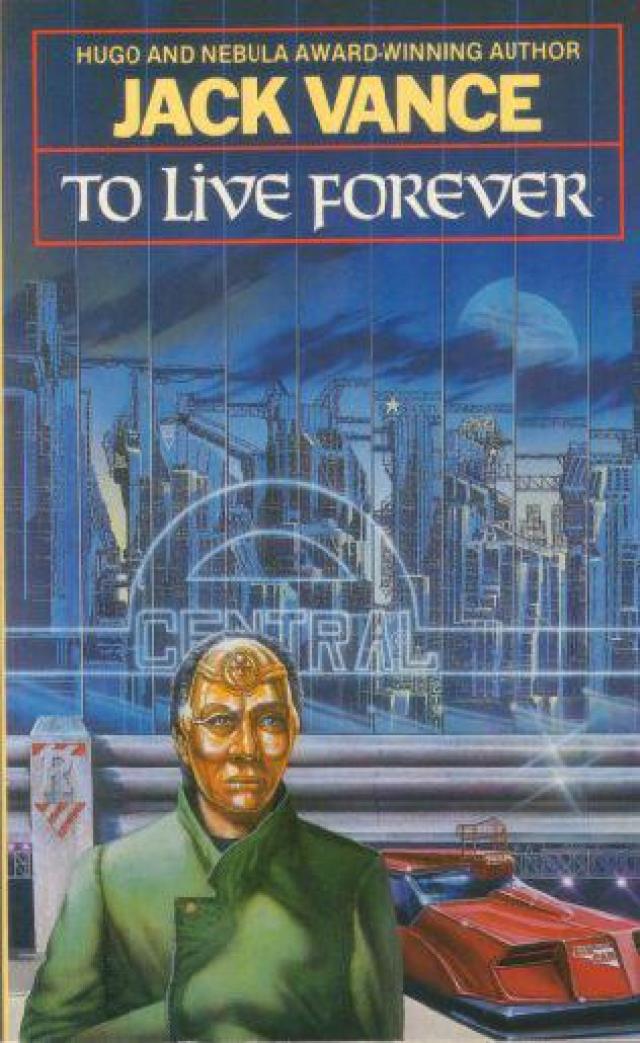


At a kiosk he bought a tube of assorted Stimmos * , and after a moment’s reflection, swallowed the yellow, the green and the purple.
Ahead rose the glowing shoulders of successive hills: far ahead Temple Cloud, then the Vandoon Highlands, with Balliasse and the Palliatory down by Riverside Road; and closer, Semaphore Hill overlooking the Angel’s Den, where Basil kept his apartment. On the crest of Semaphore Hill, overlooking all the city, was the Pan-Arts Union.
He rode up to the flight deck and boarded one of the waiting cabs. They rose through the steaming traffic levels and flitted through the towers of the Mercery. Lights by the thousands blinked above, below, to all sides. Carnevalle, burning across the black flow of the Chant, cast a colored shimmer on the water.
Chapter XI
1
T
he air cab set Waylock down on a plat crowded with private fliers, glossy toys which only Amaranth and glarks could find time to enjoy. A broad dull path, like a strip of black carpet, led to the hall. Waylock stepped upon the path; microscopic fibers, vibrating too rapidly to be felt, slid him up the slope. He was carried through a gold and glass portal, into a vestibule.
A poster read:
TONIGHT
THE AQUEFACTS
of
REINHOLD BIEBURSSON
A large, languid woman sat at a small table, where a card read: Donation gratefully accepted. The woman appeared bored, and crocheted an intricate ribbon from metallic thread. Waylock put a florin on the table; she said, “Thank you” in a hoarse voice without breaking the rhythm of her work. Waylock stepped through portières of wine-colored velvet into the reception hall.
The aquefacts of Reinhold Biebursson, intricate constructions of congealed water, occupied pedestals around the walls. On cursory inspection, Waylock found them strange and bleak, and turned his attention to the guests.
There were two hundred persons present. They stood in groups making conversation, or circulated past the glistening aquefacts. Reinhold Biebursson himself stood near the door, a great gaunt man seven feet tall. He seemed not so much the guest of honor as a martyr reconciled to suffering. This exhibition must have represented something to him—triumph, vindication, perhaps only a financial transaction—but for all the expression on his face, Biebursson might have been walking in solitude through a lonely forest. Only when someone spoke directly to him did he lower his eyes from their brooding search of the air, and then his expression became attentive and kind.
The Jacynth stood across the hall conversing with a young woman in a dramatic gray-green leotard. She wore a sheath of a gown the exact color of her hair, which tonight was dressed in the style of the Aquitani street-dancers, combed straight up into the shape of a candle flame. Her eyes brushed Waylock as he came through the portières, but passed on with no glint of recognition.
Waylock drifted with the slow stream of people around the room. The Jacynth took no heed of him, but maintained her watch on the door. Her companion, a small alluringly shaped woman, seemed to share her vigilance. Her face, piquant, narrow at the jaw, wide at the cheekbones, with great dark eyes and a tousle of dark hair, awoke a sense of vague familiarity in Waylock; somewhere he had seen this face.
He passed behind the two, and paused, so close that fragments of their conversation came to his ears.
“Will he come, will he come?” The Jacynth asked in a petulant staccato.
“Of course,” the dark-haired girl replied. “The ridiculous creature dotes on me.”
Waylock raised his eyebrows. The watch, then, was not for him. He felt a bit deflated.
The Jacynth laughed nervously. “Even to the extent of—well, even to this extent?”
“Vincent would distribute uplift pamphlets among the Nomads if I so ordered…Here he is now.”
Waylock followed their gaze to the man who had just entered the room. He was in his late youth, with the look of middle-phyle about him. His clothes were faintly precious; he carried himself with self-consciousness. Small clay-colored eyes, a long and very sharp nose, a small cleft chin, contributed to give him an expression didactic, inquisitive and minatory.
The Jacynth turned half-around. “Probably he should not see us together.”
The dark-haired girl shrugged. “As you wish…”
Waylock, now in The Jacynth’s line of vision, thought it best to move on, and heard no more. The dark-haired girl, turning to leave, bumped into two older men approaching The Jacynth. She made a charming apology, skipped away, to be intercepted by still another young man who had something to tell her; she became absorbed in his words. The two older men joined The Jacynth and engaged her in conversation.
Waylock continued around the room. The man named Vincent seemed to be involved in The Jacynth’s schemes: it might be wise to make his acquaintance.
Vincent had started toward the dark-haired girl, but seeing her occupied came to a halt with evident annoyance.
Waylock saw Reinhold Biebursson talking with a sharp-faced young man. He strolled close.
“I am ashamed,” the young man declared, “to say that I am not completely familiar with your work.”
“Few people are.” Biebursson’s voice was guttural and labored.
“One thing puzzles me, Mr. Biebursson—and I am a technical man myself—the use of congealed water, this vitreous quartzlike substance. How do you form the water into these patterns, these compound curves, and hold it so while you concrete it with the mesongun?”
Biebursson smiled. “No problem, with the natural advantages that are mine. I am a spaceman—I work where the forces of gravity have no effect, where the whole of time is mine for contemplation.”
“Marvellous!” exclaimed the young man. “But I should think the vastness of space would daze rather than stimulate you.”
Biebursson smiled his grave smile. “The void is a mouth crying to be filled, a blank mind aching for thought, a cavity desperate for shape. What is not implies what is.”
Waylock asked, “Where did your last voyage take you, Mr. Biebursson?”
“Sirius and the Dog-planets.”
“Ah,” said the sharp young man. “Then you were aboard the Star Enterprise!”
“I am Master-Navigator,” said Biebursson.
A stocky middle-aged man joined the conversation. He had a look of waggish good-humor. “Allow me to introduce myself,” he said. “My name is Jacob Nile.”
It seemed to Waylock as if the sharp-faced young man stiffened somewhat. “My name is Vincent Rodenave,” he said.
Waylock said nothing; Biebursson regarded the three with quiet detachment.
Jacob Nile said to Biebursson, “I’ve never spoken with a spaceman before; would you think ill if I asked a few questions?”
“Certainly not.”
“From what I read, it appears that worlds without number exist through the void.”
Biebursson nodded. “Worlds without number.”
“Surely there are worlds where men may walk abroad and live.”
“I have seen such worlds.”
“Do you explore these worlds when opportunity offers?”
Biebursson smiled. “Not often. I’m no more than the pilot of an air cab, who flies at the wish of his customer.”
“But surely,” Nile protested, “you can tell us more than that!”
Biebursson nodded. “There is a world I seldom speak of. Fresh and beautiful, a primeval garden. It is mine. No one else claims it. This virgin earth with its ice-caps, continents and oceans, its forests, deserts, rivers, beaches and mountains—mine. I stood on a savannah sloping down to a river. To right and left were blue forests; far ahead a great mountain range rose. All this—mine. No other man within fifteen light-years.”
“You are wealthy,” observed Nile. “A man to be envied.”
Biebursson shook his head. “This world I chanced upon once, as a man might see a beloved face in a crowd. I have lost it. Perhaps I will never find it again.”
“There are other worlds,” said Nile. “Perhaps one for each of us, if only we would go forth to seek it.”
Biebursson nodded indifferently.
“It is a life I should have chosen,” said Waylock.
Jacob Nile laughed. “We of the Reach are not spacemen by instinct. Reinhold Biebursson is not one of us. He is a man of the past—or of the future.”
Biebursson inspected Nile with melancholy interest, and said nothing.
“We live in a fortress,” said Nile. “We hold back the Nomads with barriers; we are an island in a savage sea, and the situation suits us. Slope! slope! slope!—that’s all to be heard in Clarges.” Nile held up his hands in sardonic emphasis, and went his way through the crowd.
Rodenave moved on likewise, around the line of aquefacts. Waylock waited a moment or two, then joined him. They fell into conversation.
“What puzzles me,” said Rodenave fretfully, indicating one of the aquefacts, “is how, even in conditions of no gravity, the exact shapes are maintained. The surface tension of water would quickly draw a shape like this into a sphere.”
Waylock frowned. “Perhaps he uses a detensifier—or perhaps a surface film of air-hardening mucilage—or molds.”
Vincent Rodenave agreed without conviction. They passed near The Jacynth, still in the company of the two distinguished elderly gentlemen.
“There’s The Jacynth Martin,” said Waylock casually. “Are you acquainted with her?”
Rodenave inspected Waylock sharply. “Only by reputation. Do you know her?”
“Slightly,” said Waylock.
“Personally, I am here at the express invitation of The Anastasia de Fancourt,” said Rodenave with a self-conscious tremble in his voice.
“I am not acquainted with her.” Here was the source of the dark-haired girl’s familiarity. The Anastasia de Fancourt, the famous mime!
Rodenave shot Waylock a look of calculation. “She is a great friend of The Jacynth.”
Waylock laughed. “There is no friendship among the Amaranth. The Amaranth are too self-sufficient to need friends.”
“You evidently have made a serious study of Amaranth psychology,” Rodenave observed with a trace of rancor.
Waylock shrugged. “Nothing very profound.” He looked across the room. “Reinhold Biebursson: is he not high phyle?”
“Verge. Good reliable space-travel. No study, no strain—”
“Only a high mortality rate.”
Rodenave presently divulged his own status, which was Third. He worked as technical supervisor at the Actuarian. Waylock asked what functions he performed.
“General research and trouble-shooting. For the last year my particular project has been a simplification of the televector system. Previously the operator had to interpret a code, then transfer the coordinates to a master map. Now the information is printed directly on a flake of film which is a section of the map itself. An improvement which took me into Third, incidentally.”
“Congratulations,” said Waylock. “A friend of mine is transferring to the Actuarian; he’ll be pleased to hear that opportunity for advancement still exists.”
Rodenave seemed to disapprove. “In what capacity?”
“Probably something to do with public relations.”
“He’ll make no slope there,” sniffed Rodenave.
Waylock said, “Isn’t there always scope for refinement? I’ve been thinking I might transfer to the Actuarian myself.”
Rodenave looked bewildered. “Why this wholesale migration to the Actuarian? We’re a prosaic lot; we face no challenges, no personnel difficulties, no turnover—in short, no significant scope for slant.”
“You seem to have done well enough,” Waylock observed.
“The technical field is something apart,” said Rodenave. “If a man has a logical mind, an exact memory, a penchant for perfection, he possibly will succeed—although I must admit I broke through into Wedge on an invention.”
Waylock searched through the shifting crowd; The Jacynth still stood with the two elderly men. “Interesting. What did you invent?”
“Nothing of consequence. But its commercial popularity was such—well, you’ve probably warmed yourself before a Hearth-O-Matic.”
“Of course!” said Waylock. The Hearth-O-Matic was a screen built into the wall, usually under a mantel. A turn of a switch projected the image of a fire upon the screen, anything from a crackling conflagration to a somber bed of coals, while infrared projections radiated a corresponding degree of heat. “You must have done well financially, along with your slope.”
Rodenave snorted. “Who cares for money when time is so short? Right now I should be at home studying logarithms.”
Waylock was puzzled. “Why study logarithms?”
“I should have said memorize. I am committing to memory the logarithms for every natural constant, and all the whole numbers to a hundred.”
Waylock smiled incredulously. “What’s the log of 42?”
“To base e or base 10? I have either.”
“Base 10.”
“62325.”
“85?”
Rodenave shook his head. “I’ve only reached 71.”
“71, then.”
“85126.”
“How do you do it?” said Waylock.
Rodenave made an offhand gesture. “Naturally I use a mnemonic system. I treat each digit as a part of speech. 1 is proper noun; 2 is noun, animal; 3 is noun, vegetable; 4 is noun, mineral; 5 is verb; 6 is adjective or adverb of emotion or thought; 7 of color; 8 of direction; 9 of size; null is negativity.
“I devise a code sentence for every number. It is as simple as that. ‘Careful bear, grass and fish eats.’ That’s 62325, log of 42 base 10.”
“Remarkable!”
“Tonight,” Rodenave sighed fretfully, “I might have progressed to 74, or even 75. If it were not for The Anastasia—” he stopped short. “Here she is now.” He seemed entranced.
The Anastasia came forward almost at a trot, ingenuous as a kitten.
“Good evening, Vincent,” she called out in a clear fresh voice. She turned Waylock a quick side glance. Rodenave had forgotten him.
“I have that for which you asked; I secured it at no small risk.”
“Excellent, Vincent!” The Anastasia laid her hand on Rodenave’s arm, leaned forward with a quick intimacy that caused him to stiffen and grow pale. “Come to my dressing room after the performance.”
Rodenave stammered assent. The Anastasia gave him another brief smile, turned Waylock another appraising side glance, then slipped away. The two men watched the supple form retreating. “Marvellous creature,” muttered Rodenave.
The Anastasia stopped beside The Jacynth, who plied her with an eager question. The Anastasia made a small motion toward Vincent Rodenave. The Jacynth turned her head, saw Rodenave and Waylock standing together.