To live forever, p.3
To Live Forever,
p.3
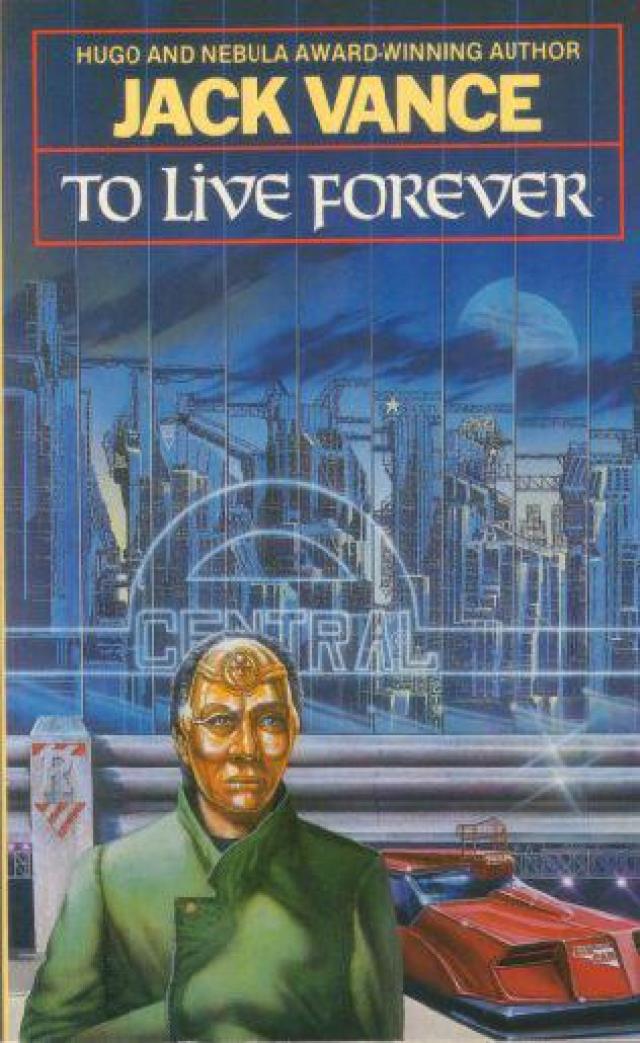


Waylock looked forward along the avenue. “I seldom cross over to Clarges,” he mused. “Once a week…Here’s the Grand Pyroteck; we shall see all Carnevalle at a glance.”
They passed under an arch which scintillated and exploded with sparks; a slideway carried them up to a high landing. One of the comet-cars, the Ultra Lazuli, veered and dipped down to a stop. Thirty passengers alighted; as many went aboard. The ports closed, the Ultra Lazuli slid up and away, trailing blue fire.
They flew low, dodging among the pagodas and towers, soared high until Carnevalle was no more than a prismatic snowflake, and at last returned to the landing stage. The Jacynth Martin, flushed and excited, chattered with the fresh joy of a child.
“Now,” said Gavin Waylock, “from high to low, from air to ocean.” He led her through another entry, down into a dark hall. They climbed upon a mushroom-shaped stand, and a transparent bubble dropped around them. They were lifted, lowered into a channel, and floated blindly through pitch-darkness. Into a watery world, glowing with faint blue and green light, they sank, drifting among coral towers and seaweed copses. Fish swam by to peer at them, polyps extended purple, red and pink streamers. Out over a great gulf they moved, and there was nothing below, only a vast black density.
The ball floated to the surface; they re-emerged into Carnevalle.
Waylock pointed. “There’s the House of Dreams. You recline on a couch and consider many strange things.”
“I’m far too restless for dreaming, I’m afraid.”
“There’s the House of Far Worlds, where you can feel the actual soil of Mars and Venus, touch the moss of Jupiter and Saturn, walk through imaginative conceptions of other worlds. And there—over across the Concourse—is the Hall of Revelation; that’s always amusing.”
They entered the Hall of Revelation and found a great chamber, bare of furnishing except for a number of raised platforms. On each of these stood a man. The first was earnest; the second, excited; the third, angry; the fourth, hysterical. They shouted, argued, addressed themselves to the knots of people who listened with interest or awe, amusement or wonder. Each of the speakers espoused a variety of religious cult. The first proclaimed himself a Manitou; the second spoke of Dionysian Mysteries; the third demanded a return to the worship of natural forces; the fourth proclaimed himself the Messiah and commanded the spectators to kneel at his feet.
Waylock and The Jacynth returned to the street. “They’re ludicrous and tragic,” she remarked; “it’s a mercy they have a rostrum from which they can relieve their internal pressures.”
“What else is all of Carnevalle?… See those people?” From an exit came men and women, by twos and threes, flushed and excited, some giggling, others pale. “They leave the House of the Unknown Thrill. The thrill is hardly unknown—it is the threat of—” he hesitated over the idea, which those of Clarges considered an obscenity “—the threat of transition. They pay to be frightened. They are tripped into a chasm, they fall screaming, two or three hundred feet. A cushion catches them. Back in the passage, a cauldron of molten metal seems to pour over them, but is diverted—so close that the heat scorches them. A giant dressed in black, with a black hat and mask—a stylized assassin—leads them into a dark room, where he clamps them into a kind of guillotine. The blade starts down and stops with the edge pressing into their necks. They come out—pale and laughing and purged. Perhaps it’s good for us to play at—at going off. I don’t know.”
“That House is not for me,” said The Jacynth. “I need no such purge, since I have none of their fears.”
“No?” He considered her through the slits in the brass mask. “Are you so very young, then?”
She laughed. “I have many other fears.”
“There’s a House in Carnevalle to tantalize them. Are you afraid of poverty?”
The Jacynth shrugged. “I don’t want to live like a Nomad.”
“Perhaps you’d like to Help Yourself to Wealth.”
“The idea has its appeal.”
“Come on, then.”
An entrance fee of ten florins was exacted at the gate to Help Yourself. They were each fitted with a harness and backboard to which were clipped nine bronze rings.
“Each of the rings represents a florin,” the attendant told them. “As soon as you enter the passages, you steal any rings you are able. Other players will steal your rings. As soon as all your rings are stolen, a buzzer sounds. You will be conducted to the pay-off booth where you will cash in the rings you have stolen. You may win or you may lose. Stealth and alertness pay better than brash grabbing. Good luck and happy theft.”
The passages proved to be a maze of mirrors and glass walls and curtained nooks. At the center was a hall whose walls were riddled with camouflaged recesses. Faces peered around corners, hands reached furtively from shadowed alcoves; the air was murmurous with hisses of exultation and frustration. At intervals the lights dimmed and flickered, and then there came a rush of skittering motion.
Waylock’s buzzer at last sounded; an attendant immediately appeared and led him to the pay-off booth, where he found The Jacynth waiting. He held a dozen rings which he cashed in.
The Jacynth said ruefully, “I’m not much of a thief. I got only three rings. You’re a better one than I am.”
Waylock grinned. “I stole two from you.”
They moved out into the street, and Waylock led her to a Stimmo booth. “What color?”
“Oh—red.”
“Red makes me daring,” said Waylock. He tilted the mask forward, put the pill in his mouth. The Jacynth looked skeptically from the pill to Waylock. “Suppose I’m already daring?”
“This makes you reckless.”
The Jacynth swallowed the pill.
Waylock laughed exultantly. “Now, the night begins.” He made a wide gesture. “Carnevalle!”
They wandered down the avenue to the esplanade. Launches and barges moored to the dock were ablaze and loud with wild sound. Across the Chant rose the towers of the Mercery; the lesser buildings up and down the river formed a lesser bulk. Clarges was austere and monumental. Carnevalle was supple and pungent and passionate.
Turning up into the Granadilla they passed the Temple of Astarte with its twenty stained-glass domes, and the Temple of Priapus beside it. Hundreds of masked and beribboned visitors streamed through the low wide doors, from which exuded the scent of flowers and fragrant wood. For a space the avenue was lined with giant grotesques, demons and monsters swaying and nodding, leering and winking; then they were back in the Concourse.
The Jacynth’s consciousness had split in two; a small cool kernel, and a much larger area which had become suffused with the personality of Carnevalle. Her faculties were concentrated on feeling and sensing; her eyes were wide, pupils dilated; she laughed a great deal and readily followed all Waylock’s suggestions. They visited a dozen Houses, sampled intoxicants at a self-serve dispensary. The Jacynth’s recollections became confused, like the colors on an old palette.
At a gambling game, players threw darts at live frogs, while spectators gasped in morbid delight.
“It’s sickening,” The Jacynth muttered.
“Why are you watching?”
“I can’t help it. There’s a dreadful fascination to the game.”
“Game? This is no game! They only pretend to gamble. They pay to kill frogs.”
The Jacynth turned away. “They must be Weirds.”
“Perhaps there’s a touch of the Weird in all of us.”
“No.” She shook her head positively. “No, not I.”
They had approached the outer edge of the Thousand Thieves section; now they turned back, and at the Café Pamphylia stopped for refreshment.
A mechanical doll brought two frosty glasses containing vermilion Sangre de Dios.
“This will refresh you,” said Waylock. “You will forget your fatigue.”
“But I am not tired.”
He sighed. “I am.”
The Jacynth leaned forward mischievously. “But you insist that the night has only just started.”
“I will drink several of these.” He lifted the goblet, tilted his mask, drank.
The Jacynth watched him speculatively. “You have not told me your name.”
“That is the way of Carnevalle.”
“Oh come now—your name!”
“My name is Gavin.”
“I am Jacynth.”
“A pleasant name.”
“Gavin, take off your mask,” said The Jacynth abruptly. “Let me see your face.”
“At Carnevalle faces are best concealed.”
“That is hardly fair, Gavin. The silver conceals nothing of me.”
“Only a beautiful person, a vain one, would dare such a costume,” said Waylock gravely. “For most of us, glamour lies in concealment. With this mask on, I’m the prince of your imagination. Remove the mask, and I am only my workaday self.”
“My imagination refuses to supply a prince.” She laid her hand on his arm. “Come,” she wheedled, “off with your mask.”
“Later, perhaps.”
“Would you have me think you ugly?”
“No, of course not.”
“Are you ugly, then?”
“I hope not.”
The Jacynth laughed. “You’re setting out to pique my curiosity!”
“Not at all. Consider me the victim of an obscure compulsion.”
“A peculiarity you share with the ancient Tuaregs.”
Waylock looked at her in surprise. “Amazing lore to find in a young glark girl.”
“We are an amazing pair,” said The Jacynth. “And what is your phyle?”
“Glark, like yourself.”
“Ah.” She nodded sagely. “Something you said made me wonder.”
Waylock stiffened. “Something I said? What?”
“All in good time, Gavin.” She rose to her feet. “And now, if you’ve had drink enough to overcome your fatigue, let us be away.”
Waylock joined her. “Wherever you wish.”
She put her hands on his shoulders, looked provocatively up at him. “Where I wish to go, you will not come.”
Waylock laughed. “I’ll go wherever you choose to lead.”
“So you say.”
“Try me.”
“Very well. Come along.” She led him back to the Concourse.
As they went up the avenue, a great gong sounded midnight. The air became heavier, the colors richer, the movements of the celebrants became meaningful and deliberate, invested with the ritualistic passion of a stately dance.
Waylock pressed close to The Jacynth, walked with his arm around her waist. “You are a miracle,” he said huskily. “A fabulous flower, a legend of beauty.”
“Ah, Gavin,” she said reproachfully, “what a liar you are!”
“I speak the truth,” he told her reproachfully.
“Truth? What is truth?”
“That no one knows.”
She stopped short. “We will discover Truth—for here is the Temple of Truth.”
Waylock hung back. “There’s no Truth in there—only malicious fools exercising their wit.”
She took his arm. “Come, Gavin, we will out-malign and out-fool them.”
“Let’s go on to—”
“Now, Gavin, you claimed you’d follow wherever I led.”
Reluctantly Waylock let himself be taken through the portal.
The attendant asked, “The Naked Truth or the Decorous Truth?”
“The Naked Truth!” said The Jacynth.
Waylock protested; The Jacynth looked slantwise at him. “Did you not claim, Gavin—”
“Oh, very well. I have no more shame than you.”
“To your left hand, if you please,” said the attendant.
“Come, Gavin.” She led him along the corridor. “Just think, you will know exactly my opinion of you.”
“So you’ll have me out of my mask, after all,” muttered Waylock.
“Of course. Didn’t you plan as much before the night was done? Or did you hope to embrace me while wearing your mask?”
The attendant conducted them each to a booth. “You may disrobe in here. Hang the numbered placard around your neck. You will carry this microphone with you, and to any comment, criticism, praise or disparagement of people you will meet, prefix the number of the person in question and speak privately into the microphone. As you leave you will receive a printed copy of comments made about you.”
Five minutes later The Jacynth Martin came out into the central hall. Around her neck hung the number 202, and she carried a small microphone. She wore no garments.
The hall was carpeted with a deep rough pile, comfortable to the bare feet. Fifty nude men and women of all ages wandered here and there talking to each other.
Gavin Waylock appeared, wearing the number 98—a man rather taller than average, youthful-seeming, well-shaped, nervously muscular. His hair was dark and thick; his eyes pale gray; his face handsome, harsh, expressive.
He came forward, meeting her gaze squarely. “Why do you stare at me?” he asked in a brittle voice.
She abruptly turned away, and looked around the hall. “Now we must circulate, and allow ourselves to be evaluated.”
“People will be oppressively frank,” said Waylock. “However,” and he eyed her from head to toe, “your appearance is beyond all criticism.” Putting the microphone to his mouth, he spoke a few sentences. “My candid impressions are now on record.”
For fifteen minutes they moved around the bright room, their bare feet comfortable on the heavy carpet, making small talk to people who seemed anxious to do the same in return. Then they returned to the booths, resumed their costumes. At the exit they were handed folded sheets of paper imprinted with the words THE NAKED TRUTH. Inside were collected the comments of those whom they had met within, generally the bluntest and most candid observations imaginable.
The Jacynth first frowned, then giggled, then blushed, then read on with eyebrows raised in amused vexation.
Waylock glanced at his sheet, at first almost negligently; then, bending his head sharply, he read with intense concentration:
Here is a face I recognize, but how and where I cannot be sure. A voice in my mind speaks a name—The Grayven Warlock! But this dread Monster was tried, adjudged, and delivered to the assassins. Who, then, can this man be?
Waylock raised his eyes. The Jacynth was watching him. He carefully folded the report, tucked it into his pocket. “Are you ready?”
“Entirely.”
“Then—let us go.”
Chapter II
1
G
avin Waylock cursed himself for a shallow fool, a mooncalf. At the frivolous persuasion of a pretty face, he had nullified the vigilance of seven years.
The Jacynth could only guess at the emotions in Waylock’s mind. The brass mask hid his face, but his hands clenched as he read the report, and his fingers trembled as he folded the paper, tucked it into his pocket.