Xaros jungle planet gu.., p.1
Xaros - Jungle Planet: Guns of the Federation Book 1,
p.1
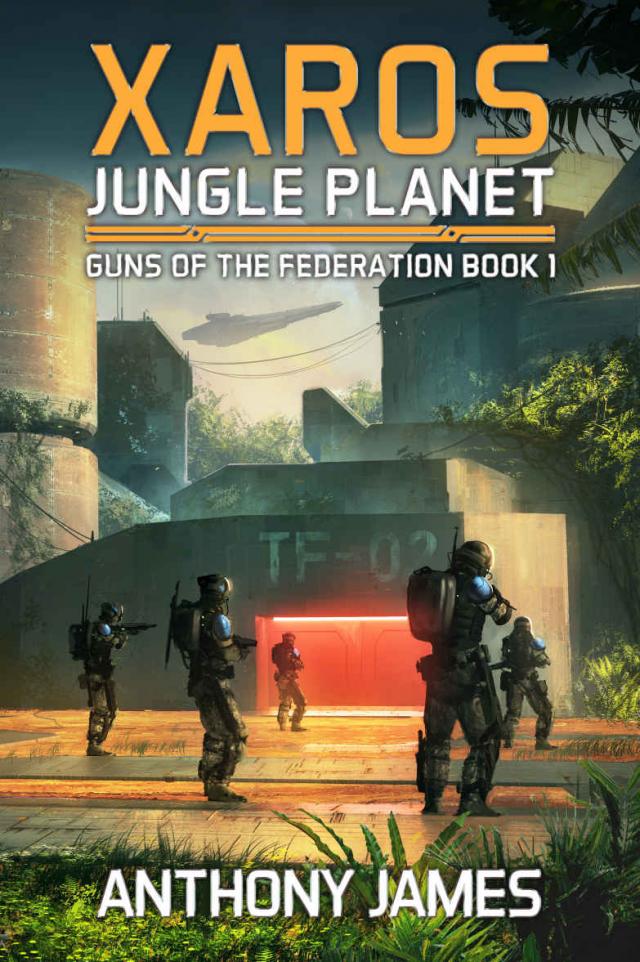


Xaros - Jungle Planet
Guns of the Federation Book 1
Anthony James
Contents
Tambus – Golor Sector
Chapter 1
Chapter 2
Chapter 3
Chapter 4
Chapter 5
Chapter 6
Chapter 7
Chapter 8
Chapter 9
Chapter 10
Chapter 11
Chapter 12
Chapter 13
Chapter 14
Chapter 15
Chapter 16
Chapter 17
Chapter 18
Chapter 19
Chapter 20
Chapter 21
Chapter 22
Chapter 23
Chapter 24
Chapter 25
Chapter 26
Chapter 27
Chapter 28
Chapter 29
End
Other Science Fiction Books by Anthony James
© 2022 Anthony James
All rights reserved
The right of Anthony James to be identified as the author of this work has been asserted by him in accordance with the Copyright, Designs and Patents Act, 1988
The characters and events portrayed in this book are fictitious. Any similarity to real persons, living or dead, is coincidental and not intended by the author
This book is sold subject to the condition that it shall not, by way of trade or otherwise, be lent, resold, hired out, or otherwise circulated without the publisher's prior consent in any form of binding or cover other than that in which it is published and without a similar condition including this condition being imposed upon the subsequent purchaser
Illustration © Tom Edwards
TomEdwardsDesign.com
Sign up to my mailing list here to be the first to find out about new releases.
Tambus – Golor Sector
The Tibor-class warship Castigate exited lightspeed with a boom of propulsion and a shudder which could be felt through the solid alloys of the bridge walls.
“Get those sensors online,” said Captain Jed Grisham, resting his hands on the horizontal control bars and holding the warship stationary.
He flared his nostrils and breathed in the over-cooled air which the warship’s life support system pumped in through vents in the ceiling. The light was an even, cool blue, yet in conjunction with the chill of the air was enough to make this feel like a place that might have been deep underground, or an outpost in a faraway icy wilderness.
“Sensors coming up, sir,” said Lieutenant Kaci Lopez.
“Running the local area scans,” said 2nd Lieutenant Dan Bishop. “Let’s hope the intel was right and we don’t run into any Kijol.”
The warship’s comms system didn’t function at lightspeed and, since the planet Tambus was two day’s comms travel time from the nearest hub, the most recent intel was already old enough to be useless. For all Grisham knew, a fleet of alien battlecruisers could be waiting here in the Arlus-2 system.
However, he wasn’t expecting to run into hostiles. According to the mission documentation, this was all about confirming the presence of Anurium. What analysis had led to Tambus being identified as a possible source of the mineral, Grisham didn’t know, but here he was doing the legwork.
“The local area scans are complete,” said Bishop. “Nothing to report.”
“Stay alert, Lieutenant,” said Grisham.
“Tambus located at 120,000 klicks, sir,” said Lopez. “It’s on the feeds.”
Grisham’s eyes were already on the bulkhead screen. Tambus was a sphere of light yellow with a nine-thousand-kilometre diameter, and fifth planet from the Arlus-2 star. From this distance, the swirling dusts of surface storms wrapping the planet were clearly visible.
“Another shithole,” said Lopez. “Same as all the others.”
“Maybe one day we’ll be sent to a tropical paradise,” said Commander Lois Deneuve.
Grisham’s glanced over to his right where Deneuve was sitting at the adjacent station. She was thirty-two years old, slim, with dark curly hair and dark eyes. She was wearing a grey combat spacesuit like every other member of the crew.
“Hoping for some vacation, Commander?” Grisham asked.
“Cat in hell’s chance of that, sir.” Deneuve’s voice was low and her accent placed her from somewhere on Loxor.
“We have to finish up here in less than six hours,” said Grisham. “After that, we return to base.”
“At least we got an easy mission for once,” said 2nd Lieutenant Eric Kinsey from his position at the propulsion station.
“You’ll have to stop saying crap like that, Lieutenant,” said Deneuve. “And before you ask, no I wasn’t superstitious before I joined the military.”
“Lieutenant Lopez, do we have any hope of detecting Anurium from 120,000 klicks?” asked Grisham.
“No, sir, the readings through that storm won’t be reliable,” said Lopez. “We’ll have to get down into the thick of it and run a close-range surface scan. Anurium isn’t usually found anywhere close to the surface, so we’re likely hunting for a fault or a fissure that goes deep into the crust.”
“I hear you,” said Grisham. “It’ll take us ten minutes on the Charos drive to reach the planet.”
Shifting the controls, he oriented the vessel and then requested maximum from the propulsion. The background hum changed to a hard-edged roar and the Castigate accelerated at a rate which would have killed the crew in moments, had the warship’s life support module not kept the interior stable. Even so, Grisham felt the strain in his neck and shoulders.
After a time, the Castigate reached its highest sub-light velocity of a fraction over two hundred kilometres per second, at which point Grisham brought the controls back to their centre position and allowed the vessel to coast through the vacuum. The engine note fell once more into the background.
“Any chance we’ll find what we’re looking for as the range decreases?” asked Grisham, more out of hope than expectation.
“If the job’s worth doing, sir,” said Lopez.
“What’s the upper altitude of that storm, Lieutenant?”
“A hundred klicks, maybe more, and it goes all the way to the surface. We’ll have sensor visibility once we’re inside, but it’ll be limited.”
“The Castigate’s paintwork is going to be a mess after this,” laughed Lieutenant Mac Adler.
“Just shows we’ve done the work,” said Deneuve.
The minutes passed and the planet grew larger on the forward sensor feed. Grisham wasn’t frightened of a storm – the Castigate’s 160-million-ton mass was enough to ensure the warship could survive the worst of nature’s wrath – but he was already feeling the pressure of the clock. While Anurium was a vital material in the production of Chareum – which was used to build Charos power modules – this was little more than a glorified scouting mission, albeit in contested territory.
Still, like Lieutenant Kinsey had said, for once this seemed like an easy mission, and Grisham didn’t get assigned many of those.
“How long will the scans take?” he asked.
“Three hours,” said Lopez. “Maybe more, maybe less, depending on luck and surface conditions.”
“Add a course overlay onto the tactical, Lieutenant. I want this done as quickly as possible.”
“Overlay added, sir,” said Lopez a few seconds later. “Stay on that heading at the given velocity and I’ll ensure every part of the surface is scanned.”
The tactical screen was to Grisham’s right and he glanced at it. A sphere representing Tambus had been ringed several times by a red line to indicate the most efficient course to follow around the planet. He adjusted the warship onto a convergent heading.
As the Castigate came near to the planet, Grisham drew back on the controls and the spaceship levelled out. As Lopez had said, the storms raged to an altitude of more than a hundred kilometres. Viewed on the sensors, the planet’s fury was unmistakable and one of the readings indicated the winds were blowing at almost eight hundred kilometres per hour.
To reduce abrasion from the combination of atmospheric friction and the dust, which was thick like deserts sands, Grisham reduced velocity to ten kilometres per second. That meant each circuit of the planet would require fifteen minutes and, at the fifty-kilometre altitude Lopez had asked for, numerous circuits would be required in order to complete the Anurium scans.
Mentally, Grisham cursed the conditions. On most other planets, it would have been a simple case of scanning from way out in space, along with a few changes of position. Maybe this was why he’d been sent to Tambus.
The Castigate entered the upper reaches of the storm and the sensor feeds immediately dimmed with a shrouding of grey. Grisham tightened his grip on the controls, though he felt nothing of the storm. On his console status panel, an amber light appeared to warn him the hull temperature was creeping up. With the spaceship travelling at only ten kilometres per second, that temperature wouldn’t climb high enough to cause significant damage to the alloy plating, though the nose section would be scarred after a time.
“Levelling out at fifty klicks altitude,” said Grisham.
Lieutenants Lopez and Bishop had worked their magic on the sensors and visibility had improved noticeably with the addition of lens filters and computational enhancem
ent from the warship’s processing core. The increased clarity allowed a view approximately two hundred kilometres in every direction, and all the way down to the surface.
“The storm is even worse at twenty klicks altitude,” said Lopez. “The sensors are having a real hard time.”
Grisham gazed at the surface of Tambus. Truly the planet was bleak, with high mountains which had somehow withstood the eroding effects of the winds, dry valleys along which wind and sand were channelled, and a multitude of wide fissures, which snaked across the surface. One such fissure ran east to west, directly through the range of mountains and Grisham wondered at its depths. From the Castigate’s current position, the underside arrays didn’t have an angle to see far beyond the opening.
“I can see why this place flagged up as a potential source of Anurium,” said Adler.
“There’s a possibility I’ll have to revise my scan time estimation in the wrong direction, sir,” said Lopez.
“In which case let’s hope we get lucky on the first circuit,” said Grisham.
He held the Castigate steady and the mountain range below fell behind. The high peaks were replaced by low, rounded foothills, which soon merged into an expansive plain of yellowish rock, strewn with immense boulders.
The enormous fissure which Grisham had seen before was to the south, visible as a dark line on the dust-shrouded horizon. For some reason, he felt an urge to bank towards it, in order that the warship’s sensors might gain a view of what lay at the bottom.
“We’re heading a little to the south, Lieutenant,” said Grisham, giving in to the temptation. He banked the Castigate portside. “I want to see what’s in that chasm.”
“No problem, sir, it won’t affect the scan time,” said Lopez. She gave a short laugh. “In fact, if there’s any Anurium on this godforsaken world, that hole in the ground is as good a place as any to find it.”
Having changed course, Grisham was irritated to discover that the fissure suddenly turned southwards, and the Castigate came no closer to the opening. Cursing the terrain, he banked again, bringing the warship far from the overlay line on the tactical.
For a few seconds, Grisham thought he was going to have to point the Castigate directly south, because it seemed as though the fissure was determined that he wouldn’t see within it. Then, the opening once more turned east and the spaceship rapidly approached.
“Let’s see what we’ve got,” said Lopez.
The Castigate flew across the fissure and Grisham altered course so that the warship would follow its snaking path. As far as geographical features went, this one was impressive, varying between ten and twenty kilometres in width. Its depths were greater still and the floor of the chasm was sometimes as far down as thirty thousand metres. What cataclysm was responsible for this sundering, Grisham didn’t know. At another time, he might have been interested in guessing, but not now.
“I’m not detecting any traces of Anurium,” said Lopez.
“Keep at it,” said Grisham, hiding his disappointment. For a reason he couldn’t explain, he wanted to get the hell away from Tambus as soon as possible.
“Yes, sir. You might as well follow this fissure a while longer. If it’s luck you want, this is the place to find it.”
For another two hundred kilometres, Grisham traced the path of the chasm as it cut across the surface. Its width and depth varied considerably, but it showed no sign of ending, as if the planet itself had been divided into two separate parts by this one fissure.
“Sir, I think I’ve detected something,” said Lopez excitedly.
Grisham drew the controls towards him and the Castigate’s velocity dropped to five kilometres per second. He peered at the forward feeds. Here, the fissure was little more than three thousand metres from one side to the other, and it sloped inwards in a way that concealed the bottom.
“What have you found, Lieutenant? Is it Anurium?”
“Yes, sir, at trace levels only,” said Lopez. “There might be greater concentrations deeper down.”
The chasm was easily wide enough to accommodate the Castigate, but Grisham didn’t relish the idea of piloting his warship inside.
“Screw it,” he said. “There’s plenty of room.”
“The sooner we’re done, the sooner we’re out of here, sir,” said Deneuve.
“Let’s get it over with,” said Grisham. He realised his mind was already on the next mission, whatever that might be, and he forced himself to concentrate on finishing this one.
Positioning the Castigate directly over the chasm, Grisham dropped it vertically through the storm. The sands blew fast along the fissure, in a mesmerising flow like a river of muddy yellow.
“Here we go,” said Adler.
The Castigate’s descent took it beneath the surface and the feeds darkened. Grisham watched those feeds carefully, noting how sand erosion had left the walls of this place smoothly rounded, yet with endless tiny scratches of abrasion.
Following the slope of the wall, Grisham guided the warship deeper inside. Rather than narrowing, the fissure widened. A few hundred metres away, the slope turned into a sheer drop and the bottom was still hidden.
“There’s Anurium here and lots of it, sir,” said Lopez. “We’ve struck paydirt.”
“Is there any need for me to continue deeper into this fissure, Lieutenant?” asked Grisham, bringing the Castigate to a standstill.
“Probably not, sir. We’ve found what we came looking for and the concentrations I’m detecting breach the threshold required for a full-scale expedition. I guess they’ll set up a mining operation here on Tambus.”
It was the news Grisham had been waiting for and he was about to guide the warship once more to the surface when he felt a sudden, unexpected need to see the bottom of the fissure. After a moment’s deliberation, curiosity got the better of him. Maybe they could unearth yet more useful data to send back to base.
Piloting the Castigate to portside brought it directly over the place where the fissure walls become once more vertical. To Grisham’s amazement, this part of the fissure opened into an immense sub-surface cavern many kilometres deep and, though the sensors didn’t yet have an angle to view everything, he was sure it was also many kilometres across.
“Sir! The sensors are detecting Terylium in those rocks!” said Lopez, practically jumping out of her seat. “A crapload of it!”
“Hot damn!” said Adler. “They’re going to give us a medal for this.”
“We’ve found what we came for. Do you need any more time to scan?” asked Grisham. This was great news, but his curiosity had evaporated and now he wanted to be away.
“No, sir,” said Lopez. “Tambus is about to become the most popular shithole planet in the whole of the Golor sector.”
It was all Grisham needed to hear and he guided the Castigate back towards the surface. As his view through the opening widened, he thought he caught a glimpse of something, and then it was gone.
That was all the warning Grisham was given before a warship dropped into sight, sinking like a stone into water. From safety only a moment before, he now found himself staring directly at the twelve-hundred-metre hull of a Kijol Aeon-class destroyer.
Chapter One
Grisham had no idea if the enemy vessel had somehow managed to follow him here, using its superior sensors to pursue from a distance, or if its arrival was no more than terrible misfortune. One thing was sure, the Castigate was completely outgunned.
If the Kijol didn’t know we’re here, perhaps they’re as surprised as we are.
“Lock and launch, Commander!” shouted Grisham.
Deneuve had the kind of reactions that made the guys who built the training simulators wonder if she was cheating.