War vessel of the axkol.., p.10
War Vessel of the Ax’Kol: Guns of the Federation Book 2,
p.10
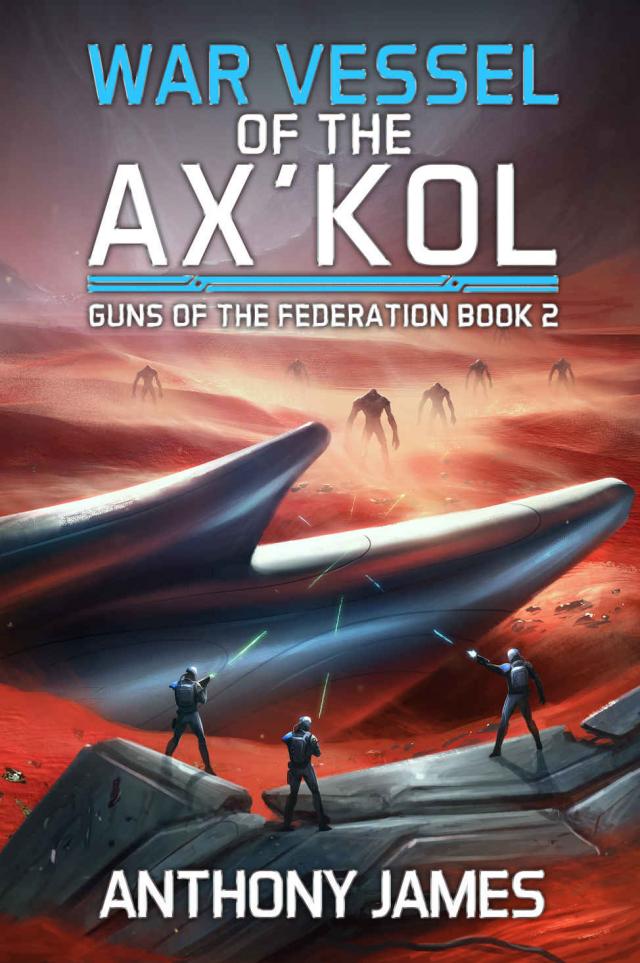


“I see shuttles, a couple of Excar fighters, one old gen Aeon destroyer and an old gen Achirus cruiser,” said Commander Deneuve, staring across the bay floor.
The Excar fighters were about four hundred metres in length and with V-shaped hulls. Both were parked parallel to the eastern bay wall. These vessels lacked the curved spines of other Kijol warships and they also lacked the firepower necessary to challenge even an old-gen Tibor. As such, the Excars were used primarily to attack ground vehicles – a task at which they excelled.
The Aeon destroyer was parallel to the western wall. These vessels weren’t designed to land, but the Charos drive of this one had evidently been shut down as part of the base evacuation, and the vessel was on the ground.
“The Achirus has taken some damage,” said Deneuve. “I guess it was in here for repairs.”
The cruiser was parked east-to-west across the bay. It too, was on the ground. The dozens of shuttles – large and small - which had been abandoned here didn’t interfere with Grisham’s view of the Achirus and he studied the craters in the warship’s hull. The vessel had suffered three visible missile impacts and Grisham thought that HF Ghosts might have been responsible.
“If every other door is open, why are those surface ones closed?” asked Lowe.
“That’s a good question, Private,” said Grisham, without offering a suggestion as to why the bay doors were shut. A few guesses jumped into his mind, but he didn’t air them.
“Anything we can use in here, sir?” asked Maxwell. He was obviously interested in the shuttles and his eyes were fixed on one of the armoured transports near the destroyer.
“I don’t know, Sergeant,” said Grisham. “I’ve never come across Kijol hardware in this state before, but – even if we can bring it online – I doubt we’ll be able to get any of these transports off the ground. Not without security codes.”
“And we’d have to figure out how to open those overhead bay doors,” said Lieutenant Adler.
“Then fly out under the nose of the Achirus,” said Grisham.
Despite his doubts, he was nonetheless convinced this was an opportunity. However, the mission had several priorities and Grisham couldn’t decide if exploring here was a greater priority than finding the comms hub. He made his uncertainty clear to the others.
“I count at least four lightspeed capable shuttles, sir,” said Commander Deneuve. “They won’t have a high multiple, but they’d get us to an HF facility in a few weeks.”
“The time we’d spend trying to get one of those working is my biggest worry, Commander. And getting out past the Achirus won’t be possible. We’d need to wait for it to leave.”
“Then you have your answer, Captain,” said Deneuve. “These shuttles will have to be the backup plan. If there’s no comms tower in the north, or if the Achirus goes elsewhere, we can talk about returning to this bay.”
Grisham grimaced. “This feels like a bird in the hand, Commander. Once we leave this bay, we may never be able to return to it.”
“In which case, we’ll handle what we’re left with.”
“Do you have a decision, sir?” asked Maxwell.
“Let’s stick with the original plan,” said Grisham. “We’ll find a comms tower and see what options are open to us then.”
“We’ll head diagonally across the bay towards the north-west corner,” said Maxwell without hesitation. “Since that Achirus is flat to the ground, we’ll have to go around it if we want to take an exit through the north wall.”
“Lead on, Sergeant,” said Grisham.
The soldiers were eager to go. Maxwell set off at a fast jog and gradually increased the pace.
Following not far behind, Grisham kept a wary eye on his surroundings. Turning, he could see three other entrances in the south wall, one of them large enough for a loading crawler to pass through. Surely there were many additional entrances from the other directions, but the landed spaceships prevented him seeing them.
The bay floor was solid and the soldiers’ footsteps made little sound. Neither did anyone speak – at Maxwell’s current pace, this would be a hard run to the north-west corner and nobody wasted their breath on words.
Grisham was glad to find that his legs had already recovered from the long descent of the steps and he kept up without difficulty. Soon, the mission personnel passed the nearest Kijol shuttle. This model was high sided and bulky, and more than fifty metres in length. Four hemispherical housings – gravity chains - on its underside indicated this was a lifter shuttle and most likely a vessel dedicated to repair work in the bay.
A little further, the group passed within a hundred metres of a second shuttle. This one was broad and angular, with twin repeaters slung beneath its nose, and flank missile launchers. Maxwell studied it as he went past.
“There’s a green light on its access panel,” he said, slowing.
Grisham hesitated. “Screw it,” he said. “Let’s see if that thing will fly. We’ll have to be quick.”
“Yes, sir,” said Maxwell, diverting towards the shuttle.
At that moment, Grisham heard a whining sound, along with a rumble. It took him a moment to realise what it was.
“Shit,” he said, looking up. “The bay doors are opening.”
Sure enough, a narrow gap had already appeared. The Achirus would be up there and soon its sensors would have a view directly into the bay.
With no other cover within three hundred metres, Grisham and the soldiers ran for the shuttle.
TWELVE
Maxwell was a fast runner and he was first to arrive. The vessel was parked on three-metre landing legs, so the entrance doors were out of reach.
“The light’s green, but the access panel won’t accept an interface request from an HF suit,” said Maxwell. He strode towards the landing leg directly beneath the flank door and pulled open a hatch. “Luckily, I know how to get inside.”
Inside the hatch was a large red button, which Maxwell pushed with the knuckles of his clenched fist. With a faint scraping sound, a ladder slid from a recess in the shuttle’s flank armour and the feet of its side rails hit the floor with a clunk.
Maxwell climbed rapidly, while the soldiers clustered beneath the transport’s hull, hoping they could avoid detection.
“Got it,” said Maxwell. “The door is open.”
Grisham was closest to the ladder and he was second up after Maxwell. As he climbed, he stared towards the bay ceiling. The doors were many metres apart already and a thin curtain of sand was falling through the opening. However, the shuttle was parked off-centre of the floor and that meant the Achirus wouldn’t yet have the soldiers in its visual arc.
When he was almost at the top, Maxwell reached out a hand and hauled Grisham into the compact airlock.
“I’ll check out the cockpit,” said Grisham at once.
The inner airlock door was already open and he dashed through, noticing at once that the engines were offline. He hadn’t been on a Kijol shuttle in a long time, but finding the cockpit didn’t require a doctorate in orienteering. A short corridor ended at an intersection, where Grisham could turn left towards the nose or right towards the stern. He went left and entered the forward passenger bay. Rows of empty metal seats were separated by three aisles and the cockpit door was directly ahead.
“Do we have access to the cockpit, sir?” asked Maxwell on the comms.
“There’s a green light,” Grisham confirmed. He touched the access panel. “The door is open – we’re in.”
Five steps led to the cockpit and Grisham entered. The size of the transport meant it was fitted with high grade tech. The hardware lights were on and Grisham sat in the centre of the three seats.
“What’ve we got, sir?” asked Commander Deneuve, entering the cockpit.
“Kijol tech,” he grunted, his eyes darting around the console. It was similar to HF hardware in many ways and the language module in his suit was able to translate the labels, but the differences were still enough that Grisham wasn’t confident to start pushing buttons yet. “I’m trying to remember how it works.”
Deneuve took the left-hand seat. “I’ll see if I can help.”
Lieutenant Lopez was next into the cockpit and she took the third seat. “I think we’re all going to make it into this shuttle without the Achirus spotting us,” she said.
“I’m not counting any chickens yet, Lieutenant,” said Grisham. “The Achirus crew opened those bay doors because they’re looking for us. And now we’re stuck in here.”
“Captain, we’re all inside,” Maxwell reported on the comms. “And since no missile hit us yet, I’m guessing that means we made it unseen.”
“Keep your heads down, Sergeant,” said Grisham. “Maybe we can bring this transport’s sensors online. Then we’ll be able to keep an eye on the Kijol.”
“Yes, sir. What about the engines?”
“We can’t risk trying to bring those online with the bay doors open,” said Grisham. “The Achirus will detect the noise of it happening, as well as the output from our hull.”
“Can we plug Corporal Barkley’s booster pack into the shuttle’s comms?” asked Maxwell hopefully.
“We could probably rig something up,” said Lopez. “But any transmission is going to require weeks to reach its target. This is why we’re so interested in the main comms hub antennae – they’ll be fitted with the best amplifiers the Kijol can build.”
“Yes, ma’am.”
Grisham had the knack with hardware and the other members of his crew did too. In a few minutes, they’d figured out how the main console worked.
“These two buttons here should activate the propulsion if that Achirus moves away,” said Grisham. “But I don’t know if it’ll come online or not, what with the installation-wide security override.”
He was itching to find out, even though activating the engines would be a certain death sentence. Assuming the cruiser would leave Ovintus at some point, this shuttle might well provide a means of escape, albeit at a very low lightspeed multiple.
“I’m ready to bring the sensors online,” said Lopez.
“Do it.” Grisham switched into the squad comms. “Sergeant Maxwell, you might want to come and look at this.”
“Yes, sir.”
The full width curved screen mounted to the top of the console illuminated and Grisham squinted at the brightness. Feeds of the bay appeared.
“The bay doors are fully open,” said Grisham. He turned at the sound of Maxwell’s arriving. “Looks like we made it just in time, Sergeant.”
Maxwell knew they were trapped and he made a noncommittal sound in response.
The bay itself was larger than the doors, but the opening was more than big enough for the shuttle’s sensors to obtain a view directly upwards. Sand still blew across the installation and some of it entered the bay. Directly overhead, the Achirus cruiser was motionless in the sky, at the same three-thousand-metre altitude as earlier. Grisham stared at the warship’s underside turrets and launch clusters, any one of which could pulverise this armoured shuttle in moments.
“Are they just going to look for a while and then move to another part of the installation?” asked Maxwell.
Grisham didn’t think that was what the Kijol planned. “I reckon they’re going to stay parked right where they are, Sergeant. Crossing this bay is probably the only way to the northern end of the installation, and by watching it, the Kijol intend to cut off our escape to the north.”
“And they succeeded in doing so,” said Deneuve sourly. “Smart bastards, eh?”
“So we have to sit here and wait,” said Lopez.
“Unless you have a better plan, Lieutenant.”
“Sergeant, you might want to come see this,” said Corporal Fine on the squad channel.
“That means I don’t want to come see it,” said Maxwell.
“Yes, sir, but you should anyway.”
Maxwell turned for the cockpit exit. On a whim, Grisham rose from his seat and followed. “Shout if you see anything, Commander.”
Corporal Fine was in the rear cargo bay, along with Private Lyles, Private Chau and a few hundred dead Kijol. The stench was terrible and Grisham shut off the filter in his suit helmet.
“We picked a good place to hide out,” said Lyles.
Grisham forced himself to look at the corpses. The cargo bay occupied the rear half of the shuttle and was intended to carry munitions, not dead bodies. Those bodies were piled up against the rear bulkhead, torn flesh exposed and dead faces staring blankly. The floor was covered in dried blood, but the thickest of it trailed to the flank loading door.
“Another stash,” said Fine. “Should I ask Private Franklin to take a look, Sergeant?”
“Don’t bother,” Maxwell growled. “I know what he’s going to say.”
“What if these corpses jump up and start throwing punches?” asked Lyles.
“We’ve seen no sign of those dark aliens,” said Maxwell.
“But they’ve been here, Sergeant,” said Grisham.
“That they have, sir.” By his expression, Maxwell wasn’t sure what he wanted to do. “If we burn these corpses with grenades, will the heat spill out through the hull?”
“Best not take the risk,” said Grisham. He crossed to the cargo bay access panel and inspected it. “There’s no way to lock this from here. Maybe I can do it from the cockpit.”
“I’d feel better knowing there was six inches of metal between me and these things,” said Fine.
“Me too,” said Grisham.
“I wonder if the Kijol know what a shit job they did at cleansing this base,” said Lyles.
“I have a feeling they did what they could and then left,” said Grisham. “I’m heading back to the cockpit. I’ll check if the cargo bay door will lock.”
“You’ll make that check first, sir?” asked Fine.
Grisham smiled thinly. “It’ll be the very first thing I do, Corporal.”
He returned to the cockpit, where his crew already knew exactly what was happening from the talk on the comms.
“The cargo bay door won’t lock, Captain,” said Lopez. “The override code is still in effect.”
“Well damn,” said Grisham. “Make sure Sergeant Maxwell is aware.”
“Yes, sir,”
Movement on the sensors caught Grisham’s eye and he swore when he realised what it was. A shuttle had been launched from one of the cruiser’s underside bays. The transport descended through the storm, on a heading that would bring it directly into the subterranean bay.
“Damnit,” said Grisham. “They’re coming our way. The Kijol must intend to land troops and send them south in the hope of catching us in a pincer.”
“If so, they’re too late,” said Lopez.
The Kijol shuttle came in at speed. Two hundred metres above the bay floor and about three hundred metres from the vessel in which Grisham and the others were hiding, it came to a halt. For a time, the enemy craft did nothing.
“They’re scanning,” said Lopez. “Looking in the places the Achirus can’t see.”
Even though Grisham knew he couldn’t be detected, he felt anxious. His eyes went to the control panel, where a green light assured him that the flank entrance door was still closed. The ladder was also retracted, and, unlike the side doors, it could be locked in place from the cockpit.
“If the Kijol search this bay, we’re in the shit,” he said.
After another five minutes of scanning, the Kijol shuttle rotated about its vertical axis and then accelerated towards the north-east corner of the bay.
“Looks like I was wrong - they’re going to send troops north,” said Grisham. “Chasing us through those tunnels would be stupid unless the Kijol have already landed other soldiers further north.”
Maxwell was in the cockpit too and watching the developments. “That shuttle will make a partial deployment and then it’ll head to the south end of the bay for another deployment. That’s what I’d do at least.”
“And what would you do after making the north and south deployments, Sergeant?”
“That shuttle has no reason to leave, Captain. I’d guess it’s going to stick around here for a time.”
Grisham swore. “I’m sure you’re right, Sergeant, though I wish it were otherwise.”
The Kijol transport remained on the ground for sixty seconds. The vessel’s orientation prevented Grisham from seeing how many enemy troops exited the transport.
“It’s going up again,” said Lopez.
Just like Maxwell had called it, the shuttle flew south and then landed. This time it set down at an angle which allowed Grisham to count the exiting Kijol troops as they sprinted towards the stairwell entrance.
“Two hundred,” he said. “Maybe a few more.”
“I’d say that transport has seats for four hundred,” said Maxwell. “If the Kijol deployed the same number north, then it may be empty except for its crew.”
Once the enemy troops stopped coming down the shuttle’s exit ramp, the vessel climbed once more into the air. Grisham willed it to stay there and not land again. Slowly, the Kijol shuttle accelerated north and then it came to a halt two hundred metres east of where the mission personnel were hiding.
“It’s going to land,” said Deneuve through gritted teeth.
Down came the Kijol transport and it landed adjacent to one of the bay lifter shuttles. Once more its flank door opened and troops emerged at speed.
“Another hundred,” said Maxwell, his voice taut. “Either it was standing room only on the way down, or the Kijol only sent a hundred north.”
With his own anger growing, Grisham watched as the Kijol troops broke into squads of ten. Each squad headed in a different direction.
“Some of them are coming our way,” said Maxwell.
“Was it ever in doubt?” asked Grisham through gritted teeth.
He was sure Maxwell and his squad could dispose of ten Kijol by ambushing them, but those ten deaths would bring hundreds of other alien soldiers this way. Or perhaps the enemy would choose the faster method of launching plasma missiles from the cruiser.