War vessel of the axkol.., p.22
War Vessel of the Ax’Kol: Guns of the Federation Book 2,
p.22
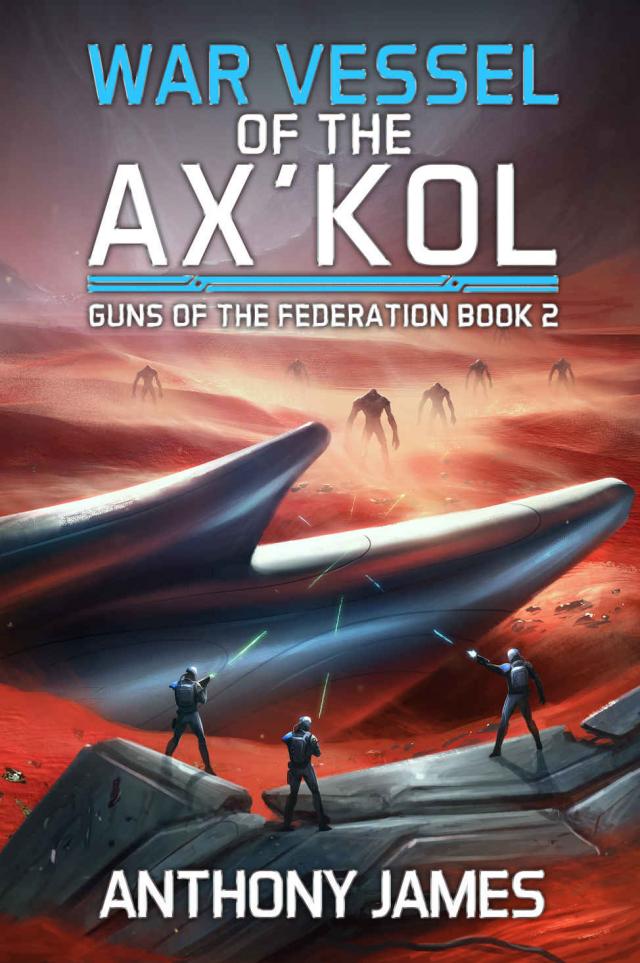


Grisham nodded while he looked across the vast bowl of the impact crater. The sand blew here like elsewhere, but it was not so dense and it didn’t prevent him seeing into the distance. The Achirus lay ahead. The plasma fires from the surface battery’s missiles were gone and he counted five huge craters in the warship’s flank. Heat lingered and would do so for days.
Of the Kijol, Grisham saw no sign. The aliens were no more adept at surviving thousand-metre falls than a human. He hadn’t mentioned it to Maxwell, but it was remotely possible a few of them had been inside a shuttle with independent life support and had therefore lived. However, no vessels large or small were visible in the sky.
Grisham turned his attention south. About two hundred metres of the alien vessel protruded from the inside of the crater wall and the rest of it was buried beneath the rubble. The part he could see was a corner, along with three adjoining surfaces that were slightly curved.
At the bottom of the slope near the alien vessel, yet more of the planet’s ancient architecture had been revealed. Broken pillars and some carved slabs of red stone lay scattered across a wide area. Grisham suspected the remnants of a huge city lay buried beneath this part of Ovintus.
“You’re hoping to find a way inside that warship,” said Maxwell.
“I am,” Grisham nodded.
“It’ll surely be locked against intrusion.”
“Yes.” Grisham’s eyes scoured the exposed part of the vessel’s hull. Its surface was completely nonreflective and with a slight undulation to the material - likely a result of the Kijol incendiaries. “But it’s possible that when it impacted, an emergency protocol released all the locks.”
“A warship needs a crew,” Maxwell observed.
“That’s the risk, isn’t it?” said Grisham. “But glass wouldn’t hold a vessel like this. If there was anything left alive, this spaceship wouldn’t be here for us to find.”
The rest of the mission personnel began arriving at the top of the slope. So far, nobody had fallen. After everything which had happened so far, a death or injury here would be especially galling.
“Let’s take a look at that warship,” said Grisham.
He headed towards the protruding section of hull a few hundred metres away. The slope on the inside of the impact crater wasn’t so steep and, though it was littered with more of the boulders, rocks, and sand, it was far easier to descend.
Soon, Grisham was within touching distance of the alien vessel. Its upper section rose far above him and he was certain much more of it remained unseen. Now that he was so close, Grisham could see the hull damage much more clearly. The marks didn’t look the same as those he’d seen on other warships that had been affected by incendiaries. Usually, the metal would be scorched and blackened, and it would melt and harden in a recognizable way. Here, the spaceship’s hull was a uniform colour and the undulations reminded him of scarring on human skin more than anything else.
Stepping closer, Grisham rubbed his fingertips across the vessel’s hull. It was solid like alloy, though he was sure it wasn’t metal, and, when he pressed harder, he sensed a yieldingness.
“What’ve we got?” asked Commander Deneuve, heading his way across the uneven ground.
“It’s the same material as that hemisphere under the Kijol installation,” said Grisham.
“Is there any way in?”
“Not on this side. Let’s try around here.”
Grisham stepped away and headed for the corner of the warship, about thirty metres down the slope. By now, the rest of the mission personnel were here. A few of the soldiers were sitting, but they were all on their guard. Most of them had a wary eye on the Achirus, as if they expected its engines to come online at any moment.
When he rounded the corner, Grisham saw an imperfection in the spaceship’s hull about twenty metres away, and half-buried in sand. He hurried closer, laid his rifle to one side and began scooping at the sand and glass.
“An entrance hatch,” said Deneuve, getting down to help.
Soon, their efforts had revealed most of an entrance, which was about two metres square. Grisham swept away the last of the sand which covered a twelve-inch circular indentation. This circular area glowed with a dim green light.
“The power is on,” said Grisham.
As if sensing the potential for a significant discovery, most of the soldiers, including Sergeant Maxwell, had come over to watch.
“Will it open?” asked Private Lowe.
Grisham touched the lit area and nothing happened. He pressed his entire palm into the indentation with no more success.
“No, it won’t open,” he concluded.
At that moment, Maxwell visibly stiffened. He raised his gun and pointed east with his free hand. “Hostiles!”
Grisham snapped his head around and what he saw chilled his blood. Far away – perhaps two kilometres or more – dark shapes were standing on the rim of the crater. He counted seven in total, and they were little more than blurs in the sand. Not one of the aliens was moving, but he knew they were looking straight towards this spaceship.
“They’ve been trapped here ever since their engagement with the Kijol,” said Grisham, as he added things up. “Now the Achirus broke the glass around this spaceship, they have a way to escape.”
This mission had been filled with challenges, one after the other. Each time a challenge was overcome, another followed, with no respite and with seemingly no way to come out on top. Grisham was beginning to think he was in the middle of a deadly game that he could never win, no matter how well he played.
He reached for his gauss rifle.
TWENTY-EIGHT
Maxwell gave orders and the soldiers took cover. There was plenty of it to be found.
“So much for incendiaries,” spat Lyles, crouching next to the warship, not far from the corner.
“Those aliens might have been hiding beneath one of the batteries the Achirus didn’t get round to destroying because we knocked it out of the sky, Private,” said Lieutenant Adler.
“Yeah, well, it sucks whichever way you look at it, Lieutenant.”
Grisham stayed near the door, in case his mind served up an inspirational method for gaining access. He focused on the aliens, which still hadn’t moved. A gauss rifle had tremendous range in the right circumstances, but shooting at a target two thousand metres away in a strong crosswind would be an exercise in futility. Everyone held fire.
“What’s the range on that repeater, Private Vaughan?” asked Grisham.
“I can hit them from here, sir, but with reduced impact. I’m down to a magazine-and-a-half of ammo, so it’ll be best if I hold fire until I can guarantee maximum effectiveness.”
“We’ve got others incoming from the north!” said Diaz.
Another four aliens had appeared on the top of the crater edge, these ones so indistinct that Grisham wasn’t sure how Diaz had managed to spot them.
“The Achirus didn’t take out the northern batteries,” said Corporal Fine. “We’re going to see others.”
“We don’t have the firepower to kill the first seven,” said Maxwell. “Nor the ammunition.”
“We could return to the battery,” said Private Franklin. “If all the aliens are heading for their warship, maybe it’ll be safe for us to go back that way.”
“They’ll run us down before we’re halfway there,” said Maxwell. “They want their spaceship, but I’ve seen enough to have learned that they’re sadistic bastards – they can kill us and still get what they want.”
“The ones to our east are moving,” said Vaughan.
“Same to the north,” said Diaz. “They’re coming real slow.”
“They want to make us suffer,” said Maxwell. He sounded livid.
Slowly, the aliens descended into the impact crater. Grisham stared, unblinking. Soon, he knew, these aliens would break into a run and he was sure it wouldn’t take them long to cover the ground, even with the sand and the rocks slowing them down.
“Uh,” said Lyles suddenly. “There’s something humming in my pack.”
Grisham didn’t look over. He held his rifle steady, wishing he was sitting at the controls of a surface mounted Gatler turret.
“Here they come!” yelled Barkley.
All at the same time, the aliens accelerated across the floor of the impact crater. Their arms rose and fell jerkily, yet they seemed to flow across the ground.
“A little over two minutes and they’ll be among us,” said Maxwell. “We’d best make every shot count. Hold for my order!”
Lyles was still muttering about her pack and, from the corner of his eye, Grisham saw her shrug out of it.
“Is this the right time, Private?” he asked.
“Sir, I’ve got a feeling—”
Lyles tore open the flap of her pack and reached inside.
“A feeling about what?” asked Grisham. He was bordering on anger at the distraction. Only his knowledge that Lyles was a competent and experienced soldier held it in check.
“This!” said Lyles in triumph. Between her forefinger and thumb, she held a small grey cube with a few protruding wires. “It’s from the Xaros security breaker. It started vibrating when we came close to this spaceship.”
Grisham remembered the discussion about it in the Marauder’s mess room. “Give it here!” he said.
“All yours, sir.”
Lyles threw it, none too gently, and Grisham put out his hand. The cube was heavier than it looked and it thudded into his palm. He wrapped his fingers around it and felt the vibration which had caught Lyles’s attention.
“Fire!” yelled Maxwell.
The soldiers unleashed their guns and Vaughan fired his repeater. Private Lowe was running short of ammunition and he held fire in the hope of landing a shot on two aliens with the same rocket.
“Let’s see what this does,” said Grisham.
He was right next to the hatch and he held the cube against the access panel. The green light turned blue and the hatch opened to reveal a ten-metre-long passage that led to a compact-looking space lit in dim blue.
“We have access to the warship!” said Grisham.
“Is it defensible?” asked Maxwell. He didn’t have an angle to see beyond the opening.
“The enemy will only be able to enter one at a time, Sergeant.”
“Then let’s go,” said Maxwell. He raised his voice. “We’re retreating into the spaceship!”
Grisham was closest and he went first. The ceiling in the passage was high enough for him to stand and he hurried along. Every surface was the same material as that of the hull, though here it was smooth and unblemished. The air smelled stale and musty, like years-old decay, and the desert wind was the only sound.
The room he’d seen from outside had a single exit, opposite to the way in. A panel there was blue and the door was open. It made him hopeful that the internal security had left all areas of the interior accessible.
Grisham paused and looked behind. The passage from outside was already filled with the members of his crew and the soldiers would be following them. He found what he was looking for, that being an access panel adjacent to the exit tunnel. With any luck, he’d be able to close the outer door using the cube, though he was sure that wouldn’t delay the aliens for long.
“The first of those assholes will be here in less than sixty seconds,” said Corporal Fine, emerging into the room.
Grisham held out the cube. “Take this, Corporal,” he said. “Once everyone’s inside, press it against that access panel. If one of those aliens opens the door afterwards, close it again.”
“I can manage that, sir,” said Fine. She took the cube.
“My crew and I are going to find the bridge. The engines are offline – maybe we can do something about that.”
“Won’t you need this?” asked Fine, indicating the cube resting in the palm of her hand. “And what if there are aliens or internal defences?”
“I’m taking a gamble,” said Grisham. “What other choice to I have?”
Fine didn’t answer.
Grisham led his crew into the tunnel leading from the entry space. The corridor wasn’t quite wide enough to travel abreast, so the crew went single file. Grisham judged the space to be just right for a single massive alien to traverse if it was running on all fours.
The passage sloped down and another corridor branched right. Grisham paused and looked that way. He saw a room.
“This way,” he said, acting entirely on hunch.
The next room was larger than the entrance space, and it was square. A grey metal cuboid – its longest edge about a metre - was embedded in the floor in one corner. What purpose this object served, Grisham couldn’t begin to guess.
He didn’t slow and sprinted through the exit in the wall opposite. A glance at his HUD informed him that the comms link to the soldiers was already degrading. If the warship was as large as he believed, the lack of comms might become an issue.
The next passage turned left, towards what Grisham thought might be the vessel’s nose, though the forward section of the ship was likely still many hundreds of metres away. Forty metres further, the passage opened into a ten-metre room, this time with two exits, both leading from the opposite wall. The scent of old decay was stronger here, though with no apparent source.
Several metre-long metal posts emerged horizontally from each of the left and right walls. An additional post rose from the middle of the floor to a height of one-point-five metres. These posts were all made from a different material to the rest of the spaceship and again, Grisham couldn’t imagine their purpose.
“It’s been longer than a minute since Corporal Fine gave her warning, sir,” said Lieutenant Kinsey. “The enemy will be at the door.”
Grisham came to a halt. He was running headlong in whatever direction his feet carried him and maybe he needed to stop and think, rather than hoping he’d reach his goal through luck alone. After all, luck hadn’t exactly been on his side so far.
“Corporal Fine, please report,” he said, walking deeper into the room.
“We’re all inside, sir,” she said. “The cube closed the door and it hasn’t opened again.”
“Keep watching,” said Grisham.
“Yes, sir.”
Grisham stopped at the central post. It was dull and unadorned. Without thinking, he reached out and placed his hand on the flat top of the metal.
Straightaway, his surroundings faded and became dim, though he remained aware of them. Grisham felt a presence all around him – a presence that was both intelligent and conscious. Perhaps it was sentient as well, but he couldn’t be sure.
The warship. I’m communicating with the warship.
TWENTY-NINE
Somehow, Grisham knew exactly what to do, as though the method was ingrained within him. His mind went seeking and a vision of what lay outside formed in his head. He saw the far edges of the crater and the wrecked Achirus as if there was no sand blowing at all. Elsewhere was only darkness. In these directions, the warship was blind.
Looking closer, Grisham saw the huge aliens clustered around what he now knew was the warship’s stern. One of the creatures held a device.
Request denied. Security key provided.
Request denied. Security key provided.
The warship didn’t understand Grisham’s language and it didn’t need to. It communicated with images, thoughts, concepts and ideas, all rolled into one to produce an exact response to whatever was asked.
In moments, Grisham learned that the warship had been nearly destroyed by the Kijol, and its systems – systems wasn’t quite the right word, but it would do – had been made inoperable. The vessel had nearly healed itself and it would soon be at its maximum potential.
It was ready for a new crew.
“Sir?” asked Commander Deneuve.
Grisham heard her voice as though she were standing behind a heavy curtain. He answered.
“We’re going to the bridge,” Grisham said, his own voice sounding remote. “We can’t do what we need to do from this node.” He lifted his hand from the post and everything snapped back into focus. “The bridge is along there,” he said, pointing to the left-hand exit.
“How are you so sure?” asked Deneuve. She was looking at him strangely.
“Let’s go,” said Grisham. “I’ll tell you on the way.”
He dashed into the left-hand passage and ran for the bridge. He talked as he went, explaining what he’d discovered. The crew listened and didn’t interrupt.
When he’d finished speaking, Grisham told his crew he didn’t want to hear any questions. Not yet. His mind was ablaze with thoughts and ideas and the journey to the bridge went by in a blur. Grisham passed through rooms and spaces filled with technology he didn’t recognize. The learning would come, but first he had to claim this vessel.
The bridge was at the end of a short, wide passage, and the door was open. Grisham entered and found himself in a circular space approximately six metres in diameter, with a five-metre ceiling. It was cold and with an unpleasant scent of char.
Arranged in a circle in the centre of the space were eight interface posts, all blackened by fire. The post at the far end of the bridge was taller than the others, with a low podium in front of it.
“Here’s the original crew,” said Grisham.
The aliens who’d crewed the warship before had been reduced to cinders by a Kijol attack and they were no more than huge lumps of carbon on the floor.
Grisham looked around and quickly pieced together the likely chain of events. In the portside quadrant of the bridge, the wall was enormously indented and the surface was lumpy. He guessed that Kijol explosives had penetrated the bridge and, given how far within the spaceship the bridge was located, the vessel must have been hardly more than a wreck when the last of the missiles detonated. Now, it had repaired most of the damage.
He crossed to the command station. A couple of the alien crew had fallen here and they weren’t so badly burned as the others. Grisham stared at them. They were huge – far bigger than the creatures outside. He estimated these two might once have been almost twelve feet in height and he didn’t want to imagine how many gauss shots it would have taken to bring them down.