

The maze cutter, p.4
The Maze Cutter,
p.4


After the last echoes of that thump bounced their way to oblivion, complete silence enveloped her. She closed her eyes and took several deep breaths. There was little doubt that Mikhail knew she had entered the stairwell to the caverns. There was every doubt that she knew how he’d react. No one had been to the Glade in over a year.
She began her descent, treading in the footsteps of a god.
The Orphan had been standing guard upon the wall for over ten hours. His muscles were stiff; his joints ached; his lower back had begun to spasm, just a little. And he was hungry. Damn, he was hungry. If it were appropriate, he’d scale down the sheer cliff of his wall, march out to the man and horse he’d killed, and feast on their meat. Man or beast, he didn’t care. Build a fire, cut some slices of flesh, roast it up.
Maybe the Orphan was going crazy up here on the wall.
Finally he heard the sound of a distant whistle, a sound that no Orphan could hear without wanting to sing, dance, or cry with relief. Maybe all three at once. He relaxed his muscles from head to toe, brought his rifle down to rest in the crook of his folded arms, and waited for a replacement. Another Orphan showed up within a minute of the whistle’s shriek. No words were exchanged, no eyes meeting. Later, in the cramped quarters where they slept and ate and read and played, they could relax and pretend to be friends. But when on duty, they were nameless servants, focused only on the defense of the Remnant Nation. Orphans had no parents, no brothers, no sisters, no friends. Only enemies.
The Orphan walked to the closest tower, slipped past the scarred wooden door, and descended the stairs in a rhythmic pattern of skipping every other step. Down he went, seven levels, to the sub-basement. Only one level existed below the one in which he lived, and its name discouraged visits. It was called Hell. The Orphan had only been there once, to deliver an Orphan who’d decided to break the rules and allow sanctuary to a stranger from the north. But he’d revisited Hell often in his dreams, and hoped to never go back. Until the day he died, he would never forget the screams, the wails of anguish, the pleas for help, the sweat, the blood, the greasy hair, the buggy eyes, the filth, the mud, the stench. It was fascinating to him that he could remember a place so well, so vividly, having only descended the one time.
In his life, when someone told you to go to Hell, you made the sign of your favorite religion to ward off the foul curse. If you didn’t adhere to such superstition, then you usually just punched them in the face or kicked them in the balls. Whatever got the job done.
The Orphan walked through the dank, carved hallways of his world, the black stone all around him looking as if it had been blasted and shaped a thousand years ago. For all he knew, it had been. The capital of the Remnant Nation had been moved to this fortress before he’d been born, and he had no knowledge of its history. Such things didn’t matter to Orphans. But he’d defended the place long enough to know that many renovations and additions had been completed over the years. Those who lived within its walls would be safe for a long time.
He passed several sentries, sitting at desks with oil lamps casting their greasy glow on the walls and ceiling. The Orphans knew each other on sight, and no questions were asked. Others were also making their way back to quarters, and the halls grew more crowded the closer he got. Finally, his patience tested only a little, he made it to Barracks Number Seven and typed his code into the mechanical terminal at the entrance. This meant he was officially off duty.
The weight of protecting the most important nation in the world lifted from his shoulders, and, as often happened, he felt a giddiness that bordered on mania. An extreme burst of excited energy exploded inside of him, sourced from an impossible reserve that he did not understand, and he found himself unable to deal with it. He laughed, a sound that held no humor, and looked around, knowing he had to expend the energy that buzzed his every molecule. He ran to the closest wall, its surface black and mostly carved flat, and punched it with the bare knuckles of his left fist. He punched it with his right. Then again, both fists in turn. Again. Again. Left, right, left, right, left, right. He didn’t stop until the skin of both hands was raw and bloody.
He stopped, chest heaving to catch his breath. Then he looked up.
Several Orphans stood nearby, staring at him. Not out of shock, but understanding. They nodded at him, and he nodded back.
“Glad I ain’t that wall,” one said, a skinny fella with a bent nose.
“Please,” a woman with orange hair replied. “I’d be impressed if you’d at least cracked the damn thing.”
They were both Orphans. Neither had a name. But he knew them. Skinny and Orange. Simple enough.
“Just wait until I get something to eat,” he responded. “I’m starving. Put some steak and potatoes in my belly and I could bust a tunnel to Number Eight.”
“I’m sure you could,” Orange replied. “But you might have to get your hands replaced. Might hurt, too.”
The Orphan shook his head. “Nothing hurts.”
“We just got back, too,” Skinny said. “Wanna head to the cafeteria?”
“That, I do.” He swore they could hear the rumbles in his stomach clear down to the worst parts of Hell. “But I go first. There might not be any left for you guys.”
Orange rolled her eyes and started walking in the direction they needed to go.
“We get it,” she said. “You’re hungry. Come on.”
He and Skinny joined her, and it wasn’t long before he smelled the wonderful scent of cooking meat. His mouth watered. He liked Orange and Skinny. He had some other friends, too. But he could never share his secrets with them. There were so many things hidden inside him.
But for now, all Minho wanted was food.
Isaac’s friends reacted the same way to the approaching ship as he had. Quietly, somberly. Isaac sank to the rocky ledge and sat down, dangling his legs over the side of the cliff. Of course he had ideas of what a large seagoing vessel looked like—the aging and dying generations of the island had done a good job of passing down the ways and walks of life in the old world. But hearing the description of a shark and bumping into one while diving for clams were too vastly different experiences.
He felt a chilling fear, mostly of the unknown.
The boat was big, probably twenty meters long and half as much wide. Although originally painted white and filled with chrome railings, the thing looked as far from brand new as Old Man Frypan. The entire vessel was filthy, paint half gone to scratches and collisions, patches of rust everywhere. Most of the windows had been cracked or busted to shreds, teeth of glass clinging to their roots in some places. Altogether it looked like it had floated its way through several wars, hurricanes, and hailstorms.
Who was on that ship? Who had blown that ominous horn?
No one spoke for several minutes as it approached, ever so slowly, propelled by nothing but waves. Isaac had a feeling that the answers to both his questions were about to be answered. Finally, Trish broke the silence.
“There’s something on the back deck. Lots of somethings.” The pronouncement had a foreboding tone to it, as if she knew exactly what it was but didn’t want to say.
“Yeah,” Sadina added. “It looks like . . .”
One tiny word came out of Dominic’s mouth, but it said more than the others.
“Oh.”
Isaac had to stand up to see what they were talking about. He did, barely maintaining his balance with a little help from Jackie, who grabbed his upper arm.
“Not a good time to go jumping, big fella,” she said. “Or falling.”
“Thanks,” Isaac replied absentmindedly, straining his eyes past the sunshine and sparkling glare from the water to see what the “somethings” were. It didn’t take long to make out. At first he saw lumpy, oblong shapes, then noticed clothes, hair, hands. Bodies lay scattered across the deck, eight or nine of them. The ship was too far away to determine their condition.
“Maybe they’re asleep,” Dominic whispered.
The suggestion was so ludicrous yet full of innocent hope that Isaac almost hugged the guy. No one wanted that ship to bump into their island while full of dead people. It was a horrifying thought on a hundred levels. Not the least of which was remembering the old virus that had driven their grandparents here. Who knew if their descendants were also immune? They’d heard stories all their life, but most of them assumed the Flare was something they’d never have to worry about. Not for a few more generations, anyway.
“Someone blew that horn,” Miyoko said. “They can’t all be dead.”
“Maybe it’s on a timer,” Trish suggested. “Or goes off automatically when it gets a certain distance from land.”
No one responded and no one needed to. There was at least one living person on that boat, and they all knew it.
Sadina cleared her throat and then spoke, more rattled than Isaac had ever seen her. “I don’t know which is worse. People dead or people alive.”
“What do you mean?” Dominic asked.
She gave him a sharp look that Isaac didn’t think he deserved.
“What do you think? A boat full of dead people can’t possibly be a good thing. But if some of them are alive, who knows what they have that might hurt us? Weapons we’ve never even heard of, diseases we’ve never been exposed to . . . I don’t know. But look at that thing. There’s no way it’s some kind of rescue ship—and even if it were, I don’t think we want to be rescued!”
“What do we do?” Isaac asked. “It’s definitely going to hit the cliff. Or twist sideways and float along the peninsula until it runs up on the beaches.”
“I’ll tell you what we do,” Dominic replied. “We run our guts out getting back to town and we tell the Congress that we have some visitors. Some dead ones and maybe live ones.”
It might’ve been the most reasonable thing he’d ever said.
Trish had come over to take Sadina’s hand. “I hate to say it, but I agree with Dom-a—”
“Don’t say it,” Dominic interrupted. “Please don’t call me that anymore.” He seemed to have grown up ten years in the last five minutes. Isaac felt the same. It was like they’d spent their entire lives believing everything outside their little island was a fairy tale, especially the scary parts. But something about this ship, getting closer by the second, made the horror stories all too real.
“He’s right,” Sadina said. “We need to warn the others.”
Isaac couldn’t move. He didn’t want to go back. A curiosity like he’d never known threatened to overwhelm him. The most exciting thing in his life was a Forge. Melting things then banging them into tools. An honorable life, sure. But seeing this boat had changed something deep and inexplicable inside of him. He wasn’t leaving.
“I’ll stay,” he said quietly. They could agree or not agree, but he was staying put. “You guys go and tell the Congress, a constable, somebody. I’ll keep a lookout and follow them, see what they do.”
“Not sure that’s a great idea,” Dominic said. The others added various forms of agreement.
“What if they have a weapon?” Sadina asked. “What if . . .”
Isaac put as much confidence into his voice as possible. “Guys, come on. Go back and let everyone know. It makes total sense for someone to stay here and see what happens. We shouldn’t let even one second go by without tracking every move they make. If they come out with guns and bombs, I promise I’ll run into the caves and hide.”
His friends looked at each other, kind of blankly. He’d never been known as the bravest wolf in the pack, and he’d shown that again as they’d made their way through the pitch-black tunnel. But he knew that they knew that what he’d said was a wise course, and not even that dangerous. The ship was here, and there could only be so many living people crammed inside of it. It wasn’t like he planned to take a kayak out there and board the stupid thing.
“Go on!” he snapped. “The sooner you tell people the sooner they can get back here with real boats and weapons to figure things out.”
“I’ll stay with him,” Miyoko said.
That did the trick, as if two people were perfectly safe compared to one. Or maybe they just trusted her to act more reasonably. Isaac didn’t care, and he was glad not to be alone.
“Okay,” Trish said. “Just . . . don’t do anything stupid. Come on, guys.”
“Got it,” Miyoko replied, coming to stand next to Isaac. “Nothing stupid. Only smart things.”
“Smart things, only,” Isaac added.
With visible reluctance, the others finally left, disappearing back into the tunnel.
A constant breeze, full of the salty taste of the ocean, blew against Isaac and Miyoko as they walked along the narrow ledge of a trail, following the ship’s course. So many sounds wafted through the air. The incessant cries of seagulls, waves smacking against rock, water lapping against the sides of the boat, the creaks and groans of the vessel itself as it bobbed up and down in the sea. But there hadn’t been another howl of the horn, and still no sign of movement from inside.
As he’d predicted earlier, the natural movement of the current twisted the boat until it was parallel with the cliffs of the peninsula, its prow pointed eastward, then south-eastward, then southward as it continued to drift toward the more solid landmass of the island proper. As the gap between them and their visitors narrowed, details came into sharp focus, only adding to the ominous, but almost adventurous feel of it all.
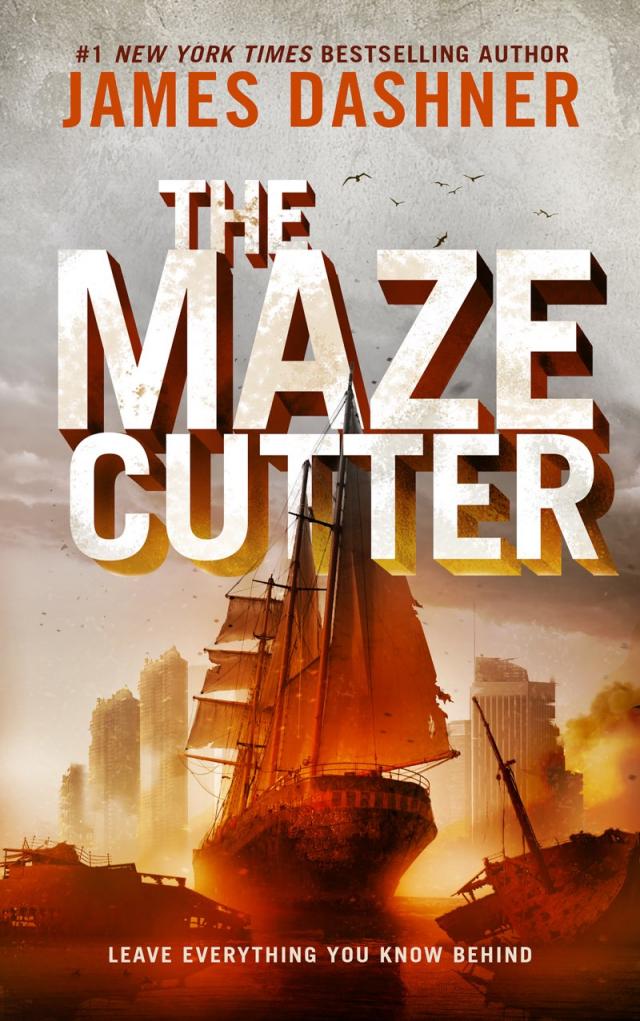
“Can you tell what those letters make out?” Miyoko asked. A half hour or so had passed since the others left, and the two remaining islanders hadn’t said a whole lot. But all four of their eyes stayed glued to the floating vessel. Miyoko pointed to the broad, dented, barnacle-infested side of the ship, where a ghostly image of three words ran along the front, just below the rusted railings. Holes in the right places indicated that plastic or metal letters had once been attached there, long since fallen off.
Isaac focused, squinting a little. “I think it says . . . The . . . something . . . Cutter.”
“Maze,” Miyoko said. “Holy crap in a handbasket. It says The Maze Cutter.”
Isaac stared at the phrase on the side of the ship, its every letter now obvious. His mind had gone blank, unable to comprehend why this boat was called such a thing.
That word meant a lot on this island. It seemed a reference to their most famous resident, Thomas, who’d been dead for over twenty years. Countless stories existed about the man and the Maze from which he and his friends had escaped. The Gladers. WICKED. Ava Paige. The Flare. Many tales, impossible for all of them to be true. But after so many decades and after so many tellings, one thing had stayed consistent. More people referred to Thomas as the Maze Runner than they did his actual name.
And here, right in front of him, seemingly out of a dream, now only fifty or sixty meters away, was a large boat with starkly similar words etched in rust and grime along its side. He’d heard people claim they were speechless before. That’s exactly what he was now, his brain a scorched valley.
Miyoko didn’t have the same problem. “What in the hell? What’s going on, here, Isaac? I’ll tell you what’s going on. This freaking boat came here looking for us. They know about Thomas and everyone that came here with him. After all these years, someone somewhere decided they weren’t done with the brave little Gladers that escaped through their magic machine. Kids, grandkids, great-grandkids, doesn’t matter. Thomas is some kind of god to them and they went on a pilgrimage. Or maybe they came to kill us. Or help us. Or tell us something.”
Isaac finally tore his eyes away from those ghostly words, The Maze Cutter. He looked at Miyoko.
“What did you say?”
She gave him a grim smile, then frowned, then tried to smile again. “Nothing. I have no idea what to say.” Her weight shifted from foot to foot.
“Me, neither,” he replied. “But we’ve gotta get on that boat.”
He expected her to say something like, let’s not be hasty. But she surprised him.
“Should we swim out?”
This broke him a little; he started laughing. She joined in. They were losing it.
“I don’t think we’ll need to,” he finally said. “Look. It’s getting really close now.”
The boat had continued drifting at a slow and steady pace, moving toward the cliff and the beaches to the south at roughly the same speed. Isaac and Miyoko had walked along with it, things moving so incrementally that it felt sudden when they realized the thing was only about twenty meters away, as if it had skipped a beat in time. And now they could really see all the details that had been fuzzy before. The bodies.
“There’s . . . eight of them,” Miyoko whispered, almost as if she worried she might wake those lying on the deck. But there wasn’t much chance of that. Each one had a bullet hole in their head, the wounds crusted with dried blood. “What the . . . Who killed them?”
“Whoever blew that horn, I guess.”
The lifeless people were dressed in warm clothing, most of it still sopping wet—the boat must’ve gone through a storm right before it reached the island. There was a mixture of gender, hair lengths, races, sizes. But they all appeared equally dead. Although the deck itself—made of warped, cracked wood—had no bloodstains he could see, that could be explained away by the storm. The murder spree couldn’t have been too recent because the bodies looked . . . spent. Not fresh.
With every one of these passing thoughts, the boat drifted closer. In a matter of minutes, they could probably leap across the gap and onto the boat if they wanted to.
As if she’d read his mind, Miyoko said, “We promised the others we’d just watch and observe. Shouldn’t we go and hide? If someone comes out of the cabin toting a gun, we’re dead unless we jump into the water.”
“We should definitely go and hide,” Isaac agreed, but neither of them made a move. Instead, they just kept walking along, one slow step after another. Never in his life had he felt such a thrilling fear, like electric eels were swimming through his guts. Something. Something was about to happen.


