

The maze cutter, p.5
The Maze Cutter,
p.5
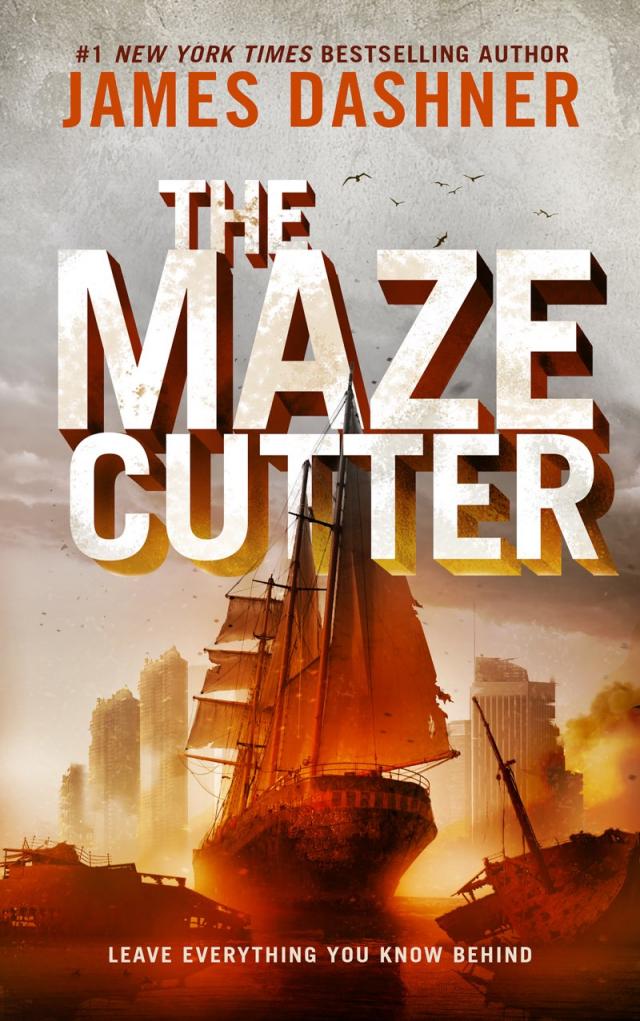


The ship finally ground to a halt twenty minutes later.
Once its starboard side had edged so close to the cliff that it risked slamming into the rocks, an amazing thing happened. An engine underneath the boat rumbled to life, gurgling and bubbling water toward the peninsula as if a giant squid were about to rise from the depths of the sea. It only lasted a minute or so, but it kept the vessel from crashing. Then the engine shut off, and The Maze Cutter continued drifting southward.
Isaac and Miyoko had stopped on instinct, now looking at the squared-off back edge of the boat, where they had the best view of the dead bodies.
“Guess that answers our question,” Miyoko said.
Isaac didn’t bother responding. Someone was definitely alive on that boat, and maybe it wasn’t such a good idea to stay close to it after all. But he wanted to. He really wanted to.
“Let’s just keep a good distance,” he said. “They’re obviously heading for the beachhead down there. It’s a gradual slope. Probably the best place on the island to wreck a ship if you gotta wreck a ship.”
Miyoko agreed. “Yeah, whoever’s on there must only have a drop or two of fuel left. Saving it for emergencies.”
The boat drifted on, bobbing like a toy. Isaac and Miyoko followed, staying roughly thirty meters behind the vessel’s back end. Drifting. Drifting. Walking. Walking. The air so full of tension that it buzzed in Isaac’s ears.
Finally, they descended from the peninsula’s black wall of rock and approached the sandy beaches on the north side of the island’s main body, which formed a right angle to the cliff. Nobody was in sight—people didn’t really come up here except for holidays in the summer. It was harvest season, and it wasn’t easy running a civilization on an isolated chunk of land in the middle of nowhere. Everyone else was hard at work.
“I hope that thing doesn’t flip over,” Miyoko said.
Isaac understood her meaning. Once you crossed the threshold from the peninsula to the beaches, it was like a magical barrier. The deep, deep waters in front of the wall of rocks prevented huge waves from forming. But the geographic terrain from there to the beach changed at a tipping point where waves as tall as five meters rolled up like charging horses and crashed in a violent display of white, watery power. However, there was a small section within the transition from rock wall to sandy beaches that just might give the ship a chance to ground itself. Almost as if . . .
“They knew,” he whispered. “She. He. They. Whoever. They knew.”
“Knew what?” Miyoko asked.
“Enough about the island to land their boat. It’s the perfect place as long as they—”
A sudden rev of engines cut him off. The ship was just passing the tipping point and it now turned sharply to the right, giant bubbles of water boiling from the back. With perhaps its last burst of energy, the boat sped toward the firmer, deeper sand nestled in the geological corner. The engines sputtered out but the ship had all the momentum it needed. With a grinding, hissing sound, it slammed into a bank of sand and stuck there, the current from the east and the dwindling waves from the north enough to keep it locked into position. Isaac didn’t know much about the old world, but he knew his island like he knew his own face, and he was certain he’d just seen someone pull off a masterful job of landing that boat in dire circumstances.
He and Miyoko had stopped walking at some point, though he didn’t remember doing so. Everything seemed so quiet now—after that short but powerful engine burst. A sound rarely heard in his little world.
“What do we do?” he whispered.
“Quick, over there!”
Miyoko ran toward a last remnant of the peninsula’s rocky landscape, big enough to hide behind. Isaac followed her and they crouched close together to peek around the edge, maybe forty meters away from the sand-docked vessel. He knew the boat’s occupants had already spotted them much earlier, but at least they had cover if someone came out with a horrible weapon intent on killing humans.
“This is so crazy,” Miyoko whispered.
“Tell me about it.” Isaac found it hard to breathe, every one of his bodily systems running at hyper speeds they weren’t used to. He focused on pulling the moist and salty air into his lungs, letting it flow back out his nose.
Seconds passed. Minutes. Felt like months. Nothing moved on the boat. Water lapped in equal strengths against both sides, but the vessel didn’t rock back and forth, not in the least. The forward-most tip of The Maze Cutter angled upward, looming three meters above the surface of the water and twice that much from the sand beneath it. The ship seemed firmly stuck into place.
A loud, metallic echo broke the lull and the silence. Isaac instinctively clutched on to Miyoko, and she did the same to him. They leaned farther out from the edge of their hiding spot, searching for any sign of movement.
There.
Something . . . someone was crawling along the walkway from the cabin to the back deck, where all those dead bodies lay. A woman. She was as frail as any person Isaac had ever seen, her body like a hastily assembled set of bones underneath ratty clothes. She moved with weary, slumping motions, barely able to pull and kick her way across the warped surface of the deck. Her skin was dark, her hair a disheveled mess. Her every movement seemed a monumental effort of sheer will, before she finally made it to the railing closest to where Isaac and Miyoko were hiding, watching.
“That lady needs some help,” Miyoko said in an egregious understatement. “Pretty sure she isn’t going to pull out a machete or gun. Come on.”
“Wait!” Isaac snapped. “Just . . . are you sure?”
“Yes, I’m sure. I’m not gonna hide here behind a rock and let that lady die.”
“But what if they have a disease?” Of all the things taught to them by their elders, it was to fear disease.
“They were shot in the head, Isaac. Getting shot in the head is not a virus I’ve heard of.”
The woman was groaning, reaching haplessly for the first rung of the rusty railing.
“I get that, Miyoko, but maybe she shot them to put them out of their misery.”
Miyoko was one of the smartest, most reasonable people Isaac knew, and she paused to consider what he’d said. Then she made a decision, a decision that Isaac knew he’d follow because he sucked at making decisions.
“No. All at the same time? They all reached the point of no return at the exact same time? And why didn’t she off herself, in that case? No, there’s something else going on. Come on, we’ll be careful.”
She stepped away from the safety of their hiding place and started walking down the slope of the beach. Isaac hurried to catch up, but he couldn’t shake his concerns. “Okay, then, isn’t that even worse? This evil lady shot and killed all of her shipmates?”
“Look at her,” Miyoko said.
Isaac did. The lady was emaciated, her face skeletal, her eyes sunken into hollows. But somehow she managed to lift herself to the top rail, scrabbling to get her feet securely planted on the deck. She leaned heavily on the bar, oblivious to the rust cutting her skin.
Miyoko continued, walking at a steady gait with Isaac on her tail. “She might be the most vicious, evil woman in the world, but she couldn’t step on an ant at this point. This is the first time in the history of our community we’ve had someone show up from the outside world. No chance in hell we’re going to pass up the chance to learn something.”
“You’re right,” Isaac said, and he meant it. That had really hit him in the gut. They needed this woman to survive, even if they had to quarantine her for a while. “Good thing we have food in our—”
He stopped short because the woman grunted an inhuman sound then swung her leg over the top railing, letting the momentum of her effort do the rest. She toppled off the boat and fell, splashing into the sea a moment later.
Isaac had the lady by one arm, Miyoko by the other, both of them gasping for breath as the cold water shocked their system. Isaac held her at the elbow and the armpit, trying his best not to hurt her any more than she already was. The stranger had used her last bit of strength to keep her head above the surface until they had gotten to her, and they now dragged her up the slope of slippery sand to the beach. As soon as they cleared the water, the three of them collapsed in a heap of exhaustion.
Isaac, catching his breath, finally sat up and put his arms on his knees, looking at the woman they’d just saved. She was on her side, spitting out water and gasping for air in short, hitched inhalations. She was so thin, so weak, it hurt his heart to see it. But if anything she seemed a little stronger than she’d appeared from a distance, and he knew she’d recover with food, water, and rest. The word disease pried its way back into his mind, then—they had to keep that on top of their stack of worries.
“Miyoko,” he said. “Now that she’s safe, we really need to keep our distance.”
His friend nodded, not about to argue something so sensible. The two of them got up, walked about ten paces away, then sat back down. Miyoko reached into her backpack, pulled out some bread, cheese, and fruit wrapped in cloth and a metal container full of water, then chucked the food over to the stranger, where it plopped into the sand right in front of her face. A sprinkle of the gritty stuff dusted the woman’s eyes and nose and mouth. She spat it out and blinked rapidly.
“Sorry!” Miyoko yelled. “We’re just trying to be careful. You need to eat and drink.”
“You need to work on your aim,” Isaac whispered, feeling a little out of his mind.
“I don’t think she has the strength to open that stuff.”
Miyoko got to her feet and ran to where the food had landed, then quickly spread open the cloth and unscrewed the cap on the water. Then she scrambled back and sat next to Isaac. All they could do now was wait.
The woman moved, but everything she did was in slow motion, almost agonizing to watch. First, she pushed her weight up to rest on one elbow, steadying herself. Next, she reached out with a shaky hand and grabbed the container of water. Appearing as if she might drop it at any second, she put it to her lips and took a long, steady drink, the muscles and tendons of her neck moving against the thin veneer of her skin with every swallow.
After she put the water back down, twisting the metal until it stood firmly in the sand, she reached over and picked up a piece of bread. Then, for the first time, she looked over at Isaac and Miyoko. Her dark, sunken eyes seemed to connect with Isaac’s along two invisible threads sizzling with static electricity.
“Thank you,” she said weakly, then took a bite of bread.
Isaac had a million questions. He was certain that Miyoko had a million more. But the stranger could barely chew, much less reveal where she’d come from, why those people had been shot, why she was here . . . endless questions.
The lady had taken three bites by now. It had to be a trick of the eyes, but it seemed as if she’d gotten a little bit of strength back. Then she spoke again.
“I’m not sick, you know.” She finished off the piece of bread, stuffing the last, giant piece into her mouth. It took a few moments for her to swallow. “I swear it on the life of everyone I’ve ever known or ever will know.”
“You know us, now,” Miyoko countered. “Seems like a lame deal to be included.”
The woman let out a tired sound that might’ve been a laugh. “Touché. I should’ve known the first people I came across would be smart-asses. Look. Do you have some way of testing for viruses? Bacteria? Do you have a medical center at all?” She held up an arm and gestured toward the crook of her elbow. “Stick me with as many needles as you want.”
“You sure talk a lot for someone who seemed three-quarters dead a couple minutes ago.” Miyoko wasn’t backing down in this test of wills, and Isaac was more than happy to stay silent. “How could we possibly trust you, anyway? Where’d you come from? Why are all those people shot in the head? Why’d you bring that big ugly boat here?”
“Doesn’t the name of it give you a clue?” the woman responded. “I know the letters fell off—ocean voyages are a pain in the ass, believe you me—but it’s still plain as day what it says.”
This time, Miyoko didn’t answer. Neither did Isaac. It seemed best to let the lady talk and spill her secrets without giving away any of their own.
The stranger grabbed a few grapes, popped them in her mouth. Then she slowly, painfully sat up, the agony and weariness plain on her face. But she probably couldn’t have done even that when they’d first dragged her out.
“Listen,” she said. “I’m not sick. Those people on my boat weren’t sick. It’s complicated, and I’m happy to tell the whole story, but I’d rather talk to your . . . leaders. Older people, anyway. Some gray hair, couple wrinkles would be nice. No offense.”
“Oh, don’t worry,” Miyoko chimed in. “They’re coming. Lots of them. But you better tell us why you’re here or we’ll save them the trouble of getting rid of you. And don’t bother lying. It’ll just waste our time and yours.”
It took every ounce of effort for Isaac not to react to that. She was being absurd, but had played the part pretty well.
The lady sighed, a sadness like the death of children melting her features. “We came because we know who you are. We came because the world has changed. A lot. We came because we’re hoping to find descendants of two very important people from a long time ago. My partners, there?” She pointed at the boat and its deck full of dead people. “They wanted to quit, go back. They threatened me when I wouldn’t let them at the fuel reserves that would ensure we could return if . . . when we found you. So I put them to sleep, then shot them. That’s how important this mission is. You wanted honesty? Well, there ya go.” She ate some fruit, drank some water.
Isaac had been silent, but was somehow stunned into being even more silent.
It took a moment for Miyoko to recover her resolve and speak, but she avoided the scarier parts of what the stranger had said. “Descendants of whom?” she asked. “What two people are you talking about?”
The woman finished off the container of water, tilting her head back to get every last drop. Then she looked at Isaac, those dark eyes boring into him, and then she looked at Miyoko.
“There’re others who are . . . immune,” she said. “I’m sure you realize they couldn’t possibly have found all of them before sending you here. And we’ve spent our lives studying the children and grandchildren of those people, trying to figure out what makes them . . . makes us . . . immune. It’s never been enough. Never enough. And now there are enough variants of the virus to make the thing infinitely more complicated.”
The stranger paused, as if all that speaking had sapped the tiny bit of strength she’d regained. She took a few slow, shallow breaths, then continued.
“But we have samples that survived the collapse of WICKED. And there were two people that stood out from the rest. Like . . . like mountains compared to anthills. Something special in their cells and in their blood that we’ve found nowhere else. We need to find them or their descendants, or we might as well give up and quit.”
“Who were they?” Miyoko asked. “Which two people are you talking about?”
The woman lay back down on the sand, looking up at the sky. The more she talked about all of this, the more pain it seemed to cause her. But after a minute or two, just when Isaac thought she’d given up on speaking, she finally answered the question.
“They were brother and sister.” She paused, closed her eyes for a few seconds, then opened them again. “Their names were Newt and Sonya.”
CHAPTER FOUR
The Keeper of Ruin
She stood amongst ruins.
Alexandra, Godhead, Second to One, Second to None.
A full hour had passed before Alexandra reached the bottom-most level of the caverns, a journey more threatened by boredom than any visceral fear. Her mind had taken on many new delights since the full-scale Evolution of thirty-one years ago, the day that changed the world forever. One of those new delights was the ability to find joy in the most unlikely of places, thanks to the Flaring discipline. As she tap-tap-tapped her way down the endless stairs leading from level to level to ever-lower levels, a minor compartment in her mind took pleasure in counting each footstep and calculating angles, distances, pace.
By the time she’d reached the bottom—with additional jaunts through corridors, hallways, secured doors, even a random chance to go up stairs instead of down—she’d been able to calculate several items of interest that kept her entertained if nothing else. Number of steps; overall pace as well as current pace of speed; total distance, both descended and traversed; the precise angle from Point A at the steel door to Point B, where she stood now. Another compartment of her mind noted the various temperature readings as she traveled deeper into the earth, translating every tiny sense and feeling and perception—every wick of moisture—on her skin, on her body’s many parts, into a reading. It fascinated her as to why the temperature dropped at such uneven rates, no consistency whatsoever. She stored the information away, determined to calculate a pattern at a later time.
But, for now, greater challenges awaited as she stood within the awesome sight of total ruin.
This had once been a mighty place. A place of power and potential. She looked at the huge expanse of it all, feeling the wonder and awe of how it must have appeared in its day. Before the great walls crumbled and toppled, and crashed onto the ground. She imagined the immense storm of dust swirling through this vast cavern on the day it happened. Presently, she observed the countless heaps of broken cement and metal, the jutting arms of stone that reached from the rubble toward the reinforced ceiling far above, like monuments to those who’d suffered here, died here. Pointing to the heavens, as if in hope for their souls.


