The wonderful world of j.., p.24
The Wonderful World of James Herriot,
p.24


‘You know, you wouldn’t believe it,’ she said. ‘He’s like a different bird.’
I swallowed. ‘Is that so? In what way?’
‘Well he’s so active now. Lively as can be. You know ’e chatters to me all day long. It’s wonderful what cuttin’ a beak can do.’
Turkey and geese are also found on the odd farm or smallholding and in The Lord Made Them All dairy farmer Mr Bogg keeps a few turkeys and chickens alongside his main herd of Ayrshire cows. He is a regular client at the Darrowby practice, and James and Siegfried have grown accustomed to his penny-pinching ways, which, even by Yorkshire standards, are impressive.
Then there was Mr Bogg, whose tight-fistedness was a byword in a community where thrift was the norm. I had heard many tales of his parsimony but I have a few experiences of my own which I cherish.
He owned a herd of good Ayrshire cows and ran a few turkeys and chickens on the side. He certainly would not be short of money.
His turkeys were frequently afflicted with blackhead and he used to come to us for Stovarsol tablets which were the popular treatment at that time.
One afternoon he approached me in the surgery.
‘Look,’ he said. ‘Ah keep comin’ here for fifty or a hundred of them little tablets and it’s a flippin’ nuisance. I’d rather buy a whole tinful – it ’ud save a lot of journeys.’
‘Yes, Mr Bogg, you’re right,’ I replied. ‘It would be a much better idea. I’ll get you some now.’
When I returned from the dispensary I held up the tin. ‘This contains a thousand tablets and as it happens it’s the only one we have in stock. It has been opened and a few have been taken out but it is virtually a new tin.’
‘A few . . . taken out . . .?’ I could read the alarm in his eyes at the idea of paying for the full thousand when he was getting less than that.
‘Oh, don’t worry,’ I said. ‘There’s maybe something like a dozen tablets short – no more.’
My words failed to reassure him and as he left the surgery he looked gloomy and preoccupied.
He was back again that same evening. He rang the bell at about eight o’clock and I faced him on the front doorstep.
‘I’ve just come in to tell ye,’ he said. ‘I’ve been counting them tablets and there’s nine hundred and eighty-seven.’
On another occasion I went to buy some eggs from Mr Bogg. I got a dozen from him most weeks because his farm was on the outskirts of the town. When I returned home with this particular batch I found that there were only eleven eggs in the bag, so when I saw him a week later I mentioned the fact.
‘Mr Bogg,’ I said. ‘There were only eleven eggs in last week’s lot.’
‘Aye, ah knaw,’ he replied, fixing me with a steady eye. ‘But one of ’em was a double-yolked ’un.’
Chapter 9
DOGS and CATS
There was one marvellous thing about the set-up in Darrowby. I had the inestimable advantage of being a large animal practitioner with a passion for dogs and cats. So that although I spent most of my time in the wide outdoors of Yorkshire there was always the captivating background of the household pets to make a contrast.
I treated some of them every day and it made an extra interest in my life; interest of a different kind, based on sentiment instead of commerce and because of the way things were it was something I could linger over and enjoy. I suppose with a very intensive small animal practice it would be easy to regard the thing as a huge sausage machine, an endless procession of hairy forms to prod with hypodermic needles. But in Darrowby we got to know them all as individual entities.
Driving through the town I was able to identify my expatients without difficulty; Rover Johnson, recovered from his ear canker, coming out of the ironmonger’s with his mistress, Patch Walker whose broken leg had healed beautifully, balanced happily on the back of his owner’s coal wagon, or Spot Briggs who was a bit of a rake anyway and would soon be tearing himself again on barbed wire, ambling all alone across the market place cobbles in search of adventure.
I got quite a kick out of recalling their ailments and mulling over their characteristics. Because they all had their own personalities and they were manifested in different ways.
Like James, Alf saw plenty of family pets at the Thirsk practice and the James Herriot books are full of memorable stories about cats and dogs. As a teenager, Alf Wight ranged the hills and parks of Glasgow with his dog Don, a glossy and beautiful Irish setter with whom he developed a close bond. Thereon he set upon pursuing a veterinary career and, while he loved working with all animals over the subsequent decades, whenever he was asked what his favourite animal was, he invariably answered, ‘most definitely dogs’.
His veterinary training, however, focused mainly on horses and large farm animals, dogs were still deemed more of a sideline concern for vets, and cats were hardly covered at all. Despite this, Alf was able to set up a small animal surgery at the Thirsk practice – Donald was happy to focus on their equine patients and Alf, with the help of Brian and various assistants, could attend to dogs and cats in between farm visits. The surgery wasn’t the gleaming operating room he’d envisaged during student days, but simply the consulting room of 23 Kirkgate or a dark corner of a cow byre or farmyard kitchen, but Alf nonetheless found the treatment of dogs and cats rewarding work.
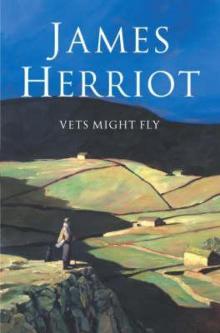
The fascination and love that Alf had for dogs – the huge range of breeds, their various personalities, quirks, ailments and devotion to humans – shines through in the James Herriot books. Cedric the boxer, who features in Vets Might Fly, is just one of the many memorable dogs we are introduced to after James receives a telephone call from Cedric’s owner, Mrs Rumney.
‘Mr Herriot . . . I should be grateful if you would come and see my dog.’ It was a woman, obviously upper class.
‘Certainly. What’s the trouble?’
‘Well . . . he . . . er . . . he seems to suffer from . . . a certain amount of flatus.’
‘I beg your pardon?’
There was a long pause. ‘He has . . . excessive flatus.’
‘In what way, exactly?’
‘Well . . . I suppose you’d describe it as . . . windiness.’ The voice had begun to tremble.
I thought I could see a gleam of light. ‘You mean his stomach . . .?’
‘No, not his stomach. He passes . . . er . . . a considerable quantity of . . . wind from his . . . his . . .’ A note of desperation had crept in.
‘Ah, yes!’ All became suddenly clear. ‘I quite understand. But that doesn’t sound very serious. Is he ill?’
‘No, he’s very fit in other ways.’
‘Well then, do you think it’s necessary for me to see him?’
‘Oh yes, indeed, Mr Herriot. I wish you would come as soon as possible. It has become quite . . . quite a problem.’
‘All right,’ I said. ‘I’ll look in this morning. Can I have your name and address, please?’
‘It’s Mrs Rumney, The Laurels.’
The Laurels was a very nice house on the edge of the town standing back from the road in a large garden. Mrs Rumney herself let me in and I felt a shock of surprise at my first sight of her. It wasn’t just that she was strikingly beautiful; there was an unworldly air about her. She would be around forty but had the appearance of a heroine in a Victorian novel – tall, willowy, ethereal. And I could understand immediately her hesitation on the phone. Everything about her suggested fastidiousness and delicacy.
‘Cedric is in the kitchen,’ she said. ‘I’ll take you through.’
I had another surprise when I saw Cedric. An enormous boxer hurled himself on me in delight, clawing at my chest with the biggest, horniest feet I had seen for a long time. I tried to fight him off but he kept at me, panting ecstatically into my face and wagging his entire rear end.
‘Sit down, boy!’ the lady said sharply, then, as Cedric took absolutely no notice, she turned to me nervously. ‘He’s so friendly.’
‘Yes,’ I said breathlessly, ‘I can see that.’ I finally managed to push the huge animal away and backed into a corner for safety. ‘How often does this . . . excessive flatus occur?’
As if in reply an almost palpable sulphurous wave arose from the dog and eddied around me. It appeared that the excitement of seeing me had activated Cedric’s weakness. I was up against the wall and unable to obey my first instinct to run for cover so I held my hand over my face for a few moments before speaking.
‘Is that what you meant?’
Mrs Rumney waved a lace handkerchief under her nose and the faintest flush crept into the pallor of her cheeks. ‘Yes,’ she replied almost inaudibly. ‘Yes . . . that is it.’
‘Oh well,’ I said briskly. ‘There’s nothing to worry about. Let’s go into the other room and we’ll have a word about his diet and a few other things.’
It turned out that Cedric was getting rather a lot of meat and I drew up a little chart cutting down the protein and adding extra carbohydrates. I prescribed a kaolin antacid mixture to be given night and morning and left the house in a confident frame of mind.
Cedric’s flatulence, however, does not improve. James goes on to try various powders, remedies and vast quantities of charcoal biscuits, as recommended by Siegfried, all of which make not the slightest difference to his condition. At the end of a long day, James decides to pay Mrs Rumney a visit, just as she is holding an elegant drinks party where James is mortified to see Cedric bound enthusiastically into the room and leap upon the guests, almost tearing off one lady’s dress. To make matters worse, the room then fills with ‘an unmistakable effluvium’ of which Cedric is clearly the guilty party.
James finally comes to the conclusion that Cedric is simply not the dog for Mrs Rumney. Con Fenton, however, a retired farm worker who helps out in the garden of Laurel House, has taken a liking to the dog, so James suggests he take Cedric and that Mrs Rumney find herself a more suitable pet. She agrees and acquires a poodle, while Con Fenton takes in Cedric and they become devoted to each other. When James visits the pair, however, he notices a familiar pungency rising from Cedric, although Con is entirely oblivious to it. It soon becomes clear why, as the two men chat and James takes in the fragrance of some carnation flowers in a vase.
Con watched me approvingly. ‘Aye, they’re lovely flowers, aren’t they? T’missus at Laurels lets me bring ’ome what I want and I reckon them carnations is me favourite.’
‘Yes, they’re a credit to you.’ I still kept my nose among the blooms.
‘There’s only one thing,’ the old man said pensively. ‘Ah don’t get t’full benefit of ’em.’
‘How’s that, Con?’
He pulled at his pipe a couple of times. ‘Well, you can hear ah speak a bit funny, like?’
‘No . . . no . . . not really.’
‘Oh aye, ye know ah do. I’ve been like it since I were a lad. I ’ad a operation for adenoids and summat went wrong.’
‘Oh, I’m sorry to hear that,’ I said.
‘Well, it’s nowt serious, but it’s left me lackin’ in one way.’
‘You mean . . .?’ A light was beginning to dawn in my mind, an elucidation of how man and dog had found each other, of why their relationship was so perfect, of the certainty of their happy future together. It seemed like fate.
‘Aye,’ the old man went on sadly. ‘I ’ave no sense of smell.’
Just as the people of the Dales have different personalities, so too do their dogs. Judy the sheepdog, who features in Vet in a Spin, has a particularly caring nature and instinctively looks after other animals around her. While treating a bullock on the farm of Eric Abbot, James notices the big dog sitting nearby.
I inserted the needle into the jugular and tipped up the bottle of clear fluid. Two drachms of the iodide I used to use, in eight ounces of distilled water and it didn’t take long to flow in. In fact the bottle was nearly empty before I noticed Judy.
I had been aware of a big dog sitting near me all the time, but as I neared the end of the injection a black nose moved ever closer till it was almost touching the needle. Then the nose moved along the rubber tube up to the bottle and back again, sniffing with the utmost concentration. When I removed the needle the nose began a careful inspection of the injection site. Then a tongue appeared and began to lick the bullock’s neck methodically.
I squatted back on my heels and watched. This was something more than mere curiosity; everything in the dog’s attitude suggested intense interest and concern.
‘You know, Eric,’ I said. ‘I have the impression that this dog isn’t just watching me. She’s supervising the whole job.’
The farmer laughed. ‘You’re right there. She’s a funny old bitch is Judy – sort of a nurse. If there’s anything amiss she’s on duty. You can’t keep her away.’
Judy looked up quickly at the sound of her name. She was a handsome animal; not the usual colour, but a variegated brindle with waving lines of brown and grey mingling with the normal black and white of the farm collie. Maybe there was a cross somewhere but the result was very attractive and the effect was heightened by her bright-eyed, laughing-mouthed friendliness.
I reached out and tickled the backs of her ears and she wagged mightily – not just her tail but her entire rear end. ‘I suppose she’s just good-natured.’
‘Oh aye, she is,’ the farmer said. ‘But it’s not only that. It sounds daft but I think Judy feels a sense of responsibility to all the stock on t’farm.’
Judy sniffs the rug covering the bullock, then gives its shaggy forehead a lick and stations herself facing the patient. The farmer Eric assures James that ‘nothing’ll shift her till he’s dead or better’. Five days later, James discovers Judy is still with the bullock, which is much better. The farmer tells James how she gives every new-born calf a good lick over as soon as it comes into the world, as she does with any kittens, and always sleeps with the farm animals every night. A week later James returns to see the bullock which is galloping around his box like a racehorse. Enquiring after Judy, Eric points her out.
I looked through the doorway. Judy was stalking importantly across the yard. She had something in her mouth – a yellow, fluffy object.
I craned out further. ‘What is she carrying?’
‘It’s a chicken.’
‘A chicken?’
‘Aye, there’s a brood of them runnin’ around just now. They’re only a month old and t’awd bitch seems to think they’d be better off in the stable. She’s made a bed for them in there and she keeps tryin’ to curl herself round them. But the little things won’t ’ave it.’
I watched Judy disappear into the stable. Very soon she came out, trotted after a group of tiny chicks which were pecking happily among the cobbles and gently scooped one up. Busily she made her way back to the stable but as she entered the previous chick reappeared in the doorway and pottered over to rejoin his friends.
She was having a frustrating time but I knew she would keep at it because that was the way she was. Judy the nurse dog was still on duty.
In Thirsk, Alf Wight continued to keep his own dogs, all of them becoming cherished companions. They invariably accompanied him on rounds and, as a break between visits, Alf liked nothing more than getting out of the car and escaping for walks with his dog, where he often revelled in the beauty and solitude of the Dales. In the books, James describes walking with his dog Sam, a composite beagle dog based on his real dogs Danny and Dinah. Danny originally belonged to Alf’s wife Joan and after their marriage he went on to accompany Alf everywhere. He had a look of a West Highland white terrier but was probably a mix of breeds and went on to live to a ripe old age of fourteen, when he was sadly killed on the main road outside their house. Dinah was the successor to Danny, one of a pack of beagle hunting dogs bred by Donald Sinclair which he gave to Alf and his family in 1953 as a successor to Danny.
This was the real Yorkshire with the clean limestone wall riding the hill’s edge and the path cutting brilliant green through the crowding heather. And, walking face-on to the scented breeze I felt the old tingle of wonder at being alone on the wide moorland where nothing stirred and the spreading miles of purple blossom and green turf reached away till it met the hazy blue of the sky.
But I wasn’t really alone. There was Sam, and he made all the difference. Helen had brought a lot of things into my life and Sam was one of the most precious; he was a beagle and her own personal pet. He would be about two years old when I first saw him and I had no way of knowing that he was to be my faithful companion, my car dog, my friend who sat by my side through the lonely hours of driving till his life ended at the age of fourteen. He was the first of a series of cherished dogs whose comradeship have warmed and lightened my working life.
Sam adopted me on sight. It was as though he had read the Faithful Hound Manual because he was always near me; paws on the dash as he gazed eagerly through the windscreen on my rounds, head resting on my foot in our bed-sitting room, trotting just behind me wherever I moved. If I had a beer in a pub he would be under my chair and even when I was having a haircut you only had to lift the white sheet to see Sam crouching beneath my legs. The only place I didn’t dare take him was the cinema and on these occasions he crawled under the bed and sulked.
Most dogs love car-riding but to Sam it was a passion which never waned – even in the night hours; he would gladly leave his basket when the world was asleep, stretch a couple of times and follow me out into the cold. He would be on to the seat before I got the car door fully open and this action became so much a part of my life that for a long time after his death I still held the door open unthinkingly, waiting for him. And I still remember the pain I felt when he did not bound inside.
And having him with me added so much to the intermissions I granted myself on my daily rounds. Whereas in offices and factories they had tea breaks I just stopped the car and stepped out into the splendour which was always at hand and walked for a spell down hidden lanes, through woods, or as today, along one of the grassy tracks which ran over the high tops.
This thing which I had always done had a new meaning now. Anybody who has ever walked a dog knows the abiding satisfaction which comes from giving pleasure to a loved animal, and the sight of the little form trotting ahead of me lent a depth which had been missing before.