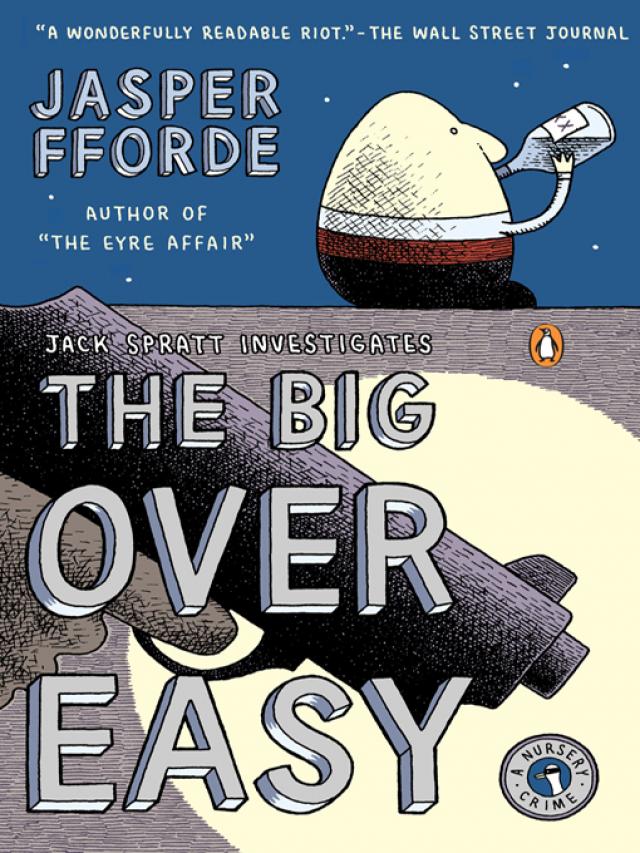
The big over easy nc 1, p.11
The big over easy nc-1,
p.11


A few moments later, an elegantly dressed woman of Jack’s age walked brusquely in from an anteroom, removed a pair of surgical gloves and tossed them in a bin. Under her white lab coat, she was dressed in a wool suit and blouse with a ring of pearls high on her neck. Her features were delicately chiseled, she wore only the merest hint of makeup and had her hair swept up in the tightest bun Mary had ever seen. She didn’t look as mad as a barrel of skunks; she looked quite sophisticated.
“Dr. Deborah Quatt?” said Jack. “My name is Detective Inspector Jack Spratt of the Nursery Crime Division, and this is Detective Sergeant Mary Mary.”
“Jack Spratt?” she asked, staring at him quizzically. “Have we met before?”
“We were in the same year at Caversham Park Junior School,” replied Jack, astounded that she remembered.
“Of course we were. You always insisted on being the pencil monitor — a policeman at heart, clearly.”
She said it with a slight derogatory air that he didn’t like.
“And you were expelled for sewing the school cat to the janitor.”
“The joyous experimentation of children,” she declared, laughing fondly at the memory. “What fun that was! Did you come all this way for a reunion?”
“Not at all. We wanted to talk to you about one of your patients — a Mr. Dumpty.”
Dr. Quatt shook her head slowly. “I never discuss patients’ records, Inspector. It is a flagrant breach of doctor-patient confidentiality. However, I could stretch a point given some form of fiscal reparation. Shall we say fifty pounds?”
“Doctor, you do know that he’s dead?”
“I was nowhere near him,” declared Dr. Quatt haughtily. “If you want to try me for malpractice, you’ll have to mount a good case. I’ve plenty of experience defending them, believe you me.” She stared at Jack for a moment. “Mr. Dumpty? Dead? What a pity. A very, very great pity.”
“His death was tragic, I agree,” admitted Jack.
“Death comes to us all, Inspector. No, it’s a pity the patient-confidentiality clause is null and void — I could have done with fifty pounds. The price of lab equipment these days is simply scandalous.”
She looked around, lowered her voice and leaned forwards. “Did you know that I have successfully grafted a kitten’s head onto a haddock?”
“Should you be telling me this?” asked Jack, also in a quiet voice.
She leaned back and raised an eyebrow. “It’s not against the law — I just can’t get any funding to do proper research because of that damnable Jellyman and his outdated moral principles. In the world of cutting-edge genetic research, you can’t make an omelette without breaking eggs.”
“Which brings us back to Mr. Dumpty,” said Jack. “How long had you been his doctor?”
“For five years,” she said as she sat behind her large desk and indicated for them to be seated, “ever since I arrived in this dump. I was a psychiatrist before I moved into genetic research. What do you want to know?”
“His state of mind.”
“Ah!” she said, getting up to rifle through a rusty filing cabinet. “You are considering suicide, Inspector?”
“It is possible.”
“Indeed it is,” replied Dr. Quatt, looking at the files carefully.
“Physically, he was in a pretty ropy state. He was a lifelong salmonella sufferer, with frequent recurrences; when he had a bad bout, it was most debilitating. He drank more than was good for him, frequently overate and didn’t get much exercise — he never could walk far on those short legs.”
“And mentally?”
“Not good — but functional. He suffered from a sense of extreme low worth that manifested itself in frequent and self-destructive binges of drinking and womanizing. He also had depressive fits that sometimes lasted for days; all he could do was sit on his wall. Aside from that, he sometimes had problems differentiating reality from fantasy. He was particularly fearful that a giant mongoose was after him, was phobic about soufflé, meringue, and egg whisks, and had a recurring nightmare of being boiled alive for exactly three minutes.”
“When did you last see him?”
“Six days ago. Easter was a bad time for him, as you can imagine, with all those chocolate eggs being eaten and real ones dyed — he was a virtual prisoner in his own home. We had two sessions last week, and I think we really made some headway.”
“Did he talk about his work?”
She shook her head. “Never. It was all purely domestic.”
“But could he have been suicidal?”
Dr. Quatt thought for a moment. “I’m sorry to say that I can’t rule it out, despite my best attentions.”
Jack nodded slowly. It was what he had been expecting to hear.
“One more thing: How long had he been coming to St. Cerebellum’s?”
“For forty years, Inspector. It was almost his second home.”
Jack got up. “Thank you, Dr. Quatt; you’ve been most helpful. Tell me — and this is just personal curiosity — were you serious when you said you’d grafted a kitten’s head onto a haddock?”
Dr. Quatt’s eyes lit up, and she looked at them in turn, her youthful enthusiasm boiling to the surface. “Do you want to see?”
“That was pretty gross, wasn’t it?” announced Mary as they drove away from St. Cerebellum’s a few minutes later.
“Yes, but fascinating in a prurient, icky, dissecting-frogs, brains-in-jars kind of way. I thought keeping the collar and bell was an inspired touch, and it was kind of cute watching it try to play with that soggy ball of wool inside the tank.”
“Sir!”
“Just kidding. Yes, it was gross, and Dr. Quatt is definitely as mad as a barrel of skunks. And listen, I never insisted on being a pencil monitor at school. Where can I drop you?”
He left her outside the front of Reading Central Police Station. They bade each other good night, and she walked into the car park to retrieve her BMW, thinking that perhaps, given the direction of her new career, she should simply drive straight to Basingstoke and give Flowwe another whack with the onyx ashtray — just to be even-steven.
But when she got to her car, there was something unexpected waiting for her: an envelope carefully tucked under her windshield wiper. She thought it might be from Arnold, but it wasn’t. She read the note again, then a third time. She thought for a moment and then trotted into the station’s changing rooms to check herself in the mirror. If you are invited to the Reading branch of the Guild of Detectives by DCI Chymes himself, you should always look your best.
14. Meeting the Detective
First there was The Strand, the original magazine for which Dr. Watson so painstakingly penned all Holmes adventures. Following Sherlock’s retirement The Strand went through a sticky patch and was relaunched in 1931 under the title True Detection Monthly and featured Guild of Detectives stalwart Hercule Porridge and newcomer Miss Maple. The summer of 1936 saw both these characters abscond to the newly formed Real Detective Magazine. Lord Peter Flimsey and Father Broom, however, favored Extraordinary Detecting Feats, which folded after two issues, to be replaced by Sleuth Illustrated. The end of the “golden era” saw a shaking up of the true-crime franchise, and Real Detective, Astounding Police, Remarkable Crime and Popular Sleuthing merged into Amazing Crime Stories, which is now regarded as the world leader in true-crime adventure.
From Watching the Detectives by Maisie Gray
Mary walked nervously up the steps of the old Georgian town house on Friar Street and presented herself to the porter. He looked at her disdainfully until he saw the note and Chymes’s signature, then went through an extraordinary transformation, welcomed her to the club, relieved her of her coat, pointed out the facilities if she felt like a freshen-up and rang a small bell. He talked politely to her for a few minutes, pointed out the many framed newspaper front pages and Amazing Crime Stories cover artwork hanging up in the lobby until a footman arrived and gestured for her to follow him. They walked through some frosted-glass swinging doors and down a paneled corridor hung with more framed headlines and letters from celebrities offering their testimonials and grateful thanks. She was ushered into a bar that was elegantly bedecked in dark oak, rich burgundy carpets and brass light fixtures. There were groups of off-duty officers sitting around chatting and laughing, but these weren’t just ordinary rank-and-file officers such as you might find down at the Dog and Truncheon. These officers were different — the elite assistants who worked exclusively for the five Amazing Crime—ranked investigators in Reading, the most influential and successful being Chymes, of course. Each of the five detectives had his own coterie of dedicated support officers, each led by an Official Sidekick, four of whom were in that room tonight and three of which she could name.
The footman presented her to a group near the bar, bowed and withdrew.
“It’s DS Mary, isn’t it?” said a man smoking a large cigar as he sized her up and down in a professional sort of way.
“Yes, sir.”
“Chymes will be with you in a minute. He asked us to entertain you. Fancy a drink?”
“Thank you; a half of special would be good.”
The man nodded to the barman who had been hovering discreetly nearby.
“Do you know who I am?” asked the man.
“Yes, you’re DS Eddie Flotsam. You’ve been Chymes’s OS for sixteen years and penned over seventy of his stories. But you’re less… cockney than I imagined.”
“Not cockney at all,” he admitted, “nor particularly chirpy. It was a marketing ploy FC and I came up with in the early days. I think it works.”
“It does. I’ve been a big fan since before I was in the force.”
“You’ve been an OS yourself, haven’t you?” asked Flotsam.
“I was with DI Flowwe for four years.”
“We know,” replied Flotsam, handing her the beer that had just arrived. “Your file makes for good reading. Cheers.”
“Cheers. Um… are personal files meant for general distribution?”
He laughed. “This is the Guild, sister. Let me introduce the gang.”
The “gang,” as Flotsam described them, had all received numerous mentions in the Friedland Chymes stories, but their fictionalized counterparts, like Flotsam’s, didn’t really match up, so they were hard to figure out.
“That’s Barnes, Hamilton, Hoorn and Haynes. Seagrove is over there on the blower. Probably the bookies.”
They all nodded their greetings. Despite stories to the contrary, they didn’t look an unfriendly bunch.
“I read your account of the Shakespeare fight-rigging caper,” said the one named Hoorn. “I thought it impressive. The pace was good, you built the tension early, and you managed to keep it sustained throughout the story.” He shook her hand and added, by way of an afterthought, “And the police investigation itself was quite good, too — although if I’d been Flowwe, I would have let one member of the gang escape to add a small amount of tension to a recapture. You could have stretched the headlines over another two days.”
“It was our biggest case to date,” replied Mary defensively.
“I don’t think he wanted to blow it for the sake of a few good headlines.”
“That’s what sorts out the good from the greats,” said Hamilton, sipping a martini. “If you want to hit the big time and run investigations that fit well into a TV or movie format, you’re going to have to take a few risks.”
“Does Friedland?”
No one answered, which Mary took to mean that he did. You don’t get to number two in the Amazing Crime rankings by playing it safe. It wasn’t permitted to “alter, embellish or omit pertinent facts” in one’s investigation to make better copy, but all of them did it in one form or another. If it got a result, no one minded. The whole thing suddenly seemed that much more exciting and daring. Friedland’s team under Flotsam was a close unit and had been through a lot together — and had reaped the benefits, both professionally and financially. Piarno Keyes had played Flotsam in Friedland Chymes and the Carnival of Death, and character rights paid handsomely.
“What does DCI Chymes want with me?”
“Barnes retires next month,” Flotsam said, pointing to a member of the small clique who was rolling a cigarette. “Network Mole wants to retain him as police adviser on their TV shows.”
She couldn’t quite believe her ears. “I’m up for inclusion in the team?”
“Nothing’s fixed,” said Flotsam with a shrug, “but you’re qualified and a looker.”
“Is that important?”
“For the telly. The Guv’nor wants us to look a bit less male elitist, so we need another girlie. But he doesn’t carry dead wood, and there’s no one else suitable in the frame.”
“I’m working down at the NCD at present.”
There was a murmur of impolite laughter from the small group.
“Nothing to be ashamed of. Barnes and Seagrove have both done a stretch down there. How’s Jack, by the by?”
“He’s… Jack,” she answered, finding it too much of an easy shot to gain Brownie points by trashing him, something that would doubtless have gone down well. Jack was unremarkable and in a loser department, but he’d treated her well. Chymes’s gang took her meaning to be derogatory and laughed. Flotsam’s phone beeped, and he glanced at the text message before putting down his cigar and straightening his tie.
“That was the Guv’nor. He’ll see you now.”
Mary was taken through another door, which led into the inner sanctum, a personal retreat for the great detectives themselves. It was here surrounded by the dark oak paneling that they met nightly to discuss cases, brainstorm ideas or simply just unwind among their intellectual equals. Mary tried not to gawk at the six or seven famous names that she recognized from her initial glance around the room, but it was tricky not to. There had never been this sort of thing at Basingstoke, but then twenty-fifth was the highest ranking a Basingstoke detective had ever got.
“Guv’nor,” said Flotsam in greeting to Chymes, who was seated next to a fastidiously dressed detective of foreign extraction who rose to his feet and bowed politely as Mary was presented. She felt herself go hot at the exalted company and managed to mumble something respectful as the small man greeted her, thanked Chymes, retrieved his small sherry and departed to the other side of the room.
“Charming man, Hercule,” said Chymes with a winning grin, adding as soon as the small foreigner was out of earshot, “but a tad overrated. All that ‘little gray cells’ stuff he goes on about. A lot of the time, he’s simply surfing on a rich seam of luck. Take a seat, DS — has Flotsam been looking after you?”
“Extremely well, sir.”
“Good. Thank you, Eddie.”
Flotsam bowed obsequiously and departed. Chymes stared at Mary for a moment without speaking. He was a large man and had a deep, commanding voice that inspired confidence. He was handsome, too, and his eyes seemed to sparkle at her. The room suddenly began to grow hot.
“You used to work with DI Flowwe at Basingstoke?”
“Yes, sir.”
“That’s nothing to be ashamed of.”
“Flowwe or Basingstoke, sir?”
Chymes laughed and took a sip from his ice and whiskey. “So how’s my friend Jack?”
“I haven’t known him that long, sir,” replied Mary, trying to sidestep the question. Chymes picked up on it straightaway.
“Loyalty is something I appreciate, Mary, so I’ll tell you: Jack is not well at all. He’s up shit creek without a paddle. The pig thing was career suicide, even by the somewhat loose standards of the NCD. He has no idea how to approach a tricky case in order to get a conviction and no sense at all about dramatic timing or case construction so it will fit the format demanded by Amazing Crime. And now he wants to be in the Guild. Do you see Jack fitting in here, Mary?”
She looked around. Inspector Moose was leaning on the ornate marble fire surround, talking in subdued tones to Rhombus, down from Edinburgh to interview a suspect, apparently.
“Frankly, no,” replied Mary, quickly pushing aside feelings of disloyalty in order to make more important room for thoughts concerning promotion and career.
“I concur,” replied Chymes, leaning closer. “How’s the Humpty case going?”
“Almost certainly suicide.”
Chymes shook his head. “I’ll bet you it isn’t. I can smell a good investigation the way a perfumer can detect a drop of lavender in a locker room. There is something about a crime scene that is like the opening aria of a fine opera — a few lone notes that portend of great things to come. I’ve made my career upon it. Humpty is more than meets the eye, I promise you. I need something for the Summer Special issue of Amazing Crime, and we thought the Humpty case would do well.”
“It’s NCD jurisdiction, surely?”
“I have only solutions, never problems,” replied Chymes quietly. “I’ll have the Humpty investigation, but I won’t have it yet. I need to time myself well for the increased dramatic effect. And to do this, I need your help.”
“Mine?”
“Of course. I need to know how things are progressing. You can be my eyes and ears.”
He could sense her slight reticence.
“You will not find me ungrateful. I read your account of the Shakespeare fight-rigging caper, and I was impressed. Your prose is good, and in the not-too-distant future I might have need of someone with a fresh eye and a fresh pen. Barnes isn’t the only one up for retirement.”
He raised an imperious eyebrow and stared at her. Mary weighed the pros and cons of what he was suggesting. It didn’t take long.
“What do you need to know?”