Trades and treaties the.., p.7
Trades & Treaties: The Glyphwright Chronicles - Book 3,
p.7
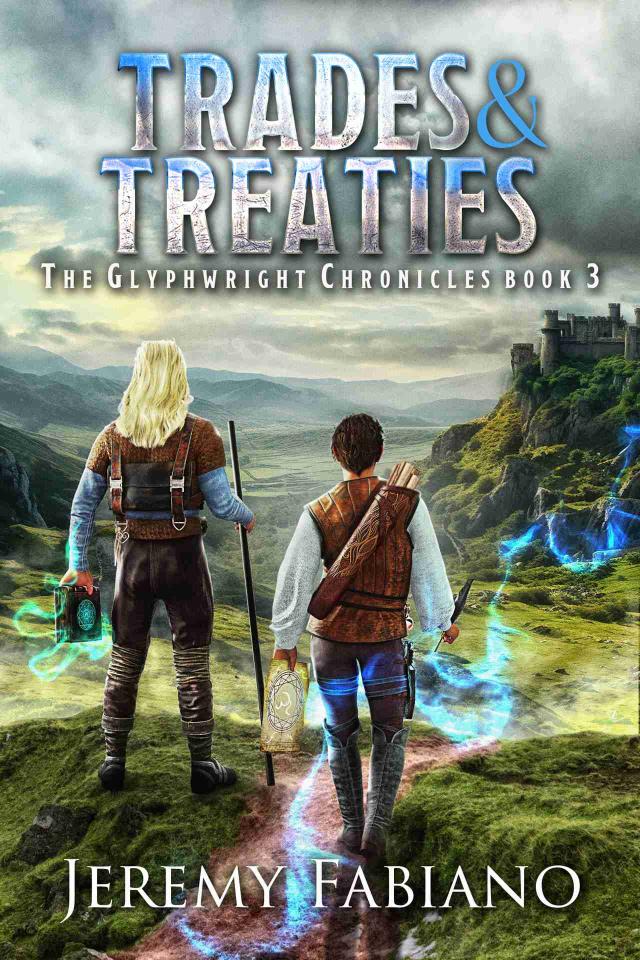


I knelt beside it and pulled out my silver-infused ink. The inscription had to be perfect. Every line connected to a larger pattern that stretched back to Millbrook and forward to wherever we placed the next anchor. One mistake could create interference that degraded the entire network.
“The base pattern establishes resonance with the existing network.” I drew the first symbols while Adrian watched each stroke. “These secondary glyphs filter ambient magical energy and convert it to a stable form. The tertiary layer handles communication protocols.”
“How far can the network reach?” Adrian asked.
“In theory? Unlimited, as long as we place anchors at regular intervals.” I completed the base pattern and began the secondary layer. “Our equations show that the signal degradation becomes an issue past about fifty anchors. We’re still working on solutions for that.”
“Thomas thinks crystalline amplifiers at junction points might help,” Felix added. “But the materials are expensive and the theory is untested.”
The work took twenty minutes. When I finished, the inscription covered the entire surface of the spike head in patterns so dense they looked like abstract art. Ink gleamed wetly in the afternoon sun before settling into the metal with a faint shimmer that indicated successful binding.
“Now we test it.”
I pulled out one of the resonance chambers from my pack. We had made a dozen during the eastern expedition and still had several spares. When I activated it near the fresh anchor, both crystals began to glow with soft amber light.
“Connection established,” Felix confirmed. He made notes with rapid efficiency. “Signal strength is good. Stable resonance with the Millbrook hub.”
Thomas’s voice crackled through the chamber.
“Marcus? Felix? Is that you?”
“We’re here,” I said. “First anchor north of the capital is online.”
“Excellent. The connection is clean. Rose says hello. She’s been monitoring the network expansion from her end.”
“Tell her we’ll have another anchor placed by tomorrow evening.”
“Will do. Safe travels.”
The chamber went quiet. I tucked it back into my pack with a satisfaction that never grew old. Another link in the chain. Another piece of infrastructure that would outlast all of us.
Over the next week, the work became routine.
We placed anchors at intervals Felix calculated for optimal coverage. Each installation followed the same pattern. Find the location. Drive the spike. Inscribe the wards. Test the connection. Document everything. Move on.
The landscape changed around us. Flat farmland gave way to rolling hills. The hills grew steeper and more dramatic as we traveled north. Trees shifted from the familiar oaks and maples of home to hardier species that could survive colder winters. The air itself tasted different.
The weather turned cooler with each passing day. Mornings brought frost that lingered until midday. Evenings required heavier cloaks and fires that burned longer. The waystations where we slept each night were military-grade facilities with solid construction and defensible positions. They were supplied and maintained by crown funding for exactly these kinds of expeditions.
The rhythm of travel settled into something almost comfortable.
“Twenty goblins,” Roderick said.
We sat in the wagon on the third day as rain drummed against the canvas cover and made conversation the only entertainment available. Adrian had dozed off in his corner. Felix documented anchor placements from memory. That left me with the guards and hours to fill.
“Twenty,” I repeated. “On a bridge.”
“A stone bridge over a gorge that was the only way across for miles in either direction.” Roderick’s scarred face showed nothing as he spoke. His voice stayed flat and matter-of-fact. “Civilians needed to evacuate. Someone had to hold the crossing.”
“You volunteered?”
“I was there. Volunteering didn’t enter into it.” He shifted his war hammer where it leaned against the wagon wall. “They came in waves. The first five went down easy. The next five learned from watching the first. By the time the third wave hit, they’d figured out my reach and timing.”
“How long did you hold?”
“Long enough.” He touched the pale scar line that ran from his temple to his jaw. “Got this from the sixteenth. Clever little bastard came in low while his friends distracted me high. Almost took my eye.”
“But you held.”
“The civilians made it across. That’s what mattered.” Pain and pride flickered across his scarred features. “I killed nineteen of them before reinforcements arrived. The twentieth ran when he saw the cavalry coming.”
Henrick had been quiet through the telling. Now he spoke.
“I was at Thornwood.”
The name meant nothing to me. But Roderick’s expression tightened and Adrian stirred in his sleep.
“Fifteen years ago,” Henrick continued. “It was a dungeon break. The containment wards failed at night without any warning or time to evacuate.”
“I’ve heard stories,” Felix said. He had stopped writing.
“Stories don’t capture it.” Henrick stared at the rain streaming down the wagon’s canvas. “Monsters pouring out of the ground like water from a broken dam. Hundreds of them. Thousands, maybe. We never got an accurate count.”
“What happened?”
“We fought. Everyone who could hold a weapon fought.” His weathered face grew distant. “I was sixteen. My brother was eighteen. My father handed us both swords and told us to hold the back door while he organized the neighbors.”
The wagon creaked as we hit a rut in the road.
“The first wave hit before we were ready. They were creatures I’d never seen before. Things with too many legs and teeth in places where teeth shouldn’t be. My brother killed three of them before they dragged him down.” Henrick’s voice stayed flat. The voice of someone who had told this story before and learned to keep the emotion locked away. “I tried to reach him, but I couldn’t. By the time I fought through, there was nothing left to save.”
“Henrick,” Roderick said quietly. A warning or a comfort, it was hard to tell which.
“My father died holding the main street. He bought time for maybe thirty people to reach the temple. The wards there held long enough for the army to arrive.” Henrick finally looked away from the rain. His eyes met mine. “I lost my brother and father that night. Hells, half the people I’d grown up with. The dungeon consumed our village before the army pushed it back.”
“I’m sorry.”
“Don’t be. It was a long time ago.” Henrick’s expression shifted. Something harder settled into place. “I joined the royal guard afterward. Figured if I couldn’t protect my own family, maybe I could protect someone else’s. Maybe I could make sure other villages got warnings. Got time to evacuate. Got help before everything fell apart.”
“That’s why you take this work seriously,” I said.
“Every assignment is someone’s family. Someone’s village. Someone’s brother who might live if we do our jobs right.” He gestured at Adrian’s sleeping form. “The prince is a good man. He’s worth protecting. But even if he weren’t, the work would matter. Every person we keep safe is someone’s world.”
The rain continued falling. Nobody spoke for a long while.
On the fourth day, the weather cleared.
We stopped to place another anchor on a hillside with views that stretched for miles in every direction. The work went quickly now. Practice had made the process efficient. Felix barely needed to calculate anymore. His hands knew the angles.
Roderick watched me inscribe the final symbols.
“That ice spell in the dungeon was quick thinking,” he said.
I looked up from my work. “I had the pattern memorized from when I inscribed Elara’s combat spells. The mana crystal provided the power. I just had to put them together.”
“Still quick thinking. Most people freeze when monsters charge. You acted.” He studied me with an assessing gaze. “Ever consider adventuring properly? You’ve got instincts for it.”
“Kyle asked me the same thing after the expedition.” I finished the inscription and sat back on my heels. “I gave him the same answer. I’m better suited to building things. Infrastructure that lasts longer than I will.”
“That’s a noble goal.”
“It’s a practical goal.” I gestured at the anchor I had just completed. “This network will help people communicate across distances that used to mean weeks of travel. Villages that faced emergencies alone will be able to call for help. Families separated by mountains will stay connected. When I’m old and gray, it will still be working. That matters more to me than dungeon delving.”
“You sound certain.”
“I’ve had time to think about it.” I gathered my inscription supplies and stood. “The dungeon expedition taught me something. I can fight when I have to. I don’t freeze. But fighting isn’t what I’m good at. It’s not what I love.”
“What do you love?”
The question caught me off guard. Roderick asked it simply, without judgment.
“Making things work,” I said after a moment. “Solving problems that seem impossible until someone looks at them the right way. Watching a ward I inscribed protect someone’s home or preserve someone’s memories or connect someone to family they thought they’d lost.” I shrugged. “Building things that matter.”
“And?”
I paused. Roderick had caught something in my voice.
“And I’d like a family someday,” I admitted. “It’d probably be hard to raise children from a dungeon.”
Roderick’s scarred face almost smiled. “There’s wisdom in that. More than most young men have.” He clapped me on the shoulder with a hand that could have crushed stone. “Build your infrastructure. Raise your family. The world needs people who think past the next fight.”
Henrick returned from checking the perimeter. “We should move. Kyle wants to reach the next waystation before dark.”
I gathered my supplies and climbed back into the wagon. The anchor behind us pulsed with the soft blue light of another connection. Another piece of something larger than any of us.
Felix caught my eye as we settled onto the benches.
“Sarah?” he asked quietly.
“Eventually.” I watched the hillside recede through the wagon’s rear window. “When the time is right.”
Felix nodded and returned to his documentation as Kyle’s team formed up around us. The road stretched north toward Keldrath and whatever waited there.
Henrick began telling Adrian about a card game he had lost spectacularly last week. Roderick disputed several key details. Their argument filled the wagon with noise that felt almost like home.
Chapter 9
Northern Hospitality
Valdmere rose from the highlands like something carved by giants.
The city clung to a series of dramatic cliffsides that overlooked a valley so green it hurt to look at after days of brown roads and grey skies. A castle crowned the highest point and its towers stretched toward clouds that seemed close enough to touch. Stone buildings cascaded down the slopes in terraces connected by steep staircases and winding paths. The whole place looked like it had grown from the rock itself.
“Impressive,” Felix said.
“Wait until you see the view from the castle.” Adrian leaned forward to look through the wagon window. “On clear days, you can see three kingdoms from the north tower.”
Kyle’s team had peeled off at the border crossing two days prior. Their contract took them east toward the wastes, and we had parted with handshakes and promises to share drinks when our paths crossed again. Now it was just our wagon making its way through streets that grew narrower as we climbed toward the city center.
The signs of strain became visible once we passed the outer walls. A shop with boarded windows. A fountain that stood dry and cracked. Ward anchors along the main street that flickered with unstable light instead of glowing steady. The infrastructure problems Adrian had described in his briefing were real, and they started at the capital itself.
“We’ll go to the inn first,” Adrian said. “Get settled. Send word to the castle.”
“Not announcing your arrival?” I asked.
“Better to keep things quiet. Duncan knows we’re coming, but there’s no need for formal ceremonies.” Adrian gestured at his practical traveling clothes. “I’m here as a friend helping a friend. The diplomatic protocols can wait.”
The inn stood on a terrace overlooking the lower city. It rose three stories of solid stone construction with a slate roof and windows that caught the afternoon light. A sign above the door showed a stag with golden antlers. Faded lettering beneath read The Highland Crown.
Roderick and Henrick checked the building before we entered. They emerged a few minutes later and nodded the all-clear.
Our rooms were simple and clean. I washed the road dust from my face and changed into clothes that did not smell like a week of travel. Felix had gone to his room next door to do the same. By the time we gathered in the common room, Adrian had already sent a message to the castle.
“Duncan will see us this evening,” he said. “It’ll be an informal meeting with just us and whoever he has advising him.”
Meanwhile,” Felix said, “we should eat.”
The castle gates opened without ceremony.
Guards in Keldrath colors nodded to Adrian as we passed. They recognized him despite his plain clothes, and their expressions held genuine warmth rather than formal respect. These people knew him.
The interior matched the exterior in its dramatic construction. Hallways cut through living rock. Windows framed views of the valley below. Tapestries depicted highland battles and ancient heroes. Everything felt old and solid and permanent.
A servant led us through corridors that climbed steadily upward until we reached a private study near the top of the main tower. The door stood open and firelight spilled into the hallway.
Prince Duncan waited inside.
He was younger than I expected. Maybe a year or two older than Adrian, with the same aristocratic bearing but none of the polish. His hair looked like he had been running his hands through it for hours. His sleeves were rolled up to his elbows. Papers covered every surface of the desk behind him, and a map of Keldrath hung on the wall with pins marking what I assumed were problem areas.
There were a lot of pins.
“Adrian.” Duncan crossed the room in three quick strides and clasped Adrian’s arm. “Thank the gods you’re here.”
“Duncan. You look terrible.”
“I haven’t slept properly in two weeks.” Duncan released him and turned to Felix and me. His eyes were sharp despite the exhaustion. “You must be glyphwrights Fairwind and Penwright.”
“Your Highness.” I offered a slight bow.
“None of that. Not in here.” Duncan waved the formality away. “Adrian vouches for you. That’s enough for me.” He gestured toward chairs arranged near the fire. “Sit. Please. I need to show you what we’re dealing with.”
Something felt odd as I moved closer to him. The air carried a charge like the moments before a thunderstorm. The hair on my arms stood up for just an instant before settling again. I glanced at Felix. He had noticed it too.
Duncan’s hands moved constantly as he talked. He paced. He pointed. He picked up papers and set them down in different places. The energy coming off him felt barely contained.
“Six months ago, everything worked.” He pointed to the map. “Ward infrastructure across the kingdom. Preservation for food storage. Defensive wards for the border villages. Water purification. Climate control for the granaries. All of it worked as it should.”
“What changed?” Felix asked.
“Prices.” Duncan’s jaw tightened. “Materials we need to maintain the wards. Mana crystals. Purified silver. Binding agents. All of it tripled in cost practically overnight. Then tripled again. And that’s just the glyph trade. I won’t even mention the mages, blacksmiths, and the like.”
“Supply shortage?” I asked.
“That’s what they claim. But Marcus…” He turned to face me directly. His hands clenched at his sides. “I’ve checked the records. The mines haven’t slowed production. The refineries are running at full capacity. The supply exists. Someone is just making it impossible for us to afford.”
For a moment, I could have sworn I saw a spark arc between his fingers. It must have been a trick of the firelight.
“All the major suppliers quote the same prices?” I asked.
“Every single one. Within copper of each other.”
“That’s not market forces.” My merchant training recognized the pattern immediately. “That’s coordination. Someone is controlling the supply chain and setting artificial prices.”
“That’s what I thought as well.” Duncan’s expression shifted to something like relief. “My advisors kept telling me it was just economics. Supply and demand. Nothing to be done but pay the prices or do without.”
“Your advisors are wrong.” I stood and walked to the map. Pins clustered around three towns in particular. “Or they’re lying to you.”
Duncan went very still.
“I don’t know which yet,” I continued. “But coordinated pricing across multiple suppliers doesn’t happen by accident. Someone built this situation. And someone is profiting from it.”
“Can you fix the wards without the expensive materials?”
“That’s what we do.” Felix joined me at the map. “We use local alternatives such as waste products from the other trades. These are techniques that use what you have instead of what someone wants to sell you.”
“We did it in Millbrook,” I added. “We did it across the eastern provinces during the corruption crisis. The principles are the same. The materials change based on what’s available locally.”